Entanglement: Portrait as Performance at the Haunt Slam

During the 2025 Portrait Slam in Denver, a striking portrait of a model named Wednesday showcases the photographer’s evolution into theatrical portraiture. The image, emphasizing themes of entrapment and performance, uses sophisticated artificial lighting to create dramatic effects. It reflects a shift towards collaborative photography, merging documentation with creative expression.

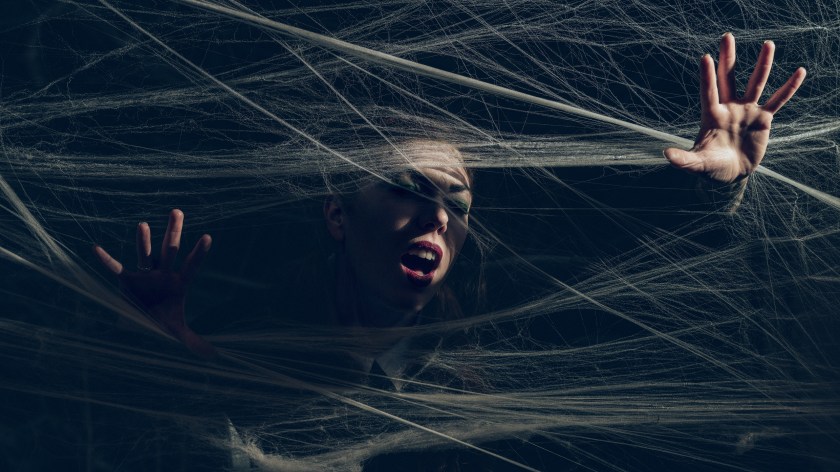
Portrait of a person pressing their hands forward through layers of stretched web-like material, with dramatic low-key lighting against a dark background.
Wednesday photographed during the 2025 Portrait Slam (Haunt Slam) at the DCO space in Denver, Colorado.

This striking portrait, captured during the 2025 Portrait Slam at Denver’s DCO space, represents a significant departure into theatrical portraiture for a photographer whose journey has increasingly embraced collaborative, event-based work. The image—featuring a model known as Wednesday—transcends conventional portraiture to become a study in entrapment, theatrical expression, and the controlled chaos of performance photography.

The composition immediately arrests the viewer with its central tension: a figure ensnared in what appears to be synthetic webbing, hands pressed outward in a gesture simultaneously defensive and reaching. The model’s expression—mouth open in what could be read as exhilaration, distress, or performative intensity—refuses easy interpretation. This ambiguity serves the work well, inviting prolonged examination rather than immediate comprehension.

Technically, the photograph demonstrates sophisticated command of artificial lighting in challenging circumstances. Shot with a Nikon Z7ii and illuminated by a Godox AD100 with grid, the lighting scheme creates dramatic chiaroscuro that sculpts the figure from the deep, nearly black background. The gridded modifier produces focused illumination that highlights the face and hands while allowing the surrounding webbing to catch light selectively, creating a three-dimensional mesh that appears to hover in space. This precision lighting transforms what could be simple event documentation into controlled studio-quality portraiture executed in a dynamic environment.

The web itself functions as both literal and metaphorical element. Its physical presence creates visual texture and geometric complexity, the crossing strands forming a secondary compositional structure that both fragments and frames the subject. Metaphorically, it invites reading as constraint, connection, or cocoon—interpretations that align with the “Haunt Slam” context while transcending mere Halloween theatrics to suggest broader themes of entanglement with technology, society, or creative process itself.

Within Chapter 6—”The Road Ahead: Recent Work & Ongoing Exploration”—this photograph signals the photographer’s continued engagement with collaborative, community-centered photography. The Portrait Slam format, hosted by Denver Models and Mike’s Camera, represents a democratization of studio portraiture, bringing together photographers, models, and creative collaborators in rapid-fire shooting sessions. That he selected this image for his Top 100 Journey suggests recognition that contemporary photographic practice increasingly exists within networks of creative exchange rather than isolated studio work.

The post-processing in Evoto maintains dramatic impact while preserving textural detail in both skin tones and the surrounding webbing. The color palette—dominated by deep teals and shadows punctuated by warm skin tones and crimson lips—creates visual coherence without sacrificing the image’s raw energy. The photographer resists over-polishing, allowing slight imperfections and authentic texture to ground the theatrical presentation in physical reality.

This work demonstrates evolution from earlier documentary and landscape work toward portraiture that embraces performance, collaboration, and conceptual staging. Yet it retains the technical rigor and compositional awareness evident throughout the Top 100 Journey. As the photographer continues exploring “the road ahead,” this image suggests that path leads toward increasingly theatrical, collaborative work that blurs boundaries between documentation and creation, between capturing moments and constructing them.

Suspension and Illusion: A Study in Controlled Ephemera

Model Everyn Darling is featured in a significant studio portrait taken during a photography workshop in Denver. This image, characterized by its minimalist setting and controlled lighting, explores themes of aspiration and vulnerability through the metaphor of a translucent balloon. The photographer’s evolving style emphasizes collaborative creativity and visual poetry over mere technical perfection.

Studio portrait of a woman in a black dress holding a translucent balloon against a plain backdrop.
Model Everyn Darling poses with a translucent balloon during a studio photography workshop in Denver, Colorado.

This studio portrait represents a significant departure within the photographer’s evolving practice, marking his exploration of collaborative, workshop-based creation and the controlled artifice of studio environments. Captured during a Creative Experimental Photography Meetup at RAW Studios in Denver, the image demonstrates how structured creative exercises can yield work of surprising conceptual depth when approached with technical precision and compositional awareness.

The photograph centers on model Everyn Darling, positioned within a minimalist studio setting characterized by graduated neutral tones that transition from cool blue-grey to warm cream. This chromatic subtlety provides visual breathing room while maintaining atmospheric presence—a backdrop that supports rather than competes. The subject, dressed in a simple black dress with white collar detail, appears barefoot in a pose of upward contemplation, one arm extended to hold a translucent balloon trailing delicate white ribbons or fabric.

What elevates this image beyond documentation of a workshop exercise is the photographer’s attention to the psychology of gesture and the poetry of the ostensibly simple prop. The balloon—that most ephemeral and-associated of objects—becomes a vehicle for exploring themes of lightness, release, and the tenuous connection between desire and drift. The model’s gaze follows the balloon upward, creating a diagonal compositional line that draws the eye through the frame while suggesting aspiration, longing, or perhaps the acceptance of letting go.

The technical execution reveals disciplined studio craft. Working with his Nikon Z5 and the versatile 24-120mm f/4 lens, the photographer has managed studio lighting with restraint, avoiding the harsh drama often favored in workshop settings. The illumination appears softly directional, modeling the subject’s features and dress while maintaining detail in the translucent balloon. Shadow work on the studio floor provides subtle grounding without becoming graphic or distracting. The slightly elevated perspective and negative space allocation give the subject room to breathe within the frame—a compositional generosity that reinforces the image’s contemplative mood.

Within the context of Chapter 6—”The Road Ahead: Recent Work & Ongoing Exploration”—this photograph signals important developments in his practice. The workshop origin indicates openness to collaborative creative structures and willingness to work within parameters set by others. Yet the result bears his aesthetic signature: careful attention to subtle tonal gradations, preference for psychological ambiguity over narrative certainty, and interest in objects as metaphorical carriers rather than mere props.

The image also represents exploration of human subjects with greater intimacy than much of his earlier landscape and architectural work. The model’s upturned face, though not confronting the camera directly, introduces vulnerability and interiority often absent from environmental documentation. This shift suggests expanding comfort with portraiture and the complex dynamics of photographer-subject collaboration.

The balloon’s deliberate artificiality—clearly held rather than actually floating—adds productive tension. The photograph acknowledges its own construction while inviting viewers to suspend disbelief, mirroring how all photography negotiates between document and fiction. In selecting this image as his best from the series, the photographer reveals evolving criteria for success: not technical perfection alone, but the achievement of visual poetry through careful orchestration of simple elements within controlled conditions.