Big Daddy: Layered Depth in Contemporary Tabletop Composition

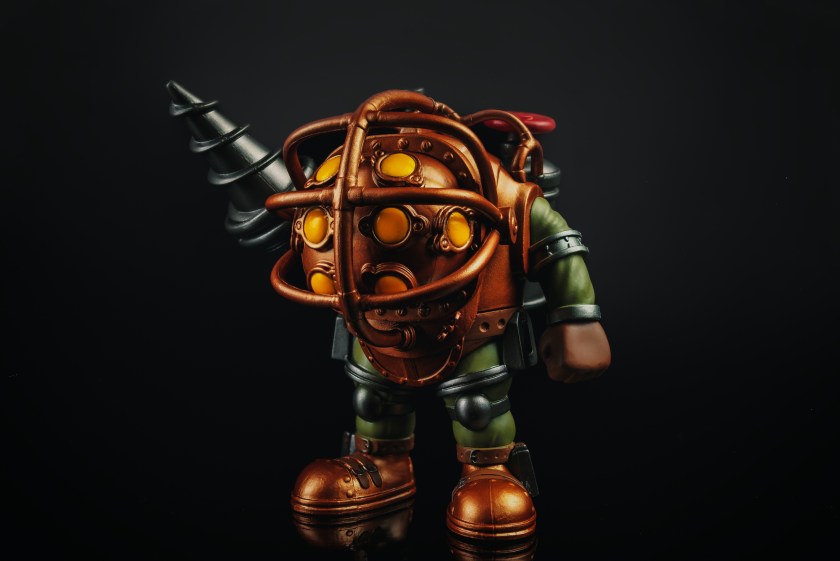
A focus-stacked image of a Funko Pop BioShock Big Daddy figure highlights the photographer’s skill in elevating a mass-market collectible to art. By mastering focus stacking and lighting techniques, he achieves hyperreal detail and visual analysis, suggesting aesthetic value exists beyond an object’s origins. This work bridges traditional and modern photography, emphasizing form and texture.

Studio photograph of a Funko Pop Big Daddy figure from BioShock, lit against a black background.
A focus-stacked studio image of a Funko Pop Games BioShock Big Daddy figure on black acrylic against a black backdrop.

In this striking tabletop study, the photographer transforms a mass-market collectible into a subject worthy of contemplated observation. The Funko Pop! Games Bioshock 65 figure—depicting the iconic Big Daddy character—emerges from absolute darkness with a presence that transcends its commercial origins. This work exemplifies the photographer’s evolving command of still life technique, demonstrating how contemporary imaging technology can elevate genre photography into something more architecturally precise and visually arresting.

The technical execution reveals a sophisticated understanding of focus stacking methodology. By compositing multiple exposures captured at incrementally adjusted focal planes, he has achieved a depth of field impossible through traditional single-exposure photography. Every riveted seam of the copper-toned diving helmet, each glowing porthole window, and the textured surfaces of the green atmospheric diving suit maintain perfect clarity throughout the frame. This exhaustive sharpness creates an almost hyperreal quality, allowing viewers to examine the figure with a scrutiny typically reserved for museum artifacts rather than vinyl toys.

His lighting strategy demonstrates restraint and intentionality. The stripbox and softbox configuration creates dimensional modeling that accentuates the sculptural qualities of the form. The warm metallic tones of the helmet and boots catch highlights that suggest weight and substance, while the darker green suit recedes appropriately into shadow. The signature yellow portholes glow with an internal luminosity, creating focal points that guide the eye through the composition. Against the black acrylic surface and backdrop, the figure exists in a void that emphasizes form over context—a classic gallery presentation strategy that isolates the subject for pure visual analysis.

Within the framework of Chapter 5’s exploration of tabletop photography from classic to experimental, this image occupies an interesting transitional space. The setup itself—studio lighting, controlled environment, careful composition—adheres to traditional still life conventions established over centuries of studio practice. Yet the technical execution, particularly the focus stacking process completed in Affinity Photo, represents distinctly contemporary capabilities. The photographer bridges historical methodology with digital innovation, creating work that honors tradition while exploiting modern tools.

The choice of subject matter also merits consideration. By photographing a figure from video game culture with the same technical rigor one might apply to antique objects or fine art pieces, he democratizes the still life genre. This approach suggests that aesthetic value exists independent of an object’s pedigree or market position. The Big Daddy, rendered with such meticulous attention, becomes a study in form, light, and texture—qualities inherent to all successful still life work regardless of subject provenance.

The reflection visible on the glossy black surface beneath the figure adds a subtle but important element of depth. This mirroring effect grounds the subject in space while maintaining the minimalist aesthetic. The overall composition reads as both technically accomplished and conceptually considered—a balance not always achieved in enthusiast tabletop work.

As part of his Top 100 Journey, this photograph represents his technical proficiency in a controlled environment, showcasing abilities that extend beyond spontaneous capture into the realm of constructed, considered image-making where patience and precision yield images of remarkable clarity and presence.

Holiday Traffic: Urban Kinetics and the Ground-Level Perspective

Greg Urbano’s long-exposure photograph captures holiday traffic at a city intersection, blending urban dynamism with modern landscape photography. The low, ground-level perspective emphasizes movement and depth, contrasting traditional views. Utilizing experimental techniques, Urbano transforms mundane urban elements into visually engaging art, reflecting an intersection of Colorado’s natural and built environments.

Long exposure light trails streak across a city intersection at night, with a sewer grate and patches of ice in the foreground.
Long exposure light trails cross a city intersection at night, viewed from curb level during holiday traffic.

This long-exposure photograph marks a decisive departure from traditional landscape photography within Chapter 3 of Greg Urbano’s Top 100 Journey, demonstrating that the “cityscapes” component of his Colorado documentation extends beyond skyline silhouettes into the kinetic reality of urban infrastructure. Positioned at street level—literally at the curb—the photographer has created a dynamic study of nocturnal traffic patterns that transforms the mundane intersection of College Boulevard into a theater of light and motion.

The technical approach reveals deliberate experimentation with newly acquired equipment. Working with a Samyang 18mm wide-angle lens on his Sony A7ii, the photographer has exploited the optical characteristics of ultra-wide focal lengths to create exaggerated perspective and spatial depth. The low vantage point amplifies this effect dramatically: the sewer grate in the immediate foreground looms with tactile presence, its metal bars and residual ice providing textural anchor, while the light trails streak overhead in explosive radial patterns that suggest velocity and urban energy.

The compositional strategy employed here is remarkably sophisticated for what the photographer describes as “one of my early outings” with this lens. The image functions as a composite of multiple 25-30 second exposures, a technique that allows for selective accumulation of specific light sources while maintaining overall exposure balance. The resulting layering creates what might be termed a temporal palimpsest—multiple moments collapsed into a single frame, where red taillights and white headlamps trace the choreography of holiday traffic against the static geometry of traffic signals, street lamps, and seasonal decorations visible in the background.

What distinguishes this work from conventional light trail photography is its grounded perspective. Rather than adopting the elevated, observational stance typical of urban night photography, the photographer has chosen a worm’s-eye view that positions the viewer within the street infrastructure itself. This decision transforms the image from documentation into experience—we are not watching traffic from safe remove, but inhabiting the same plane as the vehicles themselves, separated only by the curb’s modest elevation.

The inclusion of the ice-rimmed drain grate serves multiple functions. Practically, it provides a foreground anchor that prevents the eye from being immediately swept into the light trails. Conceptually, it connects this urban image to the winter conditions documented elsewhere in the chapter, suggesting continuity between Colorado’s natural and built environments. The detail also introduces narrative specificity—this is not generic cityscape, but a particular moment following “last week’s big snowfall,” situating the photograph within both seasonal and meteorological context.

Within Urbano’s broader practice, this image represents important evolution. It demonstrates willingness to explore the full spectrum of Colorado’s visual character, from wilderness solitude to urban dynamism. The experimental nature of the work—testing new equipment, exploring composite techniques, embracing an unconventional viewpoint—suggests a photographer actively expanding his technical vocabulary rather than retreating to established formulas.

The photograph ultimately succeeds by finding aesthetic potential in overlooked urban moments. The holiday season’s increased traffic becomes raw material for abstract light painting, while municipal infrastructure—storm drains, asphalt, street furniture—gains unexpected visual dignity through careful framing and extended exposure. It is urbanism made kinetic, infrastructure rendered poetic.