Milky Way Interrupted: The Anthropocene Inscribed in Starlight

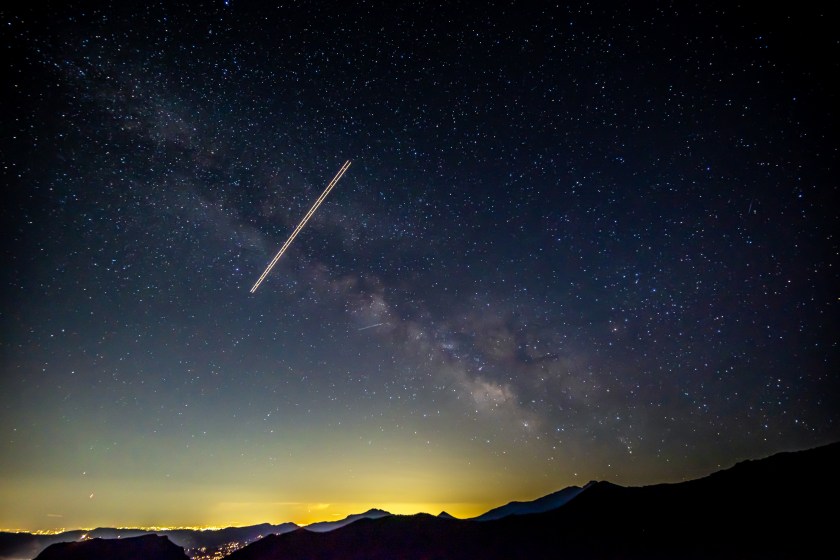
“Milky Way Interrupted,” a photograph by Greg Urbano, captures a unique blend of three realities—the Milky Way, Colorado mountains, and an aircraft’s light trail. This interplay creates tension between the timeless cosmos and modern human impact, emphasizing how even remote landscapes reflect our influence. The image invites varied interpretations while acknowledging evolving wilderness photography’s complexities.

The Milky Way stretches across a star-filled night sky above silhouetted mountain ridges, with a bright aircraft light trail crossing the stars.
The Milky Way appears above the mountains of Rocky Mountain National Park as an aircraft passes through the night sky near Rainbow Curve.

Among the selections comprising Chapter 3 of Greg Urbano’s Top 100 Journey, “Milky Way Interrupted” stands as perhaps the most conceptually layered work—a photograph that captures not one subject but three distinct temporal and spatial realities coexisting within a single frame. Captured from Rainbow Curve in Rocky Mountain National Park, the image presents the galactic core of the Milky Way, the ancient mountain silhouettes of Colorado’s high country, and a striking diagonal light trail that bisects the celestial display with unmistakable human presence.

The composition’s power lies precisely in this interruption. The aircraft’s light trail—rendered as a warm, golden-orange streak through long exposure—cuts diagonally across the frame, creating a dynamic tension between the timeless and the contemporary. While astrophotography typically seeks to eliminate such intrusions, this photographer has embraced the collision, transforming what might be considered a technical flaw into the photograph’s conceptual strength. The work becomes a document of our current moment, when even the most remote wilderness viewing points cannot escape the signatures of human movement across the planet.

Technical execution reveals careful consideration of the challenges inherent to night sky photography. Shot with a Nikon Z5, the image demonstrates the full-frame sensor’s capability to resolve stellar detail while managing the noise characteristics of extended ISO settings. The photographer has successfully balanced multiple exposure considerations: maintaining star sharpness through appropriate shutter speed selection, capturing the subtle gradations of airglow near the horizon, and rendering the mountainous foreground as legible silhouettes rather than featureless black masses.

The color palette deserves particular attention. The frame transitions from deep indigo and blue-black in the upper reaches, through the dusty rose and purple tones of the galactic core, down to the unexpected warmth of light pollution painting the horizon in amber and gold. This terrestrial glow—emanating from Front Range cities invisible beyond the mountains—creates an almost painterly quality along the lower third of the composition. The photograph thus captures three light sources simultaneously: starlight millions of years old, the reflected sunlight from a pressurized aluminum tube at 35,000 feet, and the collective illumination of human civilization diffused through atmosphere and distance.

Within the context of the Colorado Landscapes & Cityscapes chapter, this work occupies a unique position. It represents the photographer’s willingness to document Colorado not as pristine wilderness separate from human influence, but as a landscape inevitably marked by contemporary life. The image acknowledges that wilderness photography in the 21st century must contend with satellite constellations, flight paths, and light pollution—that the “natural” landscape exists now only in relationship to human infrastructure.

The title’s simple declaration—”Interrupted”—functions with appropriate restraint. It states fact without judgment, allowing viewers to bring their own interpretations to the juxtaposition. Some may read the aircraft trail as intrusion, others as a reminder of our species’ brief moment against cosmic timescales. The photographer wisely resists imposing a singular reading, instead presenting the visual evidence and trusting the inherent complexity of the image to generate meaning. This restraint marks a mature approach to landscape photography’s evolving role in documenting our changing relationship with the natural world.

St. Vrain Waterfall: A Study in Motion and Permanence

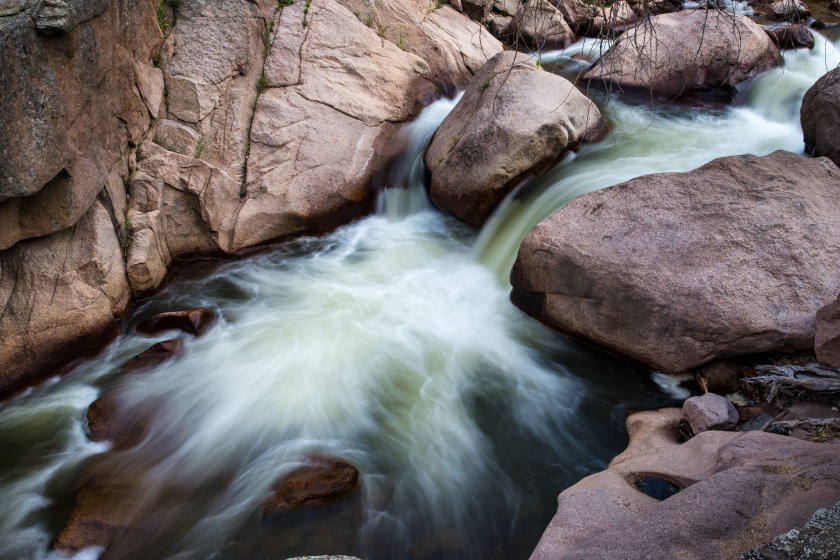
The photograph of a small waterfall along St. Vrain Creek embodies the tension between geological permanence and water’s fleeting essence. Using long exposure, it transforms the scene into a contemplative study of motion and stillness. The intimate scale highlights the beauty of overlooked subjects, emphasizing the profound within Colorado’s landscapes.

Long exposure view of a small waterfall flowing through smooth granite boulders along St. Vrain Creek.
A small waterfall flows between granite rocks along St. Vrain Creek in northern Colorado.

Within the third chapter of Greg Urbano’s Top 100 Journey—devoted to Colorado Landscapes & Cityscapes—this long exposure photograph of the St. Vrain presents a meditation on the fundamental tension between geological permanence and hydrological flux. The image captures a modest cascade in Northern Colorado, yet its technical execution elevates what might be considered a commonplace subject into something altogether more contemplative.

The photographer’s decision to employ long exposure proves essential to the work’s success. Water, rendered as gossamer curtains of white and pale green, flows through the frame with an almost supernatural quality. This technique transforms the kinetic energy of rushing water into something visually paradoxical: movement frozen into silken stillness. The effect creates a temporal ambiguity that refuses to commit to either instant or duration, existing instead in a liminal space between photographic modes.

Compositionally, the work demonstrates a sophisticated understanding of how natural forms interact within the frame. Pink-hued granite boulders, weathered and moss-touched, provide structural anchors throughout the image. These stones—products of millennia—stand in stark contrast to the ephemeral blur of water that has shaped them. The photographer positions these elements with careful attention to visual weight and balance, allowing the eye to trace pathways through the composition that mirror the water’s own journey through the rocky terrain.

The color palette reveals itself as deliberately restrained. Warm earth tones of pink and tan granite dominate, punctuated by touches of green moss and the cool, milky whites of the flowing water. This chromatic restraint prevents the image from becoming overly dramatic, instead maintaining the documentary authenticity that characterizes much of this chapter’s work. The photographer resists the temptation to over-saturate or manipulate, trusting the natural beauty of the Colorado landscape to speak for itself.

What distinguishes this photograph within the broader context of the Colorado Landscapes & Cityscapes chapter is its intimate scale. Rather than pursuing the grand vistas often associated with Rocky Mountain photography, the work turns its attention to a more modest subject—a small waterfall that countless hikers might pass without particular notice. This choice reflects a maturing sensibility within the photographer’s practice, one that finds profundity in the overlooked rather than the obvious.

The technical execution warrants recognition as well. Managing long exposure in daylight conditions requires careful control of light through neutral density filtration and precise shutter speed calculation. The photographer has balanced these elements skillfully, maintaining detail in both the highlighted water and shadowed crevices of stone. Branches visible at the top of the frame remain relatively sharp, suggesting a shutter speed calibrated to render water motion without sacrificing all structural definition in the surrounding environment.

Within the arc of the Top 100 Journey project, this image represents an important moment of focus. The work demonstrates that landscape photography need not rely on sweeping panoramas or dramatic weather to achieve visual and emotional resonance. Instead, it proposes that careful attention to the quotidian—to the small waterfalls tucked into Northern Colorado’s piedmont—can yield images of equal contemplative depth. The St. Vrain Waterfall stands as evidence of a photographer learning to see not just the spectacular, but the quietly profound.