Natural Elegance: A Portrait in Copper and Light

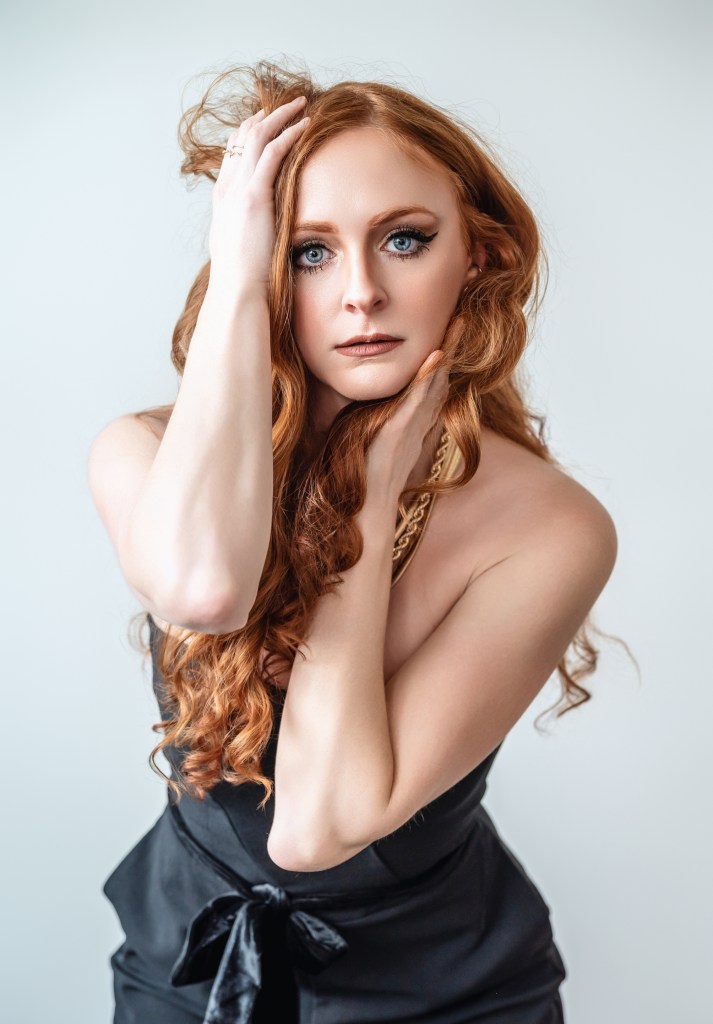
Abigail Marchetti, known as Copper Muse, poses at a Denver Models open shoot, showcasing the photographer’s evolving studio portraiture techniques. Utilizing natural light, he captures her striking features and authentic expression, emphasizing color harmony and psychological presence. This portrait marks a significant step in his artistic development, blending classical principles with a modern sensibility.

Studio portrait of a red-haired woman in a black dress posing against a light background with her hands framing her face.
Model Abigail Marchetti, known as Copper Muse, poses during a Denver Models open shoot at Realm Studio in Denver.

This compelling portrait of model Abigail Marchetti exemplifies the photographer’s deepening engagement with studio portraiture and his refined approach to natural light as a primary sculptural tool. Captured during a Denver Models open shoot at Realm Studio, the image represents continued exploration of collaborative creative environments while demonstrating increasingly sophisticated control of the portraitist’s essential elements: light, gesture, color harmony, and psychological presence.

The composition centers on the model’s striking features—vibrant copper-red hair cascading in loose waves, piercing blue-green eyes meeting the camera with direct but unguarded confidence, and pale skin that catches and reflects the soft window light with luminous clarity. Her pose, with one hand gracefully raised to her hair and the other touching her neck, creates natural framing that draws attention to her face while suggesting unaffected spontaneity. The black strapless garment provides bold tonal contrast against both her skin and the pale backdrop, creating visual drama without competing for attention.

What distinguishes this work is the photographer’s masterful exploitation of natural window light. Rather than relying on the multiple strobes and reflectors typical of commercial studio work, he has chosen a more classical approach that recalls portrait painting traditions. The directional quality of the illumination—soft yet defined—models the subject’s features with sculptural precision while maintaining delicate gradations across skin tones. Highlights along the hair reveal its rich, multidimensional copper coloring, transforming what could be merely descriptive documentation into chromatic study.

The technical execution demonstrates growing confidence with the Nikon Z5 system and the versatile 24-120mm lens. The focal length selection—likely in the moderate telephoto range—provides flattering perspective without distortion, while the depth of field keeps the subject sharply defined against the subtly gradated background. The exposure balances the challenge of pale skin and light background without sacrificing detail in either the model’s features or the deeper tones of her garment.

Within the framework of Chapter 6—”The Road Ahead: Recent Work & Ongoing Exploration”—this portrait signals important developments in his artistic trajectory. The open shoot environment, like the previous workshop-based work, indicates willingness to engage with structured collaborative opportunities while bringing his distinct sensibility to bear. Yet where some open shoots yield generic beauty documentation, this image transcends its circumstances through careful attention to classical portraiture principles: the quality of light, the authenticity of expression, the harmony of color and form.

The model’s direct gaze introduces a quality often absent from his landscape and architectural work—reciprocal acknowledgment between photographer and subject. This mutual recognition adds psychological dimension, transforming technical exercise into genuine encounter. The slight asymmetry in her expression—contemplative rather than performative—suggests comfort and trust within the photographic exchange.

The photograph also reveals evolving aesthetic priorities. While maintaining the tonal sensitivity and compositional rigor evident throughout his portfolio, he demonstrates here that minimalism need not preclude richness. The interplay of copper hair, pale skin, black fabric, and soft grey background creates visual complexity through chromatic relationships rather than environmental detail. This represents a distillation of his practice—finding depth in apparent simplicity, discovering complexity in restraint—now applied to the human figure with increasing assurance and grace.
Anne-Elise

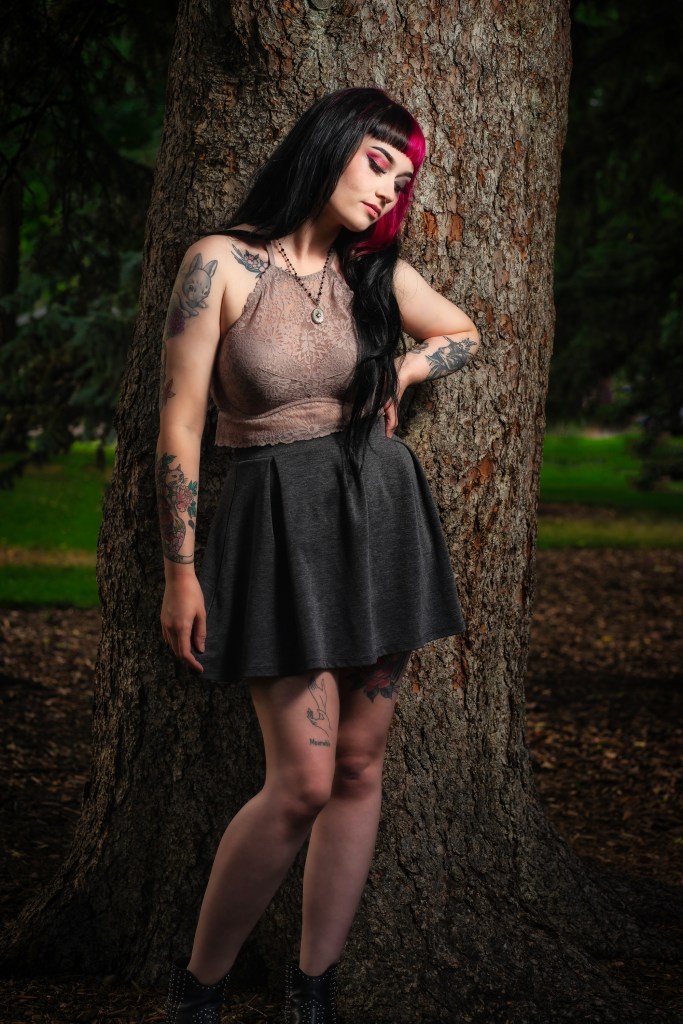
The portrait of Anne-Elise Chapman in City Park, Fort Collins, highlights the photographer’s skill in blending environmental portraiture with studio techniques. Utilizing careful lighting and composition, the image captures contrasts between natural and contemporary elements. The strategic use of color and texture enriches the narrative, showcasing technical excellence and artistic vision.

Woman with long dark hair and visible tattoos leaning against a large tree in a park, eyes closed, wearing a sleeveless top and skirt.
Anne-Elise Chapman stands against a tree in City Park, Fort Collins, Colorado.

This portrait exemplifies the photographer’s nuanced approach to environmental portraiture, where natural settings are transformed into outdoor studios through strategic lighting and compositional choices. Photographed in City Park, Fort Collins, the image presents the subject leaning against the textured bark of a mature tree, her contemplative pose and distinctive styling creating a study in contrasts between the organic and the contemporary, the natural and the cultivated.

The technical foundation reveals a methodical approach to outdoor flash photography. Working with a Sony A7ii and the respected 85mm f/1.8 lens—a classic portrait focal length that provides flattering perspective and subject isolation—the photographer employed a Godox V1s flash modified with a shoot-through umbrella. This diffusion choice proves critical to the image’s success. The softened light wraps around the subject’s features and form, preventing the harsh shadows that plague poorly executed outdoor flash work while maintaining directionality that provides dimension and depth. The lighting appears to originate from camera left, creating subtle modeling across the face and body that complements rather than competes with the ambient forest light.

The compositional structure demonstrates careful consideration of both subject and environment. The tree trunk functions as more than backdrop; it becomes an active element in the visual narrative, its rough, organic texture providing counterpoint to the smooth skin and fabric surfaces. The subject’s positioning—slightly offset from center, body angled, one hand resting naturally against the bark—creates a relaxed asymmetry that invites extended viewing. The visible tattoos become graphic elements within the composition, their dark forms echoing the patterns in the tree bark and adding layers of personal narrative to the environmental context.

Color relationships within the frame merit attention. The earthy tones of the subject’s outfit—muted rose and deep charcoal—harmonize with the brown and gray palette of the bark while maintaining sufficient contrast to ensure separation. The vivid magenta accent in the hair provides a calculated color note that draws the eye upward to the face, where the complementary makeup palette reinforces this focal point. The defocused green background, rendered as soft bokeh by the 85mm lens at apparent wide aperture, provides color balance without competing for attention.

Within Chapter 4’s exploration of portrait methodologies, this photograph demonstrates the photographer’s ability to translate studio lighting principles into outdoor contexts. The controlled light quality typically associated with indoor work here interacts with natural ambient illumination, creating a hybrid aesthetic that benefits from both approaches. The umbrella modification prevents the artificial quality that often characterizes outdoor flash photography, instead producing a luminosity that feels organic to the wooded setting while maintaining the precise control necessary for professional portraiture.

The post-processing in Luminar 4 enhances the image’s tonal sophistication without sacrificing naturalism. Skin tones remain truthful, the detail in both highlights and shadows suggests careful attention to dynamic range, and the overall color grading supports the slightly cinematic quality of the final image. There’s a refinement present that indicates maturity in the photographer’s workflow—the recognition that technical excellence serves artistic vision rather than existing as an end unto itself.

This portrait represents a convergence of skills developed across multiple photographic disciplines: the lighting control of studio work, the adaptability required for location shooting, and the interpersonal dynamics essential to capturing authentic moments within directed sessions.

Kelly

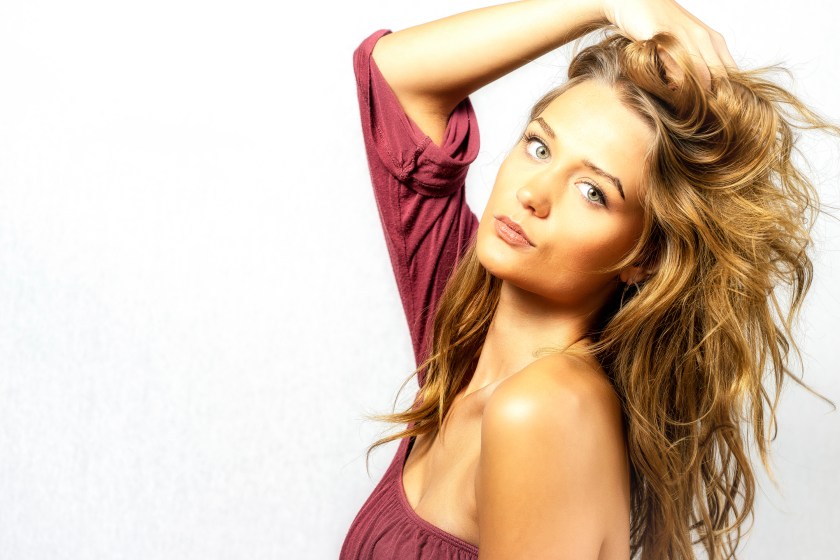
PKelly R. Bienfang’s studio portrait captures the essence of minimalist photography, focusing on the subject against a clean white backdrop. Utilizing controlled lighting and strategic posing, the image showcases the photographer’s skill and adaptability. It highlights the evolving rapport between photographer and subject, emphasizing the importance of genuine collaboration in achieving impactful portraits.

Woman with long light brown hair posing against a white background, one arm raised to her head, wearing a sleeveless top.
PKelly R. Bienfang poses during a studio portrait session in Fort Collins, Colorado.

This portrait from Chapter 4 of Greg Urbano’s Top 100 Journey exemplifies the photographer’s refined approach to studio portraiture, demonstrating how minimalist environments and controlled lighting can distill a subject’s presence to its essential elements. Captured at Old Town Yoga in downtown Fort Collins, Colorado, the image reveals the photographer’s ability to transform functional spaces into effective portrait studios, a skill central to the chapter’s exploration of diverse shooting contexts.

The composition centers on the subject, Kelly, photographed against a pure white backdrop that eliminates all contextual information, focusing attention entirely on her form, expression, and movement. Her pose—arm raised to gather flowing hair, head tilted, gaze directed toward the camera—suggests a moment caught between deliberate positioning and natural gesture. The wind-swept quality of her hair introduces dynamic motion into an otherwise static studio setup, creating visual energy that prevents the portrait from settling into conventional headshot territory.

The photographer’s technical execution demonstrates consistent mastery of the equipment established throughout this chapter. Working with the Sony A7ii and 85mm f/1.8 lens, supplemented by a Godox V1s flash modified through a shoot-through umbrella, he has created illumination that reads as both bright and dimensioned. The lighting wraps evenly across the subject’s features while maintaining sufficient shadow information to model her facial structure and the curves of her shoulders and arms. The high-key approach—white background, luminous skin tones—requires precise exposure control to prevent blown highlights while retaining textural detail in hair and fabric.

Color becomes a critical compositional element in this reduced visual field. The deep burgundy of Kelly’s garment provides the primary chromatic accent against the neutral backdrop and warm skin tones, creating a complementary relationship that anchors the eye. The photographer has allowed the subject’s honey-blonde hair to cascade freely, its varied tones adding subtle complexity to the upper portion of the frame. Post-processing in Luminar 4 has yielded clean, commercial-quality results—polished without appearing artificial, enhanced without sacrificing the authentic quality of skin and texture.

Within the broader context of Chapter 4, this photograph represents the studio portrait in its most distilled form. While other works in this series incorporate environmental elements or natural light scenarios, this image strips away such variables to focus purely on subject, light, and photographer’s vision. The setting at Old Town Yoga—likely chosen for its available space and clean backgrounds rather than thematic connection—underscores the photographer’s adaptability, his capacity to identify and utilize whatever resources a location offers.

The portrait also reflects evolving confidence in direction and collaboration. The pose suggests active guidance rather than passive documentation, indicating the photographer’s growing comfort in shaping rather than merely recording moments. Kelly’s ease before the camera—the natural grace of her gesture, the direct engagement of her gaze—speaks to successful rapport between photographer and subject, that intangible but essential element of portrait work that transcends technical proficiency.

This image stands as evidence of the photographer’s progression toward professional fluency in controlled portrait environments, demonstrating that compelling imagery emerges not from elaborate setups but from clear vision executed with precision.