American Beauty: Strawberry Ravecake

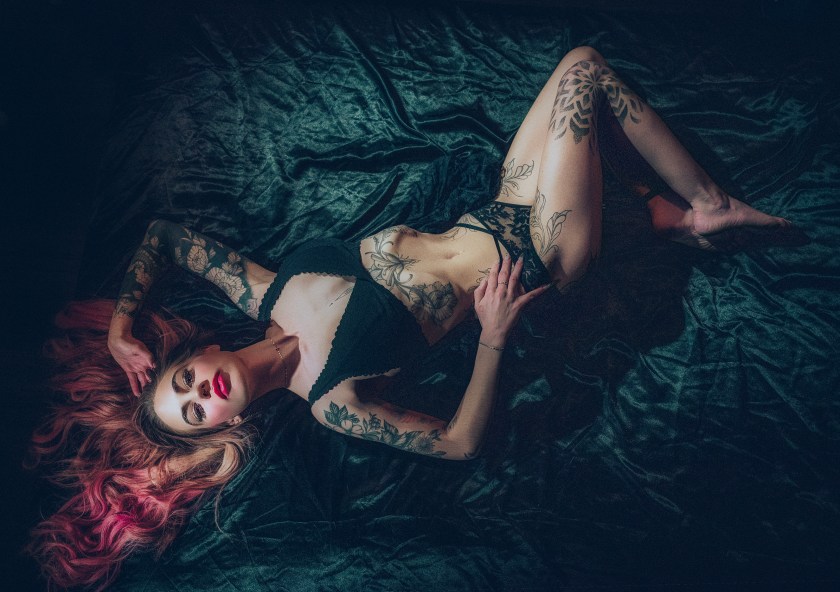
The portrait of model Strawberry Ravecake, taken during a Denver workshop, reinterprets film noir and 1940s glamour through contemporary aesthetics, merging historical and modern elements. The striking use of chiaroscuro and vibrant colors challenges traditional conventions, featuring a tattooed model in luxurious settings, creating a dialogue on representation and glamour across eras.

Overhead studio portrait of a tattooed woman reclining on dark fabric, wearing black lingerie under dramatic low-key lighting.
A studio portrait of model Strawberry Ravecake reclining on textured fabric during a themed photography workshop in Denver.

Within Chapter 6’s exploration of recent directions, this portrait represents a deliberate engagement with historical photographic language reimagined through contemporary aesthetics. Created during a workshop at RAW Studios in Denver focused on recreating film noir and 1940s Hollywood glamour, the photographer demonstrates how classical techniques can be subverted and reclaimed through modern sensibilities. The result is an image that exists in productive tension between eras, neither purely nostalgic nor entirely contemporary.

The composition draws immediate lineage to mid-century boudoir photography, yet the execution reveals crucial departures from those conventions. The model—Betty, known professionally as Strawberry Ravecake—reclines against luxurious teal-green velvet that recalls old Hollywood opulence. Her positioning, with head tilted back and limbs arranged in studied repose, references the languorous poses characteristic of 1940s pin-up and glamour photography. However, the extensive floral tattoo work covering her arms, legs, and torso fundamentally transforms the visual narrative. Where golden-age Hollywood demanded unmarked skin as a canvas for projected fantasy, here the body arrives already inscribed with personal history and deliberate aesthetic choices.

The lighting strategy merits particular attention. Deep shadows dominate the frame, with careful modeling that emphasizes dimensional form while maintaining areas of near-total darkness. This chiaroscuro approach—essential to film noir’s visual vocabulary—creates dramatic contrast between illuminated flesh and surrounding void. The photographer employs what appears to be a single key light positioned to camera right, allowing natural falloff to shape the subject rather than filling shadows with secondary sources. This restraint honors noir’s painterly treatment of darkness as an active compositional element rather than merely the absence of light.

Color becomes a strategic departure from strict period authenticity. While classic noir worked exclusively in black and white, the photographer retains the jewel tones of the velvet backdrop and the subject’s vibrant red-to-blonde ombré hair. The black lingerie and bold red lipstick provide chromatic punctuation, creating focal points that guide the viewer’s eye through the composition. This selective use of color acknowledges that contemporary audiences read images differently than their 1940s counterparts; pure monochrome might feel like affectation rather than interpretation.

The workshop context—Portfolio Building for Aspiring Photographers and Models—frames this image as both artistic output and pedagogical artifact. Workshop environments typically emphasize technical mastery and stylistic imitation, yet this photograph transcends mere exercise. The collaborative nature of such sessions, with multiple participants working alongside professional instruction, requires the photographer to synthesize learning in real-time while maintaining artistic vision. That this image earned placement in his Top 100 Journey suggests successful integration of classical technique with personal aesthetic development.

Within Chapter 6’s framework of ongoing exploration, the photograph demonstrates expanded engagement with historical photographic genres. The work reveals an artist comfortable moving between documentary observation, macro intimacy, and now studio-based portraiture. By choosing to engage with noir’s visual language through contemporary bodies and sensibilities, he participates in an ongoing cultural conversation about representation, desire, and the constructed nature of glamour across generations. The velvet wrinkles, the tattoo artistry, and the calculated pose coalesce into an image that respects its influences while asserting its moment.
Joy

Joy’s portraiture, captured during a studio session in Denver, exemplifies contemporary photography that harmonizes technical prowess with intimate atmosphere. Using controlled lighting and thoughtful composition, the image showcases Joy’s comfort and presence. It reflects the photographer’s growth in creating authentic portrayals within collaborative workshop settings, emphasizing spontaneity amidst structure.

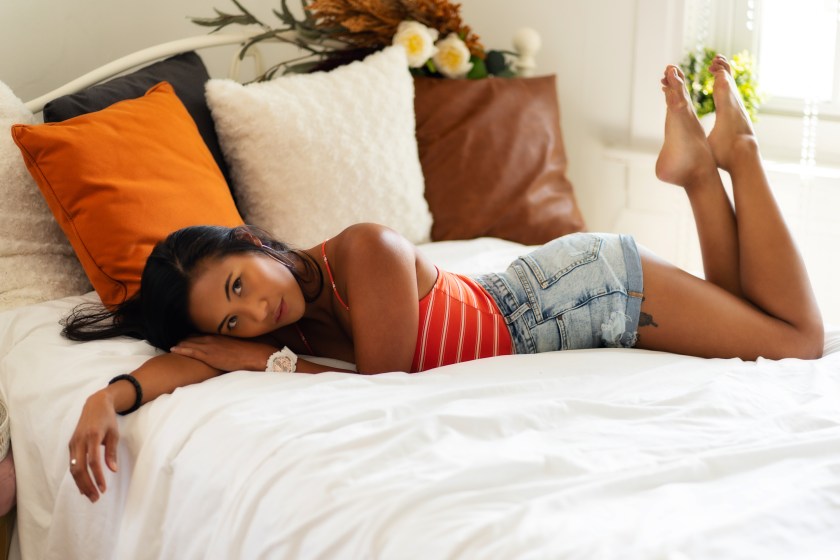
Woman lies on her stomach on a bed with pillows, looking toward the camera in a softly lit indoor space.
Joy reclines on a bed during a studio session at Headquarters in Denver, Colorado.

Within Chapter 4 of Greg Urbano’s Top 100 Journey—a section dedicated to studio, outdoor, and workshop portraiture—this photograph stands as a compelling study in contemporary portraiture that balances technical precision with an atmosphere of relaxed intimacy. Captured during the Sunday Night Meets sessions at the Headquarters in Denver, Colorado, the image demonstrates the photographer’s evolving command of controlled lighting environments and his ability to translate spontaneity into refined compositional structure.

The subject, identified simply as Joy, reclines across a bed adorned with an array of textured pillows in warm earth tones—burnt orange, cream, and cognac leather—that create a sophisticated color palette against crisp white linens. Her pose suggests ease and self-possession, legs bent upward, body stretched diagonally across the frame in a manner that fills the space without appearing contrived. The composition guides the viewer’s eye from her contemplative expression through the length of her form, utilizing the diagonal as a classical device to create visual momentum within an otherwise still domestic scene.

Technically, the photographer employed a Sony A7ii paired with an 85mm f/1.8 lens, supplemented by a Godox V1s flash fired through a shoot-through umbrella. This setup reveals a deliberate approach to managing the challenge of interior lighting. The umbrella modifier produces soft, directional illumination that wraps around the subject’s features and limbs, creating gentle gradations of shadow that model form without harsh contrast. The 85mm focal length, a portrait standard, maintains proper perspective while allowing sufficient working distance in what appears to be a modest interior space. The choice to augment available window light with flash demonstrates an understanding that control, rather than pure naturalism, often serves the portrait best.

The environmental context—a workshop setting where photographers gather to practice and experiment—adds significance to the technical choices evident here. Such collaborative sessions demand efficiency and adaptability, requiring the photographer to balance artistic vision with the practical constraints of shared time and space. That this image emerged from such circumstances speaks to his ability to synthesize technical preparation with responsive observation, recognizing and capturing moments of genuine presence even within structured shooting scenarios.

Post-processing in Skylum’s Luminar 4 has yielded a polished yet authentic aesthetic. The skin tones register warmly against the cooler neutrals of the background, while the overall color grading maintains consistency with the chapter’s broader visual language. The photographer has avoided the temptation toward heavy manipulation, instead allowing the fundamental strength of the capture—lighting, composition, and subject rapport—to carry the image.

Within the trajectory of Chapter 4, this photograph represents the photographer’s progression from purely technical competency toward a more holistic understanding of portraiture as collaborative performance. The subject’s comfort before the camera, the thoughtfully curated environment, and the measured application of artificial light combine to create an image that feels both intentional and uncontrived. It exemplifies the workshop paradigm at its most productive: controlled conditions that paradoxically enable spontaneity, resulting in portraiture that documents not just appearance, but a quality of presence that transcends the specifics of its making.

Scale and Spectacle: Industrial Heritage as Portrait Stage

Savana Steinhoff’s portrait in front of the Rio Grande 5771 locomotive at the Colorado Railroad Museum showcases Greg Urbano’s artistic vision in environmental portraiture. The photo employs effective lighting, wardrobe choice, and spatial awareness to highlight both model and industrial backdrop, reflecting broader themes of coexistence and cultural significance in contemporary photography.

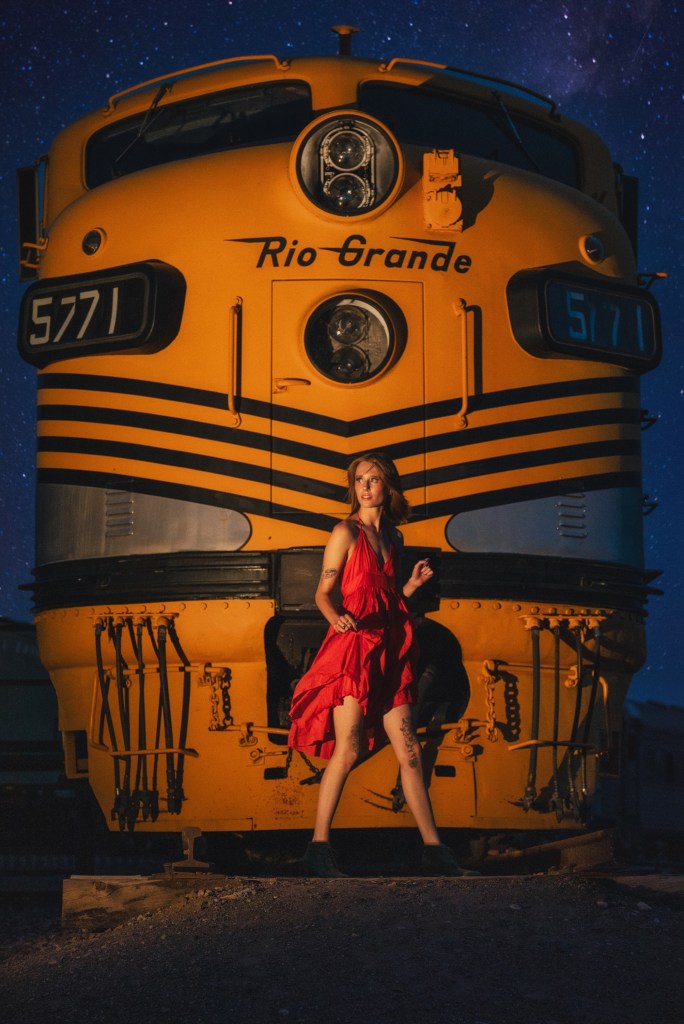
Woman in a red dress stands in front of a yellow Rio Grande locomotive at night, lit against a dark sky.
Savana Steinhoff poses in front of the Rio Grande 5771 locomotive at the Colorado Railroad Museum in Golden, Colorado.

Among the most ambitious entries in Chapter 4 of Greg Urbano’s Top 100 Journey, this photograph from Portrait Slam 2024 represents the photographer’s engagement with large-scale environmental portraiture under challenging technical conditions. Created at the Colorado Railroad Museum in Golden, the image positions model Savana Steinhoff against the imposing facade of Rio Grande locomotive 5771, transforming industrial artifact into dramatic backdrop and exploring the relationship between human scale and mechanical monumentality.

The composition immediately announces its ambitions. The locomotive dominates the frame, its iconic orange and black striping creating bold graphic elements that could easily overwhelm a human subject. Yet Urbano’s placement of the model—centered beneath the Rio Grande nameplate, her crimson dress echoing the warm tones of the engine—establishes a visual hierarchy that honors both subject and setting. The photographer has chosen a low angle that emphasizes the locomotive’s imposing height while maintaining the model’s presence as the compositional anchor. This decision reflects sophisticated spatial awareness, particularly valuable in workshop environments where multiple photographers compete for optimal vantage points.

The lighting strategy reveals careful planning and execution. Shot during the blue hour, the image captures that transitional moment when artificial illumination and residual daylight achieve balance. The locomotive’s exterior lighting creates warm pools of color against the deepening twilight sky, while additional lighting—likely strobes positioned to camera left—illuminates the model without destroying the ambient atmosphere. Stars visible in the darkening sky suggest either long exposure techniques or composite work in post-processing, adding a dreamlike quality to what might otherwise be straightforward location portraiture.

The choice of wardrobe proves integral to the photograph’s success. The flowing red dress provides both color contrast and movement, its flowing fabric creating visual interest against the rigid geometry of the industrial subject. The model’s pose—casual yet purposeful, one leg slightly forward—suggests confidence rather than confrontation with the massive machine behind her. This approach differs markedly from more aggressive “beauty and the beast” tropes often employed in automotive and industrial photography, opting instead for coexistence rather than contrast.

Within the context of Chapter 4’s documentation of workshop and collaborative shooting experiences, this photograph demonstrates the photographer’s ability to execute complex concepts under time constraints typical of group shooting events. Portrait Slam workshops challenge participants to work efficiently in unfamiliar locations with coordinated models and lighting setups, requiring both technical proficiency and decisive artistic vision. The inclusion of this image in the Top 100 Journey suggests Urbano views such collaborative environments not as limitations but as catalysts for ambitious work.

The photograph also reflects broader themes in contemporary portrait photography, where environmental context carries equal weight to subject representation. The locomotive serves as cultural artifact—a symbol of westward expansion, industrial heritage, and American rail history—while simultaneously functioning as pure visual element. This duality enriches the image beyond simple fashion or glamour photography, situating it within traditions of documentary-informed portraiture.

Ultimately, this work from Portrait Slam 2024 exemplifies the photographer’s mature approach to environmental portraiture: technically sophisticated, conceptually layered, and visually arresting without sacrificing authenticity or becoming mere spectacle.