Boulder Theater Marquee: Neon Vernacular and Urban Memory

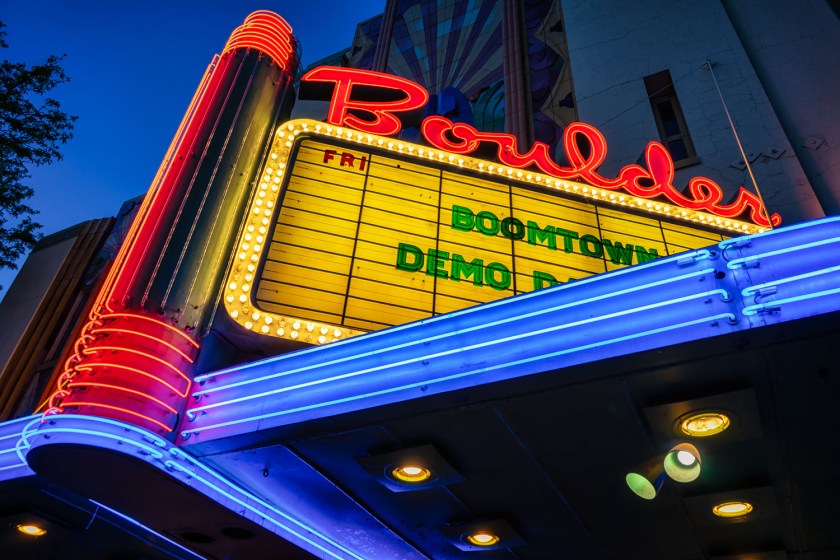
The Boulder Theater marquee in Colorado signifies a shift in the photographer’s focus from grand landscapes to community identity through vernacular architecture. The vibrant neon colors and design highlight cultural memory and urban vitality, capturing the theater as a living space that merges historical aesthetics with contemporary relevance, reflecting the complexity of Colorado’s identity.

Neon-lit marquee of the Boulder Theater viewed from below against a deep blue evening sky.
The illuminated neon marquee of the Boulder Theater glows at night in Boulder, Colorado.

Within Chapter 3 of the Top 100 Journey—Colorado Landscapes & Cityscapes—this vibrant study of the Boulder Theater marquee represents a deliberate shift in the photographer’s engagement with place. Moving beyond natural terrain and monumental civic architecture, he turns his attention to vernacular structures that anchor community identity. The theater marquee, with its layered neon typography and saturated color palette, becomes a subject through which to examine cultural memory, commercial aesthetics, and the relationship between preservation and vitality in Colorado’s urban fabric.

The composition exploits the dramatic convergence of neon signage against the deepening blue hour sky. Shot at 28mm with the Sony FE 28-70mm f/3.5-5.6 OSS kit lens, the wide angle captures the marquee’s full architectural gesture—the sweeping curves of blue neon tubing that frame the illuminated message board, the iconic “Boulder” script rendered in brilliant red and orange, and the classic Art Deco detailing that situates this structure within a specific historical moment. The exposure settings—f/5.6 at 1/125s, ISO 400—balance ambient light with the intense luminosity of the neon, preventing blown highlights while maintaining detail in the surrounding architecture.

Color becomes the image’s primary narrative force. The red-to-orange gradient of the “Boulder” lettering contrasts sharply with the cool blue neon below, creating complementary tension that draws the eye across the frame. The yellow marquee board, studded with bulbs and announcing “BOOMTOWN DEMO D,” introduces a third chromatic element while grounding the image in specificity and time. This is not a sanitized historical recreation but a working theater captured mid-programming, its marquee functioning as intended—communication, invitation, spectacle.

The photographer’s decision to include surrounding context—the modern glass facade rising behind the vintage marquee, the darkening sky, the subtle presence of street elements—situates the theater within its contemporary environment rather than isolating it as nostalgic artifact. This approach speaks to his evolving methodology within the chapter, where place is understood not as static subject but as palimpsest, layered with temporal and cultural inscriptions. The Boulder Theater, a 1906 structure renovated and preserved, embodies this complexity: historic form activated by present-day use.

The low vantage point emphasizes the marquee’s projecting geometry, its thrust into public space. This compositional choice transforms signage into sculpture, highlighting the physicality of mid-century commercial architecture. The neon tubing, with its visible mounting hardware and electrical infrastructure, reveals construction and craft—elements often obscured in more polished architectural photography but celebrated here as integral to authenticity.

Within the broader trajectory of Chapter 3, the Boulder Theater image functions as cultural counterpoint to wilderness landscapes and governmental monuments. It represents Colorado’s smaller-scale urban centers, places where preservation efforts maintain continuity with architectural heritage while accommodating contemporary cultural production. The theater becomes microcosm—a site where community gathers, where entertainment and commerce intersect, where historical aesthetics remain relevant.

The photographer captures not merely a building but an experience of place, translating the visceral impact of neon light into two-dimensional form. In doing so, he documents Colorado’s layered identity: natural grandeur, civic aspiration, and the quieter vernacular spaces where daily life unfolds. The marquee, brilliant against evening sky, asserts that urban landscapes possess their own compelling beauty—electric, temporal, human-scaled, and essential to understanding the full spectrum of place.
Colorado Capital Rotunda: A Study in Civic Monumentality

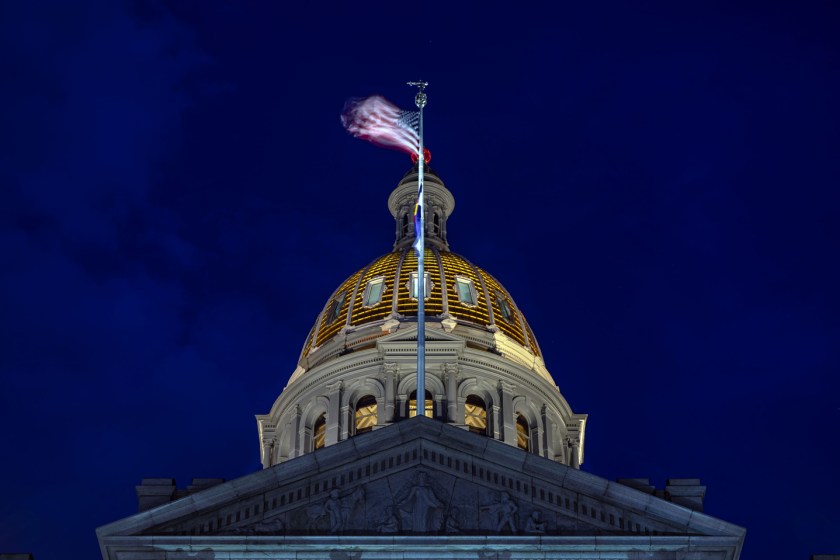
The photograph of the Colorado State Capitol at night showcases the blend of technical skill and atmospheric expression in architectural photography. Captured during the blue hour, it emphasizes the dome’s gilded brilliance against a cobalt sky, revealing a balance of light, color, and human presence, while symbolizing civic power and cultural heritage.

Night view of the Colorado State Capitol dome with a motion-blurred American flag against a deep blue sky.
The illuminated rotunda of the Colorado State Capitol rises above the building exterior at night in Denver, Colorado.

In this commanding nocturnal study of the Colorado State Capitol, the photographer demonstrates a refined understanding of architectural photography’s dual responsibilities: technical precision and atmospheric interpretation. Selected for Chapter 3 of his Top 100 Journey project—Colorado Landscapes & Cityscapes—this image represents a pivotal moment in his exploration of the built environment, where civic architecture becomes a vehicle for examining light, color, and symbolic presence.

The composition centers on the capitol’s gilded dome, captured during the blue hour when natural and artificial light exist in delicate equilibrium. This timing proves essential to the photograph’s success. The deep cobalt sky provides a saturated backdrop that amplifies the dome’s golden luminosity, creating a color relationship that feels both dramatic and harmonious. The warm interior lights visible through the arched windows add a third tonal layer, suggesting human activity within the monumental structure and grounding the image in the present moment rather than rendering it as pure abstraction.

Technical choices reveal deliberate restraint. Shot with a Sony A7 II and the modest FE 28-70mm f/3.5-5.6 OSS kit lens at 67mm, the equipment demonstrates that compelling imagery emerges from vision rather than gear acquisition. The exposure settings—f/6.3 at two seconds, ISO 50—indicate careful balancing of depth of field with the need to maintain sharpness during a moderately long exposure. The low ISO preserves image quality while the aperture ensures adequate detail across the dome’s ornate surface. The two-second shutter speed captures the flag’s motion blur, introducing a kinetic element that contrasts with the building’s permanence.

The symmetrical framing amplifies the capitol’s authority. By positioning the dome centrally and shooting from a low vantage point, the photographer emphasizes verticality and grandeur, compositional strategies long employed in architectural documentation to convey institutional power. Yet this image transcends mere documentation. The illuminated structure against the darkening sky transforms civic architecture into something more atmospheric—a beacon, a sculptural form isolated from its urban context.

Within the broader narrative of Chapter 3, this photograph serves as an essential counterpoint to natural landscape work. Where mountain vistas and wilderness scenes explore Colorado’s geological character, the capitol image examines human imprint on the landscape. The gold-leafed dome—a material detail worth noting for its literal and metaphorical weight—echoes the state’s mining heritage while asserting permanence and prosperity. The photographer captures not merely a building but a symbol, rendering it with enough aesthetic sophistication that the image functions simultaneously as architectural record and contemplative study.

The cool base lighting washing across the pediment introduces contemporary illumination techniques into classical architecture, creating temporal layering that speaks to preservation and adaptation. This detail, easily overlooked, suggests the photographer’s attention to how light shapes meaning and perception.

As part of the Top 100 Journey, this image demonstrates evolving technical confidence and conceptual maturity. The photographer moves beyond straightforward landscape capture toward work that interrogates place, power, and representation. The capitol becomes more than subject matter—it becomes a meditation on how we mark territory, assert identity, and illuminate what we value. In this nocturnal portrait of civic architecture, monumentality meets vulnerability, permanence meets fleeting light, and documentation becomes art.

First Baptist Light Trails

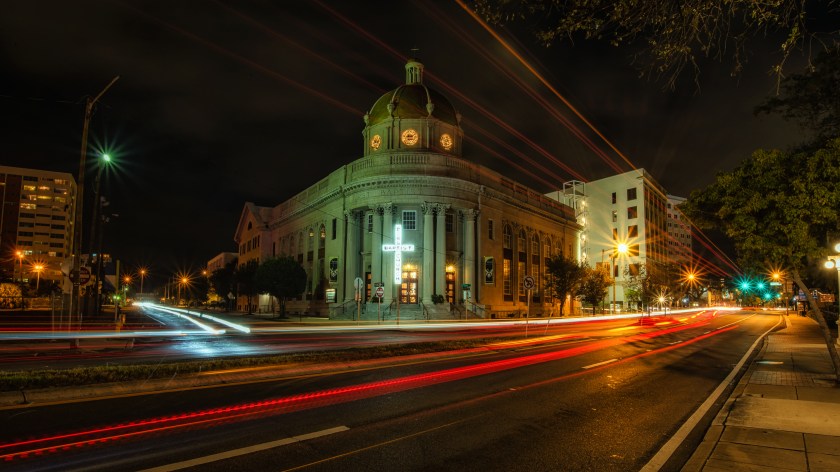
The photographer captures long exposure light trails in front of Tampa’s First Baptist Church, merging urban movement with Neoclassical architecture. This duality creates an image of modernity and tradition, showcasing the church’s historical significance against dynamic traffic patterns. The piece illustrates Tampa’s evolving identity, emphasizing beauty in its urban landscapes through innovative techniques.

Long exposure nighttime photograph of the historic First Baptist Church in Tampa, Florida, with vehicle light trails in the foreground.
Long exposure light trails in front of the historic First Baptist Church in downtown Tampa.

In this nocturnal study of Tampa’s historic First Baptist Church, the photographer transforms urban infrastructure into kinetic painting, employing a twenty-second exposure to capture the ceaseless motion of vehicular traffic as ribbons of light that both frame and animate the Neoclassical architecture. The resulting image operates simultaneously as documentary record and abstract composition, a duality that characterizes his most successful explorations of Florida’s urban environments.

The church itself commands the frame with dignified authority. Its illuminated dome, rendered in theatrical green uplighting, draws the eye upward through classical columns toward the cupola’s glowing clock faces. This architectural landmark, likely dating to the early twentieth century, represents Tampa’s ambitions during its period of rapid growth—a permanence and civic gravitas that contrasts sharply with the ephemeral streaks of red and white light that sweep through the foreground. The photographer has chosen an exposure duration that allows traffic to complete its passage through the intersection, creating continuous trails rather than fragmented segments, a decision that required both technical precision and patience in timing.

The technical execution reveals careful calibration of competing priorities. The f/20 aperture serves multiple functions: it extends the exposure time necessary to capture substantial light trails while creating pronounced starbursts from the streetlamps and building lights that punctuate the scene. This diffraction effect, often considered a technical liability, becomes here an expressive tool that enhances the image’s sense of urban energy and nocturnal luminosity. The ISO 160 setting represents a pragmatic compromise, maintaining clean shadow detail without the noise that would emerge at higher sensitivities during a twenty-second exposure.

What distinguishes this work within the Florida Landscapes & Cityscapes chapter is its engagement with the state’s urban identity—a counterpoint to the natural environments that dominate popular conceptions of Florida photography. Tampa, often overshadowed by Miami’s architectural flash or Orlando’s manufactured spectacle, possesses a layered history visible in buildings like this repurposed church structure, now apparently serving commercial functions while retaining its ecclesiastical form. The photographer documents this transformation without nostalgia or critique, allowing the juxtaposition of classical architecture and contemporary traffic patterns to speak to ongoing urban evolution.

The composition demonstrates sophisticated spatial organization. The church occupies the middle ground with centered dignity, while the light trails sweep diagonally from lower right to left, creating dynamic movement that prevents the symmetrical architecture from becoming static. Flanking buildings and street trees provide contextual depth, establishing the church within its urban fabric rather than isolating it as a monument. The streetlamp at left edge, its starburst perfectly rendered, serves as a visual anchor that balances the compositional weight of the church’s mass.

Within his broader photographic journey, this image represents an expansion of the long-exposure vocabulary established in his Bay Pier work. Where that earlier piece explored natural elements transformed by time, here he applies similar temporal techniques to the urban realm, revealing how extended duration can render the chaos of city traffic as elegant abstraction. The photograph succeeds in making visible the patterns underlying apparent disorder, suggesting that beauty in Florida’s built environments requires not different locations but altered ways of seeing—a perspective shift measured in seconds rather than miles.

Tampa Night Skyline: The City as Light Performance

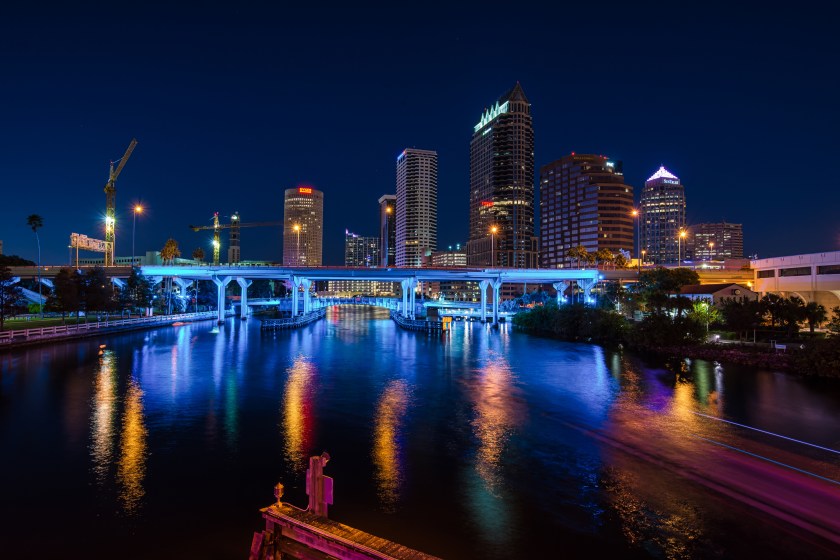
The photograph of Tampa’s skyline from the Platt Street Bridge highlights the vibrant interplay between urban light and architecture at night. With a balanced eight-second exposure, it captures the city’s dynamic illumination, showcasing rich colors reflected in water. The composition balances sleek design and texture, embodying Tampa’s architectural evolution.

Nighttime long exposure photograph of the Tampa, Florida skyline viewed from the Platt Street Bridge over the Hillsborough River.
Long exposure night view of the Tampa skyline from the Platt Street Bridge.

This nocturnal view of Tampa’s downtown district, captured from the Platt Street Bridge, represents a pivotal exploration within Chapter 2—Florida Landscapes & Cityscapes—where the photographer turns his lens toward the performative qualities of urban illumination. Unlike the contemplative stillness of his four-minute dusk exposure, this eight-second capture embraces the vibrancy of the city after dark, revealing Tampa as a stage for artificial light in conversation with architectural form.

The technical approach demonstrates confident command of night photography fundamentals. Shot at 21mm with an aperture of f/10.0, the image achieves comprehensive sharpness while managing the intense point-source lights that define the scene. The eight-second exposure strikes a careful balance: long enough to smooth the water’s surface into a receptive canvas for reflection, yet brief enough to preserve the individual character of each light source without excessive bloom or halation. An ISO of 160 keeps noise minimal while allowing the sensor to capture the full tonal range from the deep navy of the evening sky to the brilliant architectural accent lighting.

The composition is anchored by the dramatically illuminated bridge structure, its cyan LED lighting creating an almost theatrical proscenium that frames the skyline beyond. This choice of vantage point—shooting through the bridge rather than merely of it—adds dimensional complexity, transforming infrastructure into compositional architecture. The repeating vertical supports create rhythm and depth, while the horizontal span provides structural stability to an image otherwise dominated by vertical towers.

What distinguishes this photograph within the photographer’s evolving body of work is its embrace of saturated, polychromatic illumination. The water becomes a liquid prism, fragmenting and multiplying the city’s light signature into vertical streaks of cyan, magenta, amber, and emerald. These reflections possess an almost painterly quality, their chromatic intensity suggesting influence from both contemporary light art and the neon-soaked aesthetics of urban night photography. The contrast between the cool blue bridge lighting and the warmer tones emanating from building facades and street lamps creates visual tension that energizes the entire frame.

The foreground element—a wooden dock structure with visible weathering and industrial hardware—provides crucial textural counterpoint to the sleek glass and steel beyond. This detail grounds the image in physical reality, preventing it from dissolving into pure abstraction despite the transformative effects of artificial light on water. It’s a gesture toward documentary honesty within what might otherwise read as a celebration of spectacle.

Contextually, the inclusion of construction cranes in the left background speaks to Tampa’s ongoing transformation, capturing a specific moment in the city’s architectural timeline. These industrial silhouettes, backlit against the evening sky, add temporal specificity while contributing vertical accents that echo the tower forms they’re constructing.

Within the broader narrative of the Top 100 Journey, this image demonstrates the photographer’s expanding vocabulary for depicting Florida’s urban environments. Where natural landscapes might offer subtlety and organic complexity, cityscapes present their own challenges: managing competing light sources, finding order within density, revealing beauty in the manufactured. His success here lies in recognizing that the contemporary city at night is fundamentally an installation of light—one that reveals itself fully only through the camera’s ability to accumulate and organize photons across time.

Tampa Panoramic at Night: A Study in Urban Luminescence

The panoramic long exposure photograph of downtown Tampa captures its urban beauty at night from the University of Tampa. This 2014 composition emphasizes artificial light’s role in depicting the cityscape, blending architectural detail and varied illumination. It challenges perceptions of Florida, asserting urban environments as significant alongside natural landscapes, showcasing the photographer’s technical skill and versatility.

Panoramic long exposure composite of downtown Tampa, Florida, photographed at night from across the Hillsborough River, showing illuminated skyscrapers, waterfront reflections, and dramatic clouds.
Panoramic long exposure view of downtown Tampa at night, captured from the UT campus across the Hillsborough River.

In this commanding 2014 panoramic composite, the photographer captures downtown Tampa’s nocturnal identity with technical precision and compositional sophistication. Selected for Chapter 2 of his Top 100 Journey—Florida Landscapes & Cityscapes—the image represents a pivotal moment in his exploration of urban environments, where the built landscape becomes a canvas for light, reflection, and architectural rhythm.

The photograph was executed from the University of Tampa campus, positioned across the Hillsborough River to establish both physical and aesthetic distance from the subject. This vantage point proves strategic: the river functions not merely as foreground but as an active participant in the composition, its surface transforming into a liquid mirror that doubles the visual impact of the skyline. The long exposure technique smooths the water into a reflective plane, allowing the city’s illumination to paint streaks of gold, pink, and violet across the lower third of the frame.

What distinguishes this work within the chapter’s broader narrative is its treatment of artificial light as a defining characteristic of place. While Florida’s natural landscapes—its coastlines, wetlands, and subtropical flora—typically dominate photographic representations of the state, this image asserts the validity of the urban experience as equally worthy of documentation. The photographer approaches Tampa’s skyline not as an intrusion upon nature but as a distinct ecosystem of glass, steel, and light, possessing its own aesthetic logic and visual poetry.

The panoramic format extends the horizontal axis, emphasizing the sprawl and variety of Tampa’s architectural character. Twin residential towers anchor the composition’s center, their construction-phase lighting creating vertical counterpoints to the horizontal sweep of the skyline. To the right, a cylindrical high-rise glows amber, its illuminated facade creating a beacon within the frame. The building adorned with pink-magenta accent lighting introduces chromatic variation, preventing the warm-toned dominance from becoming monotonous. This diversity of illumination—commercial, residential, decorative—reveals the stratified nature of urban nightscapes, where different lighting purposes create unintentional visual harmony.

The technical execution merits attention. Creating a panoramic composite requires not only multiple exposures stitched seamlessly but also consistent exposure values across frames and careful management of the long exposure duration. The photographer balances ambient light with the stronger point sources of building illumination, preventing blown highlights while retaining detail in darker architectural elements. The clouded sky, rendered in motion-blurred copper tones, provides textural contrast to the sharp geometry below.

Within the context of the Top 100 Journey, this image demonstrates the photographer’s versatility in approaching Florida’s varied visual territories. While subsequent work in this chapter may explore the state’s natural drama—storm systems over the Gulf, the crystalline waters of its springs, the atmospheric density of its wetlands—this urban portrait establishes his comfort with diverse subject matter and technical approaches. The photograph argues for Tampa’s inclusion in the visual narrative of Florida, asserting that the state’s identity encompasses both wilderness and metropolitan sophistication.

The image remains a testament to the possibilities inherent in patient observation and technical mastery, transforming a familiar skyline into a study of light, color, and urban form.