Downtown Denver Dance in the Streets with Nina Harrington

Nina Harrington’s dance pose in downtown Denver exemplifies a sophisticated blend of environmental portraiture and spontaneous movement. The photographer skillfully uses off-camera flash and a low angle to enhance the scene, revealing dynamic interplay between light, architecture, and the dancer’s grace. This image highlights the artist’s technical evolution in outdoor portrait work.

Dancer balancing on one foot along a yellow centerline in a city street, arms extended, with buildings lining both sides.
Nina Harrington performs a dance pose in the middle of a downtown Denver street.

In this striking urban portrait, the photographer demonstrates a sophisticated command of environmental portraiture, transforming a mundane city thoroughfare into a stage for dynamic human expression. The image captures dancer Nina Harrington suspended mid-leap above yellow road markings in downtown Denver, her body forming an elegant arc against the crisp Colorado sky. The composition exemplifies the photographer’s evolving approach to outdoor portrait work, where controlled lighting meets spontaneous movement in public spaces.

The technical execution reveals deliberate choices that elevate this beyond documentary street photography. Shot at midday—traditionally challenging lighting conditions—the photographer employed a Godox AD100 pro strobe without modification to combat the harsh overhead sun. This off-camera flash technique creates a subtle but crucial fill that prevents the subject from becoming a silhouette while maintaining the natural warmth of the ambient light. The decision to forgo light modifiers preserves the hard-edged quality of the urban environment, allowing the concrete, asphalt, and brick architecture to retain their textural integrity.

Compositionally, the low vantage point proves essential to the image’s impact. By positioning the camera near street level, the photographer achieves multiple objectives: the dancer’s figure dominates the frame against the sky, creating separation from the complex urban backdrop; the road’s yellow double lines converge dramatically toward the vanishing point, providing powerful leading lines that anchor the viewer’s eye; and the surrounding buildings—including the distinctive Paramount sign—frame the action without overwhelming it. This perspective transforms the ordinary into the theatrical.

The choice of the Nikkor 24-120mm f/4 lens suggests a working distance that allowed the subject freedom of movement while maintaining compositional control. The focal length appears moderate within that range, neither compressing the perspective dramatically nor exaggerating the spatial relationships. This middle-ground approach serves the narrative well, presenting the scene as the viewer might experience it while standing in that same intersection.

Within Chapter 4’s exploration of portraits created in studios, outdoor environments, and workshop settings, this photograph represents the photographer’s confidence in synthesizing multiple disciplines. The image incorporates studio lighting principles applied to an uncontrolled environment, the collaborative relationship between photographer and subject typical of workshop environments, and the opportunistic awareness required for successful street photography. The dancer’s athletic grace becomes a vehicle for exploring light, geometry, and decisive moment—themes that recur throughout his portraiture work.

The post-processing in Luminar AI enhances rather than transforms the captured scene. The color palette—dominated by blues, warm earth tones, and the vibrant yellow road markings—feels authentic to the high-altitude western light. There’s a clarity and dimensional quality to the image that suggests thoughtful tonal adjustments without the oversaturation or artificial drama that often plague urban photography.

What distinguishes this work within the photographer’s broader journey is the seamless integration of technical skill and artistic vision. The image requires split-second timing, precise exposure calculation, spatial awareness, and the ability to direct movement—all while working in a public street with its inherent unpredictability. That such complexity appears effortless in the final result speaks to the photographer’s maturation in outdoor portrait work, where preparation meets spontaneity in equal measure.
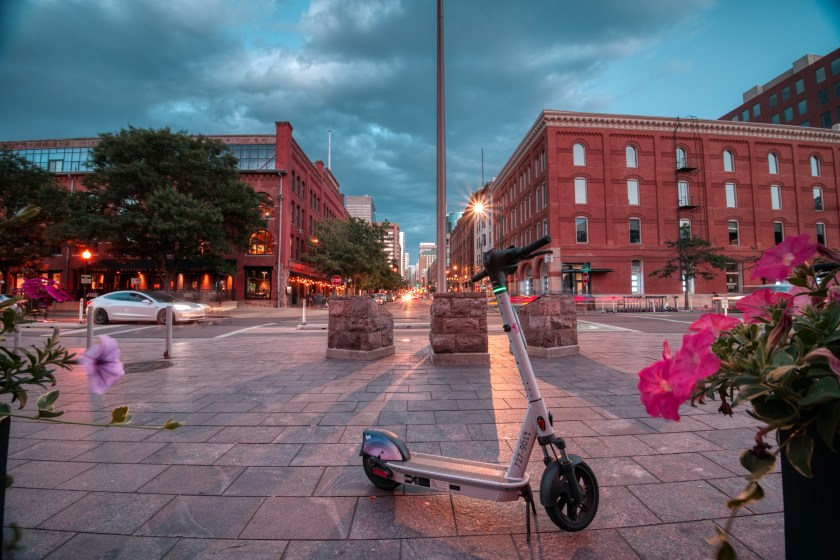
Contemporary Urban Narrative: The Scooter as Cultural Marker in Denver’s Historic District

The photograph captures Denver’s Union Station, highlighting urban mobility through an electric scooter, symbolizing the modern sharing economy. Blending historic architecture and contemporary transit, it embodies Denver’s revitalization. The technical execution showcases skill in low-light conditions, emphasizing the cityscape’s complexity as part of Colorado’s evolving identity.

An electric scooter stands on a plaza at Denver Union Station, framed by brick buildings and evening traffic under a cloudy sky.
An electric scooter sits in the foreground near Denver Union Station as evening light and traffic move through downtown Denver.

In this street-level composition from Denver’s Union Station district, the photographer constructs a narrative about contemporary urban mobility that extends beyond mere documentation. The electric scooter, positioned prominently in the foreground, functions as both subject and symbol—a deliberate choice that anchors this image firmly in its specific cultural moment while engaging with the broader themes of his Colorado cityscapes chapter.

Shot with the Nikon Z5 and Nikkor 14-30mm wide-angle lens during the transitional blue hour, the image demonstrates technical command over challenging mixed-lighting conditions. His HDR processing through Aurora software balances the warm sodium vapor glow of street lamps with the cooler tones of approaching dusk, creating a color palette that feels authentic to the urban evening experience. The dramatic cloud formations overhead add atmospheric weight without overwhelming the architectural elements below.

The composition’s strength lies in its layered storytelling. The scooter occupies the immediate foreground, a symbol of the sharing economy and evolving transportation patterns that have reshaped American cities in recent years. Behind it, motion-blurred pedestrians and vehicle light trails suggest continuous movement—the perpetual flow of urban life. The red brick Victorian-era buildings flanking the street provide historical context, their solid permanence contrasting with the ephemeral nature of the modern transit device and the transient human figures.

This juxtaposition between historic preservation and contemporary innovation becomes the photograph’s central thesis. Denver’s Union Station neighborhood represents a successful urban revitalization, where nineteenth-century industrial architecture has been adapted for twenty-first-century use. The photographer captures this temporal complexity not through obvious before-and-after documentation, but through subtle visual relationships: old brick against new pavement, traditional street furniture against app-based transportation, architectural permanence against digital-age impermanence.

The wide-angle perspective creates dynamic leading lines through the paved plaza, drawing the viewer’s eye from the scooter through the middle ground and toward the vanishing point where downtown high-rises punctuate the skyline. Pink flowers frame the right edge, their organic forms softening the geometric rigor of the built environment while adding unexpected color that complements the warm building tones.

Within the context of Chapter 3’s exploration of Colorado landscapes and cityscapes, this image represents an important counterpoint to mountain vistas and natural panoramas. It acknowledges that Colorado’s contemporary identity includes rapidly growing urban centers navigating questions of density, mobility, and livability. The photographer treats the cityscape with the same observational care one might afford wilderness photography, suggesting that urban environments deserve equally thoughtful documentation.

The technical execution reflects growing proficiency with the Z5 system in low-light scenarios. The exposure balances bright highlights from street lamps and vehicle headlights while retaining shadow detail in the building facades and foreground elements. This dynamic range management, enhanced through HDR processing, avoids the artificial appearance that often compromises such techniques.

Ultimately, this photograph functions as cultural documentation—a moment preserved when electric scooters had become ubiquitous urban fixtures, when historic districts balanced preservation with progress, and when cities like Denver negotiated their identity between Western heritage and metropolitan aspiration. The photographer’s choice to include this image in his curated Top 100 Journey acknowledges that landscape photography can encompass the human-altered terrain of city streets, where the stories being told are equally complex and worthy of attention.