Passagrille Sunset

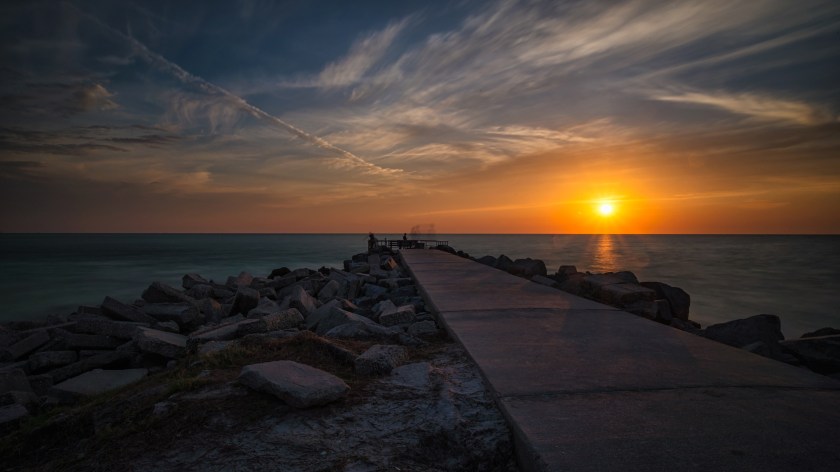
The photograph of a sunset over the Gulf of Mexico from the Pass-a-Grille jetty captures a sense of departure and geometric clarity. It juxtaposes the structural jetty against soft, ethereal water and sky, reflecting the photographer’s evolving approach while highlighting the tension between permanence and impermanence in landscapes.

Sunset photograph of the Pass‑a‑Grille jetty in Florida, with a concrete pier extending into the Gulf of Mexico and silhouetted figures at the horizon.
Sunset over the Gulf of Mexico from the Pass‑a‑Grille jetty.

This image from Chapter 2 of the Top 100 Journey carries with it a distinct sense of departure—a final engagement with a familiar location rendered with the careful attention of someone taking leave. Shot at Pass-a-Grille, the southern terminus of St. Pete Beach, the photograph distills the photographer’s technical vocabulary into a study of geometric clarity against atmospheric flux.

The concrete jetty commands the composition with unwavering linear authority, stretching from the immediate foreground toward the distant horizon where the sun hangs in perfect alignment. This centered positioning—often avoided in landscape photography as overly symmetrical—here becomes an asset, emphasizing the directional thrust of both structure and light. The jetty serves as more than mere subject; it functions as visual pathway, invitation, and barrier simultaneously. Flanked by massive boulder riprap on either side, the walkway creates a corridor that focuses attention while the rough-hewn stones provide textural contrast to the smooth concrete surface.

The technical approach reveals the photographer’s continued exploration of extended exposure. At fifteen seconds and f/22, the water on both sides of the jetty transforms into a milky abstraction, its individual waves collapsed into a singular luminous mass. This treatment—shorter than the sixty-second exposure employed in his Pier 60 work yet still substantially extended—suggests a refinement in his methodology. The turquoise-tinted water retains enough definition to read as liquid rather than dissolving into pure atmosphere, maintaining a crucial anchor to physical reality.

Above, the sky performs its transitional theater. Wispy cirrus formations streak diagonally across the frame from upper left, their directional movement contrasting with the horizontal stratification of color closer to the horizon. The gradient moves from deep slate blues through amber and peach tones to the incandescent disc of the sun itself. A single contrail cuts through the upper portion—a contemporary detail that situates this timeless scene firmly in the present moment, a reminder that even pristine natural settings exist within our flight-path-crossed modern reality.

The photographer has positioned himself low, allowing the foreground boulders to occupy significant visual weight in the left portion of the frame. These lichen-stained rocks, rendered in earth tones that echo the warm sunset palette, ground the image literally and figuratively. Their solidity counterbalances the ethereal qualities of water and sky, creating a dialogue between permanence and impermanence that resonates with the image’s contextual note about departure.

Within the framework of Chapter 2—Florida Landscapes & Cityscapes—this photograph demonstrates the photographer’s evolving relationship with infrastructure as subject. Where tourist piers offer human presence and activity, this utilitarian jetty provides something more austere: pure form against elemental forces. The viewing platform visible at the jetty’s terminus, occupied by silhouetted figures, offers scale and human connection without sentimentality.

The work succeeds in balancing documentary precision with interpretive mood. It captures a specific engineered structure at a specific coastal location while transcending those particulars to engage broader themes: the paths we walk toward light, the structures we build against erosion, the moments we choose to mark as endings before moving forward.
Venice Fishing Pier Sunset: Mastering the Fundamentals of Light

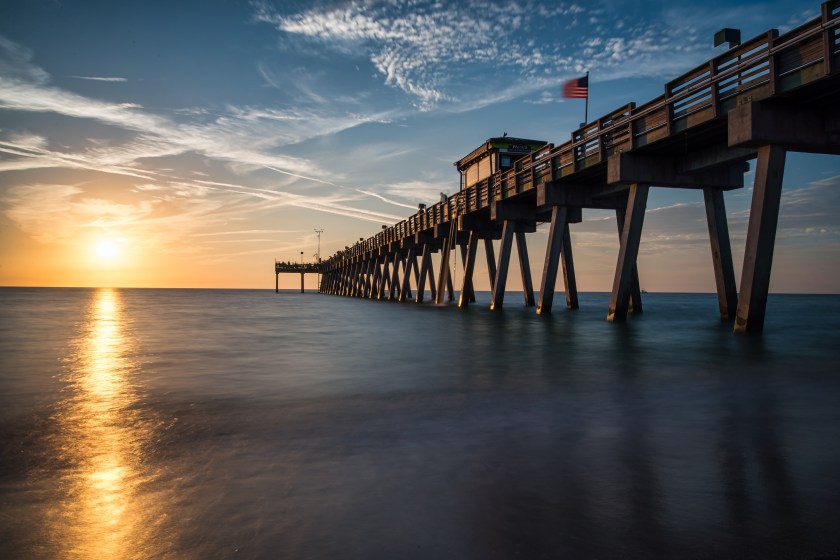
Greg Urbano’s sunset photograph of the Venice Fishing Pier exemplifies the intersection of technical skill and artistic sensibility in landscape photography. Through meticulous use of exposure and composition, Urbano captures a moment where structured permanence meets the fluidity of nature, showcasing balanced tones and dynamic movement in a serene coastal scene.

Sunset photograph of the Venice Fishing Pier in Florida, showing the pier extending into the Gulf of Mexico with golden reflections on calm water.
Sunset over the Gulf of Mexico with the Venice Fishing Pier in the background, captured in a long exposure.

Within Greg Urbano’s “Beginnings” chapter, this sunset photograph of the Venice Fishing Pier represents a photographer coming to terms with landscape photography’s essential discipline: the patient orchestration of light, water, and architecture. Shot along Florida’s Gulf Coast, the image demonstrates technical competence married to an emerging aesthetic sensibility—a combination that marks the transition from enthusiast to serious practitioner.

The technical execution reveals deliberate choices that elevate this beyond a simple sunset snapshot. Using a Nikon D610 with an 18-35mm lens set to 28mm, Urbano selected an aperture of f/18 to maximize depth of field, ensuring sharpness from the foreground water to the distant pier structure. The 13-second exposure at ISO 100 transforms the Gulf of Mexico into a silken plane, smoothing the texture of incoming waves into an ethereal blue gradient. This long exposure technique—fundamental to seascape photography—requires both technical knowledge and patience, waiting for the precise moment when light, tide, and atmospheric conditions align.

The composition demonstrates sophisticated spatial awareness. The pier’s diagonal thrust from lower right to upper left creates dynamic movement through the frame, leading the viewer’s eye from the silky foreground water toward the structure’s vanishing point. The rhythmic repetition of pier supports establishes a visual cadence, their angular geometry contrasting beautifully with the organic flow of water and clouds. An American flag atop the pier adds a vertical accent and a touch of patriotic iconography without overwhelming the scene’s natural beauty.

What distinguishes this photograph is Urbano’s treatment of light. The setting sun hovers just above the horizon line, its golden warmth reflected in a shimmering path across the water’s surface. The exposure balances multiple tonal zones expertly: the brilliant sun doesn’t blow out to featureless white, the shadowed pier structure retains detail, and the water holds both luminous highlights and cool, deep blues. This tonal control suggests a photographer who understands exposure compensation and potentially uses graduated neutral density filters or careful post-processing to manage the scene’s extreme dynamic range.

The sky deserves particular attention. Wispy cirrus clouds stretch across the frame in delicate streaks, their feathered patterns creating texture and visual interest in what might otherwise be empty blue space. The interplay between warm sunset tones near the horizon and cooler blues above establishes atmospheric depth, giving the image a sense of vast space and coastal openness.

As a “Beginnings” chapter work, this photograph represents mastery of landscape photography fundamentals. The long exposure technique, the careful attention to composition and leading lines, the patient waiting for optimal light—these are the building blocks upon which more experimental work can later be constructed. There’s confidence here, a photographer who has moved beyond technical uncertainty into intentional image-making.

The Venice Pier becomes more than a documentary subject; it transforms into a meditation on structure and impermanence. The solid, engineered permanence of the pier contrasts with the fluid, ever-changing water—a tension made visible through photographic technique. Urbano captures not just a place, but a moment of perfect equilibrium between human construction and natural forces, all bathed in the transient golden light that photographers chase endlessly along coastlines worldwide.