Stuckey’s Skeleton: Monuments to Velocity and Obsolescence

The photo of an abandoned Stuckey’s along I-76 in Colorado captures the decline of mid-century roadside travel due to economic shifts and infrastructure changes. With documentary clarity, it emphasizes architectural decay and cultural history, inviting viewers to reflect on both nostalgia and contemporary relevance while preserving a forgotten era of American mobility.

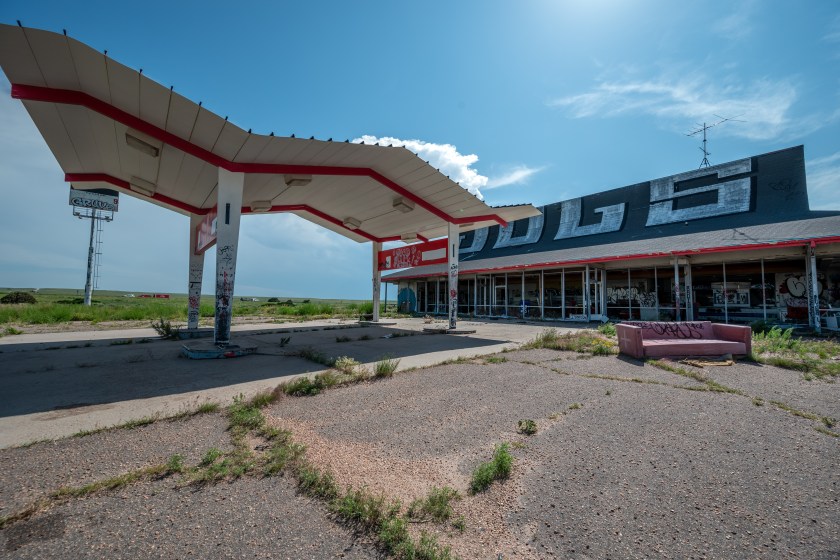
Abandoned roadside building with a former gas canopy and boarded storefront, covered in graffiti and surrounded by cracked pavement and weeds under a blue sky.
The abandoned remains of a former Stuckey’s at the Sedgwick exit along I-76 in northeastern Colorado.

In this documentation of a former Stuckey’s roadside station along Interstate 76 near Sedgwick, Colorado, the photographer captures a distinctly American form of ruin—one born not of catastrophe but of bypass, economic shift, and the relentless evolution of travel infrastructure. The image, positioned within Chapter 6 of his Top 100 Journey, reflects a thematic concern with both literal and metaphorical roads ahead, while simultaneously acknowledging what has been left behind.

The composition employs a wide-angle perspective that emphasizes the structure’s geometric severity against an expansive Colorado sky. The canopy’s angular red-and-white striping draws the eye leftward, while the weathered building facade—bearing faded lettering and graffiti-marked columns—anchors the right side of the frame. Between these elements lies cracked asphalt overtaken by scrub grass, a visual testimony to years of abandonment. The photographer positions himself at a slight distance, allowing the full scope of dereliction to register without sensationalizing the decay.

What distinguishes this work from mere urban exploration photography is its restraint. Rather than fetishizing abandonment or deploying dramatic processing techniques, the photographer presents the scene with documentary clarity. The natural light—diffused through wispy clouds—provides even illumination that reveals texture in the deteriorating surfaces without casting the scene into melodrama. A discarded pink couch in the lower right corner serves as an unexpected punctuation mark, a surreal domestic intrusion into commercial space that hints at the site’s reappropriation by transient visitors.

The Stuckey’s chain represents a specific era of American mobility—mid-century road travel when interstate commerce moved at human speeds and roadside stops functioned as destinations rather than mere interruptions. The photographer’s selection of this subject speaks to an interest in cultural archaeology, in preserving evidence of infrastructures that once defined travel experience but now exist as skeletal reminders of obsolete commercial models.

Within the context of Chapter 6’s “ongoing exploration,” this photograph demonstrates an expansion of the photographer’s subject matter beyond controlled studio environments and collaborative performances. Here, he engages with the built environment as found object, approaching landscape and architecture with the same compositional rigor previously applied to portraiture and experimental lighting. The decision to include this image alongside more technically innovative work suggests an artistic practice concerned with breadth as much as depth—a willingness to move between modes of image-making as the subject demands.

The personal dimension—referenced in the accompanying text through memories of hot dogs and pecan log rolls—remains deliberately absent from the photograph itself. This restraint allows the image to function on multiple levels: as architectural document, as cultural commentary, as landscape study. The photographer trusts the visual evidence to carry meaning without editorial intervention, letting viewers project their own relationships to such spaces.

As part of the Top 100 selection, this photograph confirms that the journey ahead need not always involve technical innovation or conceptual complexity. Sometimes it requires simply bearing witness to what time and economics have rendered irrelevant, preserving in two dimensions what three-dimensional space will not sustain much longer. The road ahead, this image suggests, is also paved with remnants of roads already traveled.
Convention Center Station: Urban Infrastructure as Light Study

The photograph at Denver’s Convention Center RTD station captures an arriving light rail train through long exposure, emphasizing urban environments over natural landscapes. The technical choices create depth and contrast between warm light trails and cooler architectural tones. This piece illustrates Colorado’s identity, showcasing urban transit as significant as its natural vistas.

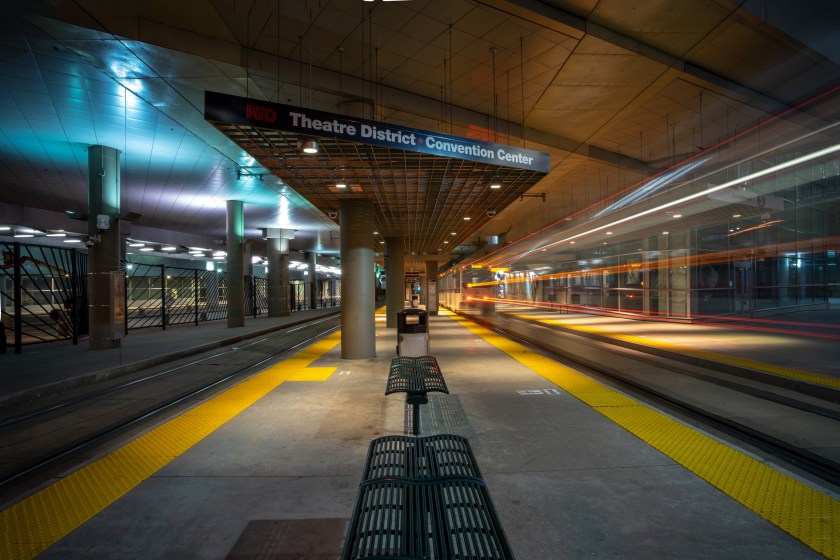
Text: Long exposure view of the RTD light rail platform at the Convention Center with blurred train lights in downtown Denver.
A long exposure captures an arriving RTD light rail train at the Convention Center station in downtown Denver, Colorado.

In the urban component of Chapter 3—Colorado Landscapes & Cityscapes—this long exposure photograph of Denver’s Convention Center RTD station marks a deliberate shift from natural subjects to the constructed environments that define contemporary Colorado life. The image captures a light rail train arriving at the platform, its motion rendered as luminous streaks of amber and red that cut through the architectural geometry of the underground station. This is urban photography that privileges process and temporal collapse over the decisive moment, transforming public transit infrastructure into an exercise in controlled abstraction.

The photographer’s technical approach is fundamental to the image’s success. Using a Sony A7ii paired with a Samyang 18mm wide-angle lens, he has embraced the distortions and expansiveness that such focal lengths provide. The wide angle compresses the station’s perspective while simultaneously stretching its architectural lines, creating a sense of depth that pulls the viewer’s eye from the central platform toward both vanishing points. The long exposure—likely several seconds given the degree of light trail elongation—allows the moving train to register as pure energy rather than solid form, a ghost of motion suspended within the static framework of concrete, steel, and tile.

Color plays a crucial structural role. The safety-yellow platform edges create strong horizontal bands that anchor the composition and provide visual weight at the bottom of the frame. These bright strips contrast sharply with the cooler tones dominating the upper portions—cyan-tinted fluorescent lighting that bathes the ceiling panels and creates atmospheric zones of cool illumination. The train’s light trails introduce warm amber tones that bridge these temperature extremes, serving as the compositional focal point despite their ethereal nature. The signage identifying the Theatre District/Convention Center stop glows in the upper third, grounding the image in specific geographic and civic context.

What distinguishes this work within the broader chapter is its commitment to representing Colorado’s urban character with the same attention previously devoted to its natural landscapes. Denver’s RTD system, as critical infrastructure connecting the metropolitan region, deserves documentation as much as any mountain vista or aspen grove. The photographer recognizes this and approaches the subject with seriousness of purpose. The empty platform—devoid of waiting passengers—allows the architecture and light to speak without human interruption, though the absence of people also raises questions about time of day, accessibility, and the photographer’s relationship to urban space during off-peak hours.

The symmetry is notable but not absolute. The central platform creates a strong vertical axis, reinforced by support columns and the overhead ceiling structure. Yet the composition retains enough asymmetry—particularly in the light trails and architectural details—to avoid static formalism. The textured platform surface, captured with clarity despite the low light conditions, provides tactile detail that prevents the image from becoming purely graphic.

Within a collection that spans Colorado’s diverse visual territories, this photograph asserts that the state’s identity includes its cities and their infrastructure. It is work that finds aesthetic potential in transit stations, that sees light trails as valid subjects alongside geological formations, and that expands the definition of landscape to include the spaces humans build for movement and connection.