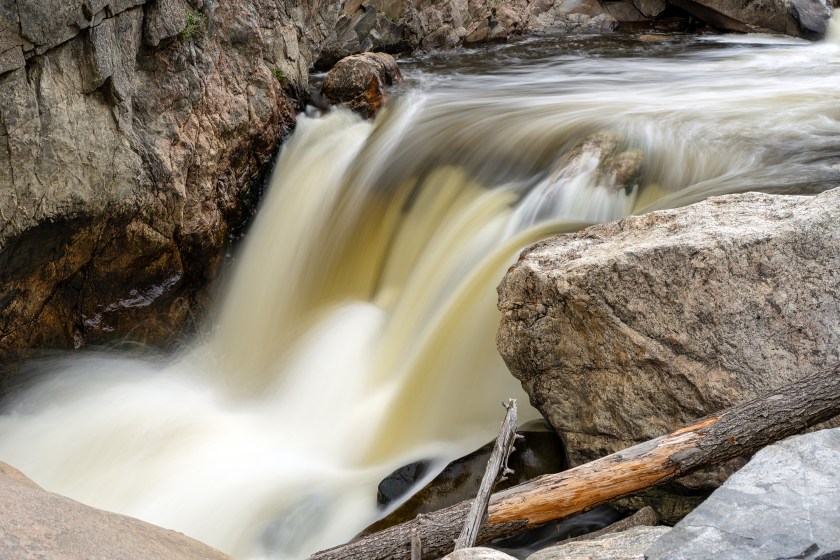
The photographer’s technical mastery converges with natural drama in this commanding study of the Big Thompson River, captured in Colorado’s rugged high country. Shot with a Sony Alpha a7 II paired with the Sony FE 28-70mm f/3.5-5.6 OSS lens at 62mm, the image employs long exposure technique enhanced by neutral density filtration to transform rushing water into ethereal ribbons of motion. At ƒ/9.0 and ISO 50, the exposure settings reveal a deliberate approach to capturing both sharpness in the surrounding geology and the silken blur of flowing water.
What immediately arrests the viewer is the dramatic interplay between permanence and fluidity. Massive granite boulders—textured, ancient, immovable—frame a cascade that appears simultaneously powerful and gossamer-soft. The long exposure technique transforms the torrent into bands of cream and amber, creating visual movement that guides the eye through the composition in sweeping arcs. The golden tint in the water suggests the presence of sediment or tannins, lending warmth to what might otherwise read as a cool mountain scene.
The compositional architecture demonstrates sophisticated understanding of visual weight and balance. A substantial boulder occupies the right foreground, its weathered surface rendered in exquisite detail, while a piece of driftwood creates a diagonal element that adds depth and natural geometry. The left side reveals stratified rock walls, their vertical presence providing counterpoint to the horizontal flow. This triangulation of elements—stone, water, wood—creates a cohesive environmental portrait rather than merely documenting a waterfall.
The inclusion of this image within Chapter 2—Florida Landscapes & Cityscapes—presents an intriguing curatorial question. Clearly captured in Colorado’s Rocky Mountain ecosystem rather than Florida, the photograph signals an expansion in the photographer’s geographical scope and thematic boundaries. This apparent departure from the chapter’s titular focus suggests an evolving artistic journey, one where the photographer moves beyond regional constraints to explore universal themes of landscape and natural process. Perhaps the chapter title reflects the photographer’s home base or primary focus, while individual works demonstrate his widening field of exploration.
The technical execution reveals growing confidence with long exposure photography as a expressive tool. The neutral density filter allows for extended exposure times in daylight conditions, creating that characteristic motion blur while maintaining proper exposure across the frame’s dynamic range. The choice of ƒ/9.0 ensures adequate depth of field to keep both foreground rocks and background elements acceptably sharp, a critical consideration in landscape work where context matters as much as subject.
What elevates this beyond technical exercise is the photographer’s eye for natural composition. The cascade’s S-curve creates inherent grace, while the careful positioning relative to the boulder forms suggests patient observation and deliberate framing. The subdued color palette—grays, tans, muted greens—speaks to naturalistic rendering rather than heightened saturation, allowing texture and form to dominate over chromatic spectacle.
Within the broader trajectory of the Top 100 Journey project, this image represents an artist testing boundaries and methodologies. It demonstrates that landscape photography, when executed with technical precision and compositional awareness, can reveal the sublime within the observable—the eternal dance between stone and water, stillness and motion, captured in a single decisive exposure.
 Greg Urbano