The Gateway Image: Passagrille Jetty Silhouette and the Dawn of a Photographic Vision

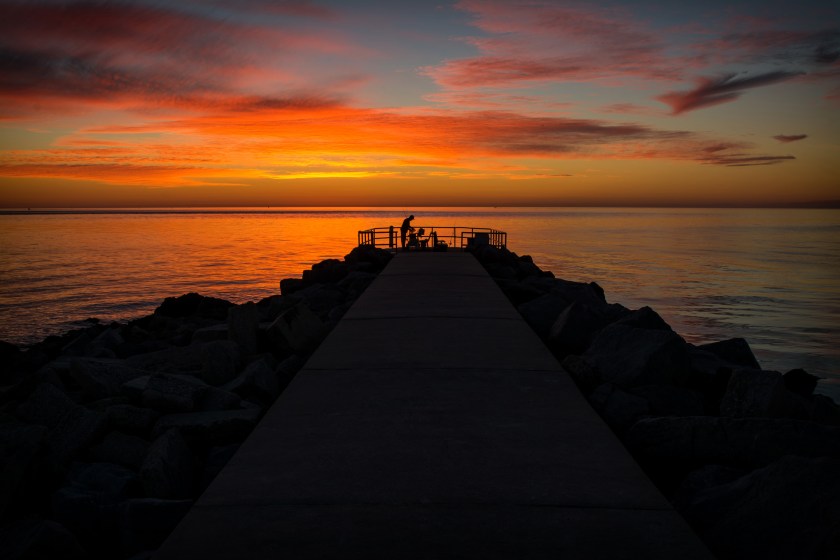
In a 2014 photograph taken at Passagrille Beach, Greg Urbano captures a stunning sunset over the Gulf of Mexico, which inspires his beach photography. Featuring a silhouetted fisherman against an orange sky, the image combines technical skill and emotional depth, symbolizing Urbano’s artistic journey and his evolving relationship with landscape imagery.

Silhouette of a lone fisherman standing on a rock jetty at Passagrille Beach during an orange Gulf of Mexico sunset, photographed with a Nikon D7100 at 24mm.
A 2014 sunset silhouette of a fisherman on the rock jetty at Passagrille Beach, Florida.

In the context of Greg Urbano’s “Beginnings” chapter, this 2014 sunset photograph from Passagrille Beach holds particular significance—not merely as a technically accomplished image, but as a foundational moment that would shape the photographer’s artistic trajectory for years to come. The image captures that precise intersection where technical competence meets emotional resonance, creating what Urbano himself identifies as his “inspiration for years of beach photography.”

The compositional structure reveals a photographer already thinking in strong geometric terms. The jetty’s dark pathway cuts through the frame with striking linearity, creating a powerful visual corridor that draws the viewer’s eye toward the observation platform at the terminus. This use of leading lines demonstrates sophisticated spatial awareness, transforming the rocky breakwater into a narrative device—a journey into the sublime moment captured in the sky above.

What distinguishes this photograph from countless other sunset images is Urbano’s commitment to silhouette as an artistic choice. Shot at ƒ/11 with a relatively slow shutter speed of 1/20 second at ISO 100, the exposure prioritizes the spectacular gradation of color in the sky while allowing the foreground elements to fall into deep shadow. The lone fisherman—barely discernible yet unmistakably present—becomes an everyman figure, a contemplative sentinel witnessing the day’s transition. This human element, reduced to pure form, prevents the image from becoming merely a spectacular sky study; instead, it grounds the natural drama in human experience.

The technical execution warrants examination. Using the Nikon D7100 with a 10-24mm lens at its maximum 24mm focal length, Urbano captures an expansive view that encompasses both the architectural elements of the jetty and the full breadth of the atmospheric display. The cropped sensor’s field of view provides enough width to establish context while maintaining focus on the central narrative. The aperture choice of ƒ/11 ensures sharpness throughout the frame, from the textured rocks in the immediate foreground to the distant horizon where sea meets sky.

The color palette—ranging from deep oranges and burning yellows to subtle purples and grays in the cloud formations—displays nature at its most theatrical. Yet Urbano’s restraint in post-processing (evident in the natural tonal transitions) allows the scene to speak with authenticity rather than hyperbole. This restraint would become a hallmark of his approach, distinguishing his work from the over-saturated aesthetic that dominates much contemporary landscape photography.

Perhaps most revealing is Urbano’s own reflection on this image as inspirational—a north star that guided subsequent explorations. One can trace forward from this moment to understand his ongoing fascination with the Gulf Coast’s theatrical sunsets, his appreciation for human elements within natural landscapes, and his sophisticated use of silhouette as a storytelling device. The photograph represents not an endpoint but a beginning, a discovery of visual vocabulary that would be refined and expanded throughout his career.

In the broader context of the “Beginnings” chapter, this Passagrille jetty image serves as both literal and metaphorical gateway—the concrete walkway leading toward beauty, the artist’s path toward photographic maturity, and the viewer’s invitation into Urbano’s evolving body of work.
Coney Island Grill, 2011

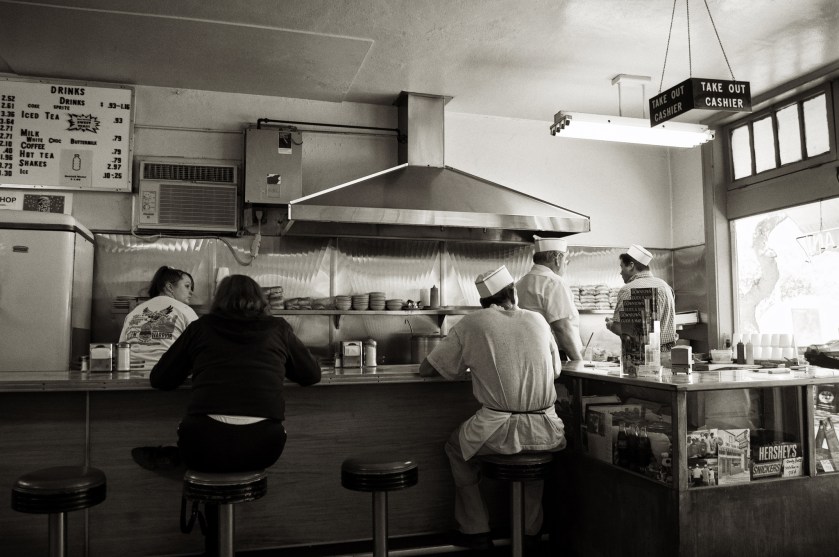
Greg Urbano’s 2011 photograph of Coney Island Grill in St. Petersburg, Florida, captures the intersection of nostalgia and contemporary life. Through careful composition and lighting, Urbano highlights the diner as a communal space. The image preserves a sense of belonging while acknowledging economic pressures facing such establishments, transforming it into a documentary elegy.

Black and white interior photograph of Coney Island Grill diner in St. Petersburg, Florida, showing customers at counter with chrome stools, cooks in white uniforms behind the counter, vintage menu board, and classic diner lighting and fixtures.
The timeless charm of Coney Island Grill in downtown St. Petersburg, Florida, 2011. This black and white photograph captures the authentic American diner experience with counter service, vintage stools, and white-uniformed cooks serving up classic hot dogs and nostalgia in this beloved St. Pete institution.

In the monochromatic stillness of this 2011 photograph, Greg Urbano captures the Coney Island Grill in downtown St. Petersburg, Florida, not as a restaurant, but as a theater of American nostalgia. The image presents a classic counter-service establishment frozen in a moment that feels simultaneously contemporary and timeless, a quality that speaks to the enduring nature of these communal spaces in American culture.

The composition demonstrates Urbano’s understanding of documentary photography’s essential paradox: how to frame the ordinary in ways that reveal its extraordinary nature. Shot with a Pentax K-x at 18mm, the wide-angle perspective encompasses the full breadth of the counter scene while maintaining intimate proximity to the subjects. The technical choices—f/5.6 at 1/40s, ISO 400—suggest available light work, resulting in the soft, natural illumination that bathes the scene in an almost ethereal quality despite the grittiness of the setting.

What commands attention is the photographer’s positioning. Urbano places the viewer among the patrons, seated at the counter alongside two customers whose backs form the photograph’s foreground. This deliberate framing creates layers of engagement: we observe not just the space, but the act of inhabiting it. The diner on the left, in a dark jacket, and the chef in white with his distinctive paper hat become characters in a narrative about place and belonging.

The tonal range of the black and white rendering amplifies the scene’s nostalgic register. Notice how the overhead hood reflects light downward onto the work surface, creating a stage-like illumination for the kitchen staff. The ribbed metal backdrop, the orderly rows of plates, the utilitarian equipment—all these elements speak to efficiency and tradition. Yet Urbano avoids romanticizing the space. The air conditioning unit, the fluorescent fixtures, the practical signage directing customers to the “TAKE OUT CASHIER”—these details ground the image in working-class reality.

The drinks menu board, visible in the upper left corner, provides cultural specificity. Iced tea, milk, hot chocolate, shakes—this is comfort food territory, unpretentious and familiar. The pricing, the handwritten additions, the weathered appearance of the signage all contribute to the sense that this establishment has served its community for years, possibly decades.

Within the context of Urbano’s Top 100 Journey, this photograph functions as documentary evidence of endangered spaces. Classic diners and grills face mounting economic pressures, often displaced by chains or upscale development. By photographing the Coney Island Grill with such careful attention to atmosphere and human presence, Urbano creates both record and elegy. The image honors the social function of these establishments—as gathering places, as democratic spaces where counter seats make everyone equal, where the transaction between server and served maintains its human dimension.

The geometry of the composition reinforces this democratic spirit. The long horizontal line of the counter, repeated in the overhead hood and service shelf, creates stability and continuity. The figures, distributed across the frame, suggest community without crowding. Even in stillness, the photograph conveys the rhythm of daily life, the quiet choreography of ordering, preparing, and serving food.

This is photography that understands place as palimpsest—layers of time, use, and memory inscribed in a single frame.

See this image on:

500px

Flickr