Ancient Greek Coin, Head of Alexander II Zebina

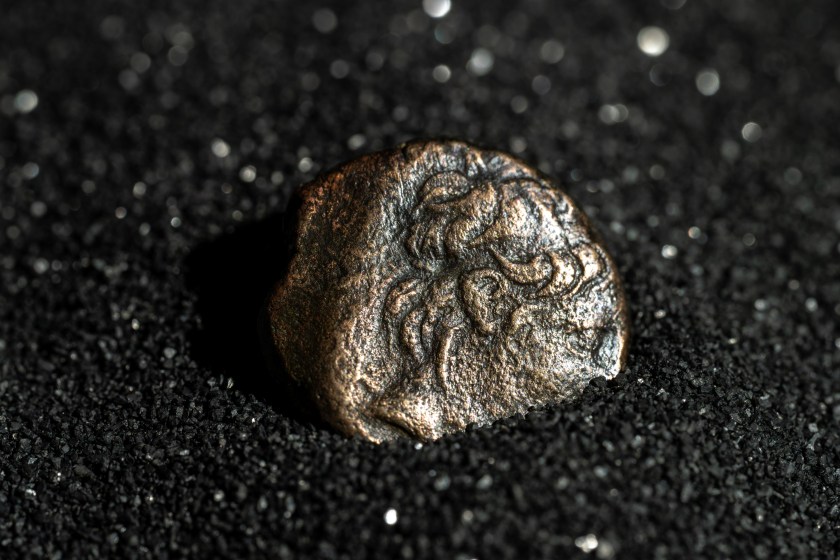
A macro photograph of a 123 BC Greek coin by Alexander II Zebina captures its historical significance and texture. The artist avoids over-sharpening, choosing selective focus to highlight the coin’s surface. This work raises questions about ownership, memory, and our connection to time, ultimately transforming the coin into a philosophical exploration of history.

Close-up of a worn ancient Greek coin showing a raised portrait, resting on coarse black granular material.
A macro photograph of an ancient Greek coin with a portrait relief placed on a dark textured surface.

In this macro study from Chapter 6 of his Top 100 Journey, the photographer confronts an artifact that predates the medium of photography by over two millennia. The coin—a bronze piece from 123 BC bearing the portrait of Alexander II Zebina—becomes both subject and collaborator, its weathered surface telling stories that extend far beyond the frame. This single exposure, created for the 52 Frames challenge, demonstrates a mature understanding of how light and composition can resurrect history from oxidized metal.

The technical execution reveals deliberate restraint. Rather than employ focus stacking to render every millimeter sharp, he opts for a single capture that honors the coin’s irregular topography through selective focus. The shallow depth of field becomes a curatorial choice: not everything from antiquity needs to be preserved with clinical precision. Some details fade into soft ambiguity, much as memory itself blurs across centuries. The side lighting—achieved through what appears to be a carefully positioned single source—rakes across the relief, transforming corrosion patterns into a luminous bronze landscape. Highlights catch on the highest points of wear, creating a constellation of golden moments against near-black valleys of shadow.

The substrate selection proves equally thoughtful. Black granular material, possibly sand or volcanic rock, provides textural contrast while introducing delicate bokeh spheres that float in the background like suspended time. This environmental choice feels archaeological, suggesting the coin might have just emerged from excavation rather than from a flea market display case. The photographer resists any impulse toward nostalgic sepia or artificial aging effects; instead, he allows the genuine patina—two thousand years in the making—to provide all the historical gravitas the image requires.

What distinguishes this work within Chapter 6’s framework of ongoing exploration is its meditation on ownership and stewardship. The accompanying note reveals this coin represents “the oldest man-made thing I have ever owned,” yet the photograph itself seems to question that possessive relationship. Can anyone truly own such an object, or are we merely temporary custodians in an impossibly long chain of hands? The macro perspective literalizes this contemplation, bringing the viewer so close that individual crystals of corrosion become visible, each one a marker of time the photographer will never witness.

The portrait of Alexander II Zebina—barely discernible beneath centuries of oxidation—emerges as a ghost in metal, features obscured yet undeniably present. This parallel between photographic and numismatic portraiture feels intentional. Both mediums attempt to freeze time, to preserve likeness against entropy’s relentless work. The photograph succeeds where the coin has partially failed, capturing not just the object but the precise quality of light falling upon it on a specific day in 2025, creating a new historical layer atop the ancient one.

Within the photographer’s evolving practice, this image represents a turn toward material intimacy and temporal reflection. The macro lens becomes a tool for philosophical inquiry rather than mere magnification. By isolating this small artifact against darkness and bringing such focused attention to its corrupted beauty, he creates space for viewers to contemplate their own relationship with history, permanence, and the objects that outlive their makers by millennia.
Metallic Army Men Still Life: The Alchemy of Transformation

Greg Urbano’s 2014 still life photograph of metallic army men illustrates a crucial moment in his artistic development. Through intentional composition and lighting, he transforms simple toys into evocative symbols of memory and mythology, balancing childhood nostalgia with adult artistry. The photograph reflects Urbano’s conceptual approach and mastery of his medium.

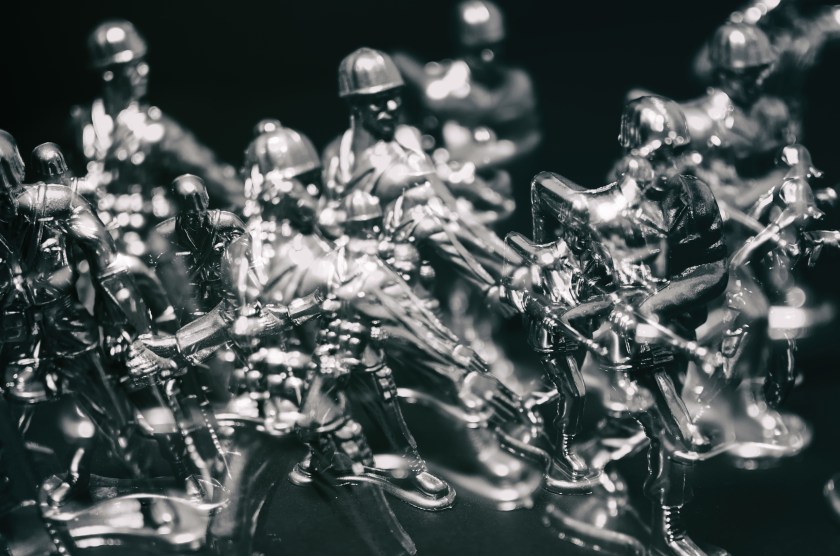
Metallic silver toy army men photographed in dramatic low light against a black background, creating an ethereal tabletop photography scene.
Metallic Army Men Still Life – Purpose-Driven Tabletop Photography (2014)

In the opening chapter of Greg Urbano’s photographic journey, this 2014 still life stands as a pivotal moment—a declaration of intentionality. The image depicts metallic army men frozen mid-action, their silver surfaces catching and scattering light across a void-like background. What began as dollar store plastic toys has been transmuted through spray paint and careful composition into something far more evocative: a meditation on memory, mythology, and the photographer’s emerging visual voice.

The technical execution reveals an artist learning to control his medium with precision. Shot on a Nikon D5100 with a 35mm f/1.8 lens wide open, Urbano exploits the shallow depth of field to create a dreamlike atmosphere. The foreground figures emerge sharp and detailed, their helmets and rifles rendered in crisp focus, while those behind dissolve into soft bokeh. This selective focus mimics the way memory itself operates—certain moments crystalline and vivid, others fading into impressionistic blur. The 1/20 second shutter speed at ISO 100 suggests a carefully controlled tabletop setup, likely using continuous lighting that allowed him to maintain the drama of highlights dancing across metallic surfaces.

What distinguishes this photograph within the “Beginnings” chapter is its purposefulness. Unlike casual snapshots or experimental exercises, this image demonstrates conceptual thinking from inception through execution. The decision to spray paint the figures silver wasn’t merely aesthetic—it stripped these mass-produced symbols of childhood play from their conventional context. No longer green plastic soldiers evoking backyard battles, they become archetypal warriors, their metallic finish suggesting both classical statuary and science fiction. They exist outside time, suspended between the ancient and the futuristic.

The composition itself rewards extended viewing. Urbano arranges the figures in a dynamic diagonal sweep that guides the eye through the frame. There’s a sense of advancing movement, of forces converging, yet the shallow focus and monochromatic treatment create an ethereal quality that contradicts any literal interpretation. These aren’t soldiers storming a beach—they’re specters, memories of conflict rendered as beautiful objects. The black background becomes an infinite space, allowing the figures to float free from any specific context or narrative.

The lighting deserves particular attention. The way highlights trace the contours of each figure—the curve of a helmet, the angle of a raised arm—reveals an understanding of how light sculpts form in photography. Some figures glow almost luminously, while others recede into shadow, creating a tonal range that prevents the silver-on-black palette from becoming monotonous. This careful modulation of light transforms what could have been a simple craft project into a genuine photographic study.

Positioned within Urbano’s broader body of work, this image represents a crucial developmental moment. It demonstrates his willingness to manipulate reality rather than simply document it, to transform found objects into vehicles for artistic expression. The photograph bridges childhood nostalgia and adult artistry, acknowledging the army men’s playful origins while elevating them through photographic treatment.

As a statement of beginnings, this work reveals an artist already thinking beyond the conventional. He wasn’t content to photograph the world as found; instead, he reimagined it, spray paint and camera serving as tools of transformation. The metallic army men become a fitting metaphor for the photographic process itself—ordinary subjects made extraordinary through vision, technique, and intention.