Architectural Authority: The Denver Public Library

The photograph of the Denver Public Library showcases the interplay of monumental architecture and urban landscape. The black and white imagery emphasizes geometric shapes and textures, transforming harsh midday light into stark contrasts. This representation transcends mere documentation, reflecting civic aspiration and how societies express values through built form within the Colorado context.

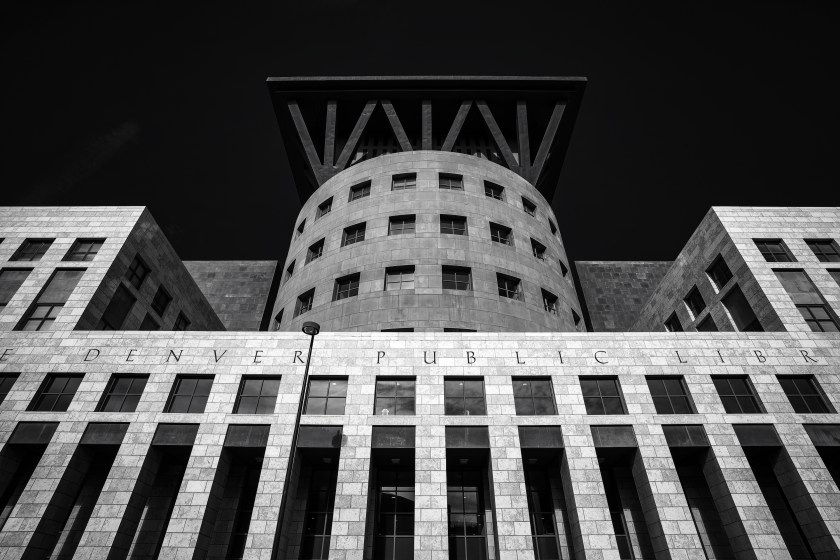
Black and white view of the Denver Public Library exterior, showing a cylindrical central structure framed by angular stone façades.
The exterior of the Denver Public Library is shown in black and white in downtown Denver, Colorado.

In this commanding study of civic architecture, the photographer demonstrates a sophisticated understanding of how monumental structures assert themselves within the urban landscape. Shot at midday when harsh overhead light typically challenges photographers, he transforms potentially difficult conditions into an asset, using deep contrast to emphasize the building’s geometric severity and sculptural mass.

The composition centers on the Denver Public Library’s distinctive cylindrical tower, which rises from the frame like a monolithic drum. The extreme upward angle, facilitated by his Samyang 18mm wide-angle lens, creates a dramatic sense of monumentality while the symmetrical flanking wings establish visual order. This architectural framework—circular form nested within angular geometry—speaks to postmodern design principles that dominated American civic architecture in the late twentieth century. The photographer’s decision to shoot in black and white strips away temporal markers and weather conditions, rendering the structure as a timeless study in form, shadow, and material.

What distinguishes this image within Chapter 3’s exploration of Colorado landscapes and cityscapes is its departure from natural grandeur toward human-made authority. Where mountain vistas offer sublime, untamed power, this photograph presents institutional permanence. The stone cladding, methodically rendered in graduated tones from light gray to near-black, becomes a study in texture and depth. The dramatic diagonal supports visible at the structure’s crown introduce dynamic tension, their angular thrust contrasting sharply with the tower’s curved facade.

The technical execution reveals maturity in the photographer’s approach to architectural documentation. Shot with the Sony A7ii, the image maintains clarity across multiple planes of depth despite the wide-angle distortion inherent to the 18mm focal length. The midday timing, often avoided by landscape photographers, proves deliberate here—the high sun creates stark shadows that carve out the building’s volumes and reveal the recessed windows as dark voids. This interplay between solid and void, light and shadow, transforms descriptive documentation into interpretive art.

The street lamp appearing at center-bottom provides crucial human scale, a reminder that this imposing structure exists within the pedestrian realm. Its modest presence underscores the building’s overwhelming verticality and mass. The text carved into the facade—”DENVER PUBLIC LIBR”—becomes both identifier and compositional element, the letterforms creating horizontal rhythm that grounds the tower’s upward thrust.

Within the photographer’s Top 100 Journey project, this image represents an important evolution. Chapter 3’s focus on Colorado landscapes and cityscapes broadens beyond wilderness to encompass how humans shape their environment. The library, as a democratic institution dedicated to public knowledge, carries symbolic weight that elevates the photograph beyond mere architectural record. It becomes a meditation on civic aspiration, on how societies express values through built form.

The conversion to monochrome proves essential to the image’s impact. Color would introduce distraction—blue sky, stone variations, surrounding urban context. Instead, the black and white treatment creates graphic clarity, emphasizing pattern, geometry, and tonal relationships. The nearly black sky becomes void, pushing the building forward as the sole subject demanding attention.

This photograph confirms the photographer’s ability to find compelling visual architecture within urban environments, applying the same compositional rigor and tonal sensitivity he brings to natural landscapes.

First Baptist Light Trails

The photographer captures long exposure light trails in front of Tampa’s First Baptist Church, merging urban movement with Neoclassical architecture. This duality creates an image of modernity and tradition, showcasing the church’s historical significance against dynamic traffic patterns. The piece illustrates Tampa’s evolving identity, emphasizing beauty in its urban landscapes through innovative techniques.

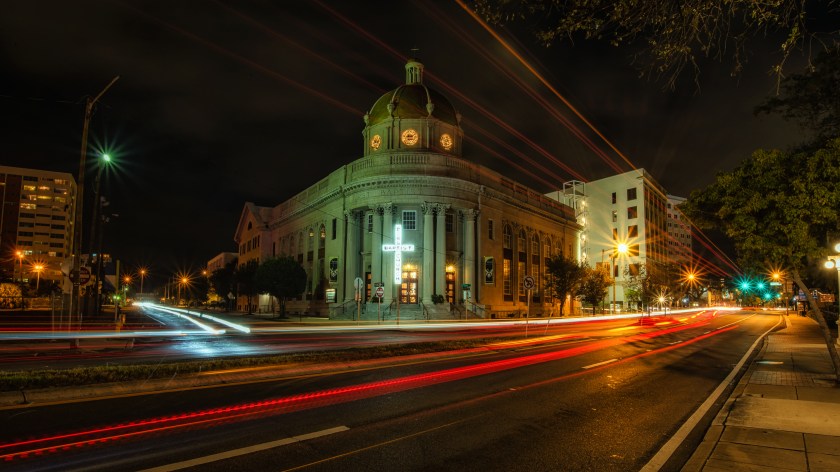
Long exposure nighttime photograph of the historic First Baptist Church in Tampa, Florida, with vehicle light trails in the foreground.
Long exposure light trails in front of the historic First Baptist Church in downtown Tampa.

In this nocturnal study of Tampa’s historic First Baptist Church, the photographer transforms urban infrastructure into kinetic painting, employing a twenty-second exposure to capture the ceaseless motion of vehicular traffic as ribbons of light that both frame and animate the Neoclassical architecture. The resulting image operates simultaneously as documentary record and abstract composition, a duality that characterizes his most successful explorations of Florida’s urban environments.

The church itself commands the frame with dignified authority. Its illuminated dome, rendered in theatrical green uplighting, draws the eye upward through classical columns toward the cupola’s glowing clock faces. This architectural landmark, likely dating to the early twentieth century, represents Tampa’s ambitions during its period of rapid growth—a permanence and civic gravitas that contrasts sharply with the ephemeral streaks of red and white light that sweep through the foreground. The photographer has chosen an exposure duration that allows traffic to complete its passage through the intersection, creating continuous trails rather than fragmented segments, a decision that required both technical precision and patience in timing.

The technical execution reveals careful calibration of competing priorities. The f/20 aperture serves multiple functions: it extends the exposure time necessary to capture substantial light trails while creating pronounced starbursts from the streetlamps and building lights that punctuate the scene. This diffraction effect, often considered a technical liability, becomes here an expressive tool that enhances the image’s sense of urban energy and nocturnal luminosity. The ISO 160 setting represents a pragmatic compromise, maintaining clean shadow detail without the noise that would emerge at higher sensitivities during a twenty-second exposure.

What distinguishes this work within the Florida Landscapes & Cityscapes chapter is its engagement with the state’s urban identity—a counterpoint to the natural environments that dominate popular conceptions of Florida photography. Tampa, often overshadowed by Miami’s architectural flash or Orlando’s manufactured spectacle, possesses a layered history visible in buildings like this repurposed church structure, now apparently serving commercial functions while retaining its ecclesiastical form. The photographer documents this transformation without nostalgia or critique, allowing the juxtaposition of classical architecture and contemporary traffic patterns to speak to ongoing urban evolution.

The composition demonstrates sophisticated spatial organization. The church occupies the middle ground with centered dignity, while the light trails sweep diagonally from lower right to left, creating dynamic movement that prevents the symmetrical architecture from becoming static. Flanking buildings and street trees provide contextual depth, establishing the church within its urban fabric rather than isolating it as a monument. The streetlamp at left edge, its starburst perfectly rendered, serves as a visual anchor that balances the compositional weight of the church’s mass.

Within his broader photographic journey, this image represents an expansion of the long-exposure vocabulary established in his Bay Pier work. Where that earlier piece explored natural elements transformed by time, here he applies similar temporal techniques to the urban realm, revealing how extended duration can render the chaos of city traffic as elegant abstraction. The photograph succeeds in making visible the patterns underlying apparent disorder, suggesting that beauty in Florida’s built environments requires not different locations but altered ways of seeing—a perspective shift measured in seconds rather than miles.

Vertical Ascension: Modernist Form in Downtown St. Petersburg

The black and white photograph of the Signature Place high-rise in St. Petersburg captures its architectural monumentality through a minimalist lens. Stripping color emphasizes form and texture, while a dynamic composition highlights urban development. The work reflects the photographer’s evolving vision, merging documentary and artistic interpretation within contemporary architectural photography.

Black and white low‑angle photograph of the Signature Place condominium tower in downtown St. Petersburg, Florida, showing strong geometric lines and modern architecture.
Black and white architectural study of the Signature Place high‑rise in downtown St. Petersburg.

In this striking image from Chapter 2 of the photographer’s Top 100 Journey, the Signature Place Condominium tower emerges as a study in architectural monumentality and photographic restraint. Shot in downtown St. Petersburg, Florida, the photograph transforms a contemporary residential structure into something both documentary and abstract—a meditation on verticality, light, and the geometric language of modern urban development.

The decision to render this scene in black and white proves essential to the image’s success. By stripping away color, the photographer directs attention to the fundamental elements of architectural photography: form, texture, and tonal gradation. The building’s repetitive window pattern creates a rhythmic grid that draws the eye upward, while the dramatic contrast between the illuminated facade and the darkening sky suggests a specific moment of transition—likely the golden hour, when natural light rakes across surfaces to reveal dimension and depth.

Technical execution demonstrates thoughtful consideration of both optics and exposure. Working at 35mm on an 18-35mm lens mounted to a full-frame Nikon D610, he selected a narrow aperture of f/18 to maximize depth of field and ensure crisp detail throughout the frame. The resulting sharpness allows the viewer to appreciate the building’s material qualities—the interplay of glass, concrete, and steel that defines contemporary high-rise construction. A shutter speed of 1/8 second at ISO 100 suggests the use of a tripod, essential for maintaining clarity at this exposure length while preserving clean shadow detail.

The composition employs a low vantage point that accentuates the tower’s dramatic thrust skyward. This perspective, common in architectural photography but executed here with particular effectiveness, creates a sense of imposing scale while maintaining architectural integrity. The building’s angular crown punctures the upper portion of the frame, while a lower podium structure grounds the composition and provides contextual anchoring in the urban landscape.

Within the broader framework of Chapter 2—Florida Landscapes & Cityscapes—this photograph represents an important counterpoint to the state’s more commonly photographed natural environments. Rather than beaches, wetlands, or subtropical flora, the photographer turns his lens toward Florida’s built environment, acknowledging the contemporary reality of rapid urban development along the Gulf Coast. St. Petersburg’s downtown skyline, transformed dramatically over recent decades, serves as a compelling subject for examining how modern architecture reshapes regional identity.

The image also speaks to the photographer’s evolving vision throughout the Top 100 Journey. Where other selections might emphasize natural wonder or environmental preservation, this work demonstrates equal comfort with urban subject matter. The modernist aesthetic—clean lines, geometric precision, monochromatic palette—suggests an appreciation for architectural form as a legitimate subject for serious photographic inquiry.

What elevates this photograph beyond mere documentation is its atmospheric quality. The graduated sky, rendered in smooth tones from deep black to luminous gray, provides a canvas against which the building performs. The partially visible vegetation at the frame’s base hints at the subtropical context without overwhelming the primary subject. This careful balance between architectural documentation and artistic interpretation positions the work within a tradition extending from early twentieth-century modernist photography through contemporary fine art practice—a lineage that recognizes buildings not merely as structures to be recorded, but as forms to be interpreted.

Metallic Army Men Still Life: The Alchemy of Transformation

Greg Urbano’s 2014 still life photograph of metallic army men illustrates a crucial moment in his artistic development. Through intentional composition and lighting, he transforms simple toys into evocative symbols of memory and mythology, balancing childhood nostalgia with adult artistry. The photograph reflects Urbano’s conceptual approach and mastery of his medium.

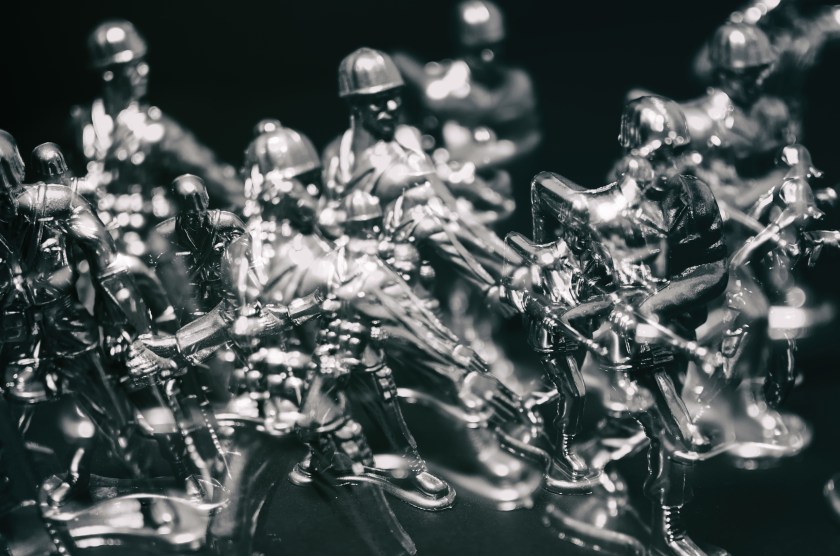
Metallic silver toy army men photographed in dramatic low light against a black background, creating an ethereal tabletop photography scene.
Metallic Army Men Still Life – Purpose-Driven Tabletop Photography (2014)

In the opening chapter of Greg Urbano’s photographic journey, this 2014 still life stands as a pivotal moment—a declaration of intentionality. The image depicts metallic army men frozen mid-action, their silver surfaces catching and scattering light across a void-like background. What began as dollar store plastic toys has been transmuted through spray paint and careful composition into something far more evocative: a meditation on memory, mythology, and the photographer’s emerging visual voice.

The technical execution reveals an artist learning to control his medium with precision. Shot on a Nikon D5100 with a 35mm f/1.8 lens wide open, Urbano exploits the shallow depth of field to create a dreamlike atmosphere. The foreground figures emerge sharp and detailed, their helmets and rifles rendered in crisp focus, while those behind dissolve into soft bokeh. This selective focus mimics the way memory itself operates—certain moments crystalline and vivid, others fading into impressionistic blur. The 1/20 second shutter speed at ISO 100 suggests a carefully controlled tabletop setup, likely using continuous lighting that allowed him to maintain the drama of highlights dancing across metallic surfaces.

What distinguishes this photograph within the “Beginnings” chapter is its purposefulness. Unlike casual snapshots or experimental exercises, this image demonstrates conceptual thinking from inception through execution. The decision to spray paint the figures silver wasn’t merely aesthetic—it stripped these mass-produced symbols of childhood play from their conventional context. No longer green plastic soldiers evoking backyard battles, they become archetypal warriors, their metallic finish suggesting both classical statuary and science fiction. They exist outside time, suspended between the ancient and the futuristic.

The composition itself rewards extended viewing. Urbano arranges the figures in a dynamic diagonal sweep that guides the eye through the frame. There’s a sense of advancing movement, of forces converging, yet the shallow focus and monochromatic treatment create an ethereal quality that contradicts any literal interpretation. These aren’t soldiers storming a beach—they’re specters, memories of conflict rendered as beautiful objects. The black background becomes an infinite space, allowing the figures to float free from any specific context or narrative.

The lighting deserves particular attention. The way highlights trace the contours of each figure—the curve of a helmet, the angle of a raised arm—reveals an understanding of how light sculpts form in photography. Some figures glow almost luminously, while others recede into shadow, creating a tonal range that prevents the silver-on-black palette from becoming monotonous. This careful modulation of light transforms what could have been a simple craft project into a genuine photographic study.

Positioned within Urbano’s broader body of work, this image represents a crucial developmental moment. It demonstrates his willingness to manipulate reality rather than simply document it, to transform found objects into vehicles for artistic expression. The photograph bridges childhood nostalgia and adult artistry, acknowledging the army men’s playful origins while elevating them through photographic treatment.

As a statement of beginnings, this work reveals an artist already thinking beyond the conventional. He wasn’t content to photograph the world as found; instead, he reimagined it, spray paint and camera serving as tools of transformation. The metallic army men become a fitting metaphor for the photographic process itself—ordinary subjects made extraordinary through vision, technique, and intention.

Fubbles: The Ephemeral Made Eternal

The photograph “Fubbles,” taken in 2014 by Greg Urbano at Fort de Soto Park, captures a soap bubble mid-flight, showcasing early artistic vision. Enhanced by motion blur, it elevates the bubble into fine art, revealing themes of transformation and impermanence. Urbano’s technical choices demonstrate a sophisticated understanding of photography and artistry.

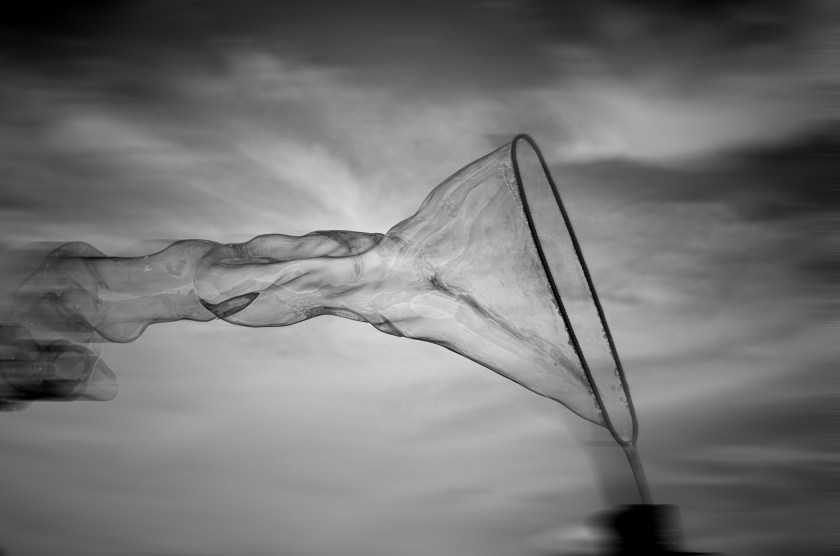
Large elongated soap bubble stretching through the air against a cloudy sky, photographed with a Nikon D5100 and 35mm lens at high shutter speed.
This photograph captures a long, tube‑shaped soap bubble drifting through the air against a cloudy sky at Fort De Soto Park in Florida. The bubble’s reflective surface and fluid form create an abstract, fine‑art appearance, with motion blur added during post‑processing to enhance the sense of movement. The image was taken on July 27, 2014 using a Nikon D5100 with a 35mm lens at ƒ/6.3, 1/1250s, ISO 100. It is part of the Top 100 Journey project and represents early experimental work exploring motion, shape, and atmospheric minimalism.

In the opening chapter of Greg Urbano’s photographic journey, “Fubbles” stands as a remarkable testament to the artist’s early instinct for transforming the mundane into the sublime. Created in 2014 during an afternoon at Fort de Soto Park, this image captures far more than a simple bubble in flight—it reveals an emerging photographer’s understanding of light, form, and the delicate boundary between documentation and fine art.

The composition presents a soap bubble mid-flight, its translucent membrane caught in a state of graceful distortion. What immediately strikes the viewer is the dreamlike quality of the motion blur, which Urbano candidly notes was enhanced in post-processing. This creative decision speaks to an important aspect of his early development: the willingness to move beyond strict documentary realism toward a more interpretive visual language. The blur transforms the bubble from a fleeting childhood toy into something altogether more ethereal—a meditation on impermanence itself.

Shot with a Nikon D5100 at 35mm, the technical execution demonstrates a sophisticated understanding of exposure for such translucent subjects. The aperture of f/6.3 provides sufficient depth while maintaining the isolation of the bubble against the softly rendered background. Most significantly, the shutter speed of 1/1250s at ISO 100 captures crystalline detail in the bubble’s surface, preserving the swirling patterns and subtle gradations that give the sphere its otherworldly quality. These technical choices reveal an artist already thinking beyond the moment of capture to the final image.

The monochromatic palette proves essential to the photograph’s success. By stripping away color, Urbano directs our attention to form, texture, and tonal relationships. The bubble’s translucent skin becomes a study in graduated grays, while the blurred background creates a tonal symphony that could easily hang beside the work of mid-century modernist photographers. This treatment elevates a whimsical subject matter into the realm of fine art abstraction.

Within the context of “Chapter 1 — Beginnings,” this photograph occupies a fascinating position. It demonstrates that even in his earliest work, Urbano possessed the vision to see artistic potential in unexpected places. The playful title “Fubbles” maintains a connection to the image’s origins—fun with bubbles—while the execution reveals serious artistic ambitions. This duality between playfulness and sophistication would become a hallmark of his developing style.

The photograph also speaks to broader themes of transformation and transience. A soap bubble exists for mere seconds before bursting, yet through photography, Urbano arrests that moment, preserving what cannot be preserved. The enhanced motion blur serves not as deception but as emphasis, amplifying the sense of temporal fluidity that defines the bubble’s brief existence. In this way, the image becomes metaphorical—a meditation on photography itself as the art of stopping time.

For viewers encountering Urbano’s work through his Top 100 Journey project, “Fubbles” offers essential insight into his artistic foundations. Here is a photographer unafraid to experiment, willing to blend capture with creation, and possessed of an eye that finds beauty in the transient and overlooked. The bubble, forever frozen in its graceful dissolution, invites us to reconsider our own relationship with impermanence and the extraordinary potential hidden within ordinary moments.