Holiday Traffic: Urban Kinetics and the Ground-Level Perspective

Greg Urbano’s long-exposure photograph captures holiday traffic at a city intersection, blending urban dynamism with modern landscape photography. The low, ground-level perspective emphasizes movement and depth, contrasting traditional views. Utilizing experimental techniques, Urbano transforms mundane urban elements into visually engaging art, reflecting an intersection of Colorado’s natural and built environments.

Long exposure light trails streak across a city intersection at night, with a sewer grate and patches of ice in the foreground.
Long exposure light trails cross a city intersection at night, viewed from curb level during holiday traffic.

This long-exposure photograph marks a decisive departure from traditional landscape photography within Chapter 3 of Greg Urbano’s Top 100 Journey, demonstrating that the “cityscapes” component of his Colorado documentation extends beyond skyline silhouettes into the kinetic reality of urban infrastructure. Positioned at street level—literally at the curb—the photographer has created a dynamic study of nocturnal traffic patterns that transforms the mundane intersection of College Boulevard into a theater of light and motion.

The technical approach reveals deliberate experimentation with newly acquired equipment. Working with a Samyang 18mm wide-angle lens on his Sony A7ii, the photographer has exploited the optical characteristics of ultra-wide focal lengths to create exaggerated perspective and spatial depth. The low vantage point amplifies this effect dramatically: the sewer grate in the immediate foreground looms with tactile presence, its metal bars and residual ice providing textural anchor, while the light trails streak overhead in explosive radial patterns that suggest velocity and urban energy.

The compositional strategy employed here is remarkably sophisticated for what the photographer describes as “one of my early outings” with this lens. The image functions as a composite of multiple 25-30 second exposures, a technique that allows for selective accumulation of specific light sources while maintaining overall exposure balance. The resulting layering creates what might be termed a temporal palimpsest—multiple moments collapsed into a single frame, where red taillights and white headlamps trace the choreography of holiday traffic against the static geometry of traffic signals, street lamps, and seasonal decorations visible in the background.

What distinguishes this work from conventional light trail photography is its grounded perspective. Rather than adopting the elevated, observational stance typical of urban night photography, the photographer has chosen a worm’s-eye view that positions the viewer within the street infrastructure itself. This decision transforms the image from documentation into experience—we are not watching traffic from safe remove, but inhabiting the same plane as the vehicles themselves, separated only by the curb’s modest elevation.

The inclusion of the ice-rimmed drain grate serves multiple functions. Practically, it provides a foreground anchor that prevents the eye from being immediately swept into the light trails. Conceptually, it connects this urban image to the winter conditions documented elsewhere in the chapter, suggesting continuity between Colorado’s natural and built environments. The detail also introduces narrative specificity—this is not generic cityscape, but a particular moment following “last week’s big snowfall,” situating the photograph within both seasonal and meteorological context.

Within Urbano’s broader practice, this image represents important evolution. It demonstrates willingness to explore the full spectrum of Colorado’s visual character, from wilderness solitude to urban dynamism. The experimental nature of the work—testing new equipment, exploring composite techniques, embracing an unconventional viewpoint—suggests a photographer actively expanding his technical vocabulary rather than retreating to established formulas.

The photograph ultimately succeeds by finding aesthetic potential in overlooked urban moments. The holiday season’s increased traffic becomes raw material for abstract light painting, while municipal infrastructure—storm drains, asphalt, street furniture—gains unexpected visual dignity through careful framing and extended exposure. It is urbanism made kinetic, infrastructure rendered poetic.

Fly Fisherman, Poudre River: Solitude and Seasonal Transition

The photograph of a fly fisherman in the Poudre River during autumn integrates human presence into Colorado’s natural landscape. Positioned mid-stream, the figure enhances the scene’s narrative and scale. This image balances aesthetics and documentary elements, showcasing a peaceful coexistence between nature and human activity amid vibrant seasonal colors.

A lone fly fisherman stands in a calm river beneath a small bridge, surrounded by autumn trees with yellow foliage.
A fly fisherman wades the Poudre River beneath a bridge during autumn in Colorado.

Among the works comprising Chapter 3—Colorado Landscapes & Cityscapes—this autumn scene along the Poudre River introduces a human presence that has been notably absent from much of the photographer’s natural landscape documentation. A lone fly fisherman stands mid-stream, his figure providing both scale and narrative focus within a composition dominated by seasonal color and the interplay of light on moving water. The image succeeds in balancing documentary observation with careful aesthetic consideration, capturing what appears to be a chance encounter during the photographer’s search for the last vestiges of fall color along this northern Colorado waterway.

The composition employs a classic landscape structure, divided roughly into thirds by the horizontal elements: the reflective water surface in the foreground, the bridge and human figure in the middle ground, and the autumn-touched forest rising beyond. The fisherman, positioned slightly off-center, serves as the crucial point of human scale that transforms what might otherwise be a standard seasonal landscape into something more contemplative. His solitary presence—the photographer notes he was likely the only other person at this remote turnoff—adds an element of quietude and shared appreciation for the conditions that drew both individuals to this location on a Saturday afternoon.

The treatment of water demonstrates technical proficiency with the Sony A7ii and kit lens combination. A moderate exposure time renders the river surface with subtle motion blur, smoothing ripples into gentle gradations of reflected light while maintaining enough definition to distinguish current patterns and submerged rocks. The right portion of the frame captures direct sunlight on the water, creating a bright zone of contrast against the darker, shadowed areas. This tonal range—from deep amber reflections to brilliant highlights—gives the water substantial visual weight and complexity.

Autumn color saturates the background, with golden aspens and cottonwoods forming luminous masses against the darker evergreens. The trees are captured at what the photographer sought—the final days of peak color—evident in the richness of the yellows and the beginning transitions toward bare branches. The small bridge, a modest steel and concrete structure, provides architectural grounding without overwhelming the natural elements. Its weathered construction suggests a rural access point rather than a major thoroughfare, reinforcing the sense of a discovered location rather than a destination.

What distinguishes this photograph within the broader chapter is its acknowledgment of human interaction with Colorado’s landscapes. Where other works present wilderness as untouched or urban environments as purely architectural, this image occupies a middle ground. The fisherman is neither intruder nor irrelevance; he belongs to this scene as much as the bridge or the turning leaves. His activity—fly fishing, with its requirements of patience, skill, and intimate knowledge of the water—suggests a relationship with place rather than mere passage through it.

The photographer’s decision to include this figure, captured during what he describes as a casual Saturday excursion, reveals an evolving understanding of how to represent place. Colorado’s identity encompasses not only its dramatic geology and seasonal transformations but also the quiet pursuits of those who seek out its rivers and forests during brief windows of perfect weather and fading color.

Aspen Stand, Poudre Canyon: A Study in Natural Geometry and Seasonal Light

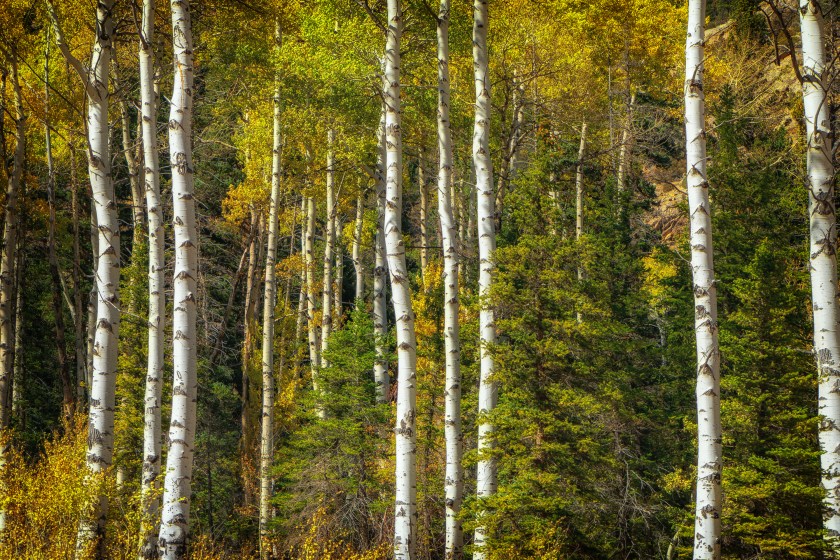
The photograph of aspen trees along Poudre Canyon Road showcases their autumn colors, balancing structural elements with individual characteristics. It features a rhythmic vertical pattern in soft light, capturing a unique moment in Colorado’s landscape photography. This singular image asserts confidence in representing the iconic aspens effectively and artistically.

Tall white-barked aspen trees with yellow autumn leaves standing among green forest vegetation.
A stand of aspen trees displays fall foliage along Poudre Canyon Road in Colorado.

Within Chapter 3 of Greg Urbano’s Top 100 Journey—dedicated to Colorado Landscapes & Cityscapes—this photograph of aspen trees along Poudre Canyon Road represents a pivotal encounter with one of the American West’s most celebrated subjects. The image captures a dense stand of aspens in their autumn transformation, their white-barked trunks creating a rhythmic vertical pattern against a backdrop of golden and green foliage. What distinguishes this work from countless other interpretations of the same subject is the photographer’s restraint and his attention to the structural elements that give the composition its quiet authority.

The vertical emphasis dominates immediately. Dozens of aspen trunks rise through the frame, their characteristic pale bark marked by dark knots and horizontal striations that break the otherwise smooth surfaces. These natural imperfections serve as visual anchors, preventing the repetition from becoming monotonous. The photographer has positioned himself to maximize this rhythm while maintaining sufficient depth to reveal the layered complexity of the forest. Evergreens punctuate the composition in the background, their darker masses providing tonal contrast to the luminous aspens and golden understory.

The treatment of light deserves particular attention. Soft, even illumination suggests either overcast conditions or the photographer’s careful timing to avoid harsh midday sun. This choice allows the full tonal range of the foliage to register—from the brilliant yellows of peak autumn color to the deeper golds and lingering greens of leaves in transition. The post-processing, executed using DXO’s Color Efex Pro 4, enhances these chromatic relationships without pushing them into artificiality. There is saturation here, certainly, but it reads as an intensification of what was present rather than an invention.

For a photographer whose body of work encompasses diverse subjects and geographies, this image represents his only definitive statement on the iconic Colorado aspen to date—a fact he acknowledges directly in his own description. This singularity is worth considering. Rather than pursuing multiple variations or returning season after season to refine his approach, he has selected this single frame as representative. The decision suggests confidence in what was captured during that Saturday excursion from Fort Collins, and indeed, the composition supports that confidence.

The photograph functions effectively within its designated chapter, contributing to a broader portrait of Colorado’s varied landscapes. Where other images in this collection might address the state’s dramatic peaks, urban environments, or expansive vistas, this work explores the intimate scale of the mid-elevation forest. The aspens become both subject and structure, their seriality creating pattern while their individuality—visible in every unique scarring and branch configuration—asserts the organic nature of the scene.

Technically, the image demonstrates solid fundamentals: adequate depth of field to maintain sharpness across the forest layers, balanced exposure that preserves detail in both the bright foliage and darker bark, and a color palette that feels cohesive despite its range. The vertical format suits the subject matter, emphasizing the trees’ upward growth and the viewer’s sense of standing within the grove rather than observing it from outside.

This photograph documents a specific moment along Poudre Canyon Road while simultaneously engaging with a broader photographic tradition of Western landscape representation. It is work that respects its subject without overstating its case—a measured, observant addition to an ongoing artistic journey.