Stacked Chrome Muscle: The Architecture of American Power

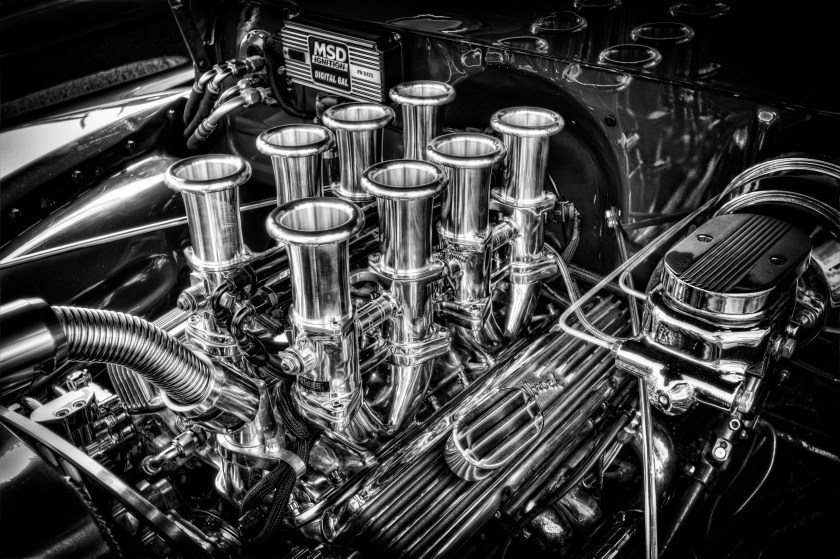
In a 2014 throwback photo, Greg Urbano captures a chrome muscle car engine at a car show, transforming it into a sculptural testament of American automotive culture. The monochrome composition highlights its intricate details and engineering philosophy, transcending typical automotive photography into fine art, reflecting power and craftsmanship.

Throwback Photo 2014, Stacked Chrome Muscle
Throwback photo from 2014 of a stacked, chrome muscle car engine I capture at a car show and then post processed in black and white.

In this striking image from Greg Urbano’s early photographic explorations, the viewer encounters not merely an engine, but a sculptural monument to American automotive culture. Shot at a car show in 2014, this photograph demonstrates how technical documentation can transcend its utilitarian origins to become a meditation on form, texture, and cultural identity.

The composition centers on a magnificent array of individual throttle bodies—eight polished chrome velocity stacks rising like organ pipes from the engine block below. Urbano’s decision to shoot at f/8.0 provides exceptional depth of field, rendering every fluted trumpet in sharp detail while maintaining visual coherence across the crowded mechanical landscape. The MSD Digital 6AL ignition box in the upper left corner grounds the image in specificity, reminding us this is a real machine, not an abstract study.

What elevates this work beyond conventional automotive photography is the photographer’s masterful use of monochrome. The conversion to black and white strips away distraction and reveals the essential geometry of performance engineering. Chrome becomes a study in gradation—from brilliant highlights on the velocity stack lips to the deep blacks of the engine valley below. The ribbed valve covers create rhythmic patterns that echo throughout the frame, establishing a visual cadence that draws the eye deeper into the mechanical complexity.

The lighting deserves particular attention. Working with the ambient conditions of a car show—notoriously challenging for photographers—Urbano has captured specular highlights that accentuate the three-dimensional quality of each component. The reflections dancing across polished surfaces create a sense of movement and life in what is, paradoxically, a static object. One can almost hear the anticipated roar of this engine, feel the vibration of its operation.

From a curatorial perspective, this image belongs firmly within the “Beginnings” chapter of Urbano’s journey. It reveals a photographer discovering his eye, learning to see beyond the obvious. Car shows present a particular challenge: everything is designed to be spectacular, yet the very abundance of visual stimulus can overwhelm. Here, the photographer has exercised editorial judgment, finding a perspective that isolates and celebrates a single element of automotive excess.

The stacked throttle bodies themselves represent a specific philosophy in performance engineering—individual runners for each cylinder, optimized airflow, uncompromising dedication to power over practicality. This photograph captures that ethos perfectly. There is nothing subtle about this engine, and Urbano wisely chooses not to apologize for its maximalism. Instead, he leans into the drama, using his technical choices to amplify the subject’s inherent theatricality.

The 24mm focal length on his Nikon D7100 provides just enough wide-angle perspective to encompass the scene without introducing distortion that would undermine the precision of these machined components. Shot at 1/30th of a second—relatively slow for handheld work—the image’s sharpness suggests careful technique, perhaps braced against the engine bay or shot with controlled breathing.

This photograph documents more than machinery; it captures a particular strain of American automotive culture that values power, craftsmanship, and conspicuous performance. In rendering it so beautifully, Urbano elevates the vernacular tradition of car photography into something approaching fine art—a promising beginning indeed for a photographer learning to find extraordinary subjects in ordinary places.

Lady in a Hat: A Study in Perspective and Presence

In 2013, Greg Urbano’s photograph “Lady in a Hat” encapsulated his experimental spirit in photography. Taken at a Veterans benefit car show in Florida, it features a classic car and a woman in a hat, illustrating the dynamic between subject and observer. This image showcases the evolution of Urbano’s artistry and HDR techniques, emphasizing compositional storytelling.

Black classic car with chrome wheels and open hood displayed at outdoor car show with woman in hat standing nearby under trees.
2013 was a breakout year for my photography. I was shooting a lot of car shows and post processing in HDR. This photograph I titled “Lady in a Hat” for obvious reasons. It was taken at a Veterans benifit car show held at the Bay Pines VA in Pinellas County Florida. Shot with a Nikon D5100.

In the early years of Greg Urbano’s photographic journey, there existed a willingness to experiment boldly with emerging digital techniques—a quality that would become foundational to his artistic identity. “Lady in a Hat,” captured in 2013 at a Veterans benefit car show in Bay Pines, Florida, exemplifies this experimental spirit while revealing an intuitive understanding of compositional storytelling that would define his later work.

The photograph presents a gleaming black classic car, its hood raised to display immaculate chrome and engineering, positioned at a dramatic low angle that transforms the vehicle into something monumental. But what elevates this image beyond typical automotive photography is the deliberate inclusion of a figure in the background—a woman in a distinctive hat, observing the scene. This compositional choice transforms what could have been a straightforward documentation of mechanical beauty into a meditation on observation itself, on the relationship between spectator and spectacle.

Urbano shot this image with a Nikon D5100 at 10mm, an ultra-wide focal length that creates pronounced perspective distortion. The technical settings—f/10 at 1/320s, ISO 160—suggest bright midday conditions, yet the photographer’s use of HDR processing pushes the tonal range far beyond what the camera captured in a single exposure. This was 2013, when HDR photography was experiencing widespread popularity in automotive and architectural work, and Urbano was actively exploring its possibilities. The processing intensifies the reflections on the car’s black paint, brings out texture in the engine bay, and maintains detail in both the bright Florida sky and the shadowed undercarriage.

What makes this image significant within the context of Chapter 1—Beginnings is not its technical perfection, but rather what it reveals about the photographer’s developing eye. The ultra-wide perspective could easily overwhelm the frame, yet Urbano maintains balance through careful positioning. The car dominates the foreground, grounded by fallen leaves and grass texture, while the human element remains present but unobtrusive in the middle distance. This suggests an emerging awareness of layered storytelling, of creating images that reward sustained viewing.

The title itself demonstrates artistic intentionality. “Lady in a Hat” redirects our attention from the obvious subject—the pristine classic car—to the peripheral human presence, suggesting that the photographer understood even then that compelling photographs often exist in the tension between primary and secondary subjects, between what commands attention and what quietly observes.

This photograph also documents a specific moment in Urbano’s technical education. HDR processing, with its characteristic emphasis on local contrast and detail recovery, taught photographers of this era to see scenes in terms of tonal relationships rather than single exposures. This training in visualizing extended dynamic range would later inform his approach to lighting and exposure, even when shooting single frames.

Within the broader narrative of the Top 100 Journey project, “Lady in a Hat” represents the necessary phase of bold experimentation that precedes refinement. It captures a photographer unafraid to push processing techniques to their limits, to shoot from unconventional angles, and to include elements that complicate rather than simplify the frame. These imperfect attempts, as Urbano himself acknowledges, formed the foundation for everything that followed—a reminder that artistic growth requires the courage to create before one fully understands how.