Hidden Valley Hike: A Study in Atmospheric Depth and Winter Quietude

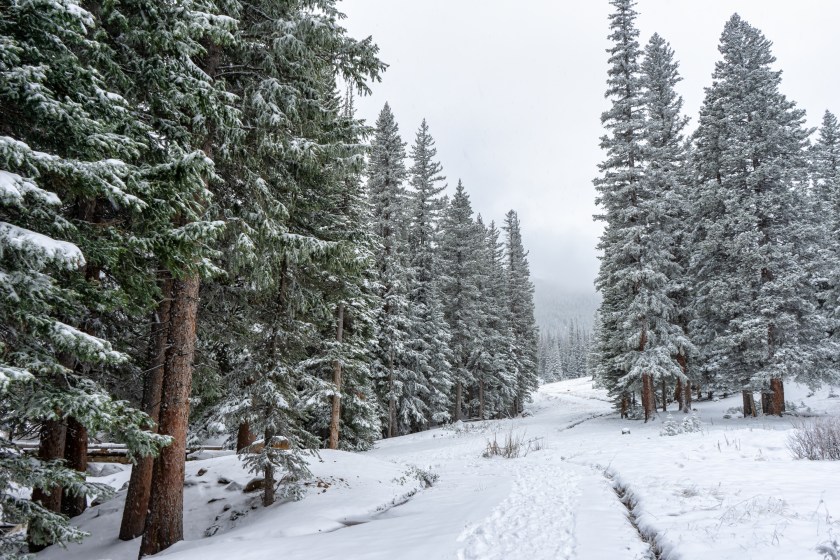
The photograph from Hidden Valley in Rocky Mountain National Park captures a snow-covered trail among dense trees, showcasing Greg Urbano’s skill in monochromatic winter photography. Emphasizing subtlety over grandeur, it conveys solitude and wilderness through careful composition and tonal restraint, highlighting ecological specifics and the beauty of intimate landscapes.

Snow-covered hiking trail winding through evergreen forest at Hidden Valley in Rocky Mountain National Park.
A snowy trail leads through dense evergreen trees at Hidden Valley in Rocky Mountain National Park, Colorado.

Within Chapter 3 of Greg Urbano’s Top 100 Journey—devoted to Colorado Landscapes & Cityscapes—this photograph from Hidden Valley in Rocky Mountain National Park represents a masterful engagement with the challenges of monochromatic winter photography. The image captures a snow-laden trail ascending through dense coniferous forest, where atmospheric conditions have reduced the distant peaks to mere suggestions within a veil of falling snow and fog.

The photographer’s compositional strategy reveals a sophisticated understanding of visual hierarchy. The trail itself functions as both literal and metaphorical pathway, drawing the viewer’s eye from the textured foreground snow through the middle ground’s architectural arrangement of pines and firs, before dissolving into the atmospheric void of the background. This recession creates a palpable sense of depth despite the flattening effect that overcast winter light typically imposes on landscape photography.

What distinguishes this work within Urbano’s broader Colorado portfolio is its restraint. Rather than pursuing the dramatic vistas and saturated alpine glow that characterize much Rocky Mountain photography, he has chosen to document a moment of visual subtlety—a soft, nearly monochromatic palette punctuated only by the warm sienna of exposed tree bark. The decision to work within such a limited tonal range demonstrates confidence in form and composition rather than relying on chromatic spectacle.

The technical execution merits particular attention. The photographer has maintained remarkable detail in the snow-weighted evergreen boughs while preserving the delicate gradation of gray tones that define the misty background. This balance suggests careful exposure management in conditions that would challenge most practitioners—the high reflectivity of fresh snow against dark timber, compounded by active precipitation and low contrast lighting.

From a thematic perspective, this photograph speaks to the contemplative dimension of Urbano’s landscape practice. The absence of human figures—save for the implicit presence suggested by the trail itself—invites meditation on solitude and the experience of wilderness in its less hospitable moments. This is not the Colorado of tourism brochures, but rather an intimate encounter with the state’s winter reality, where beauty reveals itself through subtlety rather than grandeur.

The image also functions as documentation of a specific ecological zone within Rocky Mountain National Park. The mixed conifer forest, dominated by what appear to be Engelmann spruce and subalpine fir, places the photograph within the park’s upper montane and subalpine life zones. The photographer’s attention to these botanical particulars grounds the work in a specific geographic and ecological context, elevating it beyond generic winter scenery.

Within the arc of the Top 100 Journey project, this photograph demonstrates stylistic evolution—a willingness to embrace quieter moments alongside more conventionally dramatic subjects. It suggests that Urbano’s curatorial eye has matured toward valuing atmospheric mood and compositional sophistication over spectacular subject matter alone.

The final consideration is one of timing and patience. Winter photography in Rocky Mountain National Park demands both technical preparation and willingness to work in physically demanding conditions. That this image exists at all speaks to the photographer’s commitment to documenting the full range of Colorado’s landscape character, not merely its most accessible or comfortable manifestations. The result is a work that rewards sustained attention, revealing its carefully calibrated tonal relationships and spatial complexities gradually, much like the trail itself emerging from and dissolving into winter’s embrace.

Hallett Peak: A Study in Motion and Permanence

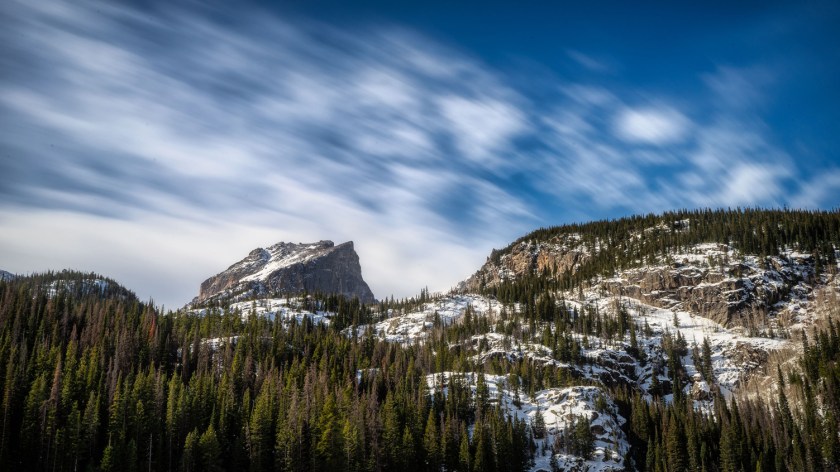
In a captivating long-exposure photograph of Hallett Peak in Rocky Mountain National Park, the artist merges landscape photography with technical artistry. The image features dynamic cloud streaks, contrasting geological permanence, and rich tonal variations, creating an engaging interplay of time and nature. This work illustrates a mature artistic voice, enhancing familiar landscapes.

Hallett Peak rises above evergreen forest and snow-dusted slopes beneath streaked clouds in Rocky Mountain National Park.
Hallett Peak towers above forested slopes near Bear Lake in Rocky Mountain National Park, Colorado.

In this striking capture from Rocky Mountain National Park, the photographer demonstrates a sophisticated command of long-exposure technique to transform a familiar Colorado landscape into something both ethereal and architectural. The image of Hallett Peak, taken from the Bear Lake area, exemplifies the technical precision and artistic vision that defines Chapter 3 of his Top 100 Journey project.

The composition is anchored by the geological drama of Hallett Peak itself—that distinctive snow-dusted formation rising with muscular authority against the left portion of the frame. Yet it is the sky that commands immediate attention. Through extended exposure, the photographer has rendered clouds as diagonal streaks of motion, creating dynamic vectors that sweep across the upper two-thirds of the image. This technique transforms the sky from mere backdrop into active participant, suggesting the passage of time within a single frozen moment. The effect is cinematic, almost reminiscent of time-lapse sequences compressed into still photography.

The tonal range demonstrates careful exposure management in challenging high-altitude conditions. Deep blues saturate the upper atmosphere while softer, almost pearl-like whites and grays occupy the middle zones where cloud and sky intermingle. The snow-covered peaks and rock faces provide textural counterpoint—solid, immutable, sharply defined—against the fluid sky. This juxtaposition between the permanent and the transient becomes the photograph’s central artistic statement.

In the foreground, dense stands of evergreens establish both scale and context. The forest appears in rich greens and shadow-dark tones, creating a horizontal band that grounds the viewer’s eye before it ascends to the peaks and sky beyond. These trees serve multiple functions: they frame the composition, they provide Colorado’s signature ecological context, and they emphasize the vertical drama of the mountain forms rising behind them.

What distinguishes this work within the Colorado Landscapes & Cityscapes chapter is its sophisticated balance between documentary and interpretive approaches. While the location remains recognizable to anyone familiar with Rocky Mountain National Park, the artistic treatment elevates the image beyond straightforward landscape photography. The photographer has chosen to emphasize process—geological, meteorological, temporal—over simple representation.

The technical execution reveals careful planning. The long exposure required for cloud streaking demands stable tripod work, precise timing, and likely the use of neutral density filtration to manage the bright mountain light. The sharpness maintained throughout the frame, from foreground forest to distant peak, suggests a narrow aperture and careful focus technique. These are not accidental achievements but rather the results of deliberate craft.

Within the broader context of his Top 100 Journey, this photograph represents a mature artistic voice. It demonstrates that the photographer understands landscape work as more than capturing beautiful places—it involves interpreting those places through technical means that reveal aspects invisible to casual observation. The streaming clouds make visible the wind, the time, the atmospheric dynamics that define mountain environments but typically escape photographic capture.

This image invites extended viewing. Initially, one registers the dramatic sky; subsequently, the eye explores the geological complexity of the peaks, the play of snow and rock, the forest’s quiet density. It is work that rewards attention, revealing the photographer’s ability to transform a well-visited location into something that feels simultaneously familiar and newly seen—a hallmark of accomplished landscape photography.

Passagrille Sunset

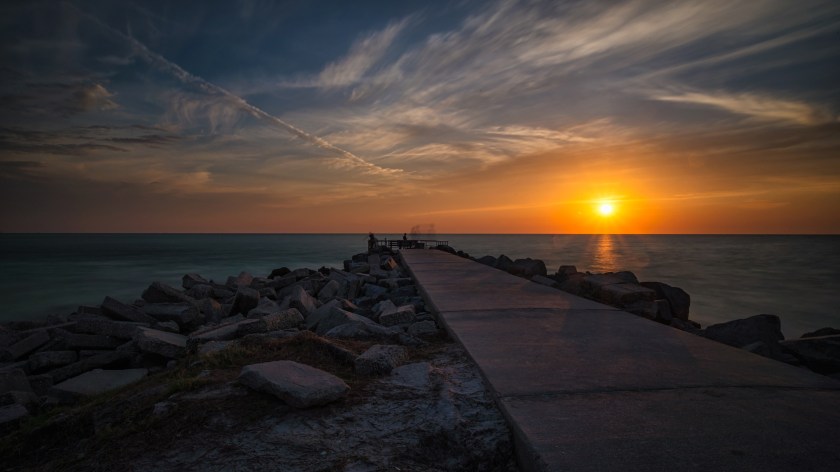
The photograph of a sunset over the Gulf of Mexico from the Pass-a-Grille jetty captures a sense of departure and geometric clarity. It juxtaposes the structural jetty against soft, ethereal water and sky, reflecting the photographer’s evolving approach while highlighting the tension between permanence and impermanence in landscapes.

Sunset photograph of the Pass‑a‑Grille jetty in Florida, with a concrete pier extending into the Gulf of Mexico and silhouetted figures at the horizon.
Sunset over the Gulf of Mexico from the Pass‑a‑Grille jetty.

This image from Chapter 2 of the Top 100 Journey carries with it a distinct sense of departure—a final engagement with a familiar location rendered with the careful attention of someone taking leave. Shot at Pass-a-Grille, the southern terminus of St. Pete Beach, the photograph distills the photographer’s technical vocabulary into a study of geometric clarity against atmospheric flux.

The concrete jetty commands the composition with unwavering linear authority, stretching from the immediate foreground toward the distant horizon where the sun hangs in perfect alignment. This centered positioning—often avoided in landscape photography as overly symmetrical—here becomes an asset, emphasizing the directional thrust of both structure and light. The jetty serves as more than mere subject; it functions as visual pathway, invitation, and barrier simultaneously. Flanked by massive boulder riprap on either side, the walkway creates a corridor that focuses attention while the rough-hewn stones provide textural contrast to the smooth concrete surface.

The technical approach reveals the photographer’s continued exploration of extended exposure. At fifteen seconds and f/22, the water on both sides of the jetty transforms into a milky abstraction, its individual waves collapsed into a singular luminous mass. This treatment—shorter than the sixty-second exposure employed in his Pier 60 work yet still substantially extended—suggests a refinement in his methodology. The turquoise-tinted water retains enough definition to read as liquid rather than dissolving into pure atmosphere, maintaining a crucial anchor to physical reality.

Above, the sky performs its transitional theater. Wispy cirrus formations streak diagonally across the frame from upper left, their directional movement contrasting with the horizontal stratification of color closer to the horizon. The gradient moves from deep slate blues through amber and peach tones to the incandescent disc of the sun itself. A single contrail cuts through the upper portion—a contemporary detail that situates this timeless scene firmly in the present moment, a reminder that even pristine natural settings exist within our flight-path-crossed modern reality.

The photographer has positioned himself low, allowing the foreground boulders to occupy significant visual weight in the left portion of the frame. These lichen-stained rocks, rendered in earth tones that echo the warm sunset palette, ground the image literally and figuratively. Their solidity counterbalances the ethereal qualities of water and sky, creating a dialogue between permanence and impermanence that resonates with the image’s contextual note about departure.

Within the framework of Chapter 2—Florida Landscapes & Cityscapes—this photograph demonstrates the photographer’s evolving relationship with infrastructure as subject. Where tourist piers offer human presence and activity, this utilitarian jetty provides something more austere: pure form against elemental forces. The viewing platform visible at the jetty’s terminus, occupied by silhouetted figures, offers scale and human connection without sentimentality.

The work succeeds in balancing documentary precision with interpretive mood. It captures a specific engineered structure at a specific coastal location while transcending those particulars to engage broader themes: the paths we walk toward light, the structures we build against erosion, the moments we choose to mark as endings before moving forward.

Pier 60 Pink Sunset

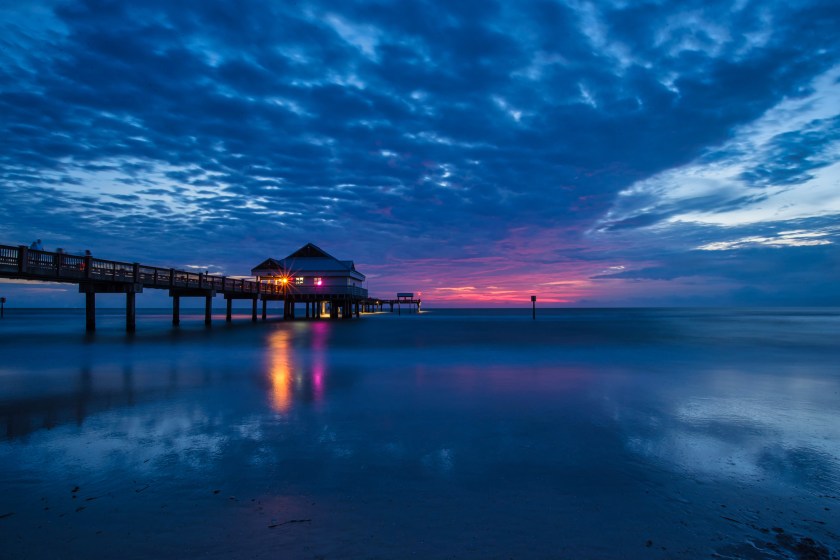
In this contemplative study from Chapter 2 of the Top 100 Journey, the photographer demonstrates a sophisticated command of long-exposure technique to capture the liminal hour where day surrenders to night along Florida’s Gulf Coast. Shot at Clearwater Beach, this sixty-second exposure transforms the volatile surf into a glassy, ethereal plane that mirrors the atmospheric drama unfolding above, while Pier 60 extends into the frame with geometric precision against a sky rendered in deep indigos and persistent pink tones.

Long exposure photograph of Pier 60 on Clearwater Beach at sunset, with pink and purple sky tones reflecting on calm water.
Long exposure pink sunset at Pier 60 on Clearwater Beach.

In this contemplative study from Chapter 2 of the Top 100 Journey, the photographer demonstrates a sophisticated command of long-exposure technique to capture the liminal hour where day surrenders to night along Florida’s Gulf Coast. Shot at Clearwater Beach, this sixty-second exposure transforms the volatile surf into a glassy, ethereal plane that mirrors the atmospheric drama unfolding above.

The composition centers on Pier 60, an iconic structure that extends into the frame with geometric precision. The photographer has positioned himself to capture the pier in its full dimensionality—the wooden pilings create a rhythmic vertical pattern that draws the eye toward the pavilion structure, where warm sodium lights pierce the deepening blue hour. These artificial punctuations of yellow and magenta provide crucial counterpoints to the natural color palette, preventing the image from dissolving entirely into monochromatic twilight. The long exposure has softened the lights into glowing orbs, their reflections stretching across the wet sand in elongated streaks that echo the horizontal thrust of the pier itself.

The technical execution reveals deliberate choices throughout. At f/22, the photographer has prioritized depth of field and the creation of diffraction spikes around the light sources, adding a subtle stellar quality to the illumination. The ISO 100 setting ensures maximum image quality, while the 18mm focal length—shot on a full-frame Nikon D610 with an 18-35mm lens—provides expansive coverage that encompasses both the architectural subject and the vast atmospheric canvas surrounding it. This wider perspective situates the human-made structure within the broader natural context, a recurring tension in his Florida landscapes.

The sky commands nearly two-thirds of the frame, and rightfully so. The textured cloud formations—rendered in deep indigos and cobalt blues—create a dramatic ceiling that seems to press down upon the horizon line where pink and peach tones persist from the recently set sun. This color gradient, from warm horizon to cool zenith, demonstrates the photographer’s understanding of transitional light and his patience in waiting for the precise moment when competing color temperatures achieve balance.

The wet foreground sand serves multiple compositional functions. Its reflective quality doubles the visual information, creating subtle mirror images of the pier lights, while the barely perceptible texture of the beach—preserved despite the long exposure—grounds the image in physical reality. This detail prevents the photograph from becoming overly abstract, maintaining the delicate equilibrium between documentary observation and interpretive vision.

Within the broader context of Chapter 2—Florida Landscapes & Cityscapes—this image exemplifies the photographer’s evolving relationship with his adopted coastal environment. Where earlier works might emphasize the region’s vibrant daylight character, this photograph engages with Florida’s more contemplative aspects: the quiet moments of transition, the interplay between natural beauty and recreational infrastructure, the way tourism and wilderness coexist along these developed shorelines.

The photograph ultimately succeeds as both technical achievement and aesthetic statement. It captures a specific place at a specific moment while transcending those particulars to evoke the universal experience of standing at the edge of vast water as darkness approaches—a meditation on transience rendered permanent through the camera’s patient eye.

Redington Long Pier Sunset

The photograph of Redington Long Pier at sunset highlights the interplay between Florida’s coastal architecture and natural beauty. Captured with a long exposure technique, it merges structure and color, showcasing the significance of humble elements like a bait shop sign. This image advocates for a broader definition of landscape photography, embracing authenticity over idealization.

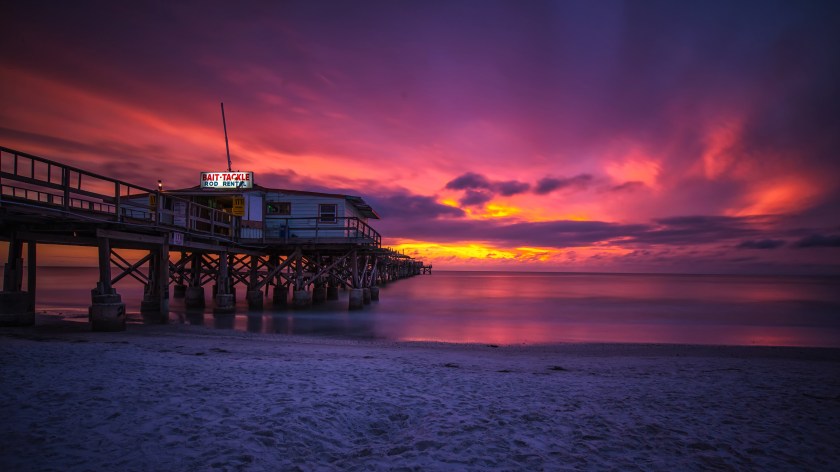
Long exposure photograph of the Redington Long Pier on Redington Beach, Florida, taken after sunset with vivid sky colors and calm reflective water.
Long exposure sunset view of the Redington Long Pier on Redington Beach.

The photographer’s approach to Florida’s coastal architecture reveals itself most compellingly in this extended exposure from Redington Beach, where a humble fishing pier becomes a study in structural grace against an incandescent sky. Captured on a Nikon D610 with an 18-35mm lens set to its widest focal length, the thirty-second exposure at f/8.0 transforms the Gulf of Mexico into liquid silk, while the pier’s weathered geometry provides essential counterpoint to the sky’s theatrical display.

What distinguishes this image within the Florida Landscapes & Cityscapes chapter is its subtle negotiation between the vernacular and the sublime. The “Bait·Tackle Rod Rental” sign—a modest beacon of commercial utility—anchors the composition with an authenticity that elevates rather than diminishes the scene’s natural grandeur. This juxtaposition speaks to the photographer’s evolving understanding of Florida’s coastal identity, where working piers and rental shacks exist not as intrusions upon beauty but as integral components of it.

The technical execution demonstrates considerable restraint. The eighteen-millimeter perspective captures the pier’s diagonal recession into the frame while maintaining clarity in the structural cross-bracing beneath the deck. The thirty-second exposure, calibrated to ISO 200, achieves that liminal smoothness in the water without sacrificing detail in the sky’s stratified clouds. The photographer has timed his capture for that brief window after sunset when the western horizon blazes with residual light while the zenith deepens toward purple—a moment lasting perhaps ten minutes when the dynamic range compresses just enough for a single exposure to hold both fire and shadow.

Color becomes the image’s primary language. The gradient from molten gold through crimson to violet speaks to the atmospheric conditions particular to Gulf Coast evenings, where humidity and marine air create these saturated transitions. The pier itself, rendered in silhouette, serves as a tonal anchor that prevents the composition from dissolving into pure chromaticism. The photographer’s choice to shoot into this gradient, rather than capturing the pier against a uniformly lit sky, reveals an understanding of how structure and color can modulate one another.

Within the broader trajectory of this chapter, the image represents a maturation of approach. Where earlier Florida work might have privileged either the natural landscape or the built environment, this photograph insists they cannot be separated. The pier extends from beach to horizon as a human gesture toward the infinite, its pilings disappearing into softened water that suggests both permanence and impermanence. The long exposure technique—a methodology that appears repeatedly throughout his landscape work—here serves not merely as technical flourish but as philosophical statement about time’s accumulation within a single frame.

The composition’s formal elegance belies its democratic subject matter. This is not a pristine wilderness or an architectural landmark, but a working-class fishing pier on a stretch of developed coastline. By rendering it with such visual authority, the photographer argues for an expanded definition of landscape photography—one that acknowledges Florida’s actual character rather than retreating to fantasies of unspoiled nature. The sunset may be spectacular, but it is the bait shop sign, glowing like a minor constellation above the water, that makes this image distinctly Floridian, distinctly true

See this image on:

Flickr

500px

Electric Sublime: Atmospheric Drama Over Tampa Bay

The image of a lightning strike over Tampa Bay, captured from Vinoy Park, showcases the photographer’s skill in storm photography. Using a Nikon D610, the thirty-second exposure reveals a dramatic interplay of colors and natural forces. This work highlights Florida’s weather patterns, merging urban and natural landscapes in a powerful visual narrative.

Long exposure photograph of lightning illuminating clouds over Tampa Bay, viewed from Vinoy Park in St. Petersburg, Florida.
Long exposure lightning strike over Tampa Bay from Vinoy Park.

Among the most technically demanding and visually arresting images in Chapter 2 of the photographer’s Top 100 Journey, this capture of a lightning strike over Tampa Bay represents a masterful convergence of patience, preparation, and meteorological fortune. Photographed from Vinoy Park in St. Petersburg, the image transforms a transient weather event into a sustained meditation on nature’s raw power and the atmospheric spectacle that defines Florida’s subtropical climate.

The composition presents a study in horizontal stratification—water, distant shoreline, and sky arranged in classical landscape proportions, yet animated by the extraordinary electrical discharge that commands the frame’s center. A single lightning bolt descends vertically through towering cumulonimbus clouds, creating a luminous column that connects the charged atmosphere to the bay’s surface. The strike illuminates the cloud structure from within, revealing billowing formations in shades of pearl, lavender, and steel blue against a gradient sky that transitions from deep indigo to warm amber.

Technical execution reflects the specialized demands of storm photography. Working with a Nikon D610 at the wide end of an 18-35mm lens, the photographer selected an 18mm focal length to encompass both the expansive cloud system and the reflective water below. The thirty-second exposure at f/5.6 and ISO 400 represents a calculated approach to lightning capture—a long enough duration to increase the probability of recording a strike within the frame, yet controlled enough to prevent overexposure of ambient light sources visible along the distant horizon. This extended shutter speed also smooths the bay’s surface into a mirror-like plane, its subtle texture suggesting gentle motion while maintaining enough definition to anchor the composition.

The color palette distinguishes this work within the chapter’s broader collection. Where the architectural study of Signature Place employed monochrome austerity, this image embraces the full chromatic range of atmospheric phenomena. The storm cell’s cool blues and purples contrast with the warm ochre glow infiltrating from the right edge of the frame—likely light pollution from Tampa’s urban corridor or residual sunset illumination scattered through distant clouds. This interplay of cool and warm tones creates visual tension that enhances the image’s dramatic impact without resorting to artificial enhancement.

Within Chapter 2’s exploration of Florida Landscapes & Cityscapes, this photograph occupies essential territory. Florida’s identity remains inextricably linked to its volatile weather patterns—the daily thunderstorm cycles of summer, the atmospheric electricity that makes the state the lightning capital of North America. By documenting this phenomenon, the photographer engages with environmental storytelling that moves beyond picturesque representation toward a more complete portrait of place.

The work also demonstrates sophisticated understanding of the sublime in contemporary landscape photography. The tradition of depicting nature’s awesome power—from nineteenth-century Romantic painters to mid-century photographers like Ansel Adams capturing Sierra storms—finds fresh expression here. The lightning strike serves as both subject and metaphor: a literal discharge of atmospheric energy and a symbolic representation of nature’s capacity to humble human observers.

Viewed alongside the chapter’s urban architectural studies, this image provides necessary balance. Together, these photographs suggest a photographer equally attentive to built and natural environments, capable of finding visual poetry in glass towers and electrical storms alike. Such range indicates a mature artistic vision—one that recognizes Florida’s complexity as both a site of intensive human development and a landscape still subject to forces beyond human control.