Shan Light: Choreographing Time and Illumination

Shannon Quinn’s photograph, taken at Void Studios, symbolizes the photographer’s exploration of long-exposure light painting in collaboration with a dancer. The composition highlights a figure in black, illuminated by vibrant light trails, merging technical skill with performance. This work exemplifies an ongoing artistic journey, emphasizing collaboration and the evolution of creative expression.

Studio portrait of go-go dancer Shannon Quinn wearing a blue wig and dark outfit, surrounded by curved orange light trails created through long-exposure light painting.
Shannon Quinn (ShanOSteel) photographed at Void Studios Denver during a collaborative light painting and long-exposure studio session.

In this striking image from Chapter 6 of Greg Urbano’s Top 100 Journey—titled “The Road Ahead: Recent Work & Ongoing Exploration”—the photographer ventures into territory that merges technical experimentation with performative energy. Shot at Void Studios in Denver during a collaborative session with dancer Shannon Quinn, the photograph represents a deliberate pivot toward long-exposure light painting, a technique the photographer had not previously explored in a controlled studio environment.

The composition centers on a figure clad in black with a blue-toned wig, positioned against a muted backdrop while wielding LED wands that trace vivid arcs of orange and yellow light through space. The long exposure—achieved through rear curtain sync flash combined with continuous LED sources—captures both the frozen stillness of the subject and the kinetic energy of movement, creating a visual paradox that challenges our perception of time. The metallic sheen of the vest catches ambient light, adding textural contrast to the otherwise shadow-heavy figure, while knee-high boots ground the composition in the physical realm even as the light trails suggest something ethereal.

What distinguishes this work within the photographer’s evolving practice is its collaborative foundation. Unlike many studio portraits that position the photographer as sole author, this image emerges from a dialogue between creator and performer. Quinn’s background as a go-go dancer informs the dynamic posture and confident spatial awareness visible in the frame. The choreography of light becomes inseparable from the choreography of the body, suggesting that technical mastery alone cannot produce such results—it requires a willing, skilled collaborator who understands how to perform for extended exposures.

The technical apparatus employed here—a Nikon Z7ii paired with Godox TL30 LED wands and an AD100 strobe—speaks to a hybrid approach that balances ambient light sculpting with decisive flash illumination. Rear curtain sync ensures that the sharpest rendering of the subject occurs at the end of the exposure, allowing motion blur and light trails to accumulate before the final moment of clarity. This reversal of typical flash timing creates a sense of forward momentum, as though the figure is moving into her frozen state rather than away from it.

Within the context of Chapter 6, this photograph embodies the spirit of its subtitle: ongoing exploration. The photographer’s willingness to attempt unfamiliar techniques in a new setting demonstrates an artistic practice that refuses stagnation. Rather than retreating to established strengths, the work here shows someone leaning into uncertainty, using collaboration as a catalyst for discovery.

The color palette—dominated by warm oranges against cool blues and deep blacks—creates a retro-futuristic aesthetic that recalls both 1980s cyberpunk imagery and contemporary LED performance art. Yet the image avoids pastiche. Instead, it synthesizes influences into something distinctly contemporary, a visual language appropriate for documenting this moment in the photographer’s trajectory.

As part of a curated selection representing his strongest work, this image signals not arrival but continuation. It captures the photographer mid-journey, experimenting with new tools and partnerships, documenting not just a subject but a process of becoming. The road ahead, as the chapter title suggests, remains open—and this photograph marks one compelling point along that route.
Suspended Between Earth and Sky: A Study in Geometric Embrace

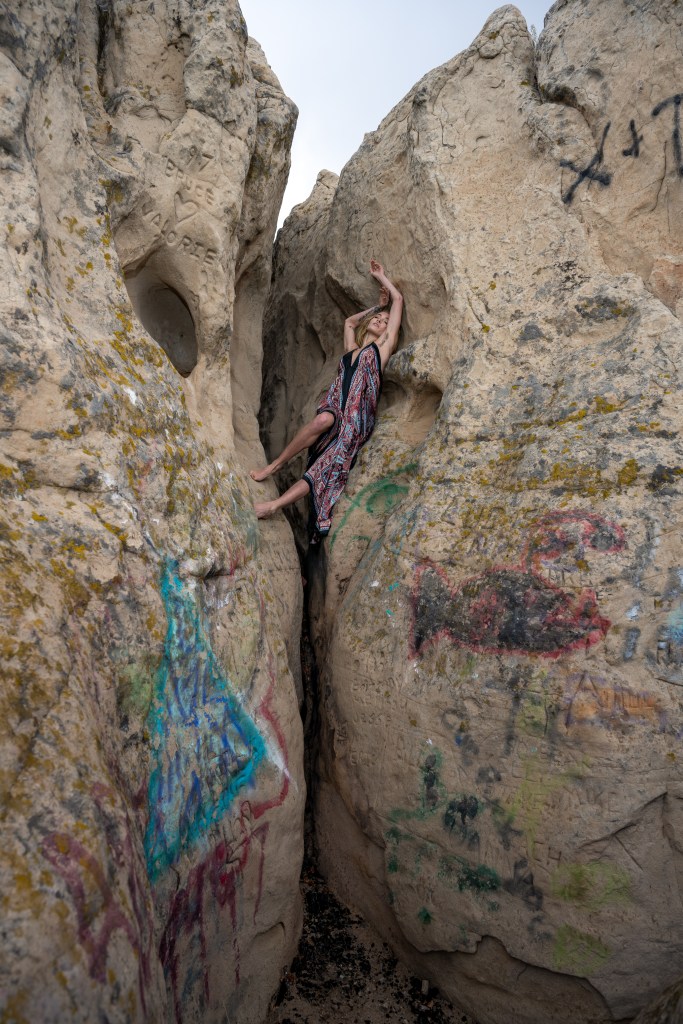
The photograph of Jennie Parks in a sandstone crevice at the Colorado-Wyoming border conveys a powerful interplay between human form and rugged landscape. The composition showcases Parks as both an integral part of the environment and a symbol of human vulnerability, enriched by graffiti that connects ancient rock with contemporary existence.

Model Jennie Parks posed barefoot within a narrow sandstone rock crevice, surrounded by weathered stone walls with graffiti and lichen.
Jennie Parks positioned inside a sandstone crevice at the Natural Fort rock formation on the Colorado–Wyoming border.

In this striking composition from Chapter 6 of the photographer’s Top 100 Journey, the human figure becomes a graceful counterpoint to the harsh geometry of desert stone. Shot at the natural fort rock formation straddling the Colorado-Wyoming border, the image captures model Jennie Parks wedged within a narrow crevasse, her body forming a living bridge between two massive limestone walls that tower overhead.

The photographer demonstrates a sophisticated understanding of environmental portraiture here, positioning his subject not merely within the landscape but as an integral element of its architecture. Parks’s extended pose—one arm reaching upward, legs braced against opposing walls—transforms the human form into a line of tension that mirrors the vertical thrust of the surrounding stone. The patterned fabric of her dress introduces rhythmic visual complexity against the textured, graffiti-marked surfaces of the rock, creating a dialogue between organic movement and geological permanence.

Technically, the composition exploits the natural framing device of the rock formation with considerable skill. The converging walls create strong diagonal lines that draw the eye upward toward the narrow strip of overcast sky, while the low vantage point emphasizes the vertiginous scale of the formation. The photographer has worked with available light to maintain detail in both the shadowed crevasse and the brighter upper reaches, a challenging exposure balance that preserves the dimensional quality of the weathered stone surfaces.

What distinguishes this work within the context of “The Road Ahead: Recent Work & Ongoing Exploration” is its synthesis of earlier themes with new formal rigor. The image continues the photographer’s established interest in the relationship between human vulnerability and natural grandeur, yet demonstrates an evolving sophistication in how that relationship is articulated. Rather than placing the figure as a small element overwhelmed by landscape—a common approach in environmental portraiture—he positions Parks as an active participant in the space’s geometry, neither dominated by nor dominating the scene.

The inclusion of graffiti on the rock faces introduces an unexpected documentary element. These colorful marks of human passage—blue and turquoise abstractions, faded pink tags—situate the timeless geological formation within contemporary reality. Rather than diminishing the image’s aesthetic power, this urban palimpsest enriches the reading: the rock has witnessed countless human gestures, from ancient weathering to modern spray paint to this moment of choreographed grace.

As representative of ongoing exploration, the photograph reveals an artist continuing to refine his visual vocabulary while remaining open to chance encounters and improvisation. The natural fort formation itself suggests the kind of site-responsive work that characterizes mature landscape photography—locations discovered rather than constructed, where the photographer’s role becomes one of recognition and revelation rather than wholesale invention.

In the broader trajectory of the Top 100 Journey, this image marks a moment of confident synthesis. The technical command is assured, the conceptual framework clear, yet there remains an element of spontaneity in how Parks inhabits the narrow space. It is work that looks both backward to established concerns and forward to possibilities yet unrealized—precisely the balance one expects from a chapter titled “The Road Ahead.”

Maia del Mazo Urban : A Study in Contemporary Youth Portraiture

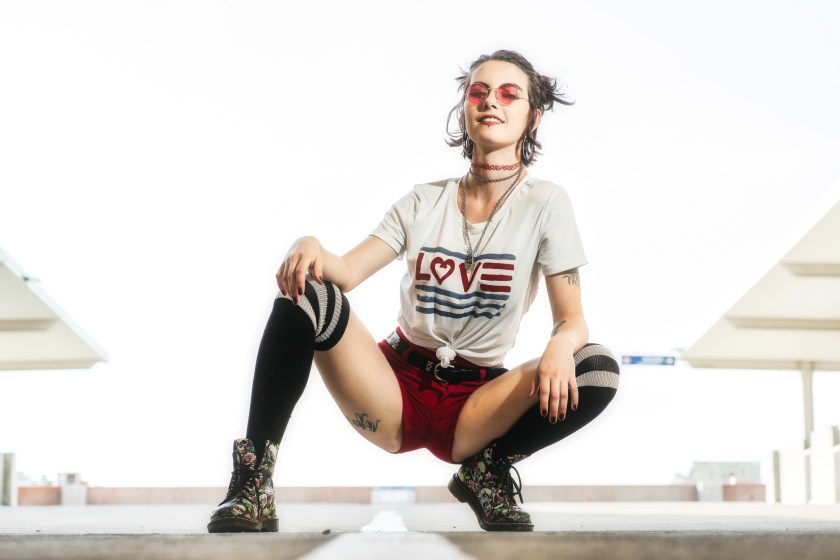
Maia del Mazo’s portrait, captured in Old Town Fort Collins, exemplifies the intersection of contemporary youth culture and environmental portraiture. Utilizing natural light and artificial enhancement, the photographer balances technical precision with spontaneity. The subject’s confident pose and styling reflect a subcultural moment, fostering an authentic connection with the viewer.

Woman wearing red shorts and knee-high socks crouches on a concrete surface in an urban setting with bright sky behind her.
Maia del Mazo poses in an urban location in Old Town Fort Collins, Colorado.

Within Chapter 4 of the photographer’s Top 100 Journey—dedicated to studio, outdoor, and workshop portraiture—this image of Maia del Mazo emerges as a compelling examination of contemporary youth culture and environmental portraiture. Shot in Old Town Fort Collins, Colorado, the photograph demonstrates the artist’s evolving command of natural light augmented by carefully controlled artificial illumination, a technical approach that has become increasingly refined throughout this chapter of his documentary project.

The composition presents the subject in a confident, grounded squat position against a minimalist architectural backdrop. Her styling—vintage band aesthetic meeting modern streetwear, complete with floral combat boots, striped knee socks, and layered chokers—speaks to a specific subcultural moment. The photographer has positioned her centrally within the frame, allowing the clean lines of the urban architecture to recede into soft focus, creating negative space that amplifies the subject’s presence rather than competing with it.

Technically, the image represents a sophisticated balance between available daylight and artificial enhancement. Shot with a Sony A7ii paired with an 85mm f/1.8 lens, the photographer employed a handheld Godox V1s flash without modification—a bold choice that suggests confidence in reading ambient conditions. The direct flash technique produces a subtle fill that lifts shadows without flattening the image’s dimensionality, while the 85mm focal length compresses the background just enough to isolate the figure without creating unnatural bokeh. The slight wind-swept quality of the subject’s hair adds dynamism to what might otherwise read as a static pose.

What distinguishes this work within the chapter’s broader context is its departure from traditional studio control. While maintaining the technical precision associated with formal portraiture, the photographer embraces environmental elements—concrete surfaces, architectural geometry, natural wind movement—that introduce spontaneity into the frame. This hybrid approach reflects an evolution in his practice, moving beyond purely controlled studio environments toward a more flexible methodology that captures authentic personality within structured compositions.

The post-processing in Luminar 4 demonstrates restraint appropriate to the subject matter. Color grading emphasizes warm tones in the subject’s skin and the amber cast of her sunglasses while maintaining the cooler neutrals of the concrete and sky. The processing enhances rather than transforms, supporting the documentary quality inherent in the photographer’s approach to his Top 100 Journey project.

The subject’s body language—relaxed yet assertive, casual yet deliberate—suggests a collaborative relationship between photographer and sitter. This comfort level allows for genuine expression rather than performative posing, a quality that distinguishes effective contemporary portraiture from mere documentation. The direct, knowing gaze above the rose-tinted frames establishes connection with the viewer while maintaining a degree of cool remove characteristic of youth subculture.

As part of the photographer’s long-term Top 100 Journey, this image contributes to an ongoing investigation into portraiture’s capacity to capture both individual personality and broader cultural moments. It represents the workshop and outdoor component of Chapter 4’s mission, demonstrating how environmental factors and technical adaptability can produce work that honors both formal photographic traditions and contemporary visual language. The result is a portrait that feels simultaneously timeless in its compositional confidence and distinctly anchored in its cultural moment.