The Studio as Theater: Classical Portraiture in Contemporary Practice

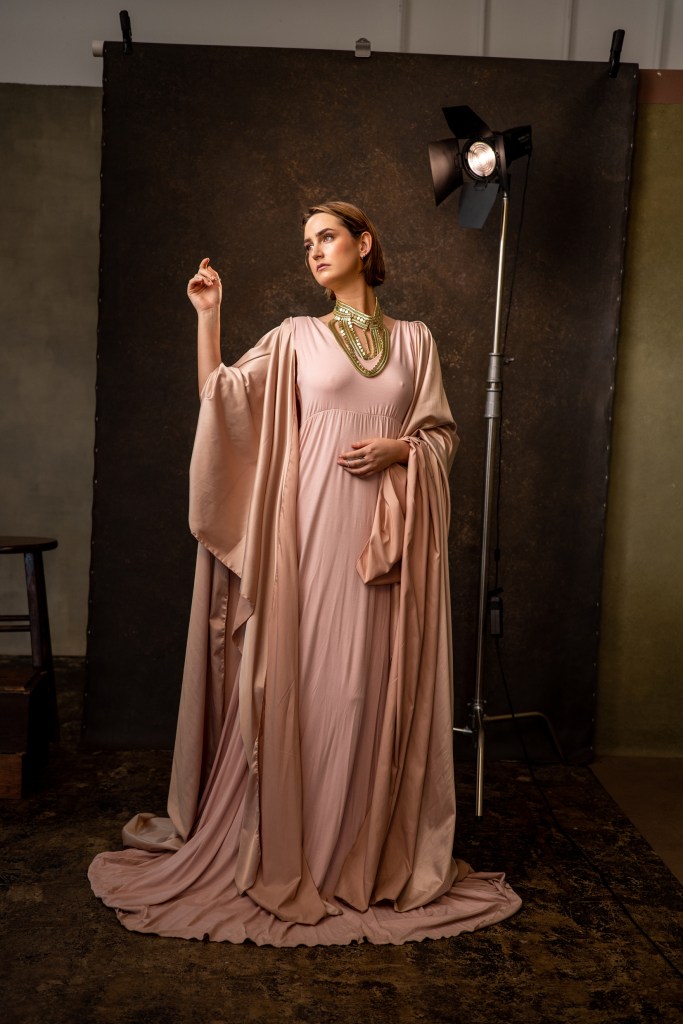
Jessica Lynn’s studio portrait showcases a fusion of classical portraiture and contemporary technique, created during a workshop at Atelier Alchimia. The photograph illustrates the artist’s growth through collaboration, using refined lighting to enhance the subject’s regal appearance. This work embodies artistic evolution, blending tradition with innovation while emphasizing continuous learning.

Studio portrait of Jessica Lynn standing in a flowing blush-colored gown, posed in front of a dark backdrop with a studio light visible behind her.
Jessica Lynn (QueenJess Rising) photographed in a studio setting during a workshop at Atelier Alchimia in Westminster, Colorado.

This studio portrait from Chapter 6 of the photographer’s Top 100 Journey represents a deliberate engagement with the formal traditions of classical portraiture, reimagined through contemporary technical means. Created during a workshop at Atelier Alchimia in Westminster, Colorado, the image demonstrates how collaborative learning environments can yield work of considerable aesthetic merit while advancing the artist’s technical vocabulary.

The subject, Jessica Lynn, is presented in a flowing blush-toned gown with dramatic bell sleeves that cascade to the floor, creating a silhouette reminiscent of Renaissance or Pre-Raphaelite painting. An ornate collar necklace in gold and green adds a regal quality that justifies the image’s title. The photographer has positioned her in a classical contrapposto-inspired stance—weight on one leg, torso gently twisted, one hand raised in a gesture of contemplation or perhaps benediction. This pose, combined with the upward gaze and theatrical lighting, evokes both historical portraiture and contemporary fashion photography’s ongoing dialogue with art history.

The technical execution reveals careful attention to studio craft. A single key light with barn doors, visible in the frame’s right edge, provides directional illumination that sculpts the subject’s features and creates tonal gradation across the fabric’s folds. The mottled canvas backdrop transitions from warm browns to darker tones, providing depth without competing for attention. The lighting setup, developed collaboratively with studio owner Jonny Edwards, demonstrates the photographer’s increasing comfort with controlled environments—a marked evolution from earlier work in the series that frequently engaged with natural light and outdoor settings.

What makes this image particularly relevant to “The Road Ahead: Recent Work & Ongoing Exploration” is its frank acknowledgment of artistic development through structured learning. Shot during a workshop led by Eric Brown, the photograph embodies a philosophy of continuous growth and technical refinement. Rather than presenting only work created in solitary practice, the photographer includes images born from educational contexts, recognizing that mastery often emerges through collaboration and mentorship.

The choice to work with studio lighting represents an expansion of technical range. The careful balance of exposure—maintaining detail in both the luminous fabric and the darker background—suggests growing confidence with artificial light sources. The warm color palette creates cohesion between subject, costume, and environment, while the visible studio elements (backdrop clamps, light stand) provide documentary transparency about the image’s construction.

Within the broader arc of the Top 100 Journey, this portrait signals a willingness to explore different photographic modes. Where earlier chapters emphasized environmental and location work, this studio piece demonstrates versatility and an interest in controlled aesthetic experiences. The theatrical quality—the visible apparatus of image-making—invites viewers into the creative process rather than presenting a seamless illusion.

The photograph succeeds both as a study in classical beauty and as evidence of artistic evolution. It captures a moment of learning translated into accomplished execution, showing that the road ahead need not abandon traditional craft in pursuit of innovation. Instead, it suggests that mastery comes through accumulation—building new skills atop established foundations, always remaining open to guidance, collaboration, and the timeless appeal of light falling gracefully upon fabric and form.

Fallen Tree: The Foundation of Seeing

The photograph from Hillsborough River State Park, taken by Greg Urbano in 2013 with a Nikon D7100, captures a pivotal moment in his artistic development. It reflects his early understanding of composition and intentionality, showcasing the dense subtropical landscape through HDR processing. This image symbolizes the importance of beginnings and learning in photography.

HDR photograph of a forest trail in Hillsborough River State Park with a large fallen tree across the path, dense vegetation, and filtered natural light, taken with a Nikon D7100 at 10mm.
A 2013 HDR landscape photograph of a fallen tree along a forest trail in Hillsborough River State Park, Florida.

In the opening chapter of Greg Urbano’s photographic journey, this image from Hillsborough River State Park stands as a testament to the essential nature of beginnings. Shot in 2013 with a Nikon D7100, the photograph captures more than a forest scene—it documents the foundational moment when a photographer learns to truly see the landscape before him.

The composition reveals an intuitive understanding of depth and perspective. Shot at 10mm, the wide-angle lens creates an immersive quality that draws viewers directly onto the trail. The fallen log in the foreground serves as both literal and metaphorical threshold, inviting passage into the deeper woods beyond. This diagonal element cuts across the frame with authority, its weathered texture rendered in sharp detail by the f/8.0 aperture, demonstrating Urbano’s early grasp of how to balance foreground interest with background context.

The HDR processing technique employed here reflects the experimental spirit characteristic of this pre-2015 period. While HDR would later fall somewhat out of favor in fine art photography circles, its application in this image serves a clear purpose: to capture the dynamic range of a Florida forest understory, where dappled sunlight creates extreme contrasts between shadow and highlight. The palmetto fronds and oak canopy are rendered with an almost hyper-real clarity that emphasizes the dense, layered nature of this subtropical ecosystem.

What makes this photograph particularly significant within the “Beginnings” chapter is its honesty about place and limitation. Urbano’s accompanying note—that this Florida park offered his “best opportunity to capture flowing water over river rocks” before relocating to Colorado—reveals something crucial about artistic development. Great photography emerges not from waiting for perfect conditions, but from working intensively with what’s available. This trail became his classroom, this fallen log his teacher.

The technical choices demonstrate a photographer thinking through his craft. The 1/50s shutter speed suggests deliberate handholding technique, while the ISO 200 setting indicates available light conditions and a preference for image quality. These aren’t the settings of someone simply pointing and shooting; they reveal consideration and intentionality, even in these early stages.

The color palette—predominantly greens with earth-toned accents—creates a cohesive, naturalistic feel despite the HDR processing. The slight motion blur in the foliage adds an organic quality, a reminder that this is a living landscape caught in a specific moment. The trail itself winds invitingly into the frame’s depth, disappearing around a bend that promises further discovery—a fitting metaphor for the artistic journey being documented.

In the context of Urbano’s larger body of work, this image represents more than just an early attempt. It embodies the crucial truth that mastery begins with showing up, with making photographs even when the circumstances aren’t ideal, even when the technique hasn’t been perfected. The photograph’s inclusion in his top 100 collection isn’t about technical perfection but about recognizing the importance of foundation.

Every artist’s journey requires a starting point, a place where curiosity meets commitment. This fallen tree, this Florida trail, this moment of learning to see—these are the essential ingredients that would eventually lead to mountain streams in Colorado and a mature photographic vision. The imperfect attempt, it turns out, isn’t just necessary. It’s everything.