Lights Camera Action: Urban Pulse and Architectural Legacy

The photograph captures the Broadway and Tremont intersection in downtown Denver, highlighting the contrast between historic architecture and modern life through long exposure techniques. It features the Brown Palace Hotel amidst urban vitality, emphasizing Denver’s artistic complexity. The image challenges traditional views on Colorado’s landscape, advocating for cityscapes’ recognition in photographic surveys.

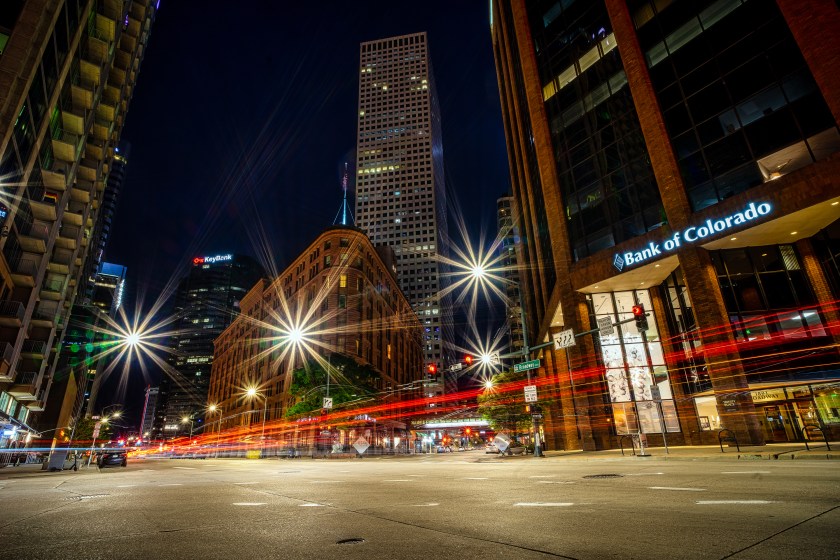
Long exposure light trails streak through a downtown Denver intersection at night, with tall buildings and streetlights surrounding the scene.
Long exposure traffic moves through the Broadway and Tremont intersection in downtown Denver, Colorado, with city buildings illuminated at night.

In this dynamic nocturnal study of downtown Denver, the photographer captures the essential duality of contemporary urban experience—the historic permanence of architecture set against the ephemeral flow of modern life. Positioned at the intersection of Broadway and Tremont, the image exemplifies his expanding vision within Chapter 3 of the Top 100 Journey, demonstrating how cityscapes demand entirely different technical and conceptual approaches than the natural landscapes that dominate much of his Colorado work.

The composition centers on the iconic triangular form of the Brown Palace Hotel, its distinctive Italianate Renaissance architecture rendered in warm amber tones against the deep blue of evening sky. This historic structure, framed between modern high-rises including the recognizable Republic Plaza tower, serves as both literal and metaphorical anchor—a touchstone of Denver’s Victorian-era prosperity surrounded by evidence of contemporary economic vitality. The photographer’s selection of this particular vantage point acknowledges the city’s layered temporal identity, where preservation and progress coexist in productive tension.

Working with an 18mm Samyang wide-angle lens mounted to his Sony A7II, he employs long exposure to transform vehicular traffic into ribbons of light—brilliant red taillights streaking horizontally across the frame’s lower third. These light trails provide kinetic energy and directional movement, leading the eye through the urban canyon while simultaneously suggesting the ceaseless motion of city life. Street lamps contribute their own starburst effects, punctuating the composition with points of crystalline brilliance that add theatrical dimension to the scene.

The technical execution reveals sophisticated understanding of night photography’s particular challenges. The exposure balances multiple light sources—artificial street lighting, illuminated building interiors, vehicle headlights, and residual ambient sky—without sacrificing detail in highlights or shadows. Corporate signage for KeyBank and Bank of Colorado glows with intentional clarity, grounding the image in specific place while contributing to the overall color harmony. The photographer’s post-processing in Luminar 4 has enhanced these chromatic relationships without pushing them into garishness, maintaining naturalistic tonality despite the inherently artificial lighting conditions.

What distinguishes this photograph within the broader chapter is its successful integration of Colorado’s urban identity alongside the state’s more frequently celebrated natural splendor. While mountain vistas and wilderness landscapes tend to dominate photographic representations of Colorado, this image argues persuasively for Denver’s visual complexity and photographic merit. The cityscape becomes landscape—vertical rather than horizontal, constructed rather than geological, but equally worthy of sustained aesthetic attention.

The wide-angle perspective introduces subtle geometric distortion that emphasizes the vertiginous quality of urban space, the way buildings frame and compress sky into channels of deep blue-black. Empty pavement in the immediate foreground provides breathing room, allowing viewers to enter the scene before being swept into the light-streaked energy of the intersection itself. This compositional breathing space demonstrates restraint and confidence, resisting the temptation to fill every pixel with information.

Within his evolving practice, this photograph represents important formal development. The controlled chaos of long-exposure urban photography requires different skills than landscape work—timing traffic flow, managing mixed lighting, balancing architectural detail against motion blur. His success here suggests a photographer expanding his technical vocabulary while maintaining consistent artistic sensibility. The image asks viewers to reconsider what constitutes Colorado landscape, proposing that cityscapes deserve equal consideration in any comprehensive photographic survey of the state’s visual identity.

Holiday Traffic: Urban Kinetics and the Ground-Level Perspective

Greg Urbano’s long-exposure photograph captures holiday traffic at a city intersection, blending urban dynamism with modern landscape photography. The low, ground-level perspective emphasizes movement and depth, contrasting traditional views. Utilizing experimental techniques, Urbano transforms mundane urban elements into visually engaging art, reflecting an intersection of Colorado’s natural and built environments.

Long exposure light trails streak across a city intersection at night, with a sewer grate and patches of ice in the foreground.
Long exposure light trails cross a city intersection at night, viewed from curb level during holiday traffic.

This long-exposure photograph marks a decisive departure from traditional landscape photography within Chapter 3 of Greg Urbano’s Top 100 Journey, demonstrating that the “cityscapes” component of his Colorado documentation extends beyond skyline silhouettes into the kinetic reality of urban infrastructure. Positioned at street level—literally at the curb—the photographer has created a dynamic study of nocturnal traffic patterns that transforms the mundane intersection of College Boulevard into a theater of light and motion.

The technical approach reveals deliberate experimentation with newly acquired equipment. Working with a Samyang 18mm wide-angle lens on his Sony A7ii, the photographer has exploited the optical characteristics of ultra-wide focal lengths to create exaggerated perspective and spatial depth. The low vantage point amplifies this effect dramatically: the sewer grate in the immediate foreground looms with tactile presence, its metal bars and residual ice providing textural anchor, while the light trails streak overhead in explosive radial patterns that suggest velocity and urban energy.

The compositional strategy employed here is remarkably sophisticated for what the photographer describes as “one of my early outings” with this lens. The image functions as a composite of multiple 25-30 second exposures, a technique that allows for selective accumulation of specific light sources while maintaining overall exposure balance. The resulting layering creates what might be termed a temporal palimpsest—multiple moments collapsed into a single frame, where red taillights and white headlamps trace the choreography of holiday traffic against the static geometry of traffic signals, street lamps, and seasonal decorations visible in the background.

What distinguishes this work from conventional light trail photography is its grounded perspective. Rather than adopting the elevated, observational stance typical of urban night photography, the photographer has chosen a worm’s-eye view that positions the viewer within the street infrastructure itself. This decision transforms the image from documentation into experience—we are not watching traffic from safe remove, but inhabiting the same plane as the vehicles themselves, separated only by the curb’s modest elevation.

The inclusion of the ice-rimmed drain grate serves multiple functions. Practically, it provides a foreground anchor that prevents the eye from being immediately swept into the light trails. Conceptually, it connects this urban image to the winter conditions documented elsewhere in the chapter, suggesting continuity between Colorado’s natural and built environments. The detail also introduces narrative specificity—this is not generic cityscape, but a particular moment following “last week’s big snowfall,” situating the photograph within both seasonal and meteorological context.

Within Urbano’s broader practice, this image represents important evolution. It demonstrates willingness to explore the full spectrum of Colorado’s visual character, from wilderness solitude to urban dynamism. The experimental nature of the work—testing new equipment, exploring composite techniques, embracing an unconventional viewpoint—suggests a photographer actively expanding his technical vocabulary rather than retreating to established formulas.

The photograph ultimately succeeds by finding aesthetic potential in overlooked urban moments. The holiday season’s increased traffic becomes raw material for abstract light painting, while municipal infrastructure—storm drains, asphalt, street furniture—gains unexpected visual dignity through careful framing and extended exposure. It is urbanism made kinetic, infrastructure rendered poetic.

Contemporary Urban Narrative: The Scooter as Cultural Marker in Denver’s Historic District

The photograph captures Denver’s Union Station, highlighting urban mobility through an electric scooter, symbolizing the modern sharing economy. Blending historic architecture and contemporary transit, it embodies Denver’s revitalization. The technical execution showcases skill in low-light conditions, emphasizing the cityscape’s complexity as part of Colorado’s evolving identity.

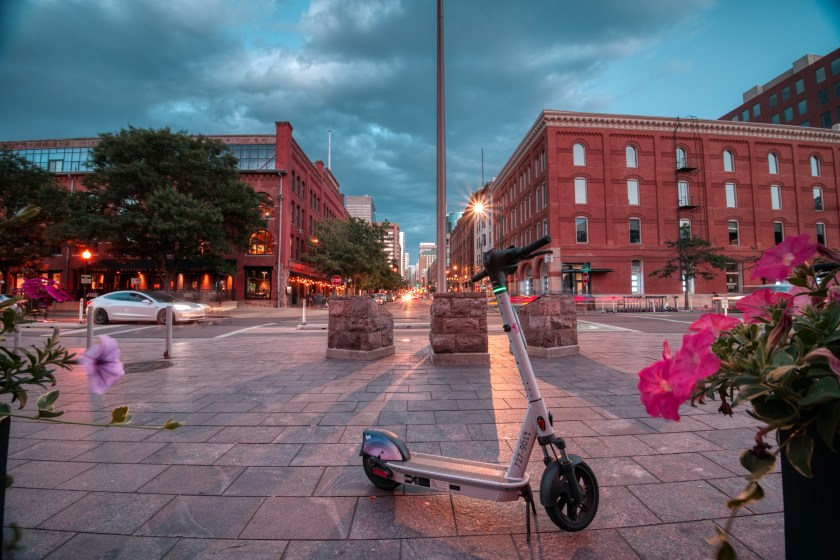
An electric scooter stands on a plaza at Denver Union Station, framed by brick buildings and evening traffic under a cloudy sky.
An electric scooter sits in the foreground near Denver Union Station as evening light and traffic move through downtown Denver.

In this street-level composition from Denver’s Union Station district, the photographer constructs a narrative about contemporary urban mobility that extends beyond mere documentation. The electric scooter, positioned prominently in the foreground, functions as both subject and symbol—a deliberate choice that anchors this image firmly in its specific cultural moment while engaging with the broader themes of his Colorado cityscapes chapter.

Shot with the Nikon Z5 and Nikkor 14-30mm wide-angle lens during the transitional blue hour, the image demonstrates technical command over challenging mixed-lighting conditions. His HDR processing through Aurora software balances the warm sodium vapor glow of street lamps with the cooler tones of approaching dusk, creating a color palette that feels authentic to the urban evening experience. The dramatic cloud formations overhead add atmospheric weight without overwhelming the architectural elements below.

The composition’s strength lies in its layered storytelling. The scooter occupies the immediate foreground, a symbol of the sharing economy and evolving transportation patterns that have reshaped American cities in recent years. Behind it, motion-blurred pedestrians and vehicle light trails suggest continuous movement—the perpetual flow of urban life. The red brick Victorian-era buildings flanking the street provide historical context, their solid permanence contrasting with the ephemeral nature of the modern transit device and the transient human figures.

This juxtaposition between historic preservation and contemporary innovation becomes the photograph’s central thesis. Denver’s Union Station neighborhood represents a successful urban revitalization, where nineteenth-century industrial architecture has been adapted for twenty-first-century use. The photographer captures this temporal complexity not through obvious before-and-after documentation, but through subtle visual relationships: old brick against new pavement, traditional street furniture against app-based transportation, architectural permanence against digital-age impermanence.

The wide-angle perspective creates dynamic leading lines through the paved plaza, drawing the viewer’s eye from the scooter through the middle ground and toward the vanishing point where downtown high-rises punctuate the skyline. Pink flowers frame the right edge, their organic forms softening the geometric rigor of the built environment while adding unexpected color that complements the warm building tones.

Within the context of Chapter 3’s exploration of Colorado landscapes and cityscapes, this image represents an important counterpoint to mountain vistas and natural panoramas. It acknowledges that Colorado’s contemporary identity includes rapidly growing urban centers navigating questions of density, mobility, and livability. The photographer treats the cityscape with the same observational care one might afford wilderness photography, suggesting that urban environments deserve equally thoughtful documentation.

The technical execution reflects growing proficiency with the Z5 system in low-light scenarios. The exposure balances bright highlights from street lamps and vehicle headlights while retaining shadow detail in the building facades and foreground elements. This dynamic range management, enhanced through HDR processing, avoids the artificial appearance that often compromises such techniques.

Ultimately, this photograph functions as cultural documentation—a moment preserved when electric scooters had become ubiquitous urban fixtures, when historic districts balanced preservation with progress, and when cities like Denver negotiated their identity between Western heritage and metropolitan aspiration. The photographer’s choice to include this image in his curated Top 100 Journey acknowledges that landscape photography can encompass the human-altered terrain of city streets, where the stories being told are equally complex and worthy of attention.

Architectural Symmetry and Urban Solitude: An HDR Study of Denver Union Station

The photographer’s nocturnal exploration of Denver Union Station highlights its architectural beauty through HDR techniques. Using a Nikon Z5, he captures the arched canopy and geometric metalwork, emphasizing both urban context and functional identity. This work redefines landscape photography, recognizing the significance of transportation infrastructure in Colorado’s cultural identity.

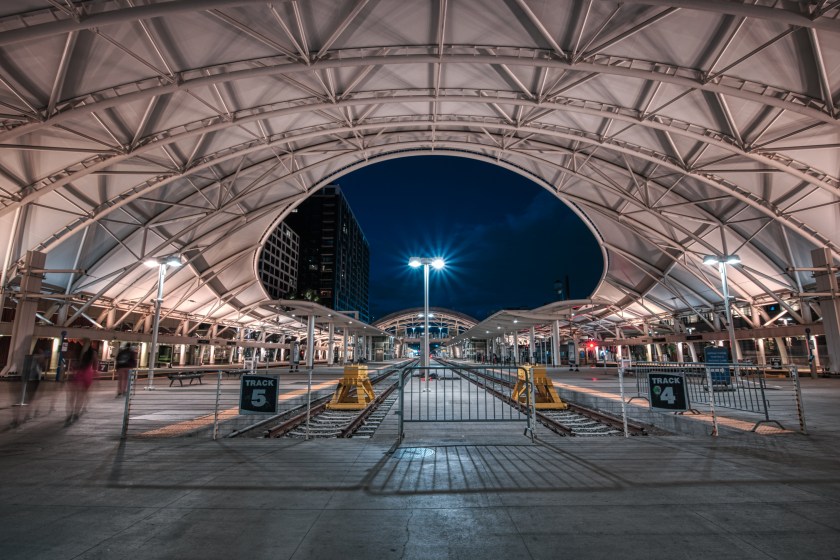
Symmetrical view of covered light rail platforms inside Denver Union Station at night, with tracks centered beneath a white arched roof.
The light rail platforms inside Denver Union Station are shown at night beneath the station’s arched canopy.

The photographer’s exploration of Colorado’s built environment finds a striking culmination in this nocturnal study of Denver Union Station’s interior architecture. Captured with a Nikon Z5 and Nikkor 14-30mm wide-angle lens, this HDR composition demonstrates a mature understanding of how contemporary digital techniques can reveal the inherent drama within civic spaces.

The image centers on the station’s distinctive arched canopy structure, a feat of engineering that dominates the frame with rhythmic precision. Metal trusses radiate outward in geometric patterns, their repetition creating a sense of ordered monumentality. The wide-angle lens choice proves deliberate rather than merely expedient—it allows the photographer to encompass both the sweeping overhead architecture and the rail infrastructure below while maintaining the spatial relationship that gives the composition its power. The central void, opening to the deep blue evening sky and a distant office tower, punctuates the manufactured enclosure with a reminder of the urban context beyond.

His HDR processing through Aurora software reveals a considered approach to tonal range. The metalwork retains textural detail without the artificial hyper-clarity that often plagues high dynamic range photography. The warm metallic tones of the canopy structure contrast effectively with the cooler blues of the twilight sky and platform lighting, establishing a color palette that feels naturalistic despite the technical manipulation required to balance such extreme luminance values.

The human element appears deliberately subdued—motion-blurred figures at the platform edges suggest activity without demanding attention, reinforcing the architectural subject while maintaining the space’s functional identity as a transportation hub. Yellow bumper stops and safety railings provide geometric counterpoints to the dominant curves above, their utilitarian forms grounding the composition in operational reality.

Within the context of Chapter 3’s focus on Colorado landscapes and cityscapes, this work represents a conceptual bridge. While the chapter presumably encompasses the state’s renowned natural vistas, the photographer recognizes that Colorado’s urban environments possess their own topography worth documenting. Denver Union Station, a historic structure serving contemporary transit needs, embodies the intersection of preservation and progress that characterizes much of the American West’s relationship with its past.

The technical execution reflects growing confidence with the Z5 system’s capabilities in challenging lighting conditions. Night photography in mixed-light environments demands both equipment competence and processing discipline, both evident here. The decision to shoot during the transitional moment between day and night—when ambient light still registers in the sky while artificial illumination dominates the platform—demonstrates an understanding of how fleeting conditions can elevate architectural documentation beyond mere record-keeping.

This image functions as more than a single photograph within his Top 100 Journey project; it suggests an expanding definition of landscape photography itself. The constructed landscape of transportation infrastructure, with its own valleys and peaks of metal and light, receives the same considered attention he might afford a mountain vista. The result is a document that honors both the anonymous designers who created this functional space and the ongoing human movement that gives it purpose.

In positioning this work within his curated collection, the photographer asserts that Colorado’s identity exists not only in its natural grandeur but in the spaces where communities gather, depart, and return—the thresholds that connect wilderness to civilization.

Boulder Creek Long Exposure

The aerial photograph of Boulder Creek, captured with a DJI Mini 3 Pro drone, showcases a harmonious blend of long exposure techniques and modern technology. The composition balances flowing water and angular granite boulders, creating an abstract visual narrative that highlights the juxtaposition of motion and permanence in landscape photography.

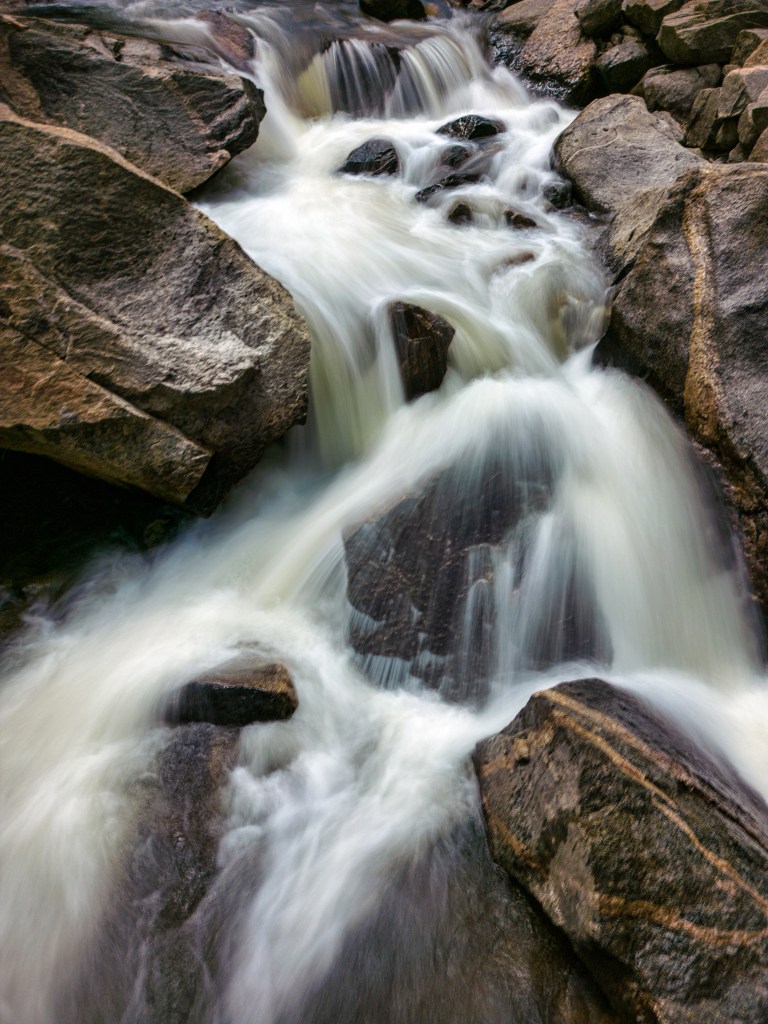
Long-exposure view of flowing creek water cascading over large rocks in a narrow channel.
Long-exposure water flows over boulders in Boulder Creek along Boulder Canyon Drive, Colorado.

This aerial perspective of Boulder Creek represents a striking departure in both technical approach and creative vision, captured not with traditional camera equipment but with a DJI Mini 3 Pro drone equipped with a Freewell ND2000 filter. The photographer’s willingness to embrace emerging technologies while maintaining classical long exposure techniques demonstrates an adaptive practice that refuses to be constrained by conventional methodologies. Shot at 6.7mm with ƒ/1.7 aperture, 1/2 second exposure, and ISO 100, the image transforms cascading water and weathered granite into an abstract study of motion and permanence.

The aerial vantage point offers what might be termed a “god’s eye” perspective—looking directly down upon the creek as it navigates through massive boulders along Boulder Canyon Drive. This top-down orientation fundamentally alters the traditional landscape viewing experience. Rather than observing the scene from a human standpoint at creek level, the viewer hovers above, granted access to compositional relationships and water patterns typically invisible from ground perspective. The half-second exposure blurs the rushing water into silken ribbons that weave between dark stones, creating organic shapes that appear almost calligraphic against the textured rock surfaces.

The geological elements provide crucial counterpoint to the flowing water. Angular granite boulders, their surfaces marked by striations and mineral deposits, display warm ochre and gray tones that anchor the composition’s cooler water tones. These stones reveal billions of years of geological history—compression, uplift, erosion—rendered in layers and fractures visible even from the drone’s elevation. The photographer frames the scene to balance solid mass with liquid movement, allowing neither element to dominate but instead creating a dynamic equilibrium between opposing forces.

The technical execution demonstrates sophisticated problem-solving. Achieving long exposure effects from an airborne platform presents unique challenges—the drone itself must remain perfectly stable while the camera shutter stays open. The ND2000 filter proves essential, reducing light transmission sufficiently to permit a half-second exposure in daylight conditions without overexposure. At ƒ/1.7, the lens operates wide open, yet the minimal depth of field concerns inherent in macro or portrait photography become irrelevant when shooting from such elevation; everything within the frame exists at roughly equivalent focus distance.

Within Chapter 2—Florida Landscapes & Cityscapes—this Colorado waterway continues the photographer’s geographic expansion evident throughout this section of the Top 100 Journey. The consistent choice to photograph Rocky Mountain landscapes suggests deliberate exploration of environments radically different from Florida’s flat, subtropical character. Perhaps this juxtaposition serves the project’s broader narrative: an artist defining his vision through contrast, discovering what landscape means by experiencing its various manifestations across diverse topographies.

“Boulder Creek Long Exposure ” ultimately represents the democratization of aerial perspective through consumer drone technology, married to time-honored long exposure aesthetics. The photographer recognizes that tools matter less than vision—that a small drone can produce work as artistically valid as traditional large-format equipment when wielded with intention and compositional awareness. The image stands as testament to adaptive practice in contemporary landscape photography, where technical innovation serves timeless artistic goals.

Black Forest

The photograph “Black Forest,” taken along Colorado Highway 14 in the Roosevelt National Forest, captures the aftermath of wildfire with striking clarity. The image, presented in monochrome, highlights resilience amidst destruction, showcasing charred pine trees against snow. Through meticulous technical execution, the artist transforms environmental tragedy into profound visual poetry.

all, fire-scarred pine trees rise from a snow-covered forest under an overcast winter sky.
Fire-scarred pine trees stand in deep snow along Colorado Highway 14 in the Roosevelt National Forest.

Stark verticality defines this haunting monochrome study captured along Colorado Highway 14 in the Roosevelt National Forest, where the photographer confronts the aftermath of wildfire with unflinching clarity. Titled “Black Forest,” the image transforms environmental tragedy into a meditation on resilience, absence, and the stark beauty found in landscapes marked by upheaval. Shot with a Sony Alpha a7 II equipped with a Samyang AF 18mm f/2.8 lens, the technical specifications—ƒ/11.0, 1/200s, ISO 100—reveal a photographer working with precision to render both foreground detail and atmospheric depth.

The composition presents a forest reduced to skeletal architecture. Charred pines, stripped of foliage by fire, rise as dark sentinels against pristine snow cover and a brooding sky. The wide-angle perspective at 18mm creates exaggerated depth, pulling the viewer into this expanse of vertical repetition. Trees march rhythmically across the frame, their bare trunks creating a natural grid that speaks simultaneously to destruction and order. The interplay between the blackened wood and white snow generates maximum tonal contrast—a decision reinforced by the photographer’s choice to render the scene in black and white during post-processing.

This monochromatic treatment proves essential to the image’s power. By eliminating color, the photographer strips away potential distraction, forcing attention to form, texture, and the dramatic chiaroscuro that defines the scene. The absence of color becomes metaphorically resonant, echoing the absence of living foliage. Shadows stretch across the snow-covered ground, cast by winter sun through the denuded canopy, creating secondary patterns that add visual complexity to the stark tableau.

The technical execution demonstrates sophisticated understanding of landscape photography fundamentals. The aperture choice of ƒ/11.0 provides substantial depth of field, ensuring sharpness from the foreground trees through to the distant background, while the relatively fast shutter speed of 1/200s freezes any potential wind movement in the upper branches. At ISO 100, the image maintains optimal clarity and tonal gradation—critical considerations when working in monochrome, where subtle gradations between black and white carry significant expressive weight.

The image’s inclusion within Chapter 2—Florida Landscapes & Cityscapes—continues the geographical expansion evident in this photographer’s evolving project. Again working far from Florida’s borders, he engages with Rocky Mountain topography and ecological narrative. This persistent geographic departure suggests an artist whose vision transcends regional documentation, seeking instead to explore universal themes of landscape transformation, human impact, and natural regeneration across diverse environments.

What distinguishes this work from mere documentation of fire damage is its formal rigor and unexpected aesthetic grace. The photographer finds pattern and rhythm in catastrophe, transforming a scarred forest into something approaching abstract composition. The trees function as both individual subjects and collective form—a forest that remains a forest even in its diminished state.

Within the broader context of the Top 100 Journey project, “Black Forest” represents an artist willing to engage with difficult environmental subjects while maintaining commitment to visual poetry. The photograph neither exploits tragedy nor sanitizes it, instead offering honest witness rendered through thoughtful craft—a balance that marks mature artistic vision.

City Pier on Anna Maria Island: A Study in Patience and Atmospheric Drama

The long exposure photograph of the City Pier on Anna Maria Island captures the unique interplay of land, water, and sky under dramatic storm clouds. Through technical mastery, the image transforms fleeting moments into timelessness, blending sharp details of the pier with ethereal human figures and smooth water, reflecting deep engagement with Florida’s coastal landscapes.

Long exposure photograph of the City Pier on Anna Maria Island, showing a wooden pier leading to a waterfront building under dark storm clouds.
Long exposure view of the City Pier on Anna Maria Island beneath dramatic storm clouds.

Within the photographer’s carefully curated Top 100 Journey, this long exposure study of the City Pier on Anna Maria Island stands as a masterful example of how technical discipline can amplify emotional resonance. Positioned within Chapter 2—Florida Landscapes & Cityscapes—the image demonstrates a sophisticated understanding of the Gulf Coast’s unique visual character, where land, water, and sky exist in constant, subtle negotiation.

The composition reveals itself through classical simplicity: a weathered wooden pier extends from foreground to middle distance, leading the viewer’s eye toward a modest building crowned with an American flag. Yet what elevates this photograph beyond documentary record is the photographer’s deliberate manipulation of time itself. Shot with a fifteen-second exposure at f/18, the image transforms fleeting atmospheric conditions into something more permanent and contemplative. The threatening cloud formations above, rather than appearing frozen in mid-motion, achieve a painterly quality—their movement compressed and softened into bands of gray and white that suggest both weight and ethereality.

This temporal expansion creates a fascinating duality throughout the frame. While the pier’s wooden planks remain sharp and detailed, bearing the textural evidence of salt air and countless footfalls, the human figures near the building dissolve into ghostly presences, their individual identities surrendered to the longer rhythm of place. The water, too, undergoes transformation; what would typically appear as distinct waves and surface texture becomes a smooth, almost metallic gradient stretching from jade green to soft gray, merging seamlessly with the horizon.

The technical execution here deserves careful consideration. Working with a Nikon D610 and an 18-35mm lens set to 35mm, the photographer has achieved remarkable sharpness across the entire frame. The f/18 aperture ensures deep depth of field while the ISO 100 setting maintains clean tonal gradations essential for the image’s subtle atmospheric rendering. These choices reflect not mere technical competence but aesthetic intention—a desire to capture both concrete detail and ephemeral mood simultaneously.

Within the broader context of Chapter 2, this photograph exemplifies the photographer’s evolving relationship with Florida’s coastal environments. Where lesser practitioners might seek the obvious drama of golden hour or storm-tossed seas, he finds complexity in overcast conditions and the patient observation they demand. The image refuses easy categorization: it is neither purely documentary nor overtly romantic, but occupies a thoughtful middle ground where observation and interpretation merge.

The architectural elements—particularly the modest pier building with its peaked roof and practical design—anchor the composition in specificity while the long exposure technique universalizes the experience. This is simultaneously a portrait of a particular place and a meditation on impermanence, on how human structures persist while human presence itself becomes fluid and uncertain.

As part of a long-term project, this photograph suggests an artist committed to deep engagement rather than superficial tourism. The willingness to wait for proper atmospheric conditions, to set up the necessary equipment for extended exposures, and to see beyond the immediate toward something more contemplative marks this as serious photographic inquiry. Within his Top 100 Journey, it stands as evidence that Florida’s landscapes, often dismissed as visually unchallenging, reward patient observation with unexpected subtlety and depth.