Contemporary Urban Narrative: The Scooter as Cultural Marker in Denver’s Historic District

The photograph captures Denver’s Union Station, highlighting urban mobility through an electric scooter, symbolizing the modern sharing economy. Blending historic architecture and contemporary transit, it embodies Denver’s revitalization. The technical execution showcases skill in low-light conditions, emphasizing the cityscape’s complexity as part of Colorado’s evolving identity.

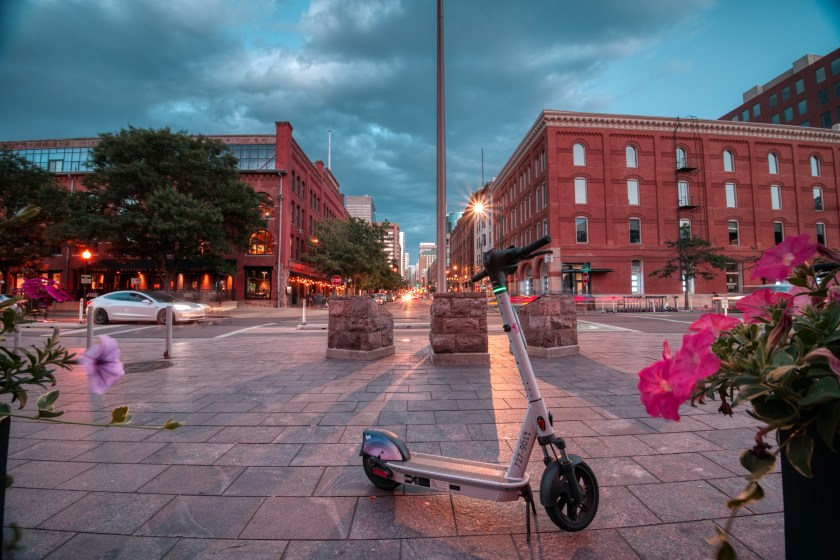
An electric scooter stands on a plaza at Denver Union Station, framed by brick buildings and evening traffic under a cloudy sky.
An electric scooter sits in the foreground near Denver Union Station as evening light and traffic move through downtown Denver.

In this street-level composition from Denver’s Union Station district, the photographer constructs a narrative about contemporary urban mobility that extends beyond mere documentation. The electric scooter, positioned prominently in the foreground, functions as both subject and symbol—a deliberate choice that anchors this image firmly in its specific cultural moment while engaging with the broader themes of his Colorado cityscapes chapter.

Shot with the Nikon Z5 and Nikkor 14-30mm wide-angle lens during the transitional blue hour, the image demonstrates technical command over challenging mixed-lighting conditions. His HDR processing through Aurora software balances the warm sodium vapor glow of street lamps with the cooler tones of approaching dusk, creating a color palette that feels authentic to the urban evening experience. The dramatic cloud formations overhead add atmospheric weight without overwhelming the architectural elements below.

The composition’s strength lies in its layered storytelling. The scooter occupies the immediate foreground, a symbol of the sharing economy and evolving transportation patterns that have reshaped American cities in recent years. Behind it, motion-blurred pedestrians and vehicle light trails suggest continuous movement—the perpetual flow of urban life. The red brick Victorian-era buildings flanking the street provide historical context, their solid permanence contrasting with the ephemeral nature of the modern transit device and the transient human figures.

This juxtaposition between historic preservation and contemporary innovation becomes the photograph’s central thesis. Denver’s Union Station neighborhood represents a successful urban revitalization, where nineteenth-century industrial architecture has been adapted for twenty-first-century use. The photographer captures this temporal complexity not through obvious before-and-after documentation, but through subtle visual relationships: old brick against new pavement, traditional street furniture against app-based transportation, architectural permanence against digital-age impermanence.

The wide-angle perspective creates dynamic leading lines through the paved plaza, drawing the viewer’s eye from the scooter through the middle ground and toward the vanishing point where downtown high-rises punctuate the skyline. Pink flowers frame the right edge, their organic forms softening the geometric rigor of the built environment while adding unexpected color that complements the warm building tones.

Within the context of Chapter 3’s exploration of Colorado landscapes and cityscapes, this image represents an important counterpoint to mountain vistas and natural panoramas. It acknowledges that Colorado’s contemporary identity includes rapidly growing urban centers navigating questions of density, mobility, and livability. The photographer treats the cityscape with the same observational care one might afford wilderness photography, suggesting that urban environments deserve equally thoughtful documentation.

The technical execution reflects growing proficiency with the Z5 system in low-light scenarios. The exposure balances bright highlights from street lamps and vehicle headlights while retaining shadow detail in the building facades and foreground elements. This dynamic range management, enhanced through HDR processing, avoids the artificial appearance that often compromises such techniques.

Ultimately, this photograph functions as cultural documentation—a moment preserved when electric scooters had become ubiquitous urban fixtures, when historic districts balanced preservation with progress, and when cities like Denver negotiated their identity between Western heritage and metropolitan aspiration. The photographer’s choice to include this image in his curated Top 100 Journey acknowledges that landscape photography can encompass the human-altered terrain of city streets, where the stories being told are equally complex and worthy of attention.
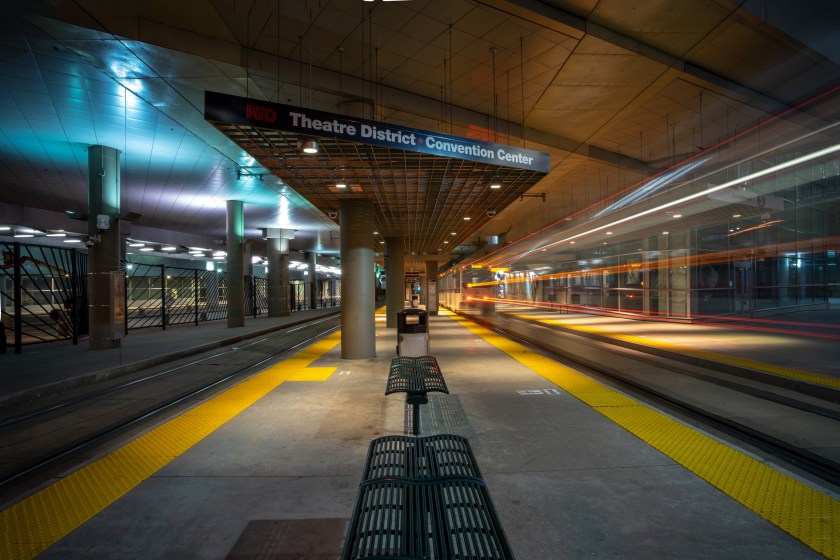
Convention Center Station: Urban Infrastructure as Light Study

The photograph at Denver’s Convention Center RTD station captures an arriving light rail train through long exposure, emphasizing urban environments over natural landscapes. The technical choices create depth and contrast between warm light trails and cooler architectural tones. This piece illustrates Colorado’s identity, showcasing urban transit as significant as its natural vistas.

Text: Long exposure view of the RTD light rail platform at the Convention Center with blurred train lights in downtown Denver.
A long exposure captures an arriving RTD light rail train at the Convention Center station in downtown Denver, Colorado.

In the urban component of Chapter 3—Colorado Landscapes & Cityscapes—this long exposure photograph of Denver’s Convention Center RTD station marks a deliberate shift from natural subjects to the constructed environments that define contemporary Colorado life. The image captures a light rail train arriving at the platform, its motion rendered as luminous streaks of amber and red that cut through the architectural geometry of the underground station. This is urban photography that privileges process and temporal collapse over the decisive moment, transforming public transit infrastructure into an exercise in controlled abstraction.

The photographer’s technical approach is fundamental to the image’s success. Using a Sony A7ii paired with a Samyang 18mm wide-angle lens, he has embraced the distortions and expansiveness that such focal lengths provide. The wide angle compresses the station’s perspective while simultaneously stretching its architectural lines, creating a sense of depth that pulls the viewer’s eye from the central platform toward both vanishing points. The long exposure—likely several seconds given the degree of light trail elongation—allows the moving train to register as pure energy rather than solid form, a ghost of motion suspended within the static framework of concrete, steel, and tile.

Color plays a crucial structural role. The safety-yellow platform edges create strong horizontal bands that anchor the composition and provide visual weight at the bottom of the frame. These bright strips contrast sharply with the cooler tones dominating the upper portions—cyan-tinted fluorescent lighting that bathes the ceiling panels and creates atmospheric zones of cool illumination. The train’s light trails introduce warm amber tones that bridge these temperature extremes, serving as the compositional focal point despite their ethereal nature. The signage identifying the Theatre District/Convention Center stop glows in the upper third, grounding the image in specific geographic and civic context.

What distinguishes this work within the broader chapter is its commitment to representing Colorado’s urban character with the same attention previously devoted to its natural landscapes. Denver’s RTD system, as critical infrastructure connecting the metropolitan region, deserves documentation as much as any mountain vista or aspen grove. The photographer recognizes this and approaches the subject with seriousness of purpose. The empty platform—devoid of waiting passengers—allows the architecture and light to speak without human interruption, though the absence of people also raises questions about time of day, accessibility, and the photographer’s relationship to urban space during off-peak hours.

The symmetry is notable but not absolute. The central platform creates a strong vertical axis, reinforced by support columns and the overhead ceiling structure. Yet the composition retains enough asymmetry—particularly in the light trails and architectural details—to avoid static formalism. The textured platform surface, captured with clarity despite the low light conditions, provides tactile detail that prevents the image from becoming purely graphic.

Within a collection that spans Colorado’s diverse visual territories, this photograph asserts that the state’s identity includes its cities and their infrastructure. It is work that finds aesthetic potential in transit stations, that sees light trails as valid subjects alongside geological formations, and that expands the definition of landscape to include the spaces humans build for movement and connection.

City Pier on Anna Maria Island: A Study in Patience and Atmospheric Drama

The long exposure photograph of the City Pier on Anna Maria Island captures the unique interplay of land, water, and sky under dramatic storm clouds. Through technical mastery, the image transforms fleeting moments into timelessness, blending sharp details of the pier with ethereal human figures and smooth water, reflecting deep engagement with Florida’s coastal landscapes.

Long exposure photograph of the City Pier on Anna Maria Island, showing a wooden pier leading to a waterfront building under dark storm clouds.
Long exposure view of the City Pier on Anna Maria Island beneath dramatic storm clouds.

Within the photographer’s carefully curated Top 100 Journey, this long exposure study of the City Pier on Anna Maria Island stands as a masterful example of how technical discipline can amplify emotional resonance. Positioned within Chapter 2—Florida Landscapes & Cityscapes—the image demonstrates a sophisticated understanding of the Gulf Coast’s unique visual character, where land, water, and sky exist in constant, subtle negotiation.

The composition reveals itself through classical simplicity: a weathered wooden pier extends from foreground to middle distance, leading the viewer’s eye toward a modest building crowned with an American flag. Yet what elevates this photograph beyond documentary record is the photographer’s deliberate manipulation of time itself. Shot with a fifteen-second exposure at f/18, the image transforms fleeting atmospheric conditions into something more permanent and contemplative. The threatening cloud formations above, rather than appearing frozen in mid-motion, achieve a painterly quality—their movement compressed and softened into bands of gray and white that suggest both weight and ethereality.

This temporal expansion creates a fascinating duality throughout the frame. While the pier’s wooden planks remain sharp and detailed, bearing the textural evidence of salt air and countless footfalls, the human figures near the building dissolve into ghostly presences, their individual identities surrendered to the longer rhythm of place. The water, too, undergoes transformation; what would typically appear as distinct waves and surface texture becomes a smooth, almost metallic gradient stretching from jade green to soft gray, merging seamlessly with the horizon.

The technical execution here deserves careful consideration. Working with a Nikon D610 and an 18-35mm lens set to 35mm, the photographer has achieved remarkable sharpness across the entire frame. The f/18 aperture ensures deep depth of field while the ISO 100 setting maintains clean tonal gradations essential for the image’s subtle atmospheric rendering. These choices reflect not mere technical competence but aesthetic intention—a desire to capture both concrete detail and ephemeral mood simultaneously.

Within the broader context of Chapter 2, this photograph exemplifies the photographer’s evolving relationship with Florida’s coastal environments. Where lesser practitioners might seek the obvious drama of golden hour or storm-tossed seas, he finds complexity in overcast conditions and the patient observation they demand. The image refuses easy categorization: it is neither purely documentary nor overtly romantic, but occupies a thoughtful middle ground where observation and interpretation merge.

The architectural elements—particularly the modest pier building with its peaked roof and practical design—anchor the composition in specificity while the long exposure technique universalizes the experience. This is simultaneously a portrait of a particular place and a meditation on impermanence, on how human structures persist while human presence itself becomes fluid and uncertain.

As part of a long-term project, this photograph suggests an artist committed to deep engagement rather than superficial tourism. The willingness to wait for proper atmospheric conditions, to set up the necessary equipment for extended exposures, and to see beyond the immediate toward something more contemplative marks this as serious photographic inquiry. Within his Top 100 Journey, it stands as evidence that Florida’s landscapes, often dismissed as visually unchallenging, reward patient observation with unexpected subtlety and depth.

Nocturnal Geometry: The Dalí Museum, St. Petersburg

This photograph captures the illuminated Dalí Museum in St. Petersburg, Florida, showcasing the contrast between its geodesic structure and concrete form during twilight. The image highlights Florida’s cultural evolution through art, exemplifying a balanced compositional approach that emphasizes architectural integrity and the atmosphere, marking a sophisticated chapter in the photographer’s journey.

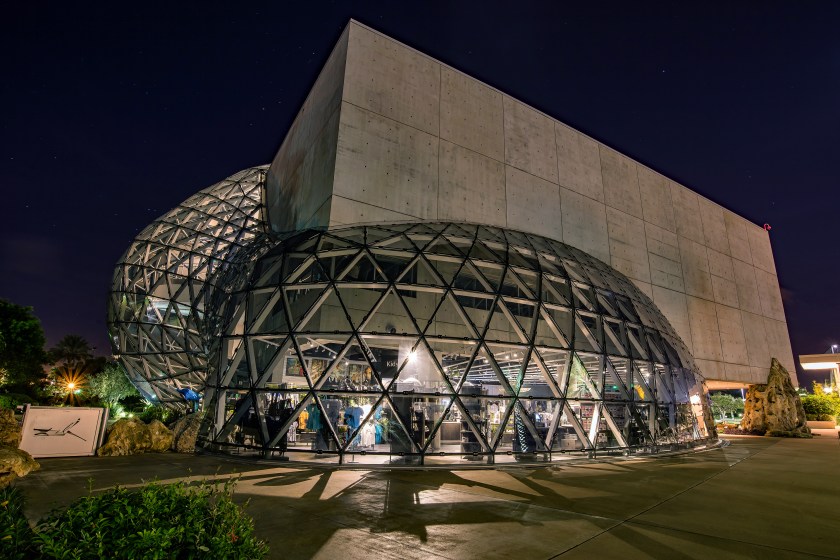
Nighttime long exposure photograph of the Dali Museum in St. Petersburg, Florida, showing its illuminated geodesic glass structure and concrete facade.
Nighttime long exposure view of the Dali Museum’s illuminated glass structure in St. Petersburg, Florida.

Within Chapter 2 of this photographic journey through Florida’s landscapes and cityscapes, this nighttime study of the Dalí Museum in St. Petersburg stands as a meditation on architectural dialogue—the convergence of structural rationality and organic form captured in the quietude of evening hours.

The photographer has positioned himself to emphasize the museum’s defining architectural gesture: the dramatic geodesic structure that emerges from the building’s otherwise austere concrete mass. Shot at 18mm, the wide-angle perspective accentuates the spherical dome’s imposing presence while maintaining the monumental quality of the adjoining concrete volume. This compositional choice creates a visual tension between geometric order and sculptural fluidity, perhaps an intentional echo of Dalí’s own artistic preoccupations with rigidity and metamorphosis.

Technical execution here demonstrates considerable deliberation. The 30-second exposure at f/11 has transformed the museum’s interior lighting into a warm, inviting glow that radiates through the triangulated framework, effectively rendering the geodesic dome as a luminous lantern against the deep blue-black sky. At ISO 250, the photographer has preserved tonal integrity in the shadows while avoiding the noise that might compromise the concrete’s textural detail—those subtle gradations and panel divisions that speak to the building’s material honesty.

The time of day proves critical to the image’s success. Shot during the transitional moment when civil twilight yields to night, enough ambient light remains in the sky to differentiate it from pure black, providing context and atmospheric depth. The surrounding landscaping, illuminated by strategic ground lighting, frames the architectural subject without competing for attention. The wet pavement in the foreground introduces specular highlights that guide the viewer’s eye toward the main structure while adding a layer of urban authenticity.

What distinguishes this photograph within the broader chapter is its representation of Florida’s cultural infrastructure rather than its natural or purely urban environment. While other images in this collection might emphasize the state’s coastal vistas or metropolitan skylines, this work acknowledges Florida’s role as a destination for arts and culture. The Dalí Museum, with its contemporary architectural interpretation housing works of surrealist mastery, becomes a symbol of Florida’s evolution beyond tourism clichés.

The photographer’s technical approach—the choice of a full-frame Nikon D610 paired with an 18-35mm lens—suggests a commitment to capturing architectural subjects with minimal distortion while maintaining portability for location work. The f/11 aperture provides sufficient depth of field to render sharp detail from the foreground plantings through to the building’s illuminated upper reaches, while the extended exposure time smooths any transient elements, creating a sense of permanence and contemplation.

In the context of the Top 100 Journey project, this image represents a maturation in the photographer’s documentation of Florida’s built environment. There is restraint here—a willingness to let the architecture speak through careful observation rather than dramatic intervention. The composition honors both the building’s geometry and its setting, creating a document that functions simultaneously as architectural photography and as a portrait of place, capturing a specific moment in Florida’s ongoing cultural narrative.

The Zipper: Temporal Geometry in Motion

Greg Urbano’s photograph of the Zipper ride at a Florida carnival uniquely transforms the concept of landscape photography. By capturing swirling light trails during twilight, it emphasizes the intersection of cultural and physical landscapes. The image reveals the dynamic nature of our experiences, illustrating how ephemeral entertainment shapes collective identity in Florida.

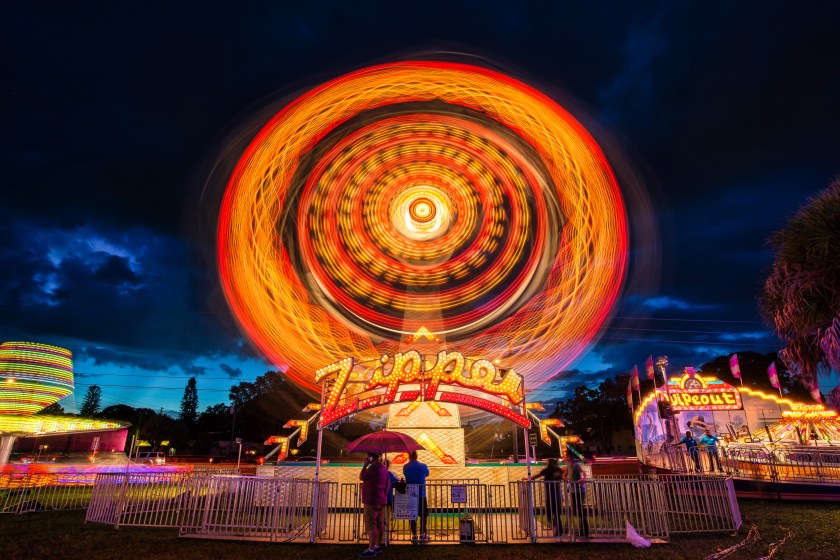
Long exposure photograph of the Zipper carnival ride at night, creating circular light trails in vivid colors with people standing below.
Long exposure night view of the Zipper ride creating swirling light trails at a carnival.

Within Chapter 2 of Greg Urbano’s Top 100 Journey, this carnival ride photograph stands as a compelling exploration of how Florida’s cultural landscape extends beyond its natural and architectural features into the realm of ephemeral entertainment. The image captures the Zipper in full rotation during twilight hours, transforming a traveling carnival attraction into a blazing mandala of light and motion that challenges traditional notions of what constitutes a “landscape.”

The photographer’s technical execution is precise and purposeful. Working with a Nikon D610 at 18mm, he has employed a six-second exposure at f/22 and ISO 100 to record not the ride itself, but rather the luminous trace of its movement through space. This approach fundamentally alters the subject’s visual character—what would typically appear as a stationary mechanical structure becomes instead a dynamic sculptural form composed entirely of light trails. The concentric circles of orange, red, and yellow fire outward from a brilliant white core, creating a hypnotic pattern that suggests both solar imagery and abstract expressionist painting.

The compositional framework demonstrates sophisticated spatial awareness. The ride occupies the central position, its circular motion perfectly framed against a deepening blue sky where storm clouds gather at the horizon. Silhouetted figures stand before the ticket booth in the immediate foreground, their stillness providing human scale and anchoring the viewer’s perspective. These stationary forms create a deliberate counterpoint to the violent spinning above them, emphasizing through contrast the temporal nature of the photographer’s chosen exposure duration.

Environmental context enriches the reading of this work. The characteristic Florida palm trees visible at right, the flat terrain, and the quality of the twilight atmosphere all ground the image firmly within the state’s visual vocabulary. Additional carnival rides glow at the periphery—including what appears to be a carousel and swing ride—establishing this as a comprehensive documentation of Florida’s traveling fair culture, a seasonal tradition that punctuates small-town life across the state.

What makes this photograph particularly significant within the Landscapes & Cityscapes chapter is its conceptual expansion of both terms. The photographer argues implicitly that Florida’s landscape includes not only its physical geography but also its temporal and cultural topography—the fairs, festivals, and itinerant amusements that transform ordinary municipal parks into spaces of collective experience. This is landscape photography that acknowledges human activity not as intrusion but as essential component.

The technical choices support this interpretation. The narrow aperture has rendered the background rides and architectural elements with acceptable sharpness while creating prominent starbursts on individual light points—a decorative effect that paradoxically enhances rather than diminishes the image’s documentary authenticity. The relatively brief six-second exposure has captured sufficient motion to abstract the Zipper into pure pattern while maintaining enough detail in the stationary elements to preserve spatial legibility.

In positioning this work alongside more conventional Florida landscapes within his broader project, the photographer demonstrates an inclusive vision of place-making. Here, the spectacular is found not in natural grandeur or architectural monumentality, but in the democratic pleasure of a county fair at dusk—a quintessentially American scene rendered with technical sophistication and genuine respect for its subject matter.

Night at the Dali: Architecture as Teacher

In 2013, Greg Urbano’s photography evolved, particularly with architecture and HDR techniques. His night photograph of the Dalí Museum in St. Petersburg showcases his technical growth and artistic maturity. Through careful exposure settings and HDR processing, he captures dramatic contrasts, reflecting his continuous exploration and adaptability in night photography.

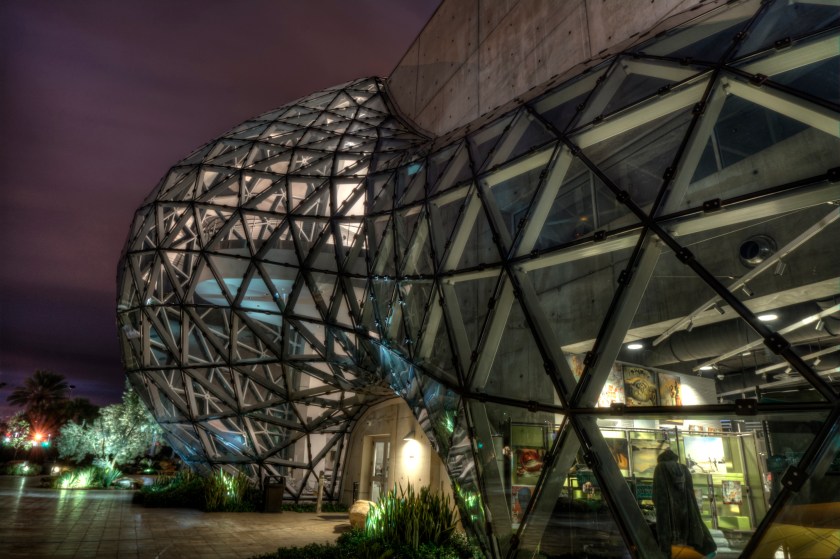
HDR nighttime photograph of the Dali Museum in St. Petersburg, Florida, showing its illuminated geodesic glass facade and surrounding landscaping, taken with a Nikon D7100 at 14mm.
A 2013 HDR nighttime photograph of the Dali Museum’s geodesic glass structure in St. Petersburg, Florida.

In this 2013 photograph of St. Petersburg’s Dalí Museum, Greg Urbano captures far more than an architectural landmark—he documents a photographer in the act of discovery, using his camera to decode the visual language of light, structure, and time. The image stands as a testament to what the Chapter 1 — Beginnings theme celebrates: the transformative power of experimentation and the artistic maturity that emerges from technical curiosity.

The composition immediately announces ambition. Shot with a 14mm ultra-wide lens, the perspective tilts upward to embrace the museum’s extraordinary geodesic glass bubble, that surrealist flourish erupting from an otherwise rectilinear concrete structure. The ultra-wide focal length creates dramatic spatial distortion—the glass sphere appears to swell toward the viewer while the building’s mass recedes at impossible angles. This is deliberate visual exaggeration, the photographer using optical characteristics as expressive tools rather than merely recording what stands before him.

Urbano’s fifteen-second exposure at ƒ/11 reveals careful consideration of night photography’s particular demands. The narrow aperture ensures front-to-back sharpness across the complex geometric planes, while the extended shutter speed gathers sufficient light to render both the illuminated interior spaces and the textured concrete exterior. At ISO 250, he maintained image quality while managing the sensor’s heat buildup during long exposures—a technical balancing act that night photography ruthlessly exposes when miscalculated.

The HDR processing, which Urbano identifies as a focus of his 2013 work, serves the subject’s inherent drama without overwhelming it. High Dynamic Range imaging compresses the vast tonal range between the glowing glass panels and the deep purple-gray twilight sky into a single viewable image. Here, the technique preserves detail in both the brightest interior lights and the shadowed architectural framework—the black steel triangles that form the geodesic pattern remain visible and textured rather than silhouetted into flat darkness.

What distinguishes this image within the Beginnings chapter is its transparency about process. The HDR treatment shows characteristic traces of learning—slight luminous halos around high-contrast edges, enhanced local contrast that gives surfaces an almost tactile presence, color saturation pushed just beyond naturalism. These are not flaws but evidence of active experimentation, a photographer testing the boundaries of technique to understand where effectiveness ends and excess begins.

The photograph’s context enriches its meaning considerably. This museum stood a brief walk from the photographer’s residence, close enough for repeated visits, for returning under different conditions, for the kind of sustained engagement that transforms casual documentation into genuine study. This proximity allowed Urbano to approach the subject with evolving sophistication, each attempt building on lessons from the previous one.

The wet pavement in the foreground adds an unexpected grace note—evidence of recent rain creating reflective surfaces that double the architectural lighting, adding visual complexity without cluttering the composition. Whether intentional or opportunistic, this detail demonstrates the photographer’s developing awareness of how environmental conditions can enhance rather than merely complicate a scene.

Viewed within the arc of artistic development, this photograph captures a crucial transition point: technical capability catching up with visual ambition, the gap between conception and execution narrowing with each frame. It is the work of a photographer actively becoming, embracing complexity as the necessary path toward mastery.