Denver Union Station Two Trains: Urban Infrastructure as Visual Poetry

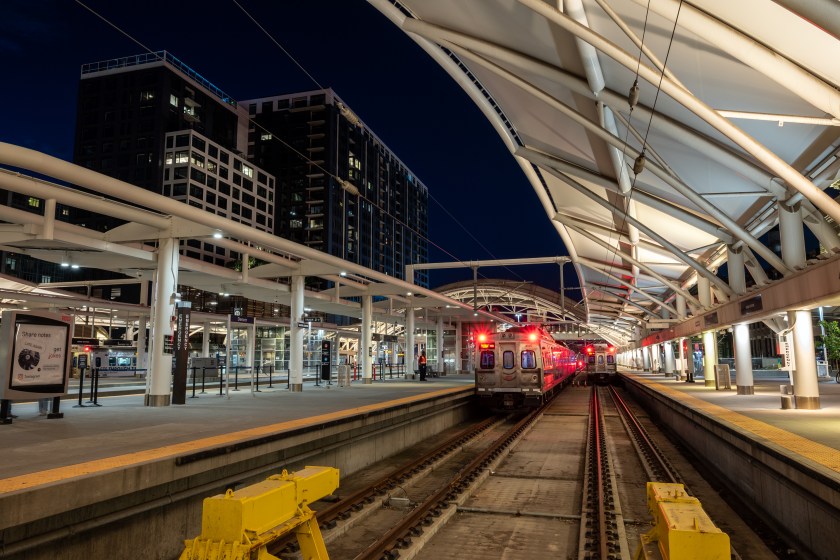
The photograph of Denver Union Station marks a shift in the photographer’s journey from natural landscapes to urban architecture. It highlights the interplay of light, color, and geometry while capturing quiet moments in public spaces. The image symbolizes Denver’s evolution in sustainable transit, merging historical preservation with contemporary design.

Two light rail trains sit on parallel tracks beneath the covered platforms at Denver Union Station at night.
Two RTD light rail trains are stopped on adjacent tracks at Denver Union Station in downtown Denver, Colorado.

This nocturnal study of Denver Union Station represents a compelling pivot within Chapter 3 of the photographer’s Top 100 Journey project—a shift from natural landscapes to the constructed geometries of urban infrastructure. Where previous works in this chapter have explored Colorado’s geological grandeur, this image examines the state’s architectural identity through one of its most significant transit hubs.

The composition is defined by bold linear perspective. Shot with a 14-30mm wide-angle lens, the photographer has positioned himself within the transit platform itself, allowing the parallel tracks to create strong diagonal lines that converge toward the vanishing point. This classical use of perspective transforms functional railway infrastructure into formal geometric study. The canopy overhead—a sweeping white lattice of structural supports—echoes and reinforces these diagonals, creating a rhythmic repetition that draws the eye inexorably toward the illuminated train in the distance.

Color plays a crucial role in establishing atmosphere. The deep navy blue of twilight sky provides saturated contrast against the warm artificial lighting of the station. The train’s red running lights introduce an accent of vivid color that punctuates the otherwise neutral palette of whites, grays, and concrete tones. A yellow maintenance box in the lower foreground adds an unexpected chromatic note—industrial, utilitarian, yet compositionally important as a counterweight to the red lights above.

The technical execution demonstrates careful consideration of low-light conditions. The exposure balances multiple light sources: the cool fluorescent platform lighting, the warm glow from the station building visible on the left, and the colored signals of the train itself. The photographer has managed to maintain detail throughout the frame—from the textured concrete of the platform to the lit windows of the distant residential tower—suggesting precise metering and likely the use of a tripod for stability during what was presumably a longer exposure.

What distinguishes this work is its treatment of public space during a quiet moment. The platform is nearly empty; a single figure appears as a small presence near the center, emphasizing scale and the architectural vastness of the station. This human element, though minimal, is essential—it prevents the image from becoming purely abstract geometry and reminds viewers that this is infrastructure designed for movement, for connection, for the daily transit of thousands.

Within the context of Colorado Cityscapes, this photograph documents Denver’s ongoing evolution as a metropolitan center investing in sustainable transit infrastructure. Union Station, a historic landmark renovated in recent years, represents the intersection of preservation and progress. The photographer captures this duality: the contemporary design of the platform canopy suggests forward-looking urban planning, while the fundamental elements—trains, tracks, waiting passengers—evoke the timeless ritual of rail travel.

The use of the Nikon Z5 with ultra-wide glass allows the photographer to emphasize architectural span while maintaining sharpness across the frame. The wide angle compresses multiple planes of depth into a single coherent visual statement, creating an image that functions simultaneously as documentary record and formal composition.

This photograph confirms the photographer’s ability to find visual poetry in utilitarian spaces, demonstrating that the “cityscape” portion of Chapter 3 merits equal attention to Colorado’s celebrated natural landscapes.

Architectural Symmetry and Urban Solitude: An HDR Study of Denver Union Station

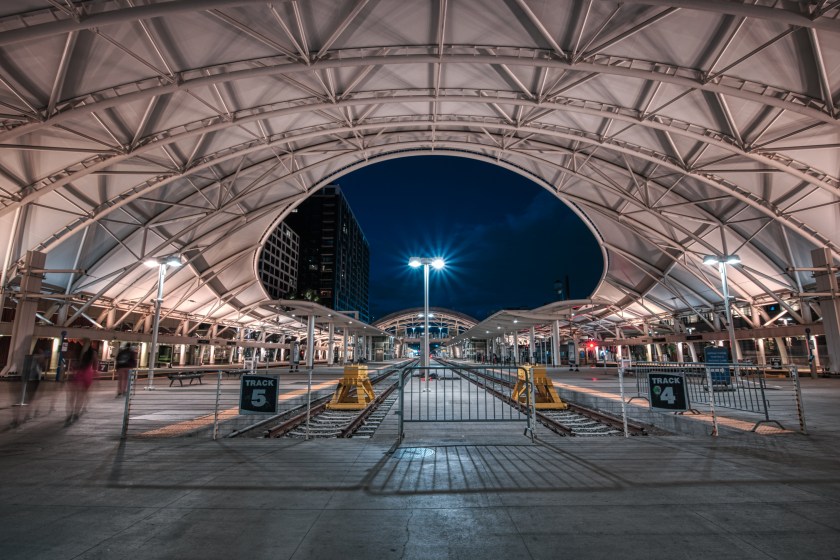
The photographer’s nocturnal exploration of Denver Union Station highlights its architectural beauty through HDR techniques. Using a Nikon Z5, he captures the arched canopy and geometric metalwork, emphasizing both urban context and functional identity. This work redefines landscape photography, recognizing the significance of transportation infrastructure in Colorado’s cultural identity.

Symmetrical view of covered light rail platforms inside Denver Union Station at night, with tracks centered beneath a white arched roof.
The light rail platforms inside Denver Union Station are shown at night beneath the station’s arched canopy.

The photographer’s exploration of Colorado’s built environment finds a striking culmination in this nocturnal study of Denver Union Station’s interior architecture. Captured with a Nikon Z5 and Nikkor 14-30mm wide-angle lens, this HDR composition demonstrates a mature understanding of how contemporary digital techniques can reveal the inherent drama within civic spaces.

The image centers on the station’s distinctive arched canopy structure, a feat of engineering that dominates the frame with rhythmic precision. Metal trusses radiate outward in geometric patterns, their repetition creating a sense of ordered monumentality. The wide-angle lens choice proves deliberate rather than merely expedient—it allows the photographer to encompass both the sweeping overhead architecture and the rail infrastructure below while maintaining the spatial relationship that gives the composition its power. The central void, opening to the deep blue evening sky and a distant office tower, punctuates the manufactured enclosure with a reminder of the urban context beyond.

His HDR processing through Aurora software reveals a considered approach to tonal range. The metalwork retains textural detail without the artificial hyper-clarity that often plagues high dynamic range photography. The warm metallic tones of the canopy structure contrast effectively with the cooler blues of the twilight sky and platform lighting, establishing a color palette that feels naturalistic despite the technical manipulation required to balance such extreme luminance values.

The human element appears deliberately subdued—motion-blurred figures at the platform edges suggest activity without demanding attention, reinforcing the architectural subject while maintaining the space’s functional identity as a transportation hub. Yellow bumper stops and safety railings provide geometric counterpoints to the dominant curves above, their utilitarian forms grounding the composition in operational reality.

Within the context of Chapter 3’s focus on Colorado landscapes and cityscapes, this work represents a conceptual bridge. While the chapter presumably encompasses the state’s renowned natural vistas, the photographer recognizes that Colorado’s urban environments possess their own topography worth documenting. Denver Union Station, a historic structure serving contemporary transit needs, embodies the intersection of preservation and progress that characterizes much of the American West’s relationship with its past.

The technical execution reflects growing confidence with the Z5 system’s capabilities in challenging lighting conditions. Night photography in mixed-light environments demands both equipment competence and processing discipline, both evident here. The decision to shoot during the transitional moment between day and night—when ambient light still registers in the sky while artificial illumination dominates the platform—demonstrates an understanding of how fleeting conditions can elevate architectural documentation beyond mere record-keeping.

This image functions as more than a single photograph within his Top 100 Journey project; it suggests an expanding definition of landscape photography itself. The constructed landscape of transportation infrastructure, with its own valleys and peaks of metal and light, receives the same considered attention he might afford a mountain vista. The result is a document that honors both the anonymous designers who created this functional space and the ongoing human movement that gives it purpose.

In positioning this work within his curated collection, the photographer asserts that Colorado’s identity exists not only in its natural grandeur but in the spaces where communities gather, depart, and return—the thresholds that connect wilderness to civilization.

Convention Center Station: Urban Infrastructure as Light Study

The photograph at Denver’s Convention Center RTD station captures an arriving light rail train through long exposure, emphasizing urban environments over natural landscapes. The technical choices create depth and contrast between warm light trails and cooler architectural tones. This piece illustrates Colorado’s identity, showcasing urban transit as significant as its natural vistas.

Text: Long exposure view of the RTD light rail platform at the Convention Center with blurred train lights in downtown Denver.
A long exposure captures an arriving RTD light rail train at the Convention Center station in downtown Denver, Colorado.

In the urban component of Chapter 3—Colorado Landscapes & Cityscapes—this long exposure photograph of Denver’s Convention Center RTD station marks a deliberate shift from natural subjects to the constructed environments that define contemporary Colorado life. The image captures a light rail train arriving at the platform, its motion rendered as luminous streaks of amber and red that cut through the architectural geometry of the underground station. This is urban photography that privileges process and temporal collapse over the decisive moment, transforming public transit infrastructure into an exercise in controlled abstraction.

The photographer’s technical approach is fundamental to the image’s success. Using a Sony A7ii paired with a Samyang 18mm wide-angle lens, he has embraced the distortions and expansiveness that such focal lengths provide. The wide angle compresses the station’s perspective while simultaneously stretching its architectural lines, creating a sense of depth that pulls the viewer’s eye from the central platform toward both vanishing points. The long exposure—likely several seconds given the degree of light trail elongation—allows the moving train to register as pure energy rather than solid form, a ghost of motion suspended within the static framework of concrete, steel, and tile.

Color plays a crucial structural role. The safety-yellow platform edges create strong horizontal bands that anchor the composition and provide visual weight at the bottom of the frame. These bright strips contrast sharply with the cooler tones dominating the upper portions—cyan-tinted fluorescent lighting that bathes the ceiling panels and creates atmospheric zones of cool illumination. The train’s light trails introduce warm amber tones that bridge these temperature extremes, serving as the compositional focal point despite their ethereal nature. The signage identifying the Theatre District/Convention Center stop glows in the upper third, grounding the image in specific geographic and civic context.

What distinguishes this work within the broader chapter is its commitment to representing Colorado’s urban character with the same attention previously devoted to its natural landscapes. Denver’s RTD system, as critical infrastructure connecting the metropolitan region, deserves documentation as much as any mountain vista or aspen grove. The photographer recognizes this and approaches the subject with seriousness of purpose. The empty platform—devoid of waiting passengers—allows the architecture and light to speak without human interruption, though the absence of people also raises questions about time of day, accessibility, and the photographer’s relationship to urban space during off-peak hours.

The symmetry is notable but not absolute. The central platform creates a strong vertical axis, reinforced by support columns and the overhead ceiling structure. Yet the composition retains enough asymmetry—particularly in the light trails and architectural details—to avoid static formalism. The textured platform surface, captured with clarity despite the low light conditions, provides tactile detail that prevents the image from becoming purely graphic.

Within a collection that spans Colorado’s diverse visual territories, this photograph asserts that the state’s identity includes its cities and their infrastructure. It is work that finds aesthetic potential in transit stations, that sees light trails as valid subjects alongside geological formations, and that expands the definition of landscape to include the spaces humans build for movement and connection.

Colorado Capital Rotunda: Vertical Aspiration and Ornamental Complexity

The photograph of the Colorado State Capitol rotunda represents a shift in architectural perspective, focusing on the interior’s ornate details rather than external views. Using a wide-angle lens, the image captures the dome’s grandeur and intricate design, embodying the civic experience and inviting public engagement while highlighting historical and democratic ideals.

Upward view of the ornate rotunda ceiling inside the Colorado State Capitol, showing concentric arches and a central skylight.
An interior view looking up into the rotunda of the Colorado State Capitol in Denver, Colorado.

This interior study of the Colorado State Capitol rotunda marks a significant compositional departure within Chapter 3 of the Top 100 Journey. Where previous images in this collection have examined architecture from external vantage points—emphasizing façade, silhouette, and contextual placement—this photograph inverts the perspective, directing the viewer’s gaze upward through concentric rings of ornamental detail toward a luminous oculus. The shift from exterior monumentality to interior intimacy reveals the photographer’s expanding investigation of how architectural space shapes civic experience and visual perception.

Shot with a Nikon D610 and an 18-35mm f/3.5-4.5 lens at 19mm, the wide-angle focal length proves essential to capturing the rotunda’s full vertical sweep within a single frame. The fisheye-like distortion inherent at this focal length amplifies the dome’s centripetal geometry, creating a vortex effect that draws the eye inexorably toward the coffered ceiling and its central aperture. The exposure settings—f/8.0 at 1/10s, ISO 400—balance the need for depth of field across multiple architectural tiers with the practical constraints of handheld low-light shooting. The resulting image maintains sharpness from the foreground balustrade through to the uppermost decorative elements.

The color palette divides into two distinct thermal zones. Warm golden tones dominate the lower registers, where artificial lighting illuminates gilt detailing, coffered panels, and classical ornamentation. These warm hues gradually transition to cooler whites and pale blues as the eye travels upward, culminating in the natural daylight filtering through the oculus. This chromatic shift reinforces the spiritual and hierarchical symbolism embedded in rotunda architecture—earthly richness below, celestial purity above—while simultaneously demonstrating the photographer’s attentiveness to mixed lighting conditions.

Compositional rigor anchors what could easily become visual chaos. The photographer positions himself at the precise center point beneath the dome, ensuring perfect radial symmetry. This decision transforms architectural documentation into geometric meditation, where repeating patterns of coffering, balustrades, and Corinthian capitals establish rhythmic visual cadence. The inclusion of the ornate balustrade in the lower left introduces human scale and tactile detail, preventing the image from becoming pure abstraction while emphasizing the building’s accessibility—a public space designed for citizen engagement.

Within the broader narrative of Chapter 3, this rotunda photograph functions as conceptual bridge between exterior civic monumentality and the quotidian experience of urban space. It reveals what lies beneath the gilded dome captured in his nocturnal exterior study, exposing the elaborate craftsmanship and symbolic program that nineteenth-century architects employed to manifest democratic ideals through built form. The image documents not merely architectural opulence but the spatial theater of governance—the designed environment through which political power seeks legitimacy through aesthetic grandeur.

The photographer’s note regarding access—”as simple as passing through a metal detector”—introduces subtle contemporary commentary. This threshold between public and civic space, between everyday citizen and architectural spectacle, becomes invisible in the final image yet remains conceptually present. The photograph captures a space designed for transparency and public access, its ornamental complexity serving not to exclude but to dignify the democratic project. In rendering this vertical architecture with technical precision and compositional thoughtfulness, the photographer documents both historical aspiration and ongoing civic function, making visible the constructed environments through which Colorado’s political identity continues to be performed and experienced.

Boulder Theater Marquee: Neon Vernacular and Urban Memory

The Boulder Theater marquee in Colorado signifies a shift in the photographer’s focus from grand landscapes to community identity through vernacular architecture. The vibrant neon colors and design highlight cultural memory and urban vitality, capturing the theater as a living space that merges historical aesthetics with contemporary relevance, reflecting the complexity of Colorado’s identity.

Neon-lit marquee of the Boulder Theater viewed from below against a deep blue evening sky.
The illuminated neon marquee of the Boulder Theater glows at night in Boulder, Colorado.

Within Chapter 3 of the Top 100 Journey—Colorado Landscapes & Cityscapes—this vibrant study of the Boulder Theater marquee represents a deliberate shift in the photographer’s engagement with place. Moving beyond natural terrain and monumental civic architecture, he turns his attention to vernacular structures that anchor community identity. The theater marquee, with its layered neon typography and saturated color palette, becomes a subject through which to examine cultural memory, commercial aesthetics, and the relationship between preservation and vitality in Colorado’s urban fabric.

The composition exploits the dramatic convergence of neon signage against the deepening blue hour sky. Shot at 28mm with the Sony FE 28-70mm f/3.5-5.6 OSS kit lens, the wide angle captures the marquee’s full architectural gesture—the sweeping curves of blue neon tubing that frame the illuminated message board, the iconic “Boulder” script rendered in brilliant red and orange, and the classic Art Deco detailing that situates this structure within a specific historical moment. The exposure settings—f/5.6 at 1/125s, ISO 400—balance ambient light with the intense luminosity of the neon, preventing blown highlights while maintaining detail in the surrounding architecture.

Color becomes the image’s primary narrative force. The red-to-orange gradient of the “Boulder” lettering contrasts sharply with the cool blue neon below, creating complementary tension that draws the eye across the frame. The yellow marquee board, studded with bulbs and announcing “BOOMTOWN DEMO D,” introduces a third chromatic element while grounding the image in specificity and time. This is not a sanitized historical recreation but a working theater captured mid-programming, its marquee functioning as intended—communication, invitation, spectacle.

The photographer’s decision to include surrounding context—the modern glass facade rising behind the vintage marquee, the darkening sky, the subtle presence of street elements—situates the theater within its contemporary environment rather than isolating it as nostalgic artifact. This approach speaks to his evolving methodology within the chapter, where place is understood not as static subject but as palimpsest, layered with temporal and cultural inscriptions. The Boulder Theater, a 1906 structure renovated and preserved, embodies this complexity: historic form activated by present-day use.

The low vantage point emphasizes the marquee’s projecting geometry, its thrust into public space. This compositional choice transforms signage into sculpture, highlighting the physicality of mid-century commercial architecture. The neon tubing, with its visible mounting hardware and electrical infrastructure, reveals construction and craft—elements often obscured in more polished architectural photography but celebrated here as integral to authenticity.

Within the broader trajectory of Chapter 3, the Boulder Theater image functions as cultural counterpoint to wilderness landscapes and governmental monuments. It represents Colorado’s smaller-scale urban centers, places where preservation efforts maintain continuity with architectural heritage while accommodating contemporary cultural production. The theater becomes microcosm—a site where community gathers, where entertainment and commerce intersect, where historical aesthetics remain relevant.

The photographer captures not merely a building but an experience of place, translating the visceral impact of neon light into two-dimensional form. In doing so, he documents Colorado’s layered identity: natural grandeur, civic aspiration, and the quieter vernacular spaces where daily life unfolds. The marquee, brilliant against evening sky, asserts that urban landscapes possess their own compelling beauty—electric, temporal, human-scaled, and essential to understanding the full spectrum of place.

Colorado Capital Rotunda: A Study in Civic Monumentality

The photograph of the Colorado State Capitol at night showcases the blend of technical skill and atmospheric expression in architectural photography. Captured during the blue hour, it emphasizes the dome’s gilded brilliance against a cobalt sky, revealing a balance of light, color, and human presence, while symbolizing civic power and cultural heritage.

Night view of the Colorado State Capitol dome with a motion-blurred American flag against a deep blue sky.
The illuminated rotunda of the Colorado State Capitol rises above the building exterior at night in Denver, Colorado.

In this commanding nocturnal study of the Colorado State Capitol, the photographer demonstrates a refined understanding of architectural photography’s dual responsibilities: technical precision and atmospheric interpretation. Selected for Chapter 3 of his Top 100 Journey project—Colorado Landscapes & Cityscapes—this image represents a pivotal moment in his exploration of the built environment, where civic architecture becomes a vehicle for examining light, color, and symbolic presence.

The composition centers on the capitol’s gilded dome, captured during the blue hour when natural and artificial light exist in delicate equilibrium. This timing proves essential to the photograph’s success. The deep cobalt sky provides a saturated backdrop that amplifies the dome’s golden luminosity, creating a color relationship that feels both dramatic and harmonious. The warm interior lights visible through the arched windows add a third tonal layer, suggesting human activity within the monumental structure and grounding the image in the present moment rather than rendering it as pure abstraction.

Technical choices reveal deliberate restraint. Shot with a Sony A7 II and the modest FE 28-70mm f/3.5-5.6 OSS kit lens at 67mm, the equipment demonstrates that compelling imagery emerges from vision rather than gear acquisition. The exposure settings—f/6.3 at two seconds, ISO 50—indicate careful balancing of depth of field with the need to maintain sharpness during a moderately long exposure. The low ISO preserves image quality while the aperture ensures adequate detail across the dome’s ornate surface. The two-second shutter speed captures the flag’s motion blur, introducing a kinetic element that contrasts with the building’s permanence.

The symmetrical framing amplifies the capitol’s authority. By positioning the dome centrally and shooting from a low vantage point, the photographer emphasizes verticality and grandeur, compositional strategies long employed in architectural documentation to convey institutional power. Yet this image transcends mere documentation. The illuminated structure against the darkening sky transforms civic architecture into something more atmospheric—a beacon, a sculptural form isolated from its urban context.

Within the broader narrative of Chapter 3, this photograph serves as an essential counterpoint to natural landscape work. Where mountain vistas and wilderness scenes explore Colorado’s geological character, the capitol image examines human imprint on the landscape. The gold-leafed dome—a material detail worth noting for its literal and metaphorical weight—echoes the state’s mining heritage while asserting permanence and prosperity. The photographer captures not merely a building but a symbol, rendering it with enough aesthetic sophistication that the image functions simultaneously as architectural record and contemplative study.

The cool base lighting washing across the pediment introduces contemporary illumination techniques into classical architecture, creating temporal layering that speaks to preservation and adaptation. This detail, easily overlooked, suggests the photographer’s attention to how light shapes meaning and perception.

As part of the Top 100 Journey, this image demonstrates evolving technical confidence and conceptual maturity. The photographer moves beyond straightforward landscape capture toward work that interrogates place, power, and representation. The capitol becomes more than subject matter—it becomes a meditation on how we mark territory, assert identity, and illuminate what we value. In this nocturnal portrait of civic architecture, monumentality meets vulnerability, permanence meets fleeting light, and documentation becomes art.

City Pier on Anna Maria Island: A Study in Patience and Atmospheric Drama

The long exposure photograph of the City Pier on Anna Maria Island captures the unique interplay of land, water, and sky under dramatic storm clouds. Through technical mastery, the image transforms fleeting moments into timelessness, blending sharp details of the pier with ethereal human figures and smooth water, reflecting deep engagement with Florida’s coastal landscapes.

Long exposure photograph of the City Pier on Anna Maria Island, showing a wooden pier leading to a waterfront building under dark storm clouds.
Long exposure view of the City Pier on Anna Maria Island beneath dramatic storm clouds.

Within the photographer’s carefully curated Top 100 Journey, this long exposure study of the City Pier on Anna Maria Island stands as a masterful example of how technical discipline can amplify emotional resonance. Positioned within Chapter 2—Florida Landscapes & Cityscapes—the image demonstrates a sophisticated understanding of the Gulf Coast’s unique visual character, where land, water, and sky exist in constant, subtle negotiation.

The composition reveals itself through classical simplicity: a weathered wooden pier extends from foreground to middle distance, leading the viewer’s eye toward a modest building crowned with an American flag. Yet what elevates this photograph beyond documentary record is the photographer’s deliberate manipulation of time itself. Shot with a fifteen-second exposure at f/18, the image transforms fleeting atmospheric conditions into something more permanent and contemplative. The threatening cloud formations above, rather than appearing frozen in mid-motion, achieve a painterly quality—their movement compressed and softened into bands of gray and white that suggest both weight and ethereality.

This temporal expansion creates a fascinating duality throughout the frame. While the pier’s wooden planks remain sharp and detailed, bearing the textural evidence of salt air and countless footfalls, the human figures near the building dissolve into ghostly presences, their individual identities surrendered to the longer rhythm of place. The water, too, undergoes transformation; what would typically appear as distinct waves and surface texture becomes a smooth, almost metallic gradient stretching from jade green to soft gray, merging seamlessly with the horizon.

The technical execution here deserves careful consideration. Working with a Nikon D610 and an 18-35mm lens set to 35mm, the photographer has achieved remarkable sharpness across the entire frame. The f/18 aperture ensures deep depth of field while the ISO 100 setting maintains clean tonal gradations essential for the image’s subtle atmospheric rendering. These choices reflect not mere technical competence but aesthetic intention—a desire to capture both concrete detail and ephemeral mood simultaneously.

Within the broader context of Chapter 2, this photograph exemplifies the photographer’s evolving relationship with Florida’s coastal environments. Where lesser practitioners might seek the obvious drama of golden hour or storm-tossed seas, he finds complexity in overcast conditions and the patient observation they demand. The image refuses easy categorization: it is neither purely documentary nor overtly romantic, but occupies a thoughtful middle ground where observation and interpretation merge.

The architectural elements—particularly the modest pier building with its peaked roof and practical design—anchor the composition in specificity while the long exposure technique universalizes the experience. This is simultaneously a portrait of a particular place and a meditation on impermanence, on how human structures persist while human presence itself becomes fluid and uncertain.

As part of a long-term project, this photograph suggests an artist committed to deep engagement rather than superficial tourism. The willingness to wait for proper atmospheric conditions, to set up the necessary equipment for extended exposures, and to see beyond the immediate toward something more contemplative marks this as serious photographic inquiry. Within his Top 100 Journey, it stands as evidence that Florida’s landscapes, often dismissed as visually unchallenging, reward patient observation with unexpected subtlety and depth.

First Baptist Light Trails

The photographer captures long exposure light trails in front of Tampa’s First Baptist Church, merging urban movement with Neoclassical architecture. This duality creates an image of modernity and tradition, showcasing the church’s historical significance against dynamic traffic patterns. The piece illustrates Tampa’s evolving identity, emphasizing beauty in its urban landscapes through innovative techniques.

Long exposure nighttime photograph of the historic First Baptist Church in Tampa, Florida, with vehicle light trails in the foreground.
Long exposure light trails in front of the historic First Baptist Church in downtown Tampa.

In this nocturnal study of Tampa’s historic First Baptist Church, the photographer transforms urban infrastructure into kinetic painting, employing a twenty-second exposure to capture the ceaseless motion of vehicular traffic as ribbons of light that both frame and animate the Neoclassical architecture. The resulting image operates simultaneously as documentary record and abstract composition, a duality that characterizes his most successful explorations of Florida’s urban environments.

The church itself commands the frame with dignified authority. Its illuminated dome, rendered in theatrical green uplighting, draws the eye upward through classical columns toward the cupola’s glowing clock faces. This architectural landmark, likely dating to the early twentieth century, represents Tampa’s ambitions during its period of rapid growth—a permanence and civic gravitas that contrasts sharply with the ephemeral streaks of red and white light that sweep through the foreground. The photographer has chosen an exposure duration that allows traffic to complete its passage through the intersection, creating continuous trails rather than fragmented segments, a decision that required both technical precision and patience in timing.

The technical execution reveals careful calibration of competing priorities. The f/20 aperture serves multiple functions: it extends the exposure time necessary to capture substantial light trails while creating pronounced starbursts from the streetlamps and building lights that punctuate the scene. This diffraction effect, often considered a technical liability, becomes here an expressive tool that enhances the image’s sense of urban energy and nocturnal luminosity. The ISO 160 setting represents a pragmatic compromise, maintaining clean shadow detail without the noise that would emerge at higher sensitivities during a twenty-second exposure.

What distinguishes this work within the Florida Landscapes & Cityscapes chapter is its engagement with the state’s urban identity—a counterpoint to the natural environments that dominate popular conceptions of Florida photography. Tampa, often overshadowed by Miami’s architectural flash or Orlando’s manufactured spectacle, possesses a layered history visible in buildings like this repurposed church structure, now apparently serving commercial functions while retaining its ecclesiastical form. The photographer documents this transformation without nostalgia or critique, allowing the juxtaposition of classical architecture and contemporary traffic patterns to speak to ongoing urban evolution.

The composition demonstrates sophisticated spatial organization. The church occupies the middle ground with centered dignity, while the light trails sweep diagonally from lower right to left, creating dynamic movement that prevents the symmetrical architecture from becoming static. Flanking buildings and street trees provide contextual depth, establishing the church within its urban fabric rather than isolating it as a monument. The streetlamp at left edge, its starburst perfectly rendered, serves as a visual anchor that balances the compositional weight of the church’s mass.

Within his broader photographic journey, this image represents an expansion of the long-exposure vocabulary established in his Bay Pier work. Where that earlier piece explored natural elements transformed by time, here he applies similar temporal techniques to the urban realm, revealing how extended duration can render the chaos of city traffic as elegant abstraction. The photograph succeeds in making visible the patterns underlying apparent disorder, suggesting that beauty in Florida’s built environments requires not different locations but altered ways of seeing—a perspective shift measured in seconds rather than miles.

Long Exposure Bay Pier

This long-exposure photograph from Fort De Soto Park captures the interplay between water and human infrastructure beneath the Bay Pier at sunset. The technical precision transforms the scene into a study of temporality, where smooth water contrasts with weathered concrete, exploring beauty in overlooked spaces. The image balances tranquility and depth, prompting contemplation.

Long exposure sunset photograph taken beneath the Bay Pier at Fort De Soto Park, showing symmetrical concrete pilings and smooth reflective water.
Long exposure sunset view beneath the Bay Pier at Fort De Soto Park.

The photographer’s technical mastery and compositional restraint converge in this striking long-exposure study from Fort De Soto Park. Captured beneath the Bay Pier at sunset, the image demonstrates a sophisticated understanding of how extended exposure transforms the ephemeral into the architectural, rendering water as smooth as polished stone and reducing the atmospheric gradient to its essential chromatic progression.

The 124-second exposure at f/16 achieves precisely what such technical specifications promise: a complete metamorphosis of the transient into the permanent. The water’s surface becomes a mirror of silk, its glassy uniformity disrupted only by the weathered pier columns that puncture the frame with rhythmic precision. These pylons, darkened by time and barnacled at their waterline, create a vanishing perspective that draws the eye inexorably toward the distant horizon where structure meets light. The photographer has positioned himself not merely under the pier but within its geometric logic, allowing the concrete deck above to function as both literal and compositional ceiling, establishing boundaries that paradoxically expand the viewer’s sense of spatial depth.

What distinguishes this work within the Florida Landscapes & Cityscapes chapter is its meditation on infrastructure as organic form. The pier’s weathered concrete surfaces—mottled with rust stains and biological growth—speak to the peninsula’s relentless humidity and salt air. Rather than presenting Florida’s more commonly depicted pristine beaches or crystalline waters, he has chosen to explore the liminal space where human construction gradually surrenders to natural forces. The corroded texture of the support beams and deck creates a counterpoint to the water’s supernatural smoothness, establishing a dialogue between industrial decay and elemental transformation.

The color palette rewards careful attention. The sky transitions from pale lavender at the zenith through bands of peach and amber toward the horizon, while the water adopts cooler tones of green and slate. This chromatic division creates temperature contrast that enhances the image’s sense of tranquility without veering into sentimentality. A yellow structure visible in the middle distance—likely a utility building or navigation marker—provides a necessary accent of saturated color, preventing the composition from becoming too subdued.

The technical execution reflects deliberate choices rather than automatic settings. The 31mm focal length on a full-frame sensor provides sufficient width to encompass the pier’s structural rhythm while maintaining proper perspective correction, avoiding the distortion that might occur at the wide end of his 18-35mm lens. The ISO 100 setting ensures maximum detail in the shadows where barnacles cling to concrete, while the extended shutter speed required neutral density filtration to prevent overexposure during the lingering twilight.

Within the photographer’s larger journey, this image represents a maturation of vision—a willingness to find beauty not in Florida’s celebrated natural wonders but in the overlooked spaces where infrastructure and environment intersect. The pier becomes a study in temporality: concrete designed to last decades, water that renews itself constantly, and light that exists only for minutes. By freezing this convergence through long exposure, he creates a document that feels both immediate and timeless, a quality that defines his most successful landscape work. The photograph succeeds because it refuses spectacle in favor of contemplation, inviting sustained viewing rather than demanding instant admiration.

Night at the Marina: A Study in Urban Reflection

The photograph from Greg Urbano’s Top 100 Journey captures St. Petersburg’s Municipal Marina at night, showcasing a dialogue of architecture, water, and light. Through a long exposure, the image blends city and reflection, revealing duality in urban nature. Urbano’s technical choices highlight Florida’s beauty within its metropolitan context.

Nighttime long exposure photograph of the St. Petersburg, Florida skyline viewed from the Municipal Marina, with boats and colorful reflections on calm water.
Long exposure nighttime view of the St. Petersburg skyline from the Municipal Marina.

In this striking nocturnal composition from Chapter 2 of Greg Urbano’s Top 100 Journey, the photographer transforms St. Petersburg’s Municipal Marina into a stage where architecture, water, and light perform an intricate dialogue. Shot with a Nikon D610 at the wide end of an 18-35mm lens, the image demonstrates his evolving command of the Florida landscape—this time rendered not through the state’s iconic natural vistas, but through the geometry and luminescence of its urban waterfront.

The technical approach reveals deliberate choices that serve the image’s contemplative mood. A 150-second exposure at f/20 has allowed the photographer to capture not merely a moment but an accumulation of light and stillness. The water becomes a flawless mirror, its surface so calm that the distinction between city and reflection dissolves into symmetry. This extended duration smooths away any transient ripples, creating an almost surreal doubling effect where the marina’s vessels and the downtown skyline exist in perfect vertical equilibrium.

The color palette is equally considered. The twilight sky transitions from deep violet to warm amber along the horizon, providing a graduated backdrop that never competes with the main subject. The buildings’ golden illumination—ranging from honey tones to brilliant white—creates rhythmic vertical accents across the frame, while the marina lights introduce unexpected splashes of emerald and ruby that punctuate the composition with chromatic variety. These colored reflections stretch and shimmer in the foreground water, adding texture to what might otherwise be an overly static scene.

Compositionally, the photographer has positioned himself to maximize the reflection’s impact while maintaining architectural legibility. The yacht in the immediate foreground serves as an anchor point, its substantial form providing scale and depth to the scene. The vessel’s subtle green illumination connects it visually to the reflected lights while distinguishing it from the darker water surrounding it. Behind, the forest of masts creates a delicate counterpoint to the solid mass of the high-rises, introducing organic irregularity into an otherwise geometric composition.

What distinguishes this work within the Florida Landscapes & Cityscapes chapter is its meditation on duality—the way human development interacts with the natural world, specifically water’s capacity to both accept and transform urban light. The photographer has found in St. Petersburg’s marina a location where Florida’s maritime character persists even within its metropolitan context. The palm fronds visible at the frame’s edge remind viewers of the subtropical environment, preventing the scene from becoming generically urban.

The technical execution supports this conceptual balance. The ISO 160 setting has preserved clean shadows and prevented noise in the darker areas, while the narrow aperture has rendered sharpness from the foreground yacht to the distant towers. The starburst effects visible on some light sources—a result of the f/20 aperture—add a subtle decorative element without overwhelming the image’s naturalistic foundation.

Within his broader body of work exploring Florida’s diverse landscapes, this photograph represents an important expansion of scope. Here, the photographer demonstrates that the state’s visual poetry exists not only in its Everglades, beaches, and wetlands, but also in the moments when its cities pause and reflect—literally and figuratively—upon themselves. The result is an image that honors both the constructed and the elemental, capturing a Florida that is simultaneously modern and timeless.

Passagrille Sunset

The photograph of a sunset over the Gulf of Mexico from the Pass-a-Grille jetty captures a sense of departure and geometric clarity. It juxtaposes the structural jetty against soft, ethereal water and sky, reflecting the photographer’s evolving approach while highlighting the tension between permanence and impermanence in landscapes.

Sunset photograph of the Pass‑a‑Grille jetty in Florida, with a concrete pier extending into the Gulf of Mexico and silhouetted figures at the horizon.
Sunset over the Gulf of Mexico from the Pass‑a‑Grille jetty.

This image from Chapter 2 of the Top 100 Journey carries with it a distinct sense of departure—a final engagement with a familiar location rendered with the careful attention of someone taking leave. Shot at Pass-a-Grille, the southern terminus of St. Pete Beach, the photograph distills the photographer’s technical vocabulary into a study of geometric clarity against atmospheric flux.

The concrete jetty commands the composition with unwavering linear authority, stretching from the immediate foreground toward the distant horizon where the sun hangs in perfect alignment. This centered positioning—often avoided in landscape photography as overly symmetrical—here becomes an asset, emphasizing the directional thrust of both structure and light. The jetty serves as more than mere subject; it functions as visual pathway, invitation, and barrier simultaneously. Flanked by massive boulder riprap on either side, the walkway creates a corridor that focuses attention while the rough-hewn stones provide textural contrast to the smooth concrete surface.

The technical approach reveals the photographer’s continued exploration of extended exposure. At fifteen seconds and f/22, the water on both sides of the jetty transforms into a milky abstraction, its individual waves collapsed into a singular luminous mass. This treatment—shorter than the sixty-second exposure employed in his Pier 60 work yet still substantially extended—suggests a refinement in his methodology. The turquoise-tinted water retains enough definition to read as liquid rather than dissolving into pure atmosphere, maintaining a crucial anchor to physical reality.

Above, the sky performs its transitional theater. Wispy cirrus formations streak diagonally across the frame from upper left, their directional movement contrasting with the horizontal stratification of color closer to the horizon. The gradient moves from deep slate blues through amber and peach tones to the incandescent disc of the sun itself. A single contrail cuts through the upper portion—a contemporary detail that situates this timeless scene firmly in the present moment, a reminder that even pristine natural settings exist within our flight-path-crossed modern reality.

The photographer has positioned himself low, allowing the foreground boulders to occupy significant visual weight in the left portion of the frame. These lichen-stained rocks, rendered in earth tones that echo the warm sunset palette, ground the image literally and figuratively. Their solidity counterbalances the ethereal qualities of water and sky, creating a dialogue between permanence and impermanence that resonates with the image’s contextual note about departure.

Within the framework of Chapter 2—Florida Landscapes & Cityscapes—this photograph demonstrates the photographer’s evolving relationship with infrastructure as subject. Where tourist piers offer human presence and activity, this utilitarian jetty provides something more austere: pure form against elemental forces. The viewing platform visible at the jetty’s terminus, occupied by silhouetted figures, offers scale and human connection without sentimentality.

The work succeeds in balancing documentary precision with interpretive mood. It captures a specific engineered structure at a specific coastal location while transcending those particulars to engage broader themes: the paths we walk toward light, the structures we build against erosion, the moments we choose to mark as endings before moving forward.

Pier 60 Pink Sunset

In this contemplative study from Chapter 2 of the Top 100 Journey, the photographer demonstrates a sophisticated command of long-exposure technique to capture the liminal hour where day surrenders to night along Florida’s Gulf Coast. Shot at Clearwater Beach, this sixty-second exposure transforms the volatile surf into a glassy, ethereal plane that mirrors the atmospheric drama unfolding above, while Pier 60 extends into the frame with geometric precision against a sky rendered in deep indigos and persistent pink tones.

Long exposure photograph of Pier 60 on Clearwater Beach at sunset, with pink and purple sky tones reflecting on calm water.
Long exposure pink sunset at Pier 60 on Clearwater Beach.

In this contemplative study from Chapter 2 of the Top 100 Journey, the photographer demonstrates a sophisticated command of long-exposure technique to capture the liminal hour where day surrenders to night along Florida’s Gulf Coast. Shot at Clearwater Beach, this sixty-second exposure transforms the volatile surf into a glassy, ethereal plane that mirrors the atmospheric drama unfolding above.

The composition centers on Pier 60, an iconic structure that extends into the frame with geometric precision. The photographer has positioned himself to capture the pier in its full dimensionality—the wooden pilings create a rhythmic vertical pattern that draws the eye toward the pavilion structure, where warm sodium lights pierce the deepening blue hour. These artificial punctuations of yellow and magenta provide crucial counterpoints to the natural color palette, preventing the image from dissolving entirely into monochromatic twilight. The long exposure has softened the lights into glowing orbs, their reflections stretching across the wet sand in elongated streaks that echo the horizontal thrust of the pier itself.

The technical execution reveals deliberate choices throughout. At f/22, the photographer has prioritized depth of field and the creation of diffraction spikes around the light sources, adding a subtle stellar quality to the illumination. The ISO 100 setting ensures maximum image quality, while the 18mm focal length—shot on a full-frame Nikon D610 with an 18-35mm lens—provides expansive coverage that encompasses both the architectural subject and the vast atmospheric canvas surrounding it. This wider perspective situates the human-made structure within the broader natural context, a recurring tension in his Florida landscapes.

The sky commands nearly two-thirds of the frame, and rightfully so. The textured cloud formations—rendered in deep indigos and cobalt blues—create a dramatic ceiling that seems to press down upon the horizon line where pink and peach tones persist from the recently set sun. This color gradient, from warm horizon to cool zenith, demonstrates the photographer’s understanding of transitional light and his patience in waiting for the precise moment when competing color temperatures achieve balance.

The wet foreground sand serves multiple compositional functions. Its reflective quality doubles the visual information, creating subtle mirror images of the pier lights, while the barely perceptible texture of the beach—preserved despite the long exposure—grounds the image in physical reality. This detail prevents the photograph from becoming overly abstract, maintaining the delicate equilibrium between documentary observation and interpretive vision.

Within the broader context of Chapter 2—Florida Landscapes & Cityscapes—this image exemplifies the photographer’s evolving relationship with his adopted coastal environment. Where earlier works might emphasize the region’s vibrant daylight character, this photograph engages with Florida’s more contemplative aspects: the quiet moments of transition, the interplay between natural beauty and recreational infrastructure, the way tourism and wilderness coexist along these developed shorelines.

The photograph ultimately succeeds as both technical achievement and aesthetic statement. It captures a specific place at a specific moment while transcending those particulars to evoke the universal experience of standing at the edge of vast water as darkness approaches—a meditation on transience rendered permanent through the camera’s patient eye.

Pilot Boat Pier

This photograph of Fort De Soto Park’s pilot boat pier captures the harmony between utilitarian structures and aesthetics. Utilizing a long exposure, the image highlights light, geometry, and the duality of human activity and nature. The pier becomes more than functional; it represents Florida’s coastal identity, deserving appreciation alongside natural landscapes.

Long exposure twilight photograph of the Bay Pier at Fort De Soto Park in Florida, with a yellow pilot‑boat building illuminated over calm water.
Long exposure twilight view of the pilot boat pier at Fort De Soto Park.

In this carefully orchestrated study of maritime infrastructure at Fort De Soto Park, the photographer demonstrates his capacity to locate poetry within utilitarian structures. The pilot boat pier—a working facility that guides commercial vessels through Tampa Bay’s shipping channels—becomes here a meditation on light, geometry, and the quiet professionalism of coastal operations. Shot during the blue hour with a twenty-five-second exposure at f/16 on a Nikon D610, the image transforms functional architecture into something approaching minimalist sculpture.

The compositional intelligence reveals itself in layers. The pier’s diagonal thrust from left to right creates dynamic movement across the frame, while the elevated structure’s horizontal rails establish rhythmic intervals that lead the eye toward the distant vessel. The photographer has positioned himself to capture the pilings in perfect vertical alignment, their reflections doubling into the glassy water below—a mirror effect achieved through the extended exposure that renders Tampa Bay into polished obsidian. At ISO 100, the twenty-five-millimeter focal length provides sufficient context to establish spatial relationships without sacrificing the intimate scale of the pier house itself.

Light operates as the image’s true subject. The warm interior glow from the pier house casts golden striations across the water, creating a luminous pathway that contrasts with the cool blue-violet gradient dominating the sky. The distant pilot boat, its navigation lights punctuating the horizon in red, provides a crucial narrative element—evidence of the pier’s ongoing purpose even as twilight suspends it in apparent timelessness. This balance between ambient and artificial light, between natural phenomena and human activity, positions the work firmly within the chapter’s exploration of Florida’s developed coastlines.

What distinguishes this image from the photographer’s other coastal studies is its emphasis on infrastructure as architecture. The pier is not merely a platform for viewing nature but an elegant construction worthy of attention in its own right. The horizontal rails, repeating with mechanical precision, create a visual counterpoint to the organic curves of the shoreline visible in the distance. The photographer acknowledges that Florida’s landscape is fundamentally collaborative—nature and human intervention existing in constant dialogue rather than opposition.

The technical execution merits particular attention. The f/16 aperture ensures depth of field sufficient to hold both foreground pilings and horizon vessel in acceptable focus, while the twenty-five-second exposure smooths the water into a reflective plane that doubles the compositional impact of every vertical element. The choice to shoot at this precise moment—when daylight has drained from the western sky but hasn’t yet surrendered to complete darkness—captures that transitional state where artificial lights begin to assert themselves without overwhelming the scene’s natural tonal range.

Within the broader context of the Florida Landscapes & Cityscapes chapter, this photograph represents the photographer’s mature understanding of the state’s coastal identity. Fort De Soto’s pilot boat pier is neither wilderness nor urban environment but something uniquely Floridian—a working maritime facility embedded within a state park, where commerce and recreation, industry and leisure, coexist without apparent conflict. By rendering it with such formal rigor and aesthetic consideration, the photographer argues for expanded recognition of these hybrid spaces as legitimate subjects for contemplation, deserving the same careful attention traditionally reserved for pristine natural vistas.

See this image on:

500px

Flickr

Redington Long Pier Sunset

The photograph of Redington Long Pier at sunset highlights the interplay between Florida’s coastal architecture and natural beauty. Captured with a long exposure technique, it merges structure and color, showcasing the significance of humble elements like a bait shop sign. This image advocates for a broader definition of landscape photography, embracing authenticity over idealization.

Long exposure photograph of the Redington Long Pier on Redington Beach, Florida, taken after sunset with vivid sky colors and calm reflective water.
Long exposure sunset view of the Redington Long Pier on Redington Beach.

The photographer’s approach to Florida’s coastal architecture reveals itself most compellingly in this extended exposure from Redington Beach, where a humble fishing pier becomes a study in structural grace against an incandescent sky. Captured on a Nikon D610 with an 18-35mm lens set to its widest focal length, the thirty-second exposure at f/8.0 transforms the Gulf of Mexico into liquid silk, while the pier’s weathered geometry provides essential counterpoint to the sky’s theatrical display.

What distinguishes this image within the Florida Landscapes & Cityscapes chapter is its subtle negotiation between the vernacular and the sublime. The “Bait·Tackle Rod Rental” sign—a modest beacon of commercial utility—anchors the composition with an authenticity that elevates rather than diminishes the scene’s natural grandeur. This juxtaposition speaks to the photographer’s evolving understanding of Florida’s coastal identity, where working piers and rental shacks exist not as intrusions upon beauty but as integral components of it.

The technical execution demonstrates considerable restraint. The eighteen-millimeter perspective captures the pier’s diagonal recession into the frame while maintaining clarity in the structural cross-bracing beneath the deck. The thirty-second exposure, calibrated to ISO 200, achieves that liminal smoothness in the water without sacrificing detail in the sky’s stratified clouds. The photographer has timed his capture for that brief window after sunset when the western horizon blazes with residual light while the zenith deepens toward purple—a moment lasting perhaps ten minutes when the dynamic range compresses just enough for a single exposure to hold both fire and shadow.

Color becomes the image’s primary language. The gradient from molten gold through crimson to violet speaks to the atmospheric conditions particular to Gulf Coast evenings, where humidity and marine air create these saturated transitions. The pier itself, rendered in silhouette, serves as a tonal anchor that prevents the composition from dissolving into pure chromaticism. The photographer’s choice to shoot into this gradient, rather than capturing the pier against a uniformly lit sky, reveals an understanding of how structure and color can modulate one another.

Within the broader trajectory of this chapter, the image represents a maturation of approach. Where earlier Florida work might have privileged either the natural landscape or the built environment, this photograph insists they cannot be separated. The pier extends from beach to horizon as a human gesture toward the infinite, its pilings disappearing into softened water that suggests both permanence and impermanence. The long exposure technique—a methodology that appears repeatedly throughout his landscape work—here serves not merely as technical flourish but as philosophical statement about time’s accumulation within a single frame.

The composition’s formal elegance belies its democratic subject matter. This is not a pristine wilderness or an architectural landmark, but a working-class fishing pier on a stretch of developed coastline. By rendering it with such visual authority, the photographer argues for an expanded definition of landscape photography—one that acknowledges Florida’s actual character rather than retreating to fantasies of unspoiled nature. The sunset may be spectacular, but it is the bait shop sign, glowing like a minor constellation above the water, that makes this image distinctly Floridian, distinctly true

See this image on:

Flickr

500px

Vertical Ascension: Modernist Form in Downtown St. Petersburg

The black and white photograph of the Signature Place high-rise in St. Petersburg captures its architectural monumentality through a minimalist lens. Stripping color emphasizes form and texture, while a dynamic composition highlights urban development. The work reflects the photographer’s evolving vision, merging documentary and artistic interpretation within contemporary architectural photography.

Black and white low‑angle photograph of the Signature Place condominium tower in downtown St. Petersburg, Florida, showing strong geometric lines and modern architecture.
Black and white architectural study of the Signature Place high‑rise in downtown St. Petersburg.

In this striking image from Chapter 2 of the photographer’s Top 100 Journey, the Signature Place Condominium tower emerges as a study in architectural monumentality and photographic restraint. Shot in downtown St. Petersburg, Florida, the photograph transforms a contemporary residential structure into something both documentary and abstract—a meditation on verticality, light, and the geometric language of modern urban development.

The decision to render this scene in black and white proves essential to the image’s success. By stripping away color, the photographer directs attention to the fundamental elements of architectural photography: form, texture, and tonal gradation. The building’s repetitive window pattern creates a rhythmic grid that draws the eye upward, while the dramatic contrast between the illuminated facade and the darkening sky suggests a specific moment of transition—likely the golden hour, when natural light rakes across surfaces to reveal dimension and depth.

Technical execution demonstrates thoughtful consideration of both optics and exposure. Working at 35mm on an 18-35mm lens mounted to a full-frame Nikon D610, he selected a narrow aperture of f/18 to maximize depth of field and ensure crisp detail throughout the frame. The resulting sharpness allows the viewer to appreciate the building’s material qualities—the interplay of glass, concrete, and steel that defines contemporary high-rise construction. A shutter speed of 1/8 second at ISO 100 suggests the use of a tripod, essential for maintaining clarity at this exposure length while preserving clean shadow detail.

The composition employs a low vantage point that accentuates the tower’s dramatic thrust skyward. This perspective, common in architectural photography but executed here with particular effectiveness, creates a sense of imposing scale while maintaining architectural integrity. The building’s angular crown punctures the upper portion of the frame, while a lower podium structure grounds the composition and provides contextual anchoring in the urban landscape.

Within the broader framework of Chapter 2—Florida Landscapes & Cityscapes—this photograph represents an important counterpoint to the state’s more commonly photographed natural environments. Rather than beaches, wetlands, or subtropical flora, the photographer turns his lens toward Florida’s built environment, acknowledging the contemporary reality of rapid urban development along the Gulf Coast. St. Petersburg’s downtown skyline, transformed dramatically over recent decades, serves as a compelling subject for examining how modern architecture reshapes regional identity.

The image also speaks to the photographer’s evolving vision throughout the Top 100 Journey. Where other selections might emphasize natural wonder or environmental preservation, this work demonstrates equal comfort with urban subject matter. The modernist aesthetic—clean lines, geometric precision, monochromatic palette—suggests an appreciation for architectural form as a legitimate subject for serious photographic inquiry.

What elevates this photograph beyond mere documentation is its atmospheric quality. The graduated sky, rendered in smooth tones from deep black to luminous gray, provides a canvas against which the building performs. The partially visible vegetation at the frame’s base hints at the subtropical context without overwhelming the primary subject. This careful balance between architectural documentation and artistic interpretation positions the work within a tradition extending from early twentieth-century modernist photography through contemporary fine art practice—a lineage that recognizes buildings not merely as structures to be recorded, but as forms to be interpreted.

Tampa Night Skyline: The City as Light Performance

The photograph of Tampa’s skyline from the Platt Street Bridge highlights the vibrant interplay between urban light and architecture at night. With a balanced eight-second exposure, it captures the city’s dynamic illumination, showcasing rich colors reflected in water. The composition balances sleek design and texture, embodying Tampa’s architectural evolution.

Nighttime long exposure photograph of the Tampa, Florida skyline viewed from the Platt Street Bridge over the Hillsborough River.
Long exposure night view of the Tampa skyline from the Platt Street Bridge.

This nocturnal view of Tampa’s downtown district, captured from the Platt Street Bridge, represents a pivotal exploration within Chapter 2—Florida Landscapes & Cityscapes—where the photographer turns his lens toward the performative qualities of urban illumination. Unlike the contemplative stillness of his four-minute dusk exposure, this eight-second capture embraces the vibrancy of the city after dark, revealing Tampa as a stage for artificial light in conversation with architectural form.

The technical approach demonstrates confident command of night photography fundamentals. Shot at 21mm with an aperture of f/10.0, the image achieves comprehensive sharpness while managing the intense point-source lights that define the scene. The eight-second exposure strikes a careful balance: long enough to smooth the water’s surface into a receptive canvas for reflection, yet brief enough to preserve the individual character of each light source without excessive bloom or halation. An ISO of 160 keeps noise minimal while allowing the sensor to capture the full tonal range from the deep navy of the evening sky to the brilliant architectural accent lighting.

The composition is anchored by the dramatically illuminated bridge structure, its cyan LED lighting creating an almost theatrical proscenium that frames the skyline beyond. This choice of vantage point—shooting through the bridge rather than merely of it—adds dimensional complexity, transforming infrastructure into compositional architecture. The repeating vertical supports create rhythm and depth, while the horizontal span provides structural stability to an image otherwise dominated by vertical towers.

What distinguishes this photograph within the photographer’s evolving body of work is its embrace of saturated, polychromatic illumination. The water becomes a liquid prism, fragmenting and multiplying the city’s light signature into vertical streaks of cyan, magenta, amber, and emerald. These reflections possess an almost painterly quality, their chromatic intensity suggesting influence from both contemporary light art and the neon-soaked aesthetics of urban night photography. The contrast between the cool blue bridge lighting and the warmer tones emanating from building facades and street lamps creates visual tension that energizes the entire frame.

The foreground element—a wooden dock structure with visible weathering and industrial hardware—provides crucial textural counterpoint to the sleek glass and steel beyond. This detail grounds the image in physical reality, preventing it from dissolving into pure abstraction despite the transformative effects of artificial light on water. It’s a gesture toward documentary honesty within what might otherwise read as a celebration of spectacle.

Contextually, the inclusion of construction cranes in the left background speaks to Tampa’s ongoing transformation, capturing a specific moment in the city’s architectural timeline. These industrial silhouettes, backlit against the evening sky, add temporal specificity while contributing vertical accents that echo the tower forms they’re constructing.

Within the broader narrative of the Top 100 Journey, this image demonstrates the photographer’s expanding vocabulary for depicting Florida’s urban environments. Where natural landscapes might offer subtlety and organic complexity, cityscapes present their own challenges: managing competing light sources, finding order within density, revealing beauty in the manufactured. His success here lies in recognizing that the contemporary city at night is fundamentally an installation of light—one that reveals itself fully only through the camera’s ability to accumulate and organize photons across time.

Tampa Skyline Long Exposure: A Study in Urban Stillness

This long exposure photograph of Tampa’s skyline captures the city at dusk, highlighting the interplay of light, architecture, and time. With a 241-second exposure, the image transforms the water into a reflective surface, merging urban forms and enhancing their beauty. The composition emphasizes symmetry and color, inviting deeper appreciation of urban landscapes.

Long exposure dusk photograph of the Tampa, Florida skyline with illuminated buildings and reflections on the Hillsborough River.
Long exposure dusk view of the Tampa skyline with river reflections.

Within the framework of Chapter 2—Florida Landscapes & Cityscapes—this long exposure photograph of Tampa’s downtown core represents a sophisticated meditation on the intersection of natural light, architectural form, and temporal manipulation. Shot at dusk from across the Hillsborough River, the image captures the city skyline in a state of suspended transition, where the photographer’s technical mastery serves to transform a familiar urban vista into something altogether more contemplative.

The technical specifications reveal deliberate choices that speak to the photographer’s evolving understanding of long exposure craft. An exposure time of 241 seconds—over four minutes—has rendered the water’s surface into a mirror-like plane of silk, creating an almost supernatural calm that contrasts sharply with the structural solidity of the buildings above. This extended duration collapses time, erasing the ephemeral movements of waves and current to reveal something closer to the river’s essential character. The choice of an 18mm focal length at f/8.0 provides expansive depth of field while maintaining critical sharpness across the entire frame, from the foreground water to the distant architectural pinnacles.

The composition demonstrates a rigorous formalism. The horizontal bands of bridge infrastructure bisect the frame at roughly the golden ratio, their purple-lit supports creating rhythmic vertical elements that guide the eye through the middle ground. The skyline itself presents as a study in geometric variation: cylindrical towers, angular glass facades, and the distinctive peaked crown of the tallest structure each catch and reflect the fading daylight in subtly different ways. The photographer has positioned himself to capture not merely the buildings themselves, but their perfect inversions in the still water below, creating a symmetry that doubles the visual information while emphasizing the transformative effect of his chosen technique.

Color plays a crucial role in the image’s success. The graduated sky transitions from warm peachy tones at the horizon to deepening blue overhead, providing a naturalistic backdrop that throws the artificial illumination into relief. The purple accent lighting on the bridge structure introduces an unexpected chromatic note, while the warm reflections—amber, gold, and rose—animate the lower half of the frame with points of concentrated light. This interplay between cool atmospheric tones and warm architectural lighting creates visual tension that keeps the eye engaged despite the overall compositional stillness.

The small electronic device visible in the immediate foreground—likely the camera’s intervalometer—serves as an unintentional but effective scale reference, grounding the viewer’s perspective and subtly acknowledging the technical apparatus required to achieve such results. It’s a moment of transparency that connects the finished image back to its means of production.

Within the broader arc of the Top 100 Journey project, this Tampa skyline represents the photographer’s deepening engagement with Florida’s urban environments as subjects worthy of the same sustained attention he brings to natural landscapes. The long exposure technique, applied here to a cityscape, reveals patterns and qualities invisible to ordinary perception—the fundamental architecture of light, the liquidity of solid water, the strange beauty of modern cities seen through the lens of time. It’s work that asks viewers to reconsider what they think they know about familiar places, finding in them unexpected dimensions of visual poetry.

Cocoa Beach Pier Sunrise: Architecture in Dialogue with the Atlantic

The photograph of Cocoa Beach Pier captures a sunrise through meticulous long exposure, transforming the landmark into a study of light and architecture. The image emphasizes structural details, blending engineering with nature. It highlights Florida’s coastal identity, embodying resilience and the interplay between human construction and natural forces against the backdrop of a serene seascape.

Long exposure sunrise photograph of the Cocoa Beach Pier in Florida, showing wooden pilings, warm light on the horizon, and reflections on wet sand.
Sunrise over the Atlantic Ocean at the Cocoa Beach Pier, captured in a long exposure.

Within Chapter 2 of the Top 100 Journey—Florida Landscapes & Cityscapes—this sunrise study of the Cocoa Beach Pier represents the photographer’s engagement with one of Florida’s most iconic coastal structures. Captured with deliberate technical restraint, the image transforms a familiar landmark into a meditation on light, time, and the intersection of human construction with natural forces.

The photograph was executed during the liminal hour of sunrise, that brief window when the sun emerges from the Atlantic horizon, casting warm, directional light across the scene. The photographer positioned himself beneath the pier’s substantial wooden framework, creating a composition that emphasizes the structure’s engineering and architectural presence. The pilings—weathered cylinders marked by barnacles and tidal wear—march in rhythmic repetition from foreground to background, their reflections doubling in the wet sand left by receding waves. This repetition creates visual cadence, leading the viewer’s eye through the layered space beneath the pier toward the glowing horizon.

The technical execution reveals calculated decision-making. Shooting at f/16 with a ten-second exposure on ISO 100, the photographer achieves several objectives simultaneously: the narrow aperture ensures sharpness throughout the deep composition, from the foreground sand texture to the distant pier house; the extended exposure time smooths the ocean into a misty, ethereal plane, contrasting with the solid geometry of wood and metal; and the low ISO preserves maximum image quality in the challenging dynamic range between shadowed understructure and brilliant sunrise. The 20mm focal length on a full-frame Nikon D610 provides sufficient width to capture the pier’s span while maintaining rectilinear integrity in the vertical pilings.

What distinguishes this work is its treatment of architectural form within the natural environment. Rather than photographing the pier as a tourist attraction—a vantage point from which to view the ocean—the photographer inverts the relationship, making the structure itself the primary subject while the seascape becomes supporting element. The underside perspective reveals construction details typically ignored: diagonal cross-bracing, the density of support columns, the engineering solutions required to anchor a recreational structure in shifting sand and relentless surf. The barnacle-encrusted pilings become textural studies, documenting the biological claim that marine life makes on human infrastructure.

The color palette reinforces the temporal specificity of the moment. Golden light bathes the right side of the frame, warming the wooden planks and casting long shadows that define the pier’s three-dimensional form. The left side remains in relative shadow, creating tonal gradation that adds depth and volume. The sky transitions from warm cream near the sun to deeper blue overhead, while the smoothed water reflects this gradient, creating visual harmony between sky and sea.

Within the broader context of Florida Landscapes & Cityscapes, this image represents the photographer’s recognition that Florida’s coastal identity includes not only pristine natural beauty but also the structures through which residents and visitors experience that environment. The Cocoa Beach Pier, a mid-century landmark rebuilt multiple times after hurricane damage, embodies Florida’s complicated relationship with its shoreline—simultaneously celebrating and challenging the power of the Atlantic.

The photograph ultimately documents persistence: of structures rebuilt after storms, of daily tides that reshape the beach, of light that returns each morning to illuminate the coast.

Tampa Panoramic at Night: A Study in Urban Luminescence

The panoramic long exposure photograph of downtown Tampa captures its urban beauty at night from the University of Tampa. This 2014 composition emphasizes artificial light’s role in depicting the cityscape, blending architectural detail and varied illumination. It challenges perceptions of Florida, asserting urban environments as significant alongside natural landscapes, showcasing the photographer’s technical skill and versatility.

Panoramic long exposure composite of downtown Tampa, Florida, photographed at night from across the Hillsborough River, showing illuminated skyscrapers, waterfront reflections, and dramatic clouds.
Panoramic long exposure view of downtown Tampa at night, captured from the UT campus across the Hillsborough River.

In this commanding 2014 panoramic composite, the photographer captures downtown Tampa’s nocturnal identity with technical precision and compositional sophistication. Selected for Chapter 2 of his Top 100 Journey—Florida Landscapes & Cityscapes—the image represents a pivotal moment in his exploration of urban environments, where the built landscape becomes a canvas for light, reflection, and architectural rhythm.

The photograph was executed from the University of Tampa campus, positioned across the Hillsborough River to establish both physical and aesthetic distance from the subject. This vantage point proves strategic: the river functions not merely as foreground but as an active participant in the composition, its surface transforming into a liquid mirror that doubles the visual impact of the skyline. The long exposure technique smooths the water into a reflective plane, allowing the city’s illumination to paint streaks of gold, pink, and violet across the lower third of the frame.

What distinguishes this work within the chapter’s broader narrative is its treatment of artificial light as a defining characteristic of place. While Florida’s natural landscapes—its coastlines, wetlands, and subtropical flora—typically dominate photographic representations of the state, this image asserts the validity of the urban experience as equally worthy of documentation. The photographer approaches Tampa’s skyline not as an intrusion upon nature but as a distinct ecosystem of glass, steel, and light, possessing its own aesthetic logic and visual poetry.

The panoramic format extends the horizontal axis, emphasizing the sprawl and variety of Tampa’s architectural character. Twin residential towers anchor the composition’s center, their construction-phase lighting creating vertical counterpoints to the horizontal sweep of the skyline. To the right, a cylindrical high-rise glows amber, its illuminated facade creating a beacon within the frame. The building adorned with pink-magenta accent lighting introduces chromatic variation, preventing the warm-toned dominance from becoming monotonous. This diversity of illumination—commercial, residential, decorative—reveals the stratified nature of urban nightscapes, where different lighting purposes create unintentional visual harmony.

The technical execution merits attention. Creating a panoramic composite requires not only multiple exposures stitched seamlessly but also consistent exposure values across frames and careful management of the long exposure duration. The photographer balances ambient light with the stronger point sources of building illumination, preventing blown highlights while retaining detail in darker architectural elements. The clouded sky, rendered in motion-blurred copper tones, provides textural contrast to the sharp geometry below.

Within the context of the Top 100 Journey, this image demonstrates the photographer’s versatility in approaching Florida’s varied visual territories. While subsequent work in this chapter may explore the state’s natural drama—storm systems over the Gulf, the crystalline waters of its springs, the atmospheric density of its wetlands—this urban portrait establishes his comfort with diverse subject matter and technical approaches. The photograph argues for Tampa’s inclusion in the visual narrative of Florida, asserting that the state’s identity encompasses both wilderness and metropolitan sophistication.

The image remains a testament to the possibilities inherent in patient observation and technical mastery, transforming a familiar skyline into a study of light, color, and urban form.

Under Naples Pier at Sunset: Architecture Meets the Ethereal

Greg Urbano’s long exposure photograph beneath Naples Pier captures the interplay of human architecture and nature, highlighting time and impermanence. Shot with meticulous technique, the image transforms a familiar locale into a contemplative space where smooth Gulf waters contrast with weathered pilings, emphasizing Florida’s geography and the enduring power of the natural world.

Long exposure photograph taken beneath the Naples Pier in Florida, showing weathered support columns receding into the distance with smooth, blurred water and soft sunset light.
Long exposure view beneath the Naples Pier in Florida, captured with softened water and warm evening light.

In Greg Urbano’s exploration of Florida’s coastal landscapes, this long exposure beneath Naples Pier represents a masterful convergence of structural geometry and natural fluidity. The photograph transforms a familiar tourist destination into something altogether more contemplative—a meditation on time, permanence, and the quiet persistence of natural forces.

The technical execution reveals deliberate artistic choices that elevate the image beyond documentary. Shot at a 30-second exposure with an aperture of ƒ/10, Urbano allows the Gulf waters to smooth into an almost supernatural plane of silk, while the pier’s wooden pilings remain sharply rendered, their weathered surfaces recording years of salt spray and tidal rhythms. The ISO 100 setting preserves exceptional clarity in both the concrete deck overhead and the barnacle-encrusted bases of each column, where marine life has claimed the structure as its own.

What distinguishes this photograph within the Florida Landscapes & Cityscapes chapter is its unique vantage point. Rather than capturing the pier from the beach or along its walkway—the conventional approaches—Urbano positions himself in the liminal space beneath, where human architecture and marine environment intersect. This perspective creates a vanishing point that draws the eye through the repetitive columns, suggesting infinity while simultaneously framing the horizon in measured increments. The composition speaks to Florida’s essential character: a place where human development exists in constant negotiation with water, weather, and an environment that ultimately cannot be controlled.

The color palette captures that transitional moment when day surrenders to evening. Soft blues dominate the frame, punctuated by warmer tones filtering through the gaps between pilings where the setting sun still reaches. The long exposure has rendered a handful of beachgoers as ghostly presences, barely perceptible in the distance—a reminder that even in this serene moment, human activity continues, though made insignificant by the photograph’s emphasis on timelessness over immediacy.

The textural contrasts throughout the frame reward sustained viewing. The smooth, almost liquid sand in the foreground shows subtle patterns from receding water, while the pier pilings display years of weathering—concrete cracking and staining, wooden supports silvered by sun and salt. Most striking are the organic clusters clinging to each column where water regularly submerges them, dark masses of mussels and barnacles that testify to the structure’s dual existence above and below the tideline.

This image exemplifies why Urbano selected Naples Pier for inclusion in his exploration of Florida’s diverse landscapes. The state’s geography is defined by its relationship with water—the Atlantic, the Gulf, the Everglades, countless rivers and springs. Here, that relationship is made architectural, structured, yet the photograph ultimately reveals nature’s quiet supremacy. The pier may impose order with its regular spacing and engineered strength, but the barnacles reclaim it, the water smooths away footprints, and time—made visible through long exposure—reveals the impermanence of even our most solid constructions.

Within the broader context of the Top 100 Journey, this photograph demonstrates Urbano’s ability to find fresh perspectives on familiar subjects, transforming a popular sunset location into a study of geometry, time, and the persistent dialogue between built and natural environments that defines Florida’s coastal identity.