Stuckey’s Skeleton: Monuments to Velocity and Obsolescence

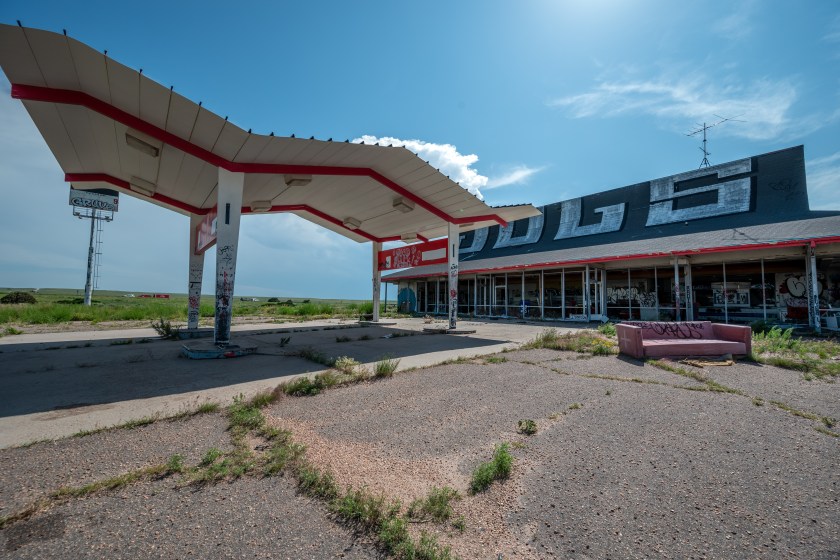
The photo of an abandoned Stuckey’s along I-76 in Colorado captures the decline of mid-century roadside travel due to economic shifts and infrastructure changes. With documentary clarity, it emphasizes architectural decay and cultural history, inviting viewers to reflect on both nostalgia and contemporary relevance while preserving a forgotten era of American mobility.

Abandoned roadside building with a former gas canopy and boarded storefront, covered in graffiti and surrounded by cracked pavement and weeds under a blue sky.
The abandoned remains of a former Stuckey’s at the Sedgwick exit along I-76 in northeastern Colorado.

In this documentation of a former Stuckey’s roadside station along Interstate 76 near Sedgwick, Colorado, the photographer captures a distinctly American form of ruin—one born not of catastrophe but of bypass, economic shift, and the relentless evolution of travel infrastructure. The image, positioned within Chapter 6 of his Top 100 Journey, reflects a thematic concern with both literal and metaphorical roads ahead, while simultaneously acknowledging what has been left behind.

The composition employs a wide-angle perspective that emphasizes the structure’s geometric severity against an expansive Colorado sky. The canopy’s angular red-and-white striping draws the eye leftward, while the weathered building facade—bearing faded lettering and graffiti-marked columns—anchors the right side of the frame. Between these elements lies cracked asphalt overtaken by scrub grass, a visual testimony to years of abandonment. The photographer positions himself at a slight distance, allowing the full scope of dereliction to register without sensationalizing the decay.

What distinguishes this work from mere urban exploration photography is its restraint. Rather than fetishizing abandonment or deploying dramatic processing techniques, the photographer presents the scene with documentary clarity. The natural light—diffused through wispy clouds—provides even illumination that reveals texture in the deteriorating surfaces without casting the scene into melodrama. A discarded pink couch in the lower right corner serves as an unexpected punctuation mark, a surreal domestic intrusion into commercial space that hints at the site’s reappropriation by transient visitors.

The Stuckey’s chain represents a specific era of American mobility—mid-century road travel when interstate commerce moved at human speeds and roadside stops functioned as destinations rather than mere interruptions. The photographer’s selection of this subject speaks to an interest in cultural archaeology, in preserving evidence of infrastructures that once defined travel experience but now exist as skeletal reminders of obsolete commercial models.

Within the context of Chapter 6’s “ongoing exploration,” this photograph demonstrates an expansion of the photographer’s subject matter beyond controlled studio environments and collaborative performances. Here, he engages with the built environment as found object, approaching landscape and architecture with the same compositional rigor previously applied to portraiture and experimental lighting. The decision to include this image alongside more technically innovative work suggests an artistic practice concerned with breadth as much as depth—a willingness to move between modes of image-making as the subject demands.

The personal dimension—referenced in the accompanying text through memories of hot dogs and pecan log rolls—remains deliberately absent from the photograph itself. This restraint allows the image to function on multiple levels: as architectural document, as cultural commentary, as landscape study. The photographer trusts the visual evidence to carry meaning without editorial intervention, letting viewers project their own relationships to such spaces.

As part of the Top 100 selection, this photograph confirms that the journey ahead need not always involve technical innovation or conceptual complexity. Sometimes it requires simply bearing witness to what time and economics have rendered irrelevant, preserving in two dimensions what three-dimensional space will not sustain much longer. The road ahead, this image suggests, is also paved with remnants of roads already traveled.

Portrait Slam 2024

Portrait Slam 2024 features Frank Graziano posed on a vintage railroad car, showcasing a blend of environmental portraiture and technical skill. The composition balances subject and setting, using light and shadow effectively. This portrait reflects the photographer’s evolution, integrating contemporary styling with Americana themes, and highlights a confident approach to on-location shooting.

Man wearing a hat stands on the side steps of a black railroad car, looking to the side.
Frank Graziano poses on a railroad car at the Colorado Railroad Museum in Golden, Colorado.

The photographer captures Frank Graziano in a moment of studied nonchalance, balanced on the step of a vintage railroad car against the industrial textures of riveted steel and weathered paint. This image, created during Portrait Slam 2024 at the Colorado Railroad Museum, exemplifies the photographer’s growing confidence in environmental portraiture—a technical and conceptual evolution clearly marked within Chapter 4 of his Top 100 Journey project.

What immediately distinguishes this portrait is its sophisticated balance between subject and setting. The railroad car’s dark, rivet-studded surface creates a powerful geometric frame, yet never overwhelms Graziano’s presence. The model’s positioning—one foot planted on the step, the other casually lifted, holding a vertical rail—demonstrates a dynamic use of diagonal lines that pulls the viewer’s eye through the composition. His cowboy hat and leather jacket evoke classic Americana, while the contemporary styling prevents the image from slipping into pastiche or nostalgia.

The photographer’s technical execution reveals careful consideration of light and shadow. The overcast sky provides even, diffused illumination that preserves detail across both the subject’s face and the textured metal surface behind him. This soft light wraps around Graziano’s features, creating subtle modeling without harsh shadows—a particularly important choice given the industrial setting’s potential to create competing visual elements. The muted color palette of charcoal grays, weathered browns, and faded blacks creates tonal harmony while allowing the warm leather tones of the hat to serve as a visual anchor.

Within the context of Chapter 4—Portraits Studio, Outdoor & Workshop Work—this image demonstrates the photographer’s ability to synthesize controlled studio techniques with the spontaneity of location work. Workshop environments often push photographers beyond their comfort zones, and this portrait suggests someone working confidently with both the challenges and opportunities of on-location shooting. The inclusion of the “KEEP OFF” text, partially visible in the frame, adds an element of subtle irony: the subject occupies precisely the forbidden space, transforming restriction into creative possibility.

The railroad setting serves as more than mere backdrop. It functions as visual metaphor—the convergence of journey, transit, and transitional spaces that resonates with the photographer’s larger Top 100 Journey project. The industrial heritage embedded in the railroad car’s weathered surface speaks to American mythology and masculine archetypes, themes Graziano’s styling deliberately engages while maintaining contemporary relevance.

From a curatorial perspective, this photograph marks a maturation in the photographer’s approach to environmental portraiture. Earlier works in his portfolio occasionally struggled with the balance between subject and location; here, both elements coexist in productive tension. The composition’s structured geometry—the vertical rails, horizontal platform, the rectangular frames within frames—creates order without rigidity, allowing Graziano’s natural pose to feel both choreographed and spontaneous.

The image’s inclusion in the Top 100 Journey project reflects its successful synthesis of technical skill, conceptual clarity, and visual impact. It demonstrates how workshop environments can push photographers toward their strongest work, combining the pressure of limited time with the inspiration of new locations and collaborative energy. The result is a portrait that honors both its subject and its setting, creating a narrative that extends beyond the single frozen moment into broader considerations of place, identity, and American visual mythology.