Corner House, Bosler Wyoming 2025: Architecture at the Edge of Erasure

In Chapter 6 of Greg Urbano’s Top 100 Journey, a photograph captures a deteriorating house in the ghost town of Bosler, Wyoming. The image illustrates the photographer’s exploration of abandonment, focusing on atmospheric conditions and the surrounding landscape. This work highlights the themes of decay, isolation, and the complexity of preservation amid a vanishing settlement.

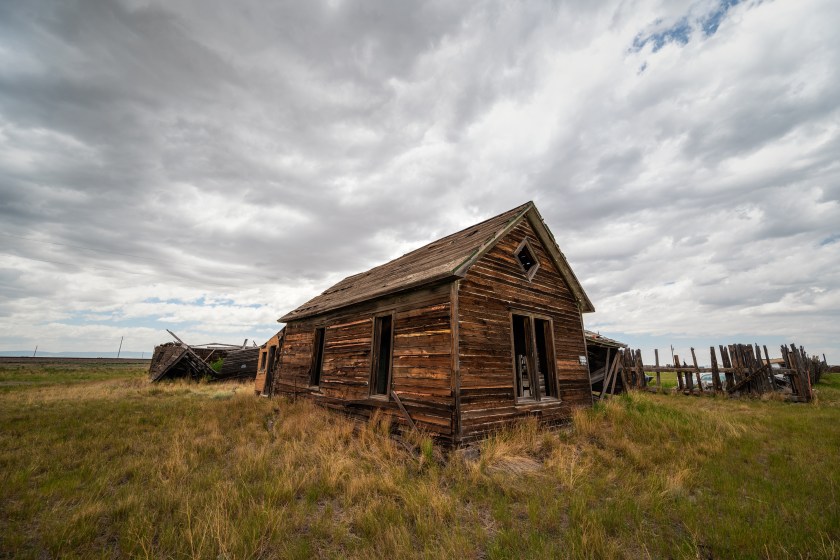
Weathered wooden house with broken windows standing alone in grassland under an overcast sky in Bosler, Wyoming.
A deteriorating wooden house stands at a corner in the ghost town of Bosler, Wyoming.

In this recently captured photograph from Chapter 6 of Greg Urbano’s Top 100 Journey, the photographer documents a collapsing structure in Bosler, Wyoming—one of the few remaining witnesses to a town that has largely disappeared from both map and memory. The image exemplifies the photographer’s continued investigation into the material traces of Western settlement, while revealing new subtleties in his approach to documenting abandonment and temporal passage.

The composition centers on a weathered wooden dwelling, its steep-pitched roofline still asserting architectural intention despite advanced structural compromise. The building’s corner placement within the frame—echoing its designation as a “corner house”—creates a dynamic diagonal energy, the structure appearing to lean into the wind-swept grassland that now reclaims the site. Dark window openings punctuate the horizontal wood siding, which has weathered to rich amber and umber tones, each plank articulated by the diffused overcast light.

What distinguishes this work within the photographer’s recent output is his expanded attention to atmospheric conditions. The turbulent cloudscape dominates nearly two-thirds of the frame, its churning gray masses punctuated by occasional breaks of blue—a meteorological drama that mirrors the building’s own precarious state between persistence and collapse. This sky is not mere backdrop but active participant, suggesting the elemental forces that have contributed to the structure’s deterioration and will eventually complete its dissolution.

The surrounding landscape provides crucial narrative context. Collapsed outbuildings and fence remnants scatter across the middle ground, fragmentary evidence of what was once a more substantial settlement. Golden prairie grasses advance toward the dwelling’s foundation, their subtle movement implied even within the photograph’s frozen moment. The extreme horizontality of the High Plains extends to a barely perceptible horizon line, emphasizing the profound isolation of this site just north of Laramie, accessible from Highway 80 yet psychologically distant from contemporary traffic patterns.

From a technical standpoint, the photographer employs what appears to be a moderate wide-angle perspective, capturing sufficient environmental context while maintaining the building’s structural integrity within the frame. The exposure handles the challenging luminosity range of overcast conditions with nuance, preserving detail in both shadowed door openings and highlighted cloud formations. This balanced approach serves the documentary imperative while allowing for aesthetic contemplation.

Within Chapter 6’s thematic framework of “The Road Ahead,” this photograph functions as meditation on endings and continuations. Bosler exists now primarily as absence—a ghost town in the most literal sense—yet the photographer’s attention validates its remaining physical evidence as worthy of sustained consideration. His choice to include this work in his curated Top 100 Journey suggests an artist grappling with questions of what deserves preservation, at least photographically, when material preservation is no longer possible.

The work also demonstrates evolution in the photographer’s relationship to his subject matter. Where earlier chapters might have emphasized formal qualities or nostalgic resonance, this image presents abandonment as process rather than state—a building actively returning to landscape, caught mid-transition. The corner house stands as both monument and warning, its dignified decay offering no easy emotional resolution. This measured, clear-eyed approach marks the maturation of an artist comfortable with ambiguity, finding profundity in the unheroic persistence of structures at civilization’s receding edge.
Scale and Spectacle: Industrial Heritage as Portrait Stage

Savana Steinhoff’s portrait in front of the Rio Grande 5771 locomotive at the Colorado Railroad Museum showcases Greg Urbano’s artistic vision in environmental portraiture. The photo employs effective lighting, wardrobe choice, and spatial awareness to highlight both model and industrial backdrop, reflecting broader themes of coexistence and cultural significance in contemporary photography.

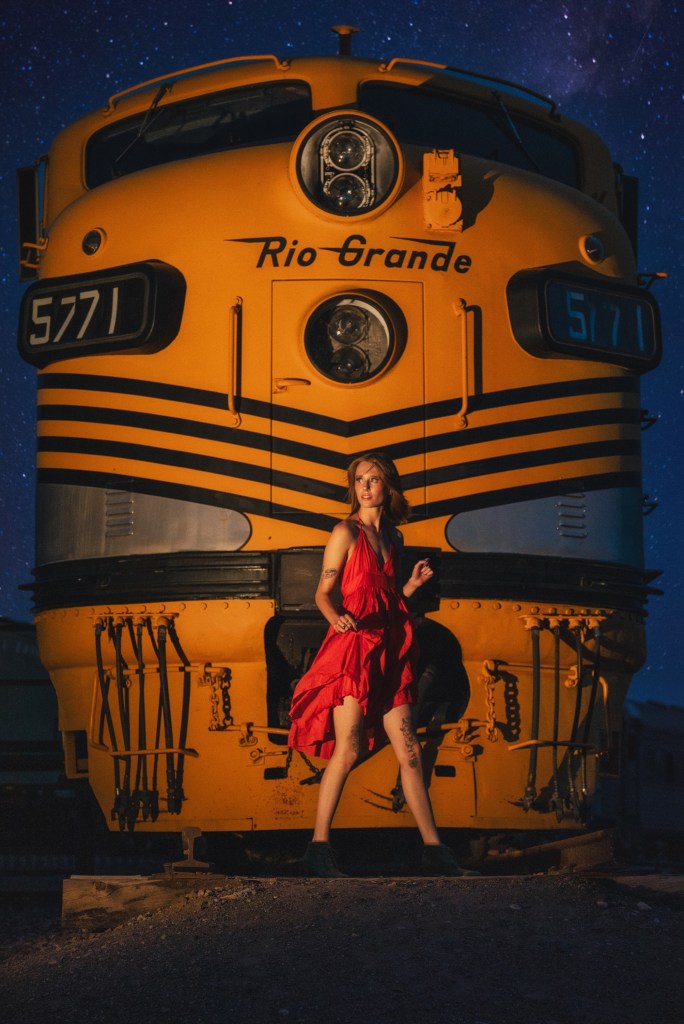
Woman in a red dress stands in front of a yellow Rio Grande locomotive at night, lit against a dark sky.
Savana Steinhoff poses in front of the Rio Grande 5771 locomotive at the Colorado Railroad Museum in Golden, Colorado.

Among the most ambitious entries in Chapter 4 of Greg Urbano’s Top 100 Journey, this photograph from Portrait Slam 2024 represents the photographer’s engagement with large-scale environmental portraiture under challenging technical conditions. Created at the Colorado Railroad Museum in Golden, the image positions model Savana Steinhoff against the imposing facade of Rio Grande locomotive 5771, transforming industrial artifact into dramatic backdrop and exploring the relationship between human scale and mechanical monumentality.

The composition immediately announces its ambitions. The locomotive dominates the frame, its iconic orange and black striping creating bold graphic elements that could easily overwhelm a human subject. Yet Urbano’s placement of the model—centered beneath the Rio Grande nameplate, her crimson dress echoing the warm tones of the engine—establishes a visual hierarchy that honors both subject and setting. The photographer has chosen a low angle that emphasizes the locomotive’s imposing height while maintaining the model’s presence as the compositional anchor. This decision reflects sophisticated spatial awareness, particularly valuable in workshop environments where multiple photographers compete for optimal vantage points.

The lighting strategy reveals careful planning and execution. Shot during the blue hour, the image captures that transitional moment when artificial illumination and residual daylight achieve balance. The locomotive’s exterior lighting creates warm pools of color against the deepening twilight sky, while additional lighting—likely strobes positioned to camera left—illuminates the model without destroying the ambient atmosphere. Stars visible in the darkening sky suggest either long exposure techniques or composite work in post-processing, adding a dreamlike quality to what might otherwise be straightforward location portraiture.

The choice of wardrobe proves integral to the photograph’s success. The flowing red dress provides both color contrast and movement, its flowing fabric creating visual interest against the rigid geometry of the industrial subject. The model’s pose—casual yet purposeful, one leg slightly forward—suggests confidence rather than confrontation with the massive machine behind her. This approach differs markedly from more aggressive “beauty and the beast” tropes often employed in automotive and industrial photography, opting instead for coexistence rather than contrast.

Within the context of Chapter 4’s documentation of workshop and collaborative shooting experiences, this photograph demonstrates the photographer’s ability to execute complex concepts under time constraints typical of group shooting events. Portrait Slam workshops challenge participants to work efficiently in unfamiliar locations with coordinated models and lighting setups, requiring both technical proficiency and decisive artistic vision. The inclusion of this image in the Top 100 Journey suggests Urbano views such collaborative environments not as limitations but as catalysts for ambitious work.

The photograph also reflects broader themes in contemporary portrait photography, where environmental context carries equal weight to subject representation. The locomotive serves as cultural artifact—a symbol of westward expansion, industrial heritage, and American rail history—while simultaneously functioning as pure visual element. This duality enriches the image beyond simple fashion or glamour photography, situating it within traditions of documentary-informed portraiture.

Ultimately, this work from Portrait Slam 2024 exemplifies the photographer’s mature approach to environmental portraiture: technically sophisticated, conceptually layered, and visually arresting without sacrificing authenticity or becoming mere spectacle.