Light Paint Egg: Precision and Wonder in Contemporary Still Life

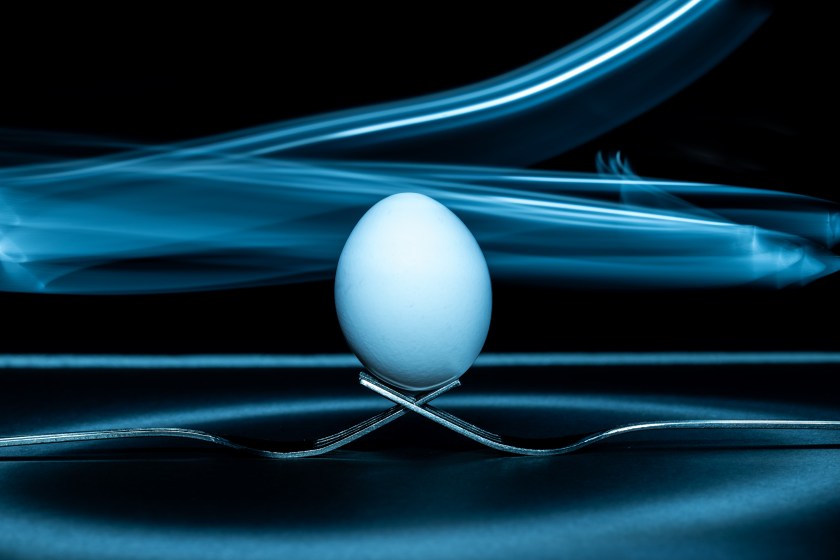
The photograph “Light Paint Egg” showcases a white egg balanced on crossed forks, illuminated through light painting techniques. This work exemplifies the artist’s blend of traditional and contemporary methods, capturing a balance between stasis and motion. It represents an innovative departure in still life, emphasizing creativity and technical mastery despite simple materials.

White egg balanced upright on crossed metal forks, photographed against a dark background with blue light trails created through light painting.
A white egg balanced on crossed forks, photographed using light painting techniques for the 52 Frames Week 11 “Egg” challenge.

In this meticulously crafted photograph, the artist demonstrates a masterful command of light painting technique, transforming an ordinary subject into an object of contemplation. The egg, positioned at the composition’s center, becomes a luminous focal point—its pale, almost ethereal surface contrasting dramatically against the deep black void that surrounds it. This is not merely documentation of an object, but rather an exploration of form, light, and the delicate balance between the tangible and the abstract.

The technical execution reveals a photographer working at the intersection of traditional still life aesthetics and contemporary experimental methods. Inspired by demonstrations from the lighting equipment company Adaptalux, he pursued this vision independently, relying on his own resourcefulness and understanding of photographic principles rather than specialized gear. This approach speaks to a fundamental confidence in craft—the knowledge that compelling imagery emerges not from equipment alone, but from vision and technical literacy working in concert.

The light trails that sweep through the frame possess an almost calligraphic quality, their cool blue tones suggesting both movement and stillness simultaneously. These luminous threads create a complex spatial environment, establishing depth and dimensionality around the egg while reinforcing its solidity and sculptural presence. The waves beneath appear to cradle the subject, while the diagonal streaks above suggest trajectory, momentum, perhaps even flight. There exists here a visual tension between stasis and motion, weight and weightlessness—themes that resonate throughout his broader body of work.

Positioned within Chapter 6 of his Top 100 Journey—”The Road Ahead: Recent Work & Ongoing Exploration”—this photograph exemplifies the artist’s willingness to embrace technical challenges and aesthetic risks. The chapter’s title suggests forward movement, continued evolution, and the photographer’s commitment to expanding his visual vocabulary. Indeed, this image represents a departure from more conventional approaches to still life, demonstrating how constraints—in this case, a weekly theme challenge—can catalyze creative innovation.

The composition adheres to classical principles while subverting expectations. The egg, that most ancient and universal of symbols, is elevated beyond its associations with fragility and potential. Here it becomes something simultaneously organic and otherworldly, as though suspended in a dimension where the laws of physics bend to artistic intention. The photographer’s choice to work with long exposure and moving light sources transforms the medium itself into a drawing tool, blurring the boundaries between photography, painting, and performance.

What distinguishes this work within his oeuvre is its synthesis of technical precision and poetic sensibility. The execution required careful planning—controlling exposure duration, choreographing light movement, managing ambient contamination—yet the final image transcends its methodology. It invites meditation on form, on the nature of photographic representation, and on how familiar objects can be estranged and renewed through careful observation and technical intervention.

As part of his ongoing exploration documented in the Top 100 Journey project, “Light Paint Egg” signals a photographer unafraid to experiment, to respond to creative prompts with rigor and imagination, and to push the boundaries of his practice. It stands as evidence that profound imagery can emerge from simple materials when vision, patience, and technical mastery converge.
Refraction and Illumination: A Study in Controlled Light

In Greg Urbano’s entry from “The Road Ahead: Recent Work & Ongoing Exploration,” a single green LED illuminates a glass sphere, creating intricate light patterns. This photograph showcases the artist’s mastery of optical effects and light manipulation. It reflects an ongoing exploration of visual ideas, balancing technical skill with artistic homage.

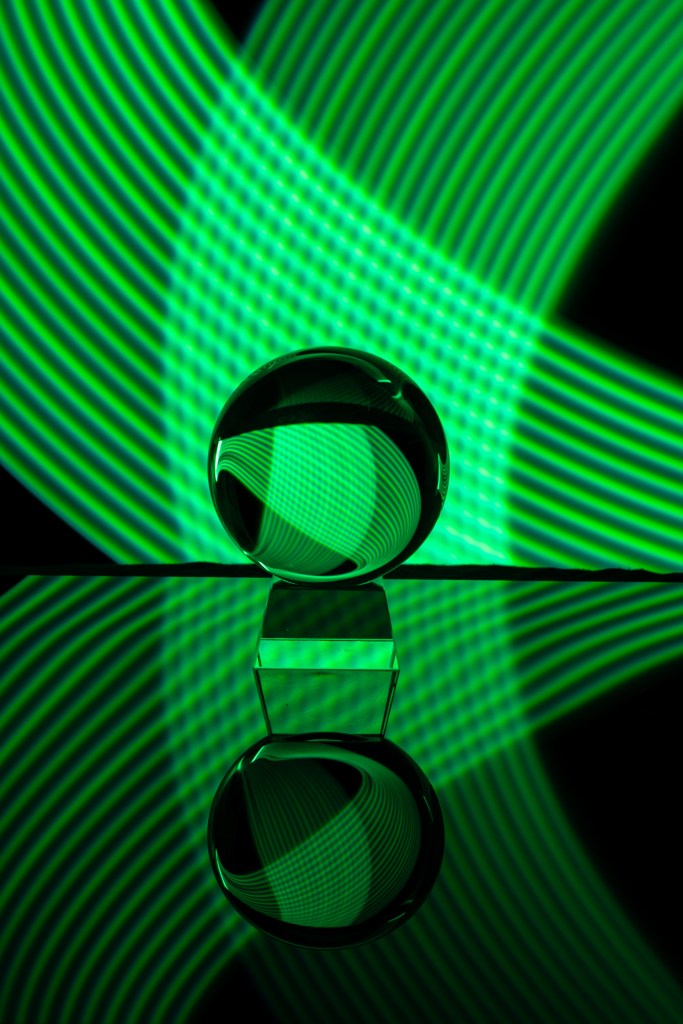
A glass sphere sits on black acrylic, bending bright green LED lines that cross diagonally, with a clear reflection below against a dark background.
A single green LED light creates intersecting line patterns that refract through a glass sphere and reflect off black acrylic.

In this striking entry from Chapter 6 of Greg Urbano’s Top 100 Journey—titled “The Road Ahead: Recent Work & Ongoing Exploration”—the photographer demonstrates a sophisticated understanding of light manipulation and optical phenomena. Created as part of the 52 Frames community’s Week 38 challenge, which called for images using a single light source, this photograph represents both technical mastery and artistic homage.

The composition centers on a glass sphere resting atop a reflective black acrylic base, positioned against a background of projected linear light patterns. What immediately captivates the viewer is the optical complexity achieved through such seemingly simple elements. The sphere acts as a lens, refracting and inverting the striped pattern behind it, while simultaneously creating a mirror image in the glossy surface below. This doubling effect—one sphere above, one reflected beneath—establishes a visual dialogue between reality and reflection that speaks to photography’s fundamental nature as a medium of light capture.

The photographer’s choice of a Godox TL30 LED wand as his single light source proves particularly astute. Rather than relying on ambient or diffused lighting, he creates a precise, linear pattern that reads as both graphic element and scientific demonstration. The vibrant green illumination pulses across the frame in parallel lines, their luminosity gradating from deep emerald to electric cyan. Where the light passes through the sphere, it bends and concentrates, revealing the optical principles at work while creating areas of intense brilliance that punctuate the geometric order.

This image explicitly acknowledges its lineage. The photographer credits Elizabeth Klepper’s 2023 work from the same community as inspiration—a refreshingly transparent gesture that positions this photograph within a continuum of artistic exchange rather than claiming isolated innovation. Yet this is no mere reproduction. Where Klepper’s original vision provided the conceptual framework, this interpretation carries distinct choices in color temperature, scale, and tonal contrast that mark it as an independent exploration.

The technical execution reveals careful consideration of multiple variables. The exposure balances the intense luminosity of the LED source with the deep blacks of the background and base, maintaining detail across a challenging dynamic range. The focus renders the sphere’s surface with crystalline clarity, allowing viewers to perceive both its transparency and its physical substance simultaneously. The alignment of the linear patterns—maintaining their parallel consistency both in direct view and through the sphere’s distortion—suggests meticulous positioning and multiple test exposures.

Within the context of Chapter 6, this photograph signals a willingness to engage with established visual ideas while pushing toward new territory. The chapter’s subtitle, “Recent Work & Ongoing Exploration,” positions the photographer at a transitional moment, actively investigating techniques and concepts that may inform future directions. This image embodies that investigative spirit—it is simultaneously a study, an exercise, and a finished work worthy of exhibition.

The minimalist aesthetic here contrasts with the more documentary or narrative approaches found in earlier chapters of the Journey. The photographer strips away contextual information, environmental cues, and representational content, focusing instead on pure optical phenomena. Light becomes subject rather than tool. The glass sphere transforms from decorative object to scientific instrument to sculptural form.

What elevates this beyond technical demonstration is its inherent beauty—the mesmerizing quality of those radiating green lines, the perfect symmetry of sphere and reflection, the luminous energy that seems to emanate from the glass itself. It exemplifies how constraint, whether self-imposed or community-mandated, can generate creative solutions that transcend their origins.