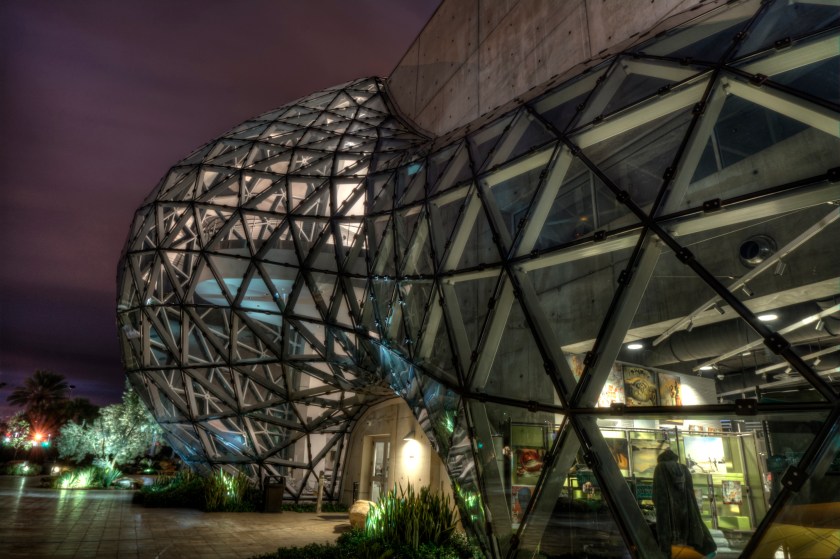
The 2013 HDR photograph of the Dalí Museum in St. Petersburg, Florida, showcases its geodesic glass dome at night. The image highlights the contrast between the museum’s concrete and glass elements, capturing a tranquil presence. Interior lights and reflections enhance the architectural details, merging the structure with its urban environment while emphasizing its grand scale.
A 2013 HDR nighttime photograph of the Dali Museum’s geodesic glass structure in St. Petersburg, Florida.
Photographed at night in 2013, this image captures the striking exterior of The Dalí Museum in St. Petersburg, Florida, a building defined as much by engineering as by spectacle. The museum’s iconic glass “Enigma” dome curves outward from the concrete structure, its triangular lattice glowing against the darkened sky and reflecting the surrounding landscape.
Seen after hours, the architecture takes on a quieter, more introspective presence. Interior lights reveal layers of steel framing, glass panels, and exposed structure, turning the façade into a study of transparency and weight. The contrast between the smooth concrete walls and the faceted glass surface emphasizes the tension between solidity and openness that defines the building’s design.
The long exposure and HDR treatment deepen the scene without overwhelming it, preserving detail in both the illuminated interior and the shadowed exterior. Reflections ripple across the glass, subtly blending interior exhibits with the night environment outside. A lone figure inside the museum provides a sense of scale, reinforcing the building’s monumental form while grounding it in human presence.
Landscaping and walkways in the foreground lead the eye toward the entrance, anchoring the composition and situating the museum within its urban setting. The sky, rendered in muted tones, frames the structure without distraction, allowing the geometry of the glass enclosure to remain the dominant visual element.
Night at the Dalí Museum is a study of contemporary architecture after dark—where light, structure, and space converge, and where the building itself becomes the subject, independent of the artwork it contains.
Greg Urbano’s “Landscapes in HDR” captures the Gulf Fishing Pier at Fort de Soto Park, reflecting his artistic development in photography. Utilizing a Nikon D7100, he balances composition with HDR techniques, achieving naturalistic vibrancy without over-processing. The image embodies a pivotal moment in skill mastery, exploring the connection between environment and human creation.
A 2013 HDR landscape photograph of the Gulf Fishing Pier at Fort De Soto Park in Pinellas County, Florida.
In the early stages of any photographer’s journey, there exists a pivotal moment when technical curiosity converges with artistic vision. Greg Urbano’s “Landscapes in HDR” from 2013 captures precisely this convergence—a photograph that speaks to the fundamentals of seeing while revealing the seeds of a maturing artistic voice.
The Gulf Fishing Pier at Fort de Soto Park presents itself as an exercise in classical composition, yet the image transcends mere documentation. Shot with a Nikon D7100 at 14mm, the photographer embraced the distortion inherent in ultra-wide-angle photography, using it not as a limitation but as a tool for emphasis. The pier’s concrete pathway stretches toward the horizon with geometric insistence, its weathered surface textured with salt stains and age—details that anchor the ethereal quality of the surrounding environment.
What distinguishes this work within the context of Chapter 1—Beginnings is the deliberate exploration of HDR processing, a technique that dominated landscape photography in the early 2010s. Rather than falling into the trap of over-processing that plagued much HDR work of this era, Urbano demonstrates restraint. The luminous gradations in the sky—from deep azure to wispy white—retain a naturalistic quality while revealing detail across an impressive tonal range. The turquoise waters of the Gulf of Mexico maintain their vibrancy without crossing into hypersaturation, suggesting an eye already sensitive to the boundaries between enhancement and artifice.
The technical choices reveal a photographer building his fundamental vocabulary. The aperture of ƒ/8.0 ensures critical sharpness from the foreground concrete to the distant structures, while the fast shutter speed of 1/400s freezes the subtle motion of the scene—likely the flutter of distant flags or the movement of the few figures visible along the pier. At ISO 100, the image maintains clarity in its textures, from the horizontal railings that create rhythmic lines to the architectural shelters that punctuate the composition’s middle ground.
What makes this photograph significant in understanding Urbano’s artistic evolution is not its perfection but its purposefulness. The nearly symmetrical composition, the careful attention to the leading lines, the consideration of how architectural elements frame the natural environment—these are the building blocks upon which more complex visual narratives are constructed. The weekly visits to this location mentioned in his notes speak to something essential in photographic development: the practice of returning, of seeing the same subject under different conditions, of learning through repetition.
The landscape itself offers something eternal—the meeting point of human construction and natural expanse. The pier extends confidently into the Gulf, a gesture of connection between land and water, between the photographer’s position and the infinite horizon. In capturing this scene, Urbano was not merely documenting a favorite location but engaging with fundamental questions about how we frame our relationship to place and space.
Within the broader context of “Beginnings,” this image exemplifies the necessary stage of mastering craft before transcending it. The imperfect attempts referenced in the chapter description are not failures but essential experiments. Here, we witness a photographer learning to see in high dynamic range, to compose with geometric precision, and to capture the luminous quality of coastal light—all foundational skills that would inform the more sophisticated work to come.
This is where journeys begin: in the clarity of intention, the discipline of practice, and the recognition that every master was once a student of light.

 Greg Urbano