Reclamation and Ruin: A Study in Agricultural Melancholy

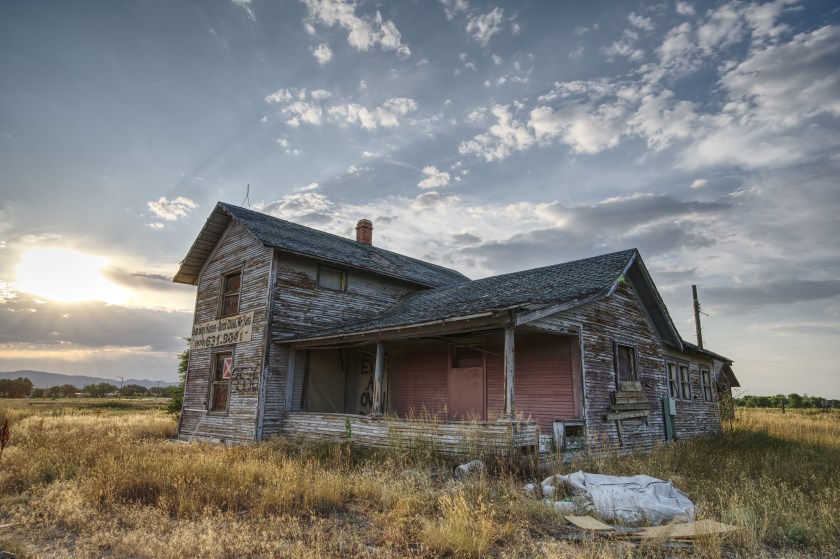
The photograph of an abandoned farmhouse near Fort Collins, Colorado, embodies themes of impermanence and decay. The image balances architectural elements with natural landscapes, showcasing technical sophistication through HDR processing. By highlighting details of deterioration amidst recent human traces, it transforms rural abandonment into a poignant meditation on time and memory.

Weathered wooden farmhouse with boarded windows and peeling paint standing in tall grass near Fort Collins, Colorado.
An abandoned wooden farmhouse sits in open prairie near Fort Collins, Colorado.

In this haunting documentation of rural abandonment, the photographer captures a weathered farmhouse on the outskirts of Fort Collins, Colorado—a structure caught in the liminal space between human history and nature’s patient reclamation. The image, selected for Chapter 6 of his Top 100 Journey, exemplifies the ongoing evolution in his practice toward subjects that speak to impermanence, transition, and the quiet dignity of forgotten places.

The compositional strategy reveals a mature understanding of architectural photography merged with landscape sensibility. The two-story structure commands the frame while remaining subordinate to the expansive Colorado sky, which fills nearly half the image with dramatic cloud formations. This deliberate balance prevents the photograph from becoming merely documentary, instead elevating it into meditation on time and decay. The golden hour lighting—captured with precision timing—rakes across the weathered clapboard siding, accentuating every crack, peel, and shadow in the wood grain. This textural emphasis transforms deterioration into visual poetry.

His decision to employ HDR processing demonstrates technical sophistication in service of artistic vision rather than mere spectacle. The extended dynamic range allows simultaneous preservation of detail in the sun-bleached siding and the darker recesses of boarded windows and doorways. The processing maintains naturalistic color while enhancing the amber warmth of dying light against cool blue-grey clouds, creating chromatic tension that mirrors the thematic conflict between persistence and decay.

The overgrown prairie grass in the foreground serves multiple functions within the composition. Practically, it provides textural contrast to the geometric severity of the architecture; symbolically, it represents nature’s inexorable advance. The discarded white fabric or tarp in the lower right corner introduces a note of recent human presence, suggesting that abandonment is an ongoing process rather than a completed historical fact. This detail prevents the image from slipping into nostalgic romanticism.

What distinguishes this work within the context of Chapter 6—titled “The Road Ahead: Recent Work & Ongoing Exploration”—is its synthesis of earlier themes with evolving concerns. The photographer has long demonstrated interest in human traces within landscape, but here the investigation deepens. Rather than simply documenting what remains, he engages with the process of vanishing itself. The boarded windows become blind eyes; the peeling paint functions as aging skin; the sagging roofline suggests exhaustion. The structure possesses almost anthropomorphic vulnerability.

The photograph’s origins as a response to the 52frames weekly challenge reveals another dimension of his practice—the ability to transform assignment-based work into personally meaningful investigation. Many photographers struggle to maintain artistic integrity within the constraints of themed prompts, yet he has consistently used such frameworks as catalysts rather than limitations.

The telephone number still visible on the building’s facade—a commercial ghost—adds poignant specificity. It grounds the abstracted themes of abandonment and time in particular lives, particular businesses, particular failures or departures. This detail resists the tendency toward generic commentary on “the death of rural America” and instead insists on the singular reality of this particular farmhouse, this particular field, this particular evening light.

In positioning this image within his ongoing journey, the photographer signals continued commitment to finding profound resonance in overlooked subjects. The road ahead, it seems, leads deliberately toward what others pass by—not from contrarian impulse, but from genuine recognition that beauty and meaning persist even in, perhaps especially in, the discarded and decaying.
Corner House, Bosler Wyoming 2025: Architecture at the Edge of Erasure

In Chapter 6 of Greg Urbano’s Top 100 Journey, a photograph captures a deteriorating house in the ghost town of Bosler, Wyoming. The image illustrates the photographer’s exploration of abandonment, focusing on atmospheric conditions and the surrounding landscape. This work highlights the themes of decay, isolation, and the complexity of preservation amid a vanishing settlement.

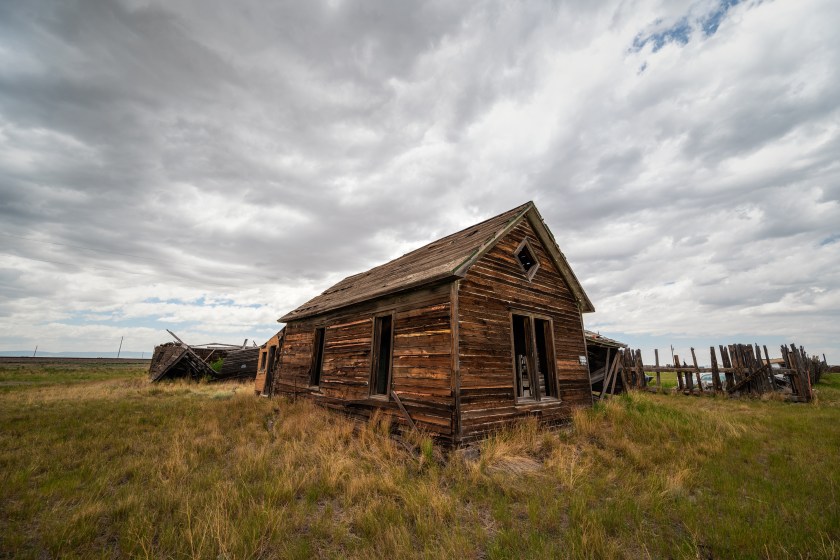
Weathered wooden house with broken windows standing alone in grassland under an overcast sky in Bosler, Wyoming.
A deteriorating wooden house stands at a corner in the ghost town of Bosler, Wyoming.

In this recently captured photograph from Chapter 6 of Greg Urbano’s Top 100 Journey, the photographer documents a collapsing structure in Bosler, Wyoming—one of the few remaining witnesses to a town that has largely disappeared from both map and memory. The image exemplifies the photographer’s continued investigation into the material traces of Western settlement, while revealing new subtleties in his approach to documenting abandonment and temporal passage.

The composition centers on a weathered wooden dwelling, its steep-pitched roofline still asserting architectural intention despite advanced structural compromise. The building’s corner placement within the frame—echoing its designation as a “corner house”—creates a dynamic diagonal energy, the structure appearing to lean into the wind-swept grassland that now reclaims the site. Dark window openings punctuate the horizontal wood siding, which has weathered to rich amber and umber tones, each plank articulated by the diffused overcast light.

What distinguishes this work within the photographer’s recent output is his expanded attention to atmospheric conditions. The turbulent cloudscape dominates nearly two-thirds of the frame, its churning gray masses punctuated by occasional breaks of blue—a meteorological drama that mirrors the building’s own precarious state between persistence and collapse. This sky is not mere backdrop but active participant, suggesting the elemental forces that have contributed to the structure’s deterioration and will eventually complete its dissolution.

The surrounding landscape provides crucial narrative context. Collapsed outbuildings and fence remnants scatter across the middle ground, fragmentary evidence of what was once a more substantial settlement. Golden prairie grasses advance toward the dwelling’s foundation, their subtle movement implied even within the photograph’s frozen moment. The extreme horizontality of the High Plains extends to a barely perceptible horizon line, emphasizing the profound isolation of this site just north of Laramie, accessible from Highway 80 yet psychologically distant from contemporary traffic patterns.

From a technical standpoint, the photographer employs what appears to be a moderate wide-angle perspective, capturing sufficient environmental context while maintaining the building’s structural integrity within the frame. The exposure handles the challenging luminosity range of overcast conditions with nuance, preserving detail in both shadowed door openings and highlighted cloud formations. This balanced approach serves the documentary imperative while allowing for aesthetic contemplation.

Within Chapter 6’s thematic framework of “The Road Ahead,” this photograph functions as meditation on endings and continuations. Bosler exists now primarily as absence—a ghost town in the most literal sense—yet the photographer’s attention validates its remaining physical evidence as worthy of sustained consideration. His choice to include this work in his curated Top 100 Journey suggests an artist grappling with questions of what deserves preservation, at least photographically, when material preservation is no longer possible.

The work also demonstrates evolution in the photographer’s relationship to his subject matter. Where earlier chapters might have emphasized formal qualities or nostalgic resonance, this image presents abandonment as process rather than state—a building actively returning to landscape, caught mid-transition. The corner house stands as both monument and warning, its dignified decay offering no easy emotional resolution. This measured, clear-eyed approach marks the maturation of an artist comfortable with ambiguity, finding profundity in the unheroic persistence of structures at civilization’s receding edge.

Briggsdale Scale and Silos: Monuments of Rural Persistence

The photograph of the Briggsdale Scale and Silos in eastern Colorado captures the beauty of agricultural remnants under a vast prairie sky. The artist portrays abandonment as transformation rather than decay, highlighting layered complexities and themes of economic change. This work reflects both personal exploration and broader cultural narratives in rural America.

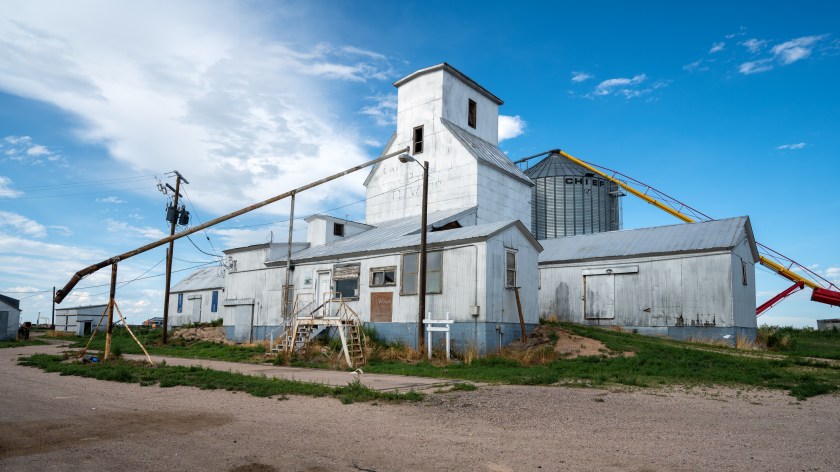
Rural grain elevator complex with white scale house buildings and metal silos under a blue sky in eastern Colorado.
The Briggsdale scale and silos stand along a roadside in rural eastern Colorado.

In this commanding photograph from Chapter 6 of Greg Urbano’s Top 100 Journey, the photographer turns his lens toward the structural remnants of agricultural infrastructure in eastern Colorado. The Briggsdale Scale and Silos stand as weathered sentinels against an expansive prairie sky, their utilitarian forms elevated to subjects of aesthetic contemplation through careful compositional framing and an acute sensitivity to light.

The image presents a study in contrasts—temporal, textural, and tonal. The white-painted grain elevator rises prominently in the frame’s left third, its verticality punctuated by narrow window openings that read as dark voids against the painted surface. Adjacent structures spread horizontally across the composition, their corrugated metal siding bearing the patina of decades exposed to the elements. A modern Chief grain bin introduces a cylindrical geometry, while the skeletal remains of what appears to be an auger system arc across the upper right quadrant, its yellow and red paint providing the only vivid chromatic notes in an otherwise muted palette.

What distinguishes this work within the photographer’s ongoing exploration is its treatment of abandonment not as decay but as transformation. The structures retain their monumental presence even as nature begins its slow reclamation—weeds push through concrete, grass encroaches on gravel pathways, and rust blooms across metal surfaces. The dramatic cloud formation sweeping across the cobalt sky suggests movement and change, while the buildings themselves remain rooted, immovable despite their gradual obsolescence.

The photographer’s technical execution reveals a sophisticated understanding of documentary traditions. Shot in brilliant midday light that might challenge less experienced practitioners, he harnesses the harsh illumination to articulate every surface detail—the vertical seams of the elevator, the weathering patterns on wood siding, the dimensional quality of the corrugated metal. The deep blue sky provides crucial tonal separation, preventing the white structures from dissolving into atmospheric haze while simultaneously emphasizing the vastness of the landscape context.

Within Chapter 6’s framework of “The Road Ahead,” this photograph functions as both retrospective and prospective statement. It acknowledges the photographer’s established interest in vernacular architecture and rural landscapes while suggesting new territories of investigation. The composition’s layered complexity—multiple structures occupying different spatial planes, the interplay of geometric forms, the dialogue between human-made and natural elements—indicates an artist pushing beyond straightforward documentation toward more nuanced visual poetry.

The work also engages broader themes of economic transition and cultural memory embedded in the American rural landscape. These agricultural structures, once vital nodes in the grain production and distribution network, now stand largely dormant, their continued presence a testament to both past prosperity and present uncertainty. The photographer neither romanticizes nor condemns this state of affairs; instead, he presents the scene with clear-eyed attention, allowing viewers to project their own narratives onto these architectural forms.

As part of his long-term Top 100 Journey project, this image demonstrates the photographer’s commitment to sustained engagement with place and subject matter. His repeated travels through eastern Colorado have yielded not mere repetition but deepening insight, as evidenced by this photograph’s confident handling of complex visual elements. It represents the work of an artist whose ongoing exploration continues to reveal new dimensions within familiar territory, finding monumentality in structures others might overlook and poetry in the persistent presence of the seemingly obsolete.

American Beauty: Strawberry Ravecake

The portrait of model Strawberry Ravecake, taken during a Denver workshop, reinterprets film noir and 1940s glamour through contemporary aesthetics, merging historical and modern elements. The striking use of chiaroscuro and vibrant colors challenges traditional conventions, featuring a tattooed model in luxurious settings, creating a dialogue on representation and glamour across eras.

Overhead studio portrait of a tattooed woman reclining on dark fabric, wearing black lingerie under dramatic low-key lighting.
A studio portrait of model Strawberry Ravecake reclining on textured fabric during a themed photography workshop in Denver.

Within Chapter 6’s exploration of recent directions, this portrait represents a deliberate engagement with historical photographic language reimagined through contemporary aesthetics. Created during a workshop at RAW Studios in Denver focused on recreating film noir and 1940s Hollywood glamour, the photographer demonstrates how classical techniques can be subverted and reclaimed through modern sensibilities. The result is an image that exists in productive tension between eras, neither purely nostalgic nor entirely contemporary.

The composition draws immediate lineage to mid-century boudoir photography, yet the execution reveals crucial departures from those conventions. The model—Betty, known professionally as Strawberry Ravecake—reclines against luxurious teal-green velvet that recalls old Hollywood opulence. Her positioning, with head tilted back and limbs arranged in studied repose, references the languorous poses characteristic of 1940s pin-up and glamour photography. However, the extensive floral tattoo work covering her arms, legs, and torso fundamentally transforms the visual narrative. Where golden-age Hollywood demanded unmarked skin as a canvas for projected fantasy, here the body arrives already inscribed with personal history and deliberate aesthetic choices.

The lighting strategy merits particular attention. Deep shadows dominate the frame, with careful modeling that emphasizes dimensional form while maintaining areas of near-total darkness. This chiaroscuro approach—essential to film noir’s visual vocabulary—creates dramatic contrast between illuminated flesh and surrounding void. The photographer employs what appears to be a single key light positioned to camera right, allowing natural falloff to shape the subject rather than filling shadows with secondary sources. This restraint honors noir’s painterly treatment of darkness as an active compositional element rather than merely the absence of light.

Color becomes a strategic departure from strict period authenticity. While classic noir worked exclusively in black and white, the photographer retains the jewel tones of the velvet backdrop and the subject’s vibrant red-to-blonde ombré hair. The black lingerie and bold red lipstick provide chromatic punctuation, creating focal points that guide the viewer’s eye through the composition. This selective use of color acknowledges that contemporary audiences read images differently than their 1940s counterparts; pure monochrome might feel like affectation rather than interpretation.

The workshop context—Portfolio Building for Aspiring Photographers and Models—frames this image as both artistic output and pedagogical artifact. Workshop environments typically emphasize technical mastery and stylistic imitation, yet this photograph transcends mere exercise. The collaborative nature of such sessions, with multiple participants working alongside professional instruction, requires the photographer to synthesize learning in real-time while maintaining artistic vision. That this image earned placement in his Top 100 Journey suggests successful integration of classical technique with personal aesthetic development.

Within Chapter 6’s framework of ongoing exploration, the photograph demonstrates expanded engagement with historical photographic genres. The work reveals an artist comfortable moving between documentary observation, macro intimacy, and now studio-based portraiture. By choosing to engage with noir’s visual language through contemporary bodies and sensibilities, he participates in an ongoing cultural conversation about representation, desire, and the constructed nature of glamour across generations. The velvet wrinkles, the tattoo artistry, and the calculated pose coalesce into an image that respects its influences while asserting its moment.

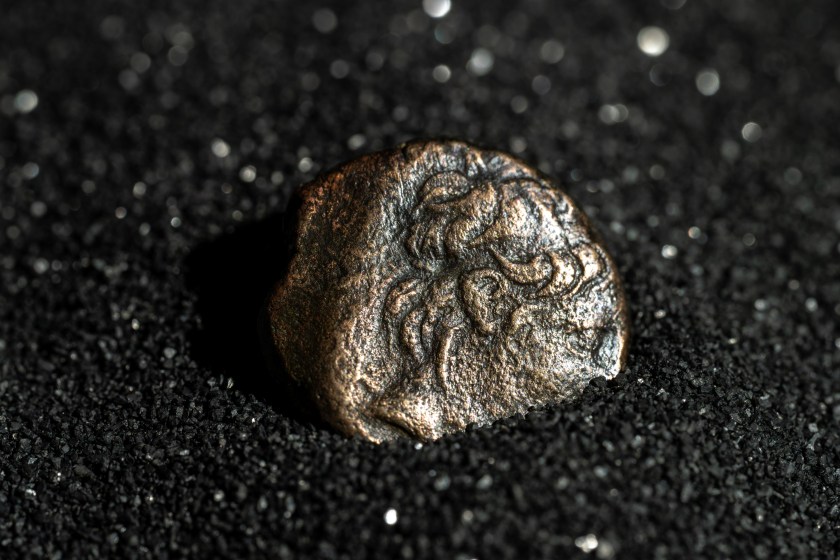
Ancient Greek Coin, Head of Alexander II Zebina

A macro photograph of a 123 BC Greek coin by Alexander II Zebina captures its historical significance and texture. The artist avoids over-sharpening, choosing selective focus to highlight the coin’s surface. This work raises questions about ownership, memory, and our connection to time, ultimately transforming the coin into a philosophical exploration of history.

Close-up of a worn ancient Greek coin showing a raised portrait, resting on coarse black granular material.
A macro photograph of an ancient Greek coin with a portrait relief placed on a dark textured surface.

In this macro study from Chapter 6 of his Top 100 Journey, the photographer confronts an artifact that predates the medium of photography by over two millennia. The coin—a bronze piece from 123 BC bearing the portrait of Alexander II Zebina—becomes both subject and collaborator, its weathered surface telling stories that extend far beyond the frame. This single exposure, created for the 52 Frames challenge, demonstrates a mature understanding of how light and composition can resurrect history from oxidized metal.

The technical execution reveals deliberate restraint. Rather than employ focus stacking to render every millimeter sharp, he opts for a single capture that honors the coin’s irregular topography through selective focus. The shallow depth of field becomes a curatorial choice: not everything from antiquity needs to be preserved with clinical precision. Some details fade into soft ambiguity, much as memory itself blurs across centuries. The side lighting—achieved through what appears to be a carefully positioned single source—rakes across the relief, transforming corrosion patterns into a luminous bronze landscape. Highlights catch on the highest points of wear, creating a constellation of golden moments against near-black valleys of shadow.

The substrate selection proves equally thoughtful. Black granular material, possibly sand or volcanic rock, provides textural contrast while introducing delicate bokeh spheres that float in the background like suspended time. This environmental choice feels archaeological, suggesting the coin might have just emerged from excavation rather than from a flea market display case. The photographer resists any impulse toward nostalgic sepia or artificial aging effects; instead, he allows the genuine patina—two thousand years in the making—to provide all the historical gravitas the image requires.

What distinguishes this work within Chapter 6’s framework of ongoing exploration is its meditation on ownership and stewardship. The accompanying note reveals this coin represents “the oldest man-made thing I have ever owned,” yet the photograph itself seems to question that possessive relationship. Can anyone truly own such an object, or are we merely temporary custodians in an impossibly long chain of hands? The macro perspective literalizes this contemplation, bringing the viewer so close that individual crystals of corrosion become visible, each one a marker of time the photographer will never witness.

The portrait of Alexander II Zebina—barely discernible beneath centuries of oxidation—emerges as a ghost in metal, features obscured yet undeniably present. This parallel between photographic and numismatic portraiture feels intentional. Both mediums attempt to freeze time, to preserve likeness against entropy’s relentless work. The photograph succeeds where the coin has partially failed, capturing not just the object but the precise quality of light falling upon it on a specific day in 2025, creating a new historical layer atop the ancient one.

Within the photographer’s evolving practice, this image represents a turn toward material intimacy and temporal reflection. The macro lens becomes a tool for philosophical inquiry rather than mere magnification. By isolating this small artifact against darkness and bringing such focused attention to its corrupted beauty, he creates space for viewers to contemplate their own relationship with history, permanence, and the objects that outlive their makers by millennia.

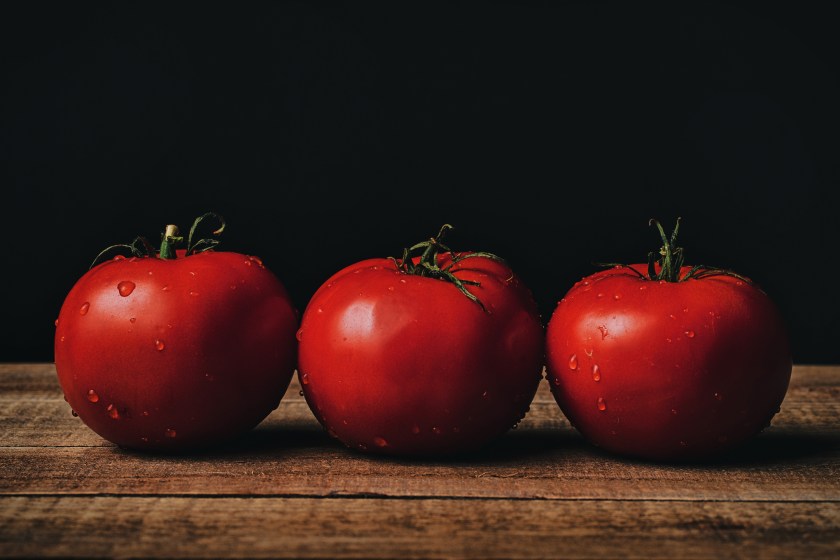
Tomatos

This photographic composition showcases three tomatoes on a textured wooden surface against a dark background, illustrating the themes of light and form in still life art. Using controlled lighting to create a dramatic chiaroscuro effect, the photographer emphasizes the tomatoes’ beauty, merging classical traditions with contemporary techniques.

Tabletop still life of three ripe tomatoes with water droplets on a wooden surface against a dark background.
A tabletop still life of three tomatoes arranged on a wooden surface and lit against a dark background.

In this deceptively simple composition, the photographer demonstrates how the most humble subjects—three tomatoes from a supermarket produce section—can become vehicles for exploring light, form, and the enduring traditions of still life photography. The work sits comfortably within the classical end of Chapter 5’s spectrum, channeling centuries of artistic precedent while employing decidedly contemporary tools and techniques.

The arrangement recalls Dutch Golden Age vanitas paintings, where ordinary kitchen staples were elevated to subjects of profound contemplation. Here, three ripe tomatoes rest upon a weathered wooden surface, their placement casual yet deliberate. The varying positions of their stems—pointing in different directions like botanical compasses—introduce subtle asymmetry that prevents the composition from becoming static. Water droplets cling to the glossy red skin, suggesting recent washing and adding points of light that animate the surface.

His lighting strategy proves crucial to the image’s success. Working with a single Godox V1s flash modified by a softbox and grid, he achieves remarkable control over illumination. The grid attachment narrows the light spread, creating focused illumination that emphasizes the tomatoes while allowing the background to fall into deep, theatrical darkness. This chiaroscuro effect—the dramatic interplay of light and shadow—lends gravitas to subjects that might otherwise seem merely documentary.

The wooden surface provides essential contextual grounding. Its rough texture and visible grain contrast beautifully with the smooth, taut skin of the tomatoes, creating a dialogue between refined organic form and rustic materiality. The warm tones of the aged wood complement the rich reds of the fruit, establishing a harmonious yet varied color palette that feels both earthy and sophisticated.

His post-processing approach through Skylum Luminar 4, utilizing a color LUT (Look-Up Table), demonstrates an efficient workflow that enhances rather than overwhelms the captured image. The color grading deepens the reds toward burgundy in the shadows while maintaining natural highlights, creating dimensionality that draws the eye around each form. This restrained digital intervention respects the photographic integrity of the scene while amplifying its visual impact.

Within the broader trajectory of his still life work, this image represents a return to fundamentals—a meditation on how controlled lighting and thoughtful composition can transform the everyday into the examined. Where other works in this chapter might push toward experimental territories, this photograph anchors itself in proven traditions, demonstrating that innovation need not always mean departure from established visual language.

The Sony A7ii captures these elements with clarity and subtle tonal gradation, rendering the tomatoes with sufficient detail to appreciate their imperfect spherical forms, the slight variations in color saturation, and the delicate green stems that signal recent harvest. These details matter; they prevent the image from becoming abstract or overly stylized, maintaining its connection to the tangible world.

Ultimately, this work succeeds through its quiet confidence. The photographer understands that compelling still life photography requires neither exotic subjects nor complex staging—only patient observation, technical competence, and an appreciation for how light reveals the inherent beauty in forms we too often overlook. These grocery store tomatoes, frozen in this particular moment of light and shadow, become worthy of sustained attention.

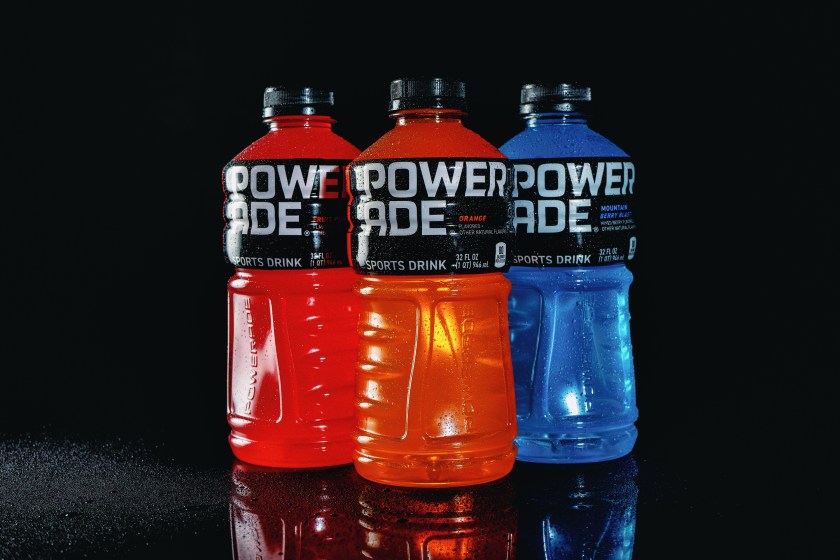
Powerade Sports Drink

The photographer’s still life study of three Powerade bottles transcends typical commercial product photography through technical mastery and thoughtful lighting. Using a classic triangular arrangement against a dark background, he elevates mundane objects into gallery-worthy art, emphasizing color and light. This work reflects his evolving confidence and duality in art and commerce.

Studio still life of three Powerade sports drink bottles in red, orange, and blue on a reflective black surface.
A studio still life of three Powerade sports drink bottles arranged on a reflective surface against a dark background.

The photographer’s exploration of commercial product photography takes an unexpectedly sophisticated turn in this meticulously composed study of three Powerade bottles. Working within the constraints of a domestic setting—his living room transformed into an improvised studio—he demonstrates how technical mastery and thoughtful lighting can elevate mundane consumer objects into subjects worthy of gallery consideration.

The composition employs a classical triangular arrangement, with the three bottles positioned against a stark black background that eliminates all contextual distraction. This deliberate void forces the viewer’s attention entirely onto the subjects themselves: the vivid red and orange bottles flanking a brilliant blue variant. The color palette recalls the saturated hues of contemporary advertising photography, yet the treatment here transcends mere product documentation. Each bottle catches and refracts light differently, creating internal luminosity that transforms the beverages into glowing, jewel-like objects.

His technical approach reveals significant evolution in his still life practice. Utilizing a Sony A7ii with a kit lens, softbox, and flash, he crafts lighting that achieves both commercial polish and artistic dimensionality. The softbox provides diffused illumination that wraps around the bottles’ curved surfaces, while strategic flash placement creates the distinctive highlights and reflections visible across each container. The condensation beading on the plastic surfaces adds textural authenticity, suggesting these are not pristine studio props but objects intercepted in their natural state—cold, recently removed from refrigeration, existing in that liminal moment between commercial packaging and consumption.

The post-processing workflow—Adobe Camera Raw within Photoshop 2018, enhanced with Nik/DXO Viveza—amplifies the inherent drama of the scene. The blacks deepen to an almost velvety darkness, while the colors intensify without crossing into oversaturation. This balance proves crucial: the image maintains photographic credibility while achieving the heightened reality that characterizes effective still life work.

Within the broader context of Chapter 5’s exploration from classic to experimental tabletop photography, this image occupies an interesting middle ground. It adheres to established commercial photography conventions—the product-forward composition, the dramatic lighting, the emphasis on color and form—yet subverts them through its gallery presentation context. Removed from their intended commercial environment and reframed as objects of aesthetic contemplation, these sports drinks become something more: symbols of contemporary consumer culture, studies in color theory and light behavior, or perhaps meditations on how photography itself mediates our relationship with everyday objects.

The work also demonstrates his growing confidence in minimal staging. Rather than elaborate props or complex narratives, he allows the bottles themselves to carry the visual weight of the image. The slight rotation of each container, the variation in liquid levels, the casual yet deliberate spacing—these subtle decisions reveal an artist increasingly comfortable trusting in restraint.

This photograph ultimately succeeds because it occupies dual territories: it could function effectively as commercial product photography while simultaneously inviting the slower, more contemplative viewing that gallery work demands. This duality, this ability to straddle commercial and fine art sensibilities, marks a significant development in his still life practice and suggests promising directions for future experimentation.