Electric Sublime: Atmospheric Drama Over Tampa Bay

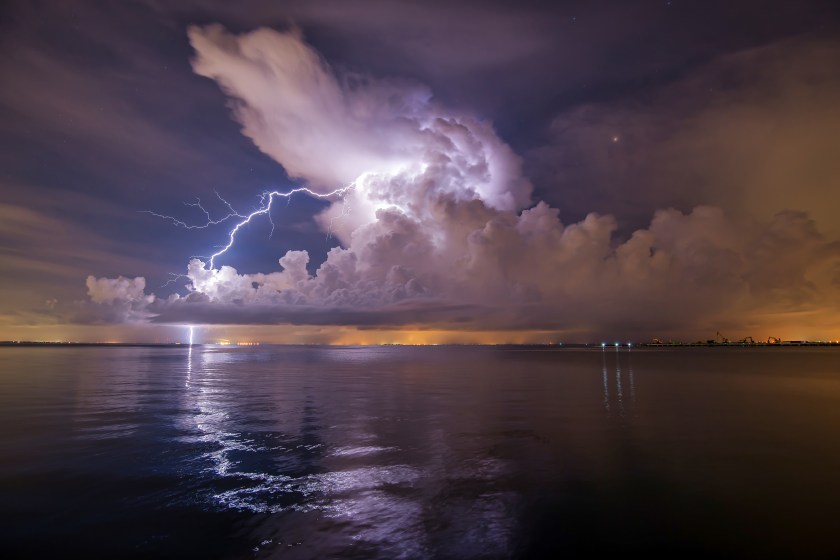
The image of a lightning strike over Tampa Bay, captured from Vinoy Park, showcases the photographer’s skill in storm photography. Using a Nikon D610, the thirty-second exposure reveals a dramatic interplay of colors and natural forces. This work highlights Florida’s weather patterns, merging urban and natural landscapes in a powerful visual narrative.

Long exposure photograph of lightning illuminating clouds over Tampa Bay, viewed from Vinoy Park in St. Petersburg, Florida.
Long exposure lightning strike over Tampa Bay from Vinoy Park.

Among the most technically demanding and visually arresting images in Chapter 2 of the photographer’s Top 100 Journey, this capture of a lightning strike over Tampa Bay represents a masterful convergence of patience, preparation, and meteorological fortune. Photographed from Vinoy Park in St. Petersburg, the image transforms a transient weather event into a sustained meditation on nature’s raw power and the atmospheric spectacle that defines Florida’s subtropical climate.

The composition presents a study in horizontal stratification—water, distant shoreline, and sky arranged in classical landscape proportions, yet animated by the extraordinary electrical discharge that commands the frame’s center. A single lightning bolt descends vertically through towering cumulonimbus clouds, creating a luminous column that connects the charged atmosphere to the bay’s surface. The strike illuminates the cloud structure from within, revealing billowing formations in shades of pearl, lavender, and steel blue against a gradient sky that transitions from deep indigo to warm amber.

Technical execution reflects the specialized demands of storm photography. Working with a Nikon D610 at the wide end of an 18-35mm lens, the photographer selected an 18mm focal length to encompass both the expansive cloud system and the reflective water below. The thirty-second exposure at f/5.6 and ISO 400 represents a calculated approach to lightning capture—a long enough duration to increase the probability of recording a strike within the frame, yet controlled enough to prevent overexposure of ambient light sources visible along the distant horizon. This extended shutter speed also smooths the bay’s surface into a mirror-like plane, its subtle texture suggesting gentle motion while maintaining enough definition to anchor the composition.

The color palette distinguishes this work within the chapter’s broader collection. Where the architectural study of Signature Place employed monochrome austerity, this image embraces the full chromatic range of atmospheric phenomena. The storm cell’s cool blues and purples contrast with the warm ochre glow infiltrating from the right edge of the frame—likely light pollution from Tampa’s urban corridor or residual sunset illumination scattered through distant clouds. This interplay of cool and warm tones creates visual tension that enhances the image’s dramatic impact without resorting to artificial enhancement.

Within Chapter 2’s exploration of Florida Landscapes & Cityscapes, this photograph occupies essential territory. Florida’s identity remains inextricably linked to its volatile weather patterns—the daily thunderstorm cycles of summer, the atmospheric electricity that makes the state the lightning capital of North America. By documenting this phenomenon, the photographer engages with environmental storytelling that moves beyond picturesque representation toward a more complete portrait of place.

The work also demonstrates sophisticated understanding of the sublime in contemporary landscape photography. The tradition of depicting nature’s awesome power—from nineteenth-century Romantic painters to mid-century photographers like Ansel Adams capturing Sierra storms—finds fresh expression here. The lightning strike serves as both subject and metaphor: a literal discharge of atmospheric energy and a symbolic representation of nature’s capacity to humble human observers.

Viewed alongside the chapter’s urban architectural studies, this image provides necessary balance. Together, these photographs suggest a photographer equally attentive to built and natural environments, capable of finding visual poetry in glass towers and electrical storms alike. Such range indicates a mature artistic vision—one that recognizes Florida’s complexity as both a site of intensive human development and a landscape still subject to forces beyond human control.

Vertical Ascension: Modernist Form in Downtown St. Petersburg

The black and white photograph of the Signature Place high-rise in St. Petersburg captures its architectural monumentality through a minimalist lens. Stripping color emphasizes form and texture, while a dynamic composition highlights urban development. The work reflects the photographer’s evolving vision, merging documentary and artistic interpretation within contemporary architectural photography.

Black and white low‑angle photograph of the Signature Place condominium tower in downtown St. Petersburg, Florida, showing strong geometric lines and modern architecture.
Black and white architectural study of the Signature Place high‑rise in downtown St. Petersburg.

In this striking image from Chapter 2 of the photographer’s Top 100 Journey, the Signature Place Condominium tower emerges as a study in architectural monumentality and photographic restraint. Shot in downtown St. Petersburg, Florida, the photograph transforms a contemporary residential structure into something both documentary and abstract—a meditation on verticality, light, and the geometric language of modern urban development.

The decision to render this scene in black and white proves essential to the image’s success. By stripping away color, the photographer directs attention to the fundamental elements of architectural photography: form, texture, and tonal gradation. The building’s repetitive window pattern creates a rhythmic grid that draws the eye upward, while the dramatic contrast between the illuminated facade and the darkening sky suggests a specific moment of transition—likely the golden hour, when natural light rakes across surfaces to reveal dimension and depth.

Technical execution demonstrates thoughtful consideration of both optics and exposure. Working at 35mm on an 18-35mm lens mounted to a full-frame Nikon D610, he selected a narrow aperture of f/18 to maximize depth of field and ensure crisp detail throughout the frame. The resulting sharpness allows the viewer to appreciate the building’s material qualities—the interplay of glass, concrete, and steel that defines contemporary high-rise construction. A shutter speed of 1/8 second at ISO 100 suggests the use of a tripod, essential for maintaining clarity at this exposure length while preserving clean shadow detail.

The composition employs a low vantage point that accentuates the tower’s dramatic thrust skyward. This perspective, common in architectural photography but executed here with particular effectiveness, creates a sense of imposing scale while maintaining architectural integrity. The building’s angular crown punctures the upper portion of the frame, while a lower podium structure grounds the composition and provides contextual anchoring in the urban landscape.

Within the broader framework of Chapter 2—Florida Landscapes & Cityscapes—this photograph represents an important counterpoint to the state’s more commonly photographed natural environments. Rather than beaches, wetlands, or subtropical flora, the photographer turns his lens toward Florida’s built environment, acknowledging the contemporary reality of rapid urban development along the Gulf Coast. St. Petersburg’s downtown skyline, transformed dramatically over recent decades, serves as a compelling subject for examining how modern architecture reshapes regional identity.

The image also speaks to the photographer’s evolving vision throughout the Top 100 Journey. Where other selections might emphasize natural wonder or environmental preservation, this work demonstrates equal comfort with urban subject matter. The modernist aesthetic—clean lines, geometric precision, monochromatic palette—suggests an appreciation for architectural form as a legitimate subject for serious photographic inquiry.

What elevates this photograph beyond mere documentation is its atmospheric quality. The graduated sky, rendered in smooth tones from deep black to luminous gray, provides a canvas against which the building performs. The partially visible vegetation at the frame’s base hints at the subtropical context without overwhelming the primary subject. This careful balance between architectural documentation and artistic interpretation positions the work within a tradition extending from early twentieth-century modernist photography through contemporary fine art practice—a lineage that recognizes buildings not merely as structures to be recorded, but as forms to be interpreted.

Tampa Night Skyline: The City as Light Performance

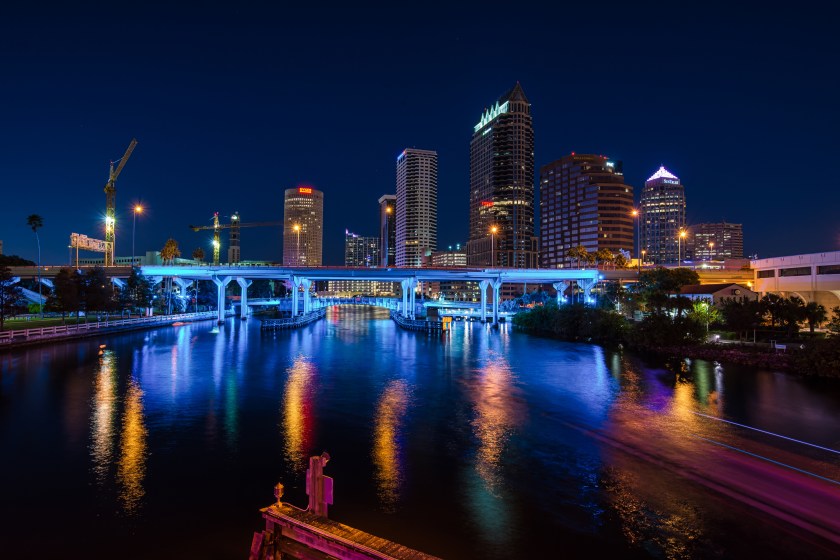
The photograph of Tampa’s skyline from the Platt Street Bridge highlights the vibrant interplay between urban light and architecture at night. With a balanced eight-second exposure, it captures the city’s dynamic illumination, showcasing rich colors reflected in water. The composition balances sleek design and texture, embodying Tampa’s architectural evolution.

Nighttime long exposure photograph of the Tampa, Florida skyline viewed from the Platt Street Bridge over the Hillsborough River.
Long exposure night view of the Tampa skyline from the Platt Street Bridge.

This nocturnal view of Tampa’s downtown district, captured from the Platt Street Bridge, represents a pivotal exploration within Chapter 2—Florida Landscapes & Cityscapes—where the photographer turns his lens toward the performative qualities of urban illumination. Unlike the contemplative stillness of his four-minute dusk exposure, this eight-second capture embraces the vibrancy of the city after dark, revealing Tampa as a stage for artificial light in conversation with architectural form.

The technical approach demonstrates confident command of night photography fundamentals. Shot at 21mm with an aperture of f/10.0, the image achieves comprehensive sharpness while managing the intense point-source lights that define the scene. The eight-second exposure strikes a careful balance: long enough to smooth the water’s surface into a receptive canvas for reflection, yet brief enough to preserve the individual character of each light source without excessive bloom or halation. An ISO of 160 keeps noise minimal while allowing the sensor to capture the full tonal range from the deep navy of the evening sky to the brilliant architectural accent lighting.

The composition is anchored by the dramatically illuminated bridge structure, its cyan LED lighting creating an almost theatrical proscenium that frames the skyline beyond. This choice of vantage point—shooting through the bridge rather than merely of it—adds dimensional complexity, transforming infrastructure into compositional architecture. The repeating vertical supports create rhythm and depth, while the horizontal span provides structural stability to an image otherwise dominated by vertical towers.

What distinguishes this photograph within the photographer’s evolving body of work is its embrace of saturated, polychromatic illumination. The water becomes a liquid prism, fragmenting and multiplying the city’s light signature into vertical streaks of cyan, magenta, amber, and emerald. These reflections possess an almost painterly quality, their chromatic intensity suggesting influence from both contemporary light art and the neon-soaked aesthetics of urban night photography. The contrast between the cool blue bridge lighting and the warmer tones emanating from building facades and street lamps creates visual tension that energizes the entire frame.

The foreground element—a wooden dock structure with visible weathering and industrial hardware—provides crucial textural counterpoint to the sleek glass and steel beyond. This detail grounds the image in physical reality, preventing it from dissolving into pure abstraction despite the transformative effects of artificial light on water. It’s a gesture toward documentary honesty within what might otherwise read as a celebration of spectacle.

Contextually, the inclusion of construction cranes in the left background speaks to Tampa’s ongoing transformation, capturing a specific moment in the city’s architectural timeline. These industrial silhouettes, backlit against the evening sky, add temporal specificity while contributing vertical accents that echo the tower forms they’re constructing.

Within the broader narrative of the Top 100 Journey, this image demonstrates the photographer’s expanding vocabulary for depicting Florida’s urban environments. Where natural landscapes might offer subtlety and organic complexity, cityscapes present their own challenges: managing competing light sources, finding order within density, revealing beauty in the manufactured. His success here lies in recognizing that the contemporary city at night is fundamentally an installation of light—one that reveals itself fully only through the camera’s ability to accumulate and organize photons across time.

Tampa Skyline Long Exposure: A Study in Urban Stillness

This long exposure photograph of Tampa’s skyline captures the city at dusk, highlighting the interplay of light, architecture, and time. With a 241-second exposure, the image transforms the water into a reflective surface, merging urban forms and enhancing their beauty. The composition emphasizes symmetry and color, inviting deeper appreciation of urban landscapes.

Long exposure dusk photograph of the Tampa, Florida skyline with illuminated buildings and reflections on the Hillsborough River.
Long exposure dusk view of the Tampa skyline with river reflections.

Within the framework of Chapter 2—Florida Landscapes & Cityscapes—this long exposure photograph of Tampa’s downtown core represents a sophisticated meditation on the intersection of natural light, architectural form, and temporal manipulation. Shot at dusk from across the Hillsborough River, the image captures the city skyline in a state of suspended transition, where the photographer’s technical mastery serves to transform a familiar urban vista into something altogether more contemplative.

The technical specifications reveal deliberate choices that speak to the photographer’s evolving understanding of long exposure craft. An exposure time of 241 seconds—over four minutes—has rendered the water’s surface into a mirror-like plane of silk, creating an almost supernatural calm that contrasts sharply with the structural solidity of the buildings above. This extended duration collapses time, erasing the ephemeral movements of waves and current to reveal something closer to the river’s essential character. The choice of an 18mm focal length at f/8.0 provides expansive depth of field while maintaining critical sharpness across the entire frame, from the foreground water to the distant architectural pinnacles.

The composition demonstrates a rigorous formalism. The horizontal bands of bridge infrastructure bisect the frame at roughly the golden ratio, their purple-lit supports creating rhythmic vertical elements that guide the eye through the middle ground. The skyline itself presents as a study in geometric variation: cylindrical towers, angular glass facades, and the distinctive peaked crown of the tallest structure each catch and reflect the fading daylight in subtly different ways. The photographer has positioned himself to capture not merely the buildings themselves, but their perfect inversions in the still water below, creating a symmetry that doubles the visual information while emphasizing the transformative effect of his chosen technique.

Color plays a crucial role in the image’s success. The graduated sky transitions from warm peachy tones at the horizon to deepening blue overhead, providing a naturalistic backdrop that throws the artificial illumination into relief. The purple accent lighting on the bridge structure introduces an unexpected chromatic note, while the warm reflections—amber, gold, and rose—animate the lower half of the frame with points of concentrated light. This interplay between cool atmospheric tones and warm architectural lighting creates visual tension that keeps the eye engaged despite the overall compositional stillness.

The small electronic device visible in the immediate foreground—likely the camera’s intervalometer—serves as an unintentional but effective scale reference, grounding the viewer’s perspective and subtly acknowledging the technical apparatus required to achieve such results. It’s a moment of transparency that connects the finished image back to its means of production.

Within the broader arc of the Top 100 Journey project, this Tampa skyline represents the photographer’s deepening engagement with Florida’s urban environments as subjects worthy of the same sustained attention he brings to natural landscapes. The long exposure technique, applied here to a cityscape, reveals patterns and qualities invisible to ordinary perception—the fundamental architecture of light, the liquidity of solid water, the strange beauty of modern cities seen through the lens of time. It’s work that asks viewers to reconsider what they think they know about familiar places, finding in them unexpected dimensions of visual poetry.

Cocoa Beach Pier Sunrise: Architecture in Dialogue with the Atlantic

The photograph of Cocoa Beach Pier captures a sunrise through meticulous long exposure, transforming the landmark into a study of light and architecture. The image emphasizes structural details, blending engineering with nature. It highlights Florida’s coastal identity, embodying resilience and the interplay between human construction and natural forces against the backdrop of a serene seascape.

Long exposure sunrise photograph of the Cocoa Beach Pier in Florida, showing wooden pilings, warm light on the horizon, and reflections on wet sand.
Sunrise over the Atlantic Ocean at the Cocoa Beach Pier, captured in a long exposure.

Within Chapter 2 of the Top 100 Journey—Florida Landscapes & Cityscapes—this sunrise study of the Cocoa Beach Pier represents the photographer’s engagement with one of Florida’s most iconic coastal structures. Captured with deliberate technical restraint, the image transforms a familiar landmark into a meditation on light, time, and the intersection of human construction with natural forces.

The photograph was executed during the liminal hour of sunrise, that brief window when the sun emerges from the Atlantic horizon, casting warm, directional light across the scene. The photographer positioned himself beneath the pier’s substantial wooden framework, creating a composition that emphasizes the structure’s engineering and architectural presence. The pilings—weathered cylinders marked by barnacles and tidal wear—march in rhythmic repetition from foreground to background, their reflections doubling in the wet sand left by receding waves. This repetition creates visual cadence, leading the viewer’s eye through the layered space beneath the pier toward the glowing horizon.

The technical execution reveals calculated decision-making. Shooting at f/16 with a ten-second exposure on ISO 100, the photographer achieves several objectives simultaneously: the narrow aperture ensures sharpness throughout the deep composition, from the foreground sand texture to the distant pier house; the extended exposure time smooths the ocean into a misty, ethereal plane, contrasting with the solid geometry of wood and metal; and the low ISO preserves maximum image quality in the challenging dynamic range between shadowed understructure and brilliant sunrise. The 20mm focal length on a full-frame Nikon D610 provides sufficient width to capture the pier’s span while maintaining rectilinear integrity in the vertical pilings.

What distinguishes this work is its treatment of architectural form within the natural environment. Rather than photographing the pier as a tourist attraction—a vantage point from which to view the ocean—the photographer inverts the relationship, making the structure itself the primary subject while the seascape becomes supporting element. The underside perspective reveals construction details typically ignored: diagonal cross-bracing, the density of support columns, the engineering solutions required to anchor a recreational structure in shifting sand and relentless surf. The barnacle-encrusted pilings become textural studies, documenting the biological claim that marine life makes on human infrastructure.

The color palette reinforces the temporal specificity of the moment. Golden light bathes the right side of the frame, warming the wooden planks and casting long shadows that define the pier’s three-dimensional form. The left side remains in relative shadow, creating tonal gradation that adds depth and volume. The sky transitions from warm cream near the sun to deeper blue overhead, while the smoothed water reflects this gradient, creating visual harmony between sky and sea.

Within the broader context of Florida Landscapes & Cityscapes, this image represents the photographer’s recognition that Florida’s coastal identity includes not only pristine natural beauty but also the structures through which residents and visitors experience that environment. The Cocoa Beach Pier, a mid-century landmark rebuilt multiple times after hurricane damage, embodies Florida’s complicated relationship with its shoreline—simultaneously celebrating and challenging the power of the Atlantic.

The photograph ultimately documents persistence: of structures rebuilt after storms, of daily tides that reshape the beach, of light that returns each morning to illuminate the coast.

Tampa Panoramic at Night: A Study in Urban Luminescence

The panoramic long exposure photograph of downtown Tampa captures its urban beauty at night from the University of Tampa. This 2014 composition emphasizes artificial light’s role in depicting the cityscape, blending architectural detail and varied illumination. It challenges perceptions of Florida, asserting urban environments as significant alongside natural landscapes, showcasing the photographer’s technical skill and versatility.

Panoramic long exposure composite of downtown Tampa, Florida, photographed at night from across the Hillsborough River, showing illuminated skyscrapers, waterfront reflections, and dramatic clouds.
Panoramic long exposure view of downtown Tampa at night, captured from the UT campus across the Hillsborough River.

In this commanding 2014 panoramic composite, the photographer captures downtown Tampa’s nocturnal identity with technical precision and compositional sophistication. Selected for Chapter 2 of his Top 100 Journey—Florida Landscapes & Cityscapes—the image represents a pivotal moment in his exploration of urban environments, where the built landscape becomes a canvas for light, reflection, and architectural rhythm.

The photograph was executed from the University of Tampa campus, positioned across the Hillsborough River to establish both physical and aesthetic distance from the subject. This vantage point proves strategic: the river functions not merely as foreground but as an active participant in the composition, its surface transforming into a liquid mirror that doubles the visual impact of the skyline. The long exposure technique smooths the water into a reflective plane, allowing the city’s illumination to paint streaks of gold, pink, and violet across the lower third of the frame.

What distinguishes this work within the chapter’s broader narrative is its treatment of artificial light as a defining characteristic of place. While Florida’s natural landscapes—its coastlines, wetlands, and subtropical flora—typically dominate photographic representations of the state, this image asserts the validity of the urban experience as equally worthy of documentation. The photographer approaches Tampa’s skyline not as an intrusion upon nature but as a distinct ecosystem of glass, steel, and light, possessing its own aesthetic logic and visual poetry.

The panoramic format extends the horizontal axis, emphasizing the sprawl and variety of Tampa’s architectural character. Twin residential towers anchor the composition’s center, their construction-phase lighting creating vertical counterpoints to the horizontal sweep of the skyline. To the right, a cylindrical high-rise glows amber, its illuminated facade creating a beacon within the frame. The building adorned with pink-magenta accent lighting introduces chromatic variation, preventing the warm-toned dominance from becoming monotonous. This diversity of illumination—commercial, residential, decorative—reveals the stratified nature of urban nightscapes, where different lighting purposes create unintentional visual harmony.

The technical execution merits attention. Creating a panoramic composite requires not only multiple exposures stitched seamlessly but also consistent exposure values across frames and careful management of the long exposure duration. The photographer balances ambient light with the stronger point sources of building illumination, preventing blown highlights while retaining detail in darker architectural elements. The clouded sky, rendered in motion-blurred copper tones, provides textural contrast to the sharp geometry below.

Within the context of the Top 100 Journey, this image demonstrates the photographer’s versatility in approaching Florida’s varied visual territories. While subsequent work in this chapter may explore the state’s natural drama—storm systems over the Gulf, the crystalline waters of its springs, the atmospheric density of its wetlands—this urban portrait establishes his comfort with diverse subject matter and technical approaches. The photograph argues for Tampa’s inclusion in the visual narrative of Florida, asserting that the state’s identity encompasses both wilderness and metropolitan sophistication.

The image remains a testament to the possibilities inherent in patient observation and technical mastery, transforming a familiar skyline into a study of light, color, and urban form.

Under Naples Pier at Sunset: Architecture Meets the Ethereal

Greg Urbano’s long exposure photograph beneath Naples Pier captures the interplay of human architecture and nature, highlighting time and impermanence. Shot with meticulous technique, the image transforms a familiar locale into a contemplative space where smooth Gulf waters contrast with weathered pilings, emphasizing Florida’s geography and the enduring power of the natural world.

Long exposure photograph taken beneath the Naples Pier in Florida, showing weathered support columns receding into the distance with smooth, blurred water and soft sunset light.
Long exposure view beneath the Naples Pier in Florida, captured with softened water and warm evening light.

In Greg Urbano’s exploration of Florida’s coastal landscapes, this long exposure beneath Naples Pier represents a masterful convergence of structural geometry and natural fluidity. The photograph transforms a familiar tourist destination into something altogether more contemplative—a meditation on time, permanence, and the quiet persistence of natural forces.

The technical execution reveals deliberate artistic choices that elevate the image beyond documentary. Shot at a 30-second exposure with an aperture of ƒ/10, Urbano allows the Gulf waters to smooth into an almost supernatural plane of silk, while the pier’s wooden pilings remain sharply rendered, their weathered surfaces recording years of salt spray and tidal rhythms. The ISO 100 setting preserves exceptional clarity in both the concrete deck overhead and the barnacle-encrusted bases of each column, where marine life has claimed the structure as its own.

What distinguishes this photograph within the Florida Landscapes & Cityscapes chapter is its unique vantage point. Rather than capturing the pier from the beach or along its walkway—the conventional approaches—Urbano positions himself in the liminal space beneath, where human architecture and marine environment intersect. This perspective creates a vanishing point that draws the eye through the repetitive columns, suggesting infinity while simultaneously framing the horizon in measured increments. The composition speaks to Florida’s essential character: a place where human development exists in constant negotiation with water, weather, and an environment that ultimately cannot be controlled.

The color palette captures that transitional moment when day surrenders to evening. Soft blues dominate the frame, punctuated by warmer tones filtering through the gaps between pilings where the setting sun still reaches. The long exposure has rendered a handful of beachgoers as ghostly presences, barely perceptible in the distance—a reminder that even in this serene moment, human activity continues, though made insignificant by the photograph’s emphasis on timelessness over immediacy.

The textural contrasts throughout the frame reward sustained viewing. The smooth, almost liquid sand in the foreground shows subtle patterns from receding water, while the pier pilings display years of weathering—concrete cracking and staining, wooden supports silvered by sun and salt. Most striking are the organic clusters clinging to each column where water regularly submerges them, dark masses of mussels and barnacles that testify to the structure’s dual existence above and below the tideline.

This image exemplifies why Urbano selected Naples Pier for inclusion in his exploration of Florida’s diverse landscapes. The state’s geography is defined by its relationship with water—the Atlantic, the Gulf, the Everglades, countless rivers and springs. Here, that relationship is made architectural, structured, yet the photograph ultimately reveals nature’s quiet supremacy. The pier may impose order with its regular spacing and engineered strength, but the barnacles reclaim it, the water smooths away footprints, and time—made visible through long exposure—reveals the impermanence of even our most solid constructions.

Within the broader context of the Top 100 Journey, this photograph demonstrates Urbano’s ability to find fresh perspectives on familiar subjects, transforming a popular sunset location into a study of geometry, time, and the persistent dialogue between built and natural environments that defines Florida’s coastal identity.