Colorado Capital Rotunda: Vertical Aspiration and Ornamental Complexity

The photograph of the Colorado State Capitol rotunda represents a shift in architectural perspective, focusing on the interior’s ornate details rather than external views. Using a wide-angle lens, the image captures the dome’s grandeur and intricate design, embodying the civic experience and inviting public engagement while highlighting historical and democratic ideals.

Upward view of the ornate rotunda ceiling inside the Colorado State Capitol, showing concentric arches and a central skylight.
An interior view looking up into the rotunda of the Colorado State Capitol in Denver, Colorado.

This interior study of the Colorado State Capitol rotunda marks a significant compositional departure within Chapter 3 of the Top 100 Journey. Where previous images in this collection have examined architecture from external vantage points—emphasizing façade, silhouette, and contextual placement—this photograph inverts the perspective, directing the viewer’s gaze upward through concentric rings of ornamental detail toward a luminous oculus. The shift from exterior monumentality to interior intimacy reveals the photographer’s expanding investigation of how architectural space shapes civic experience and visual perception.

Shot with a Nikon D610 and an 18-35mm f/3.5-4.5 lens at 19mm, the wide-angle focal length proves essential to capturing the rotunda’s full vertical sweep within a single frame. The fisheye-like distortion inherent at this focal length amplifies the dome’s centripetal geometry, creating a vortex effect that draws the eye inexorably toward the coffered ceiling and its central aperture. The exposure settings—f/8.0 at 1/10s, ISO 400—balance the need for depth of field across multiple architectural tiers with the practical constraints of handheld low-light shooting. The resulting image maintains sharpness from the foreground balustrade through to the uppermost decorative elements.

The color palette divides into two distinct thermal zones. Warm golden tones dominate the lower registers, where artificial lighting illuminates gilt detailing, coffered panels, and classical ornamentation. These warm hues gradually transition to cooler whites and pale blues as the eye travels upward, culminating in the natural daylight filtering through the oculus. This chromatic shift reinforces the spiritual and hierarchical symbolism embedded in rotunda architecture—earthly richness below, celestial purity above—while simultaneously demonstrating the photographer’s attentiveness to mixed lighting conditions.

Compositional rigor anchors what could easily become visual chaos. The photographer positions himself at the precise center point beneath the dome, ensuring perfect radial symmetry. This decision transforms architectural documentation into geometric meditation, where repeating patterns of coffering, balustrades, and Corinthian capitals establish rhythmic visual cadence. The inclusion of the ornate balustrade in the lower left introduces human scale and tactile detail, preventing the image from becoming pure abstraction while emphasizing the building’s accessibility—a public space designed for citizen engagement.

Within the broader narrative of Chapter 3, this rotunda photograph functions as conceptual bridge between exterior civic monumentality and the quotidian experience of urban space. It reveals what lies beneath the gilded dome captured in his nocturnal exterior study, exposing the elaborate craftsmanship and symbolic program that nineteenth-century architects employed to manifest democratic ideals through built form. The image documents not merely architectural opulence but the spatial theater of governance—the designed environment through which political power seeks legitimacy through aesthetic grandeur.

The photographer’s note regarding access—”as simple as passing through a metal detector”—introduces subtle contemporary commentary. This threshold between public and civic space, between everyday citizen and architectural spectacle, becomes invisible in the final image yet remains conceptually present. The photograph captures a space designed for transparency and public access, its ornamental complexity serving not to exclude but to dignify the democratic project. In rendering this vertical architecture with technical precision and compositional thoughtfulness, the photographer documents both historical aspiration and ongoing civic function, making visible the constructed environments through which Colorado’s political identity continues to be performed and experienced.

Boulder Theater Marquee: Neon Vernacular and Urban Memory

The Boulder Theater marquee in Colorado signifies a shift in the photographer’s focus from grand landscapes to community identity through vernacular architecture. The vibrant neon colors and design highlight cultural memory and urban vitality, capturing the theater as a living space that merges historical aesthetics with contemporary relevance, reflecting the complexity of Colorado’s identity.

Neon-lit marquee of the Boulder Theater viewed from below against a deep blue evening sky.
The illuminated neon marquee of the Boulder Theater glows at night in Boulder, Colorado.

Within Chapter 3 of the Top 100 Journey—Colorado Landscapes & Cityscapes—this vibrant study of the Boulder Theater marquee represents a deliberate shift in the photographer’s engagement with place. Moving beyond natural terrain and monumental civic architecture, he turns his attention to vernacular structures that anchor community identity. The theater marquee, with its layered neon typography and saturated color palette, becomes a subject through which to examine cultural memory, commercial aesthetics, and the relationship between preservation and vitality in Colorado’s urban fabric.

The composition exploits the dramatic convergence of neon signage against the deepening blue hour sky. Shot at 28mm with the Sony FE 28-70mm f/3.5-5.6 OSS kit lens, the wide angle captures the marquee’s full architectural gesture—the sweeping curves of blue neon tubing that frame the illuminated message board, the iconic “Boulder” script rendered in brilliant red and orange, and the classic Art Deco detailing that situates this structure within a specific historical moment. The exposure settings—f/5.6 at 1/125s, ISO 400—balance ambient light with the intense luminosity of the neon, preventing blown highlights while maintaining detail in the surrounding architecture.

Color becomes the image’s primary narrative force. The red-to-orange gradient of the “Boulder” lettering contrasts sharply with the cool blue neon below, creating complementary tension that draws the eye across the frame. The yellow marquee board, studded with bulbs and announcing “BOOMTOWN DEMO D,” introduces a third chromatic element while grounding the image in specificity and time. This is not a sanitized historical recreation but a working theater captured mid-programming, its marquee functioning as intended—communication, invitation, spectacle.

The photographer’s decision to include surrounding context—the modern glass facade rising behind the vintage marquee, the darkening sky, the subtle presence of street elements—situates the theater within its contemporary environment rather than isolating it as nostalgic artifact. This approach speaks to his evolving methodology within the chapter, where place is understood not as static subject but as palimpsest, layered with temporal and cultural inscriptions. The Boulder Theater, a 1906 structure renovated and preserved, embodies this complexity: historic form activated by present-day use.

The low vantage point emphasizes the marquee’s projecting geometry, its thrust into public space. This compositional choice transforms signage into sculpture, highlighting the physicality of mid-century commercial architecture. The neon tubing, with its visible mounting hardware and electrical infrastructure, reveals construction and craft—elements often obscured in more polished architectural photography but celebrated here as integral to authenticity.

Within the broader trajectory of Chapter 3, the Boulder Theater image functions as cultural counterpoint to wilderness landscapes and governmental monuments. It represents Colorado’s smaller-scale urban centers, places where preservation efforts maintain continuity with architectural heritage while accommodating contemporary cultural production. The theater becomes microcosm—a site where community gathers, where entertainment and commerce intersect, where historical aesthetics remain relevant.

The photographer captures not merely a building but an experience of place, translating the visceral impact of neon light into two-dimensional form. In doing so, he documents Colorado’s layered identity: natural grandeur, civic aspiration, and the quieter vernacular spaces where daily life unfolds. The marquee, brilliant against evening sky, asserts that urban landscapes possess their own compelling beauty—electric, temporal, human-scaled, and essential to understanding the full spectrum of place.

Colorado Capital Rotunda: A Study in Civic Monumentality

The photograph of the Colorado State Capitol at night showcases the blend of technical skill and atmospheric expression in architectural photography. Captured during the blue hour, it emphasizes the dome’s gilded brilliance against a cobalt sky, revealing a balance of light, color, and human presence, while symbolizing civic power and cultural heritage.

Night view of the Colorado State Capitol dome with a motion-blurred American flag against a deep blue sky.
The illuminated rotunda of the Colorado State Capitol rises above the building exterior at night in Denver, Colorado.

In this commanding nocturnal study of the Colorado State Capitol, the photographer demonstrates a refined understanding of architectural photography’s dual responsibilities: technical precision and atmospheric interpretation. Selected for Chapter 3 of his Top 100 Journey project—Colorado Landscapes & Cityscapes—this image represents a pivotal moment in his exploration of the built environment, where civic architecture becomes a vehicle for examining light, color, and symbolic presence.

The composition centers on the capitol’s gilded dome, captured during the blue hour when natural and artificial light exist in delicate equilibrium. This timing proves essential to the photograph’s success. The deep cobalt sky provides a saturated backdrop that amplifies the dome’s golden luminosity, creating a color relationship that feels both dramatic and harmonious. The warm interior lights visible through the arched windows add a third tonal layer, suggesting human activity within the monumental structure and grounding the image in the present moment rather than rendering it as pure abstraction.

Technical choices reveal deliberate restraint. Shot with a Sony A7 II and the modest FE 28-70mm f/3.5-5.6 OSS kit lens at 67mm, the equipment demonstrates that compelling imagery emerges from vision rather than gear acquisition. The exposure settings—f/6.3 at two seconds, ISO 50—indicate careful balancing of depth of field with the need to maintain sharpness during a moderately long exposure. The low ISO preserves image quality while the aperture ensures adequate detail across the dome’s ornate surface. The two-second shutter speed captures the flag’s motion blur, introducing a kinetic element that contrasts with the building’s permanence.

The symmetrical framing amplifies the capitol’s authority. By positioning the dome centrally and shooting from a low vantage point, the photographer emphasizes verticality and grandeur, compositional strategies long employed in architectural documentation to convey institutional power. Yet this image transcends mere documentation. The illuminated structure against the darkening sky transforms civic architecture into something more atmospheric—a beacon, a sculptural form isolated from its urban context.

Within the broader narrative of Chapter 3, this photograph serves as an essential counterpoint to natural landscape work. Where mountain vistas and wilderness scenes explore Colorado’s geological character, the capitol image examines human imprint on the landscape. The gold-leafed dome—a material detail worth noting for its literal and metaphorical weight—echoes the state’s mining heritage while asserting permanence and prosperity. The photographer captures not merely a building but a symbol, rendering it with enough aesthetic sophistication that the image functions simultaneously as architectural record and contemplative study.

The cool base lighting washing across the pediment introduces contemporary illumination techniques into classical architecture, creating temporal layering that speaks to preservation and adaptation. This detail, easily overlooked, suggests the photographer’s attention to how light shapes meaning and perception.

As part of the Top 100 Journey, this image demonstrates evolving technical confidence and conceptual maturity. The photographer moves beyond straightforward landscape capture toward work that interrogates place, power, and representation. The capitol becomes more than subject matter—it becomes a meditation on how we mark territory, assert identity, and illuminate what we value. In this nocturnal portrait of civic architecture, monumentality meets vulnerability, permanence meets fleeting light, and documentation becomes art.

Boulder Falls Long Exposure

The photograph of Boulder Falls captures the intricate interplay of water and rock in Colorado’s canyon, showcasing the photographer’s mastery of long exposure techniques. Using a Nikon D610, the image balances smooth water motion with structural clarity. This work signifies a matured artistic voice within the broader context of his evolving landscape photography.

Long-exposure view of Boulder Falls flowing over rocks into a shallow pool within a rocky canyon.
Long-exposure photograph of Boulder Falls cascading through a rocky canyon in Colorado.

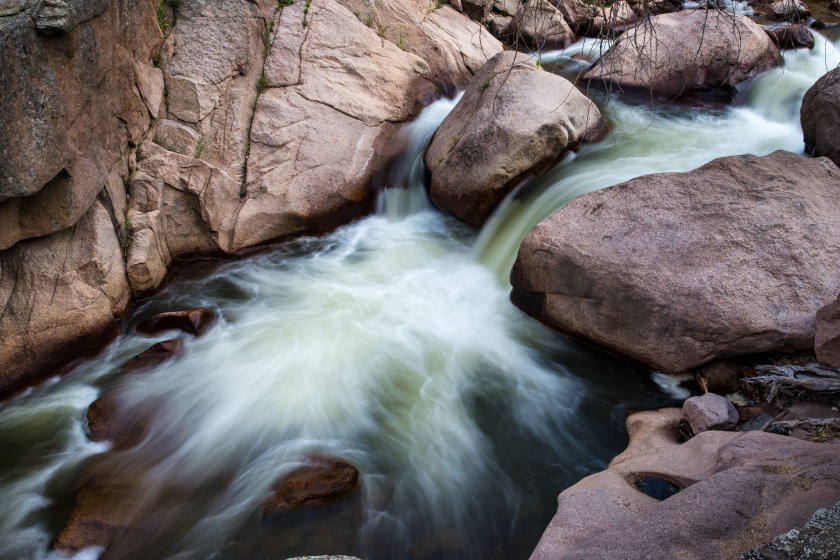
The photographer’s mastery of long exposure technique reaches full maturity in this commanding portrait of Boulder Falls, where water, stone, and light converge in a composition of remarkable spatial depth and textural complexity. Captured with a Nikon D610 and an 18-35mm f/3.5-4.5 lens at its widest setting of 18mm, the image employs a half-second exposure at ƒ/4.0 and ISO 100 to render cascading water as ethereal veils against the canyon’s ancient geological architecture.

The composition operates on multiple planes, drawing the eye through a carefully orchestrated visual journey. In the immediate foreground, stream-smoothed boulders—some dry and tan, others wet and rust-colored—create a rocky platform that grounds the viewer’s perspective. Water flows around and between these stones in delicate ribbons, their motion captured as soft blur that contrasts with the sharp detail of stationary rock. The middle ground presents the falls itself, a luminous white cascade plunging through a dramatic cleft in the granite amphitheater. Finally, the background reveals towering rock walls in warm earth tones, their fractured surfaces speaking to millennia of geological upheaval, crowned by evergreen forest and a brilliant blue sky.

What distinguishes this work from countless waterfall photographs is the photographer’s sophisticated understanding of how long exposure serves composition rather than merely creating predictable aesthetic effects. The half-second shutter speed proves precisely calibrated—long enough to smooth the water into silken forms while short enough to preserve structural definition in the cascade. The falls maintain sculptural presence rather than dissolving into amorphous white masses. Similarly, the foreground stream retains enough texture and gradation to read as water in motion rather than abstract blur.

The technical choices reveal deliberate control over the medium. The wide 18mm focal length encompasses the entire scene’s grandeur while maintaining exceptional corner-to-corner sharpness, crucial when working with such complex spatial relationships. The ƒ/4.0 aperture balances depth of field considerations—keeping both foreground rocks and distant walls acceptably sharp—with the light reduction necessary for the extended exposure. At ISO 100, the image maintains optimal clarity across its tonal range, from the brightest highlights in the falling water to the shadowed crevices in the surrounding stone.

The inclusion of this photograph in Chapter 3—Colorado Landscapes & Cityscapes—marks a significant development in the photographer’s journey. Where earlier chapters saw him exploring beyond Florida’s boundaries, this chapter formalizes Colorado as a central subject within his practice. The image embodies what might be termed “high country aesthetics”: the interplay of water and granite, the vertical drama of canyon topography, the crystalline light of elevated altitude. These elements recur throughout Rocky Mountain landscape photography, yet the photographer brings fresh eyes to familiar territory through precise craft and compositional intelligence.

Within the broader context of the Top 100 Journey project, “Boulder Falls Long Exposure” represents an artist who has moved beyond technical experimentation toward mature artistic voice. The photograph demonstrates that mastery emerges not from discovering novel techniques but from wielding established ones with intention, subtlety, and unwavering attention to the specific demands of place and moment.

Boulder Creek Long Exposure

The aerial photograph of Boulder Creek, captured with a DJI Mini 3 Pro drone, showcases a harmonious blend of long exposure techniques and modern technology. The composition balances flowing water and angular granite boulders, creating an abstract visual narrative that highlights the juxtaposition of motion and permanence in landscape photography.

Long-exposure view of flowing creek water cascading over large rocks in a narrow channel.
Long-exposure water flows over boulders in Boulder Creek along Boulder Canyon Drive, Colorado.

This aerial perspective of Boulder Creek represents a striking departure in both technical approach and creative vision, captured not with traditional camera equipment but with a DJI Mini 3 Pro drone equipped with a Freewell ND2000 filter. The photographer’s willingness to embrace emerging technologies while maintaining classical long exposure techniques demonstrates an adaptive practice that refuses to be constrained by conventional methodologies. Shot at 6.7mm with ƒ/1.7 aperture, 1/2 second exposure, and ISO 100, the image transforms cascading water and weathered granite into an abstract study of motion and permanence.

The aerial vantage point offers what might be termed a “god’s eye” perspective—looking directly down upon the creek as it navigates through massive boulders along Boulder Canyon Drive. This top-down orientation fundamentally alters the traditional landscape viewing experience. Rather than observing the scene from a human standpoint at creek level, the viewer hovers above, granted access to compositional relationships and water patterns typically invisible from ground perspective. The half-second exposure blurs the rushing water into silken ribbons that weave between dark stones, creating organic shapes that appear almost calligraphic against the textured rock surfaces.

The geological elements provide crucial counterpoint to the flowing water. Angular granite boulders, their surfaces marked by striations and mineral deposits, display warm ochre and gray tones that anchor the composition’s cooler water tones. These stones reveal billions of years of geological history—compression, uplift, erosion—rendered in layers and fractures visible even from the drone’s elevation. The photographer frames the scene to balance solid mass with liquid movement, allowing neither element to dominate but instead creating a dynamic equilibrium between opposing forces.

The technical execution demonstrates sophisticated problem-solving. Achieving long exposure effects from an airborne platform presents unique challenges—the drone itself must remain perfectly stable while the camera shutter stays open. The ND2000 filter proves essential, reducing light transmission sufficiently to permit a half-second exposure in daylight conditions without overexposure. At ƒ/1.7, the lens operates wide open, yet the minimal depth of field concerns inherent in macro or portrait photography become irrelevant when shooting from such elevation; everything within the frame exists at roughly equivalent focus distance.

Within Chapter 2—Florida Landscapes & Cityscapes—this Colorado waterway continues the photographer’s geographic expansion evident throughout this section of the Top 100 Journey. The consistent choice to photograph Rocky Mountain landscapes suggests deliberate exploration of environments radically different from Florida’s flat, subtropical character. Perhaps this juxtaposition serves the project’s broader narrative: an artist defining his vision through contrast, discovering what landscape means by experiencing its various manifestations across diverse topographies.

“Boulder Creek Long Exposure 001” ultimately represents the democratization of aerial perspective through consumer drone technology, married to time-honored long exposure aesthetics. The photographer recognizes that tools matter less than vision—that a small drone can produce work as artistically valid as traditional large-format equipment when wielded with intention and compositional awareness. The image stands as testament to adaptive practice in contemporary landscape photography, where technical innovation serves timeless artistic goals.

Black Forest

The photograph “Black Forest,” taken along Colorado Highway 14 in the Roosevelt National Forest, captures the aftermath of wildfire with striking clarity. The image, presented in monochrome, highlights resilience amidst destruction, showcasing charred pine trees against snow. Through meticulous technical execution, the artist transforms environmental tragedy into profound visual poetry.

all, fire-scarred pine trees rise from a snow-covered forest under an overcast winter sky.
Fire-scarred pine trees stand in deep snow along Colorado Highway 14 in the Roosevelt National Forest.

Stark verticality defines this haunting monochrome study captured along Colorado Highway 14 in the Roosevelt National Forest, where the photographer confronts the aftermath of wildfire with unflinching clarity. Titled “Black Forest,” the image transforms environmental tragedy into a meditation on resilience, absence, and the stark beauty found in landscapes marked by upheaval. Shot with a Sony Alpha a7 II equipped with a Samyang AF 18mm f/2.8 lens, the technical specifications—ƒ/11.0, 1/200s, ISO 100—reveal a photographer working with precision to render both foreground detail and atmospheric depth.

The composition presents a forest reduced to skeletal architecture. Charred pines, stripped of foliage by fire, rise as dark sentinels against pristine snow cover and a brooding sky. The wide-angle perspective at 18mm creates exaggerated depth, pulling the viewer into this expanse of vertical repetition. Trees march rhythmically across the frame, their bare trunks creating a natural grid that speaks simultaneously to destruction and order. The interplay between the blackened wood and white snow generates maximum tonal contrast—a decision reinforced by the photographer’s choice to render the scene in black and white during post-processing.

This monochromatic treatment proves essential to the image’s power. By eliminating color, the photographer strips away potential distraction, forcing attention to form, texture, and the dramatic chiaroscuro that defines the scene. The absence of color becomes metaphorically resonant, echoing the absence of living foliage. Shadows stretch across the snow-covered ground, cast by winter sun through the denuded canopy, creating secondary patterns that add visual complexity to the stark tableau.

The technical execution demonstrates sophisticated understanding of landscape photography fundamentals. The aperture choice of ƒ/11.0 provides substantial depth of field, ensuring sharpness from the foreground trees through to the distant background, while the relatively fast shutter speed of 1/200s freezes any potential wind movement in the upper branches. At ISO 100, the image maintains optimal clarity and tonal gradation—critical considerations when working in monochrome, where subtle gradations between black and white carry significant expressive weight.

The image’s inclusion within Chapter 2—Florida Landscapes & Cityscapes—continues the geographical expansion evident in this photographer’s evolving project. Again working far from Florida’s borders, he engages with Rocky Mountain topography and ecological narrative. This persistent geographic departure suggests an artist whose vision transcends regional documentation, seeking instead to explore universal themes of landscape transformation, human impact, and natural regeneration across diverse environments.

What distinguishes this work from mere documentation of fire damage is its formal rigor and unexpected aesthetic grace. The photographer finds pattern and rhythm in catastrophe, transforming a scarred forest into something approaching abstract composition. The trees function as both individual subjects and collective form—a forest that remains a forest even in its diminished state.

Within the broader context of the Top 100 Journey project, “Black Forest” represents an artist willing to engage with difficult environmental subjects while maintaining commitment to visual poetry. The photograph neither exploits tragedy nor sanitizes it, instead offering honest witness rendered through thoughtful craft—a balance that marks mature artistic vision.

Big Thompson Long Exposure

The photograph of the Big Thompson River showcases a masterful interplay of permanence and fluidity through long exposure techniques. Captured in Colorado, the image emphasizes detail in granite boulders alongside soft, flowing water. It reflects the photographer’s evolving artistic journey, expanding thematic boundaries while presenting a cohesive and naturalistic landscape composition.

Long exposure view of fast-moving water flowing over a rocky drop on the Big Thompson River between granite boulders.
Water flows over a small rocky drop along the Big Thompson River, photographed with a long exposure.

The photographer’s technical mastery converges with natural drama in this commanding study of the Big Thompson River, captured in Colorado’s rugged high country. Shot with a Sony Alpha a7 II paired with the Sony FE 28-70mm f/3.5-5.6 OSS lens at 62mm, the image employs long exposure technique enhanced by neutral density filtration to transform rushing water into ethereal ribbons of motion. At ƒ/9.0 and ISO 50, the exposure settings reveal a deliberate approach to capturing both sharpness in the surrounding geology and the silken blur of flowing water.

What immediately arrests the viewer is the dramatic interplay between permanence and fluidity. Massive granite boulders—textured, ancient, immovable—frame a cascade that appears simultaneously powerful and gossamer-soft. The long exposure technique transforms the torrent into bands of cream and amber, creating visual movement that guides the eye through the composition in sweeping arcs. The golden tint in the water suggests the presence of sediment or tannins, lending warmth to what might otherwise read as a cool mountain scene.

The compositional architecture demonstrates sophisticated understanding of visual weight and balance. A substantial boulder occupies the right foreground, its weathered surface rendered in exquisite detail, while a piece of driftwood creates a diagonal element that adds depth and natural geometry. The left side reveals stratified rock walls, their vertical presence providing counterpoint to the horizontal flow. This triangulation of elements—stone, water, wood—creates a cohesive environmental portrait rather than merely documenting a waterfall.

The inclusion of this image within Chapter 2—Florida Landscapes & Cityscapes—presents an intriguing curatorial question. Clearly captured in Colorado’s Rocky Mountain ecosystem rather than Florida, the photograph signals an expansion in the photographer’s geographical scope and thematic boundaries. This apparent departure from the chapter’s titular focus suggests an evolving artistic journey, one where the photographer moves beyond regional constraints to explore universal themes of landscape and natural process. Perhaps the chapter title reflects the photographer’s home base or primary focus, while individual works demonstrate his widening field of exploration.

The technical execution reveals growing confidence with long exposure photography as a expressive tool. The neutral density filter allows for extended exposure times in daylight conditions, creating that characteristic motion blur while maintaining proper exposure across the frame’s dynamic range. The choice of ƒ/9.0 ensures adequate depth of field to keep both foreground rocks and background elements acceptably sharp, a critical consideration in landscape work where context matters as much as subject.

What elevates this beyond technical exercise is the photographer’s eye for natural composition. The cascade’s S-curve creates inherent grace, while the careful positioning relative to the boulder forms suggests patient observation and deliberate framing. The subdued color palette—grays, tans, muted greens—speaks to naturalistic rendering rather than heightened saturation, allowing texture and form to dominate over chromatic spectacle.

Within the broader trajectory of the Top 100 Journey project, this image represents an artist testing boundaries and methodologies. It demonstrates that landscape photography, when executed with technical precision and compositional awareness, can reveal the sublime within the observable—the eternal dance between stone and water, stillness and motion, captured in a single decisive exposure.