Kelly: Classical Portraiture in Natural Light

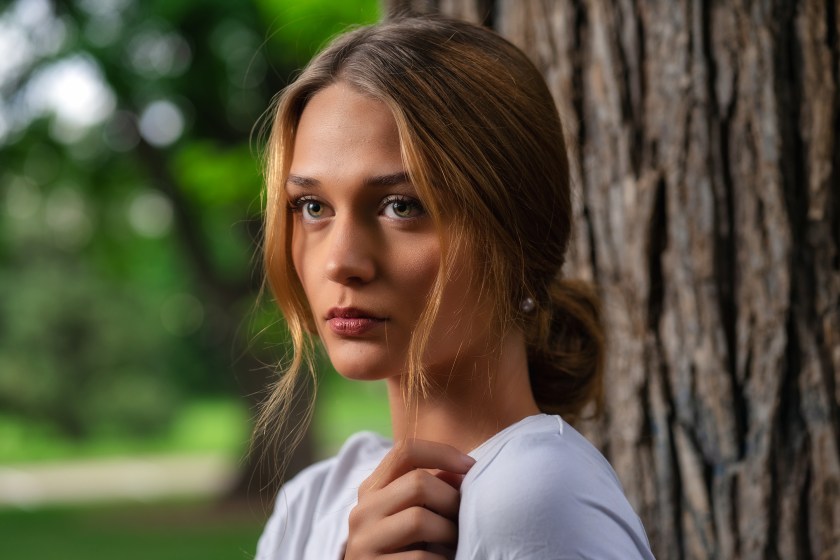
Kelly R. Bienfang’s portrait in Fort Collins’ City Park showcases refined environmental portraiture, merging classic lighting techniques with natural settings. The composition emphasizes psychological presence through thoughtful framing and soft lighting, achieving dimensionality. Using traditional optics and careful post-processing, the image balances contemporary authenticity with technical precision, reinforcing the importance of classical methods in outdoor photography.

Woman with light brown hair stands beside a tree in a park, looking toward the camera with a soft green background.
Kelly R. Bienfang poses beside a tree in City Park, Fort Collins, Colorado.

This portrait of Kelly exemplifies the photographer’s command of environmental portraiture, demonstrating how classical lighting techniques can be sensitively adapted to outdoor contexts. Created in City Park, Fort Collins, the image represents a refinement of traditional portrait methodology—translating studio principles into naturalistic settings while preserving the intimacy and control typically associated with interior work.

The composition centers on a three-quarter view of the subject positioned against the textured bark of a substantial tree trunk. This anchoring element provides both physical and visual grounding, its vertical mass creating structural balance while its organic texture contrasts productively with the smooth contours of the subject’s face. The decision to place Kelly against this natural backdrop rather than opening the frame to broader park vistas reflects deliberate focus—prioritizing psychological presence over environmental documentation.

The lighting execution reveals sophisticated outdoor flash technique. Employing a single strobe with shoot-through umbrella, the photographer has created illumination that appears to extend rather than contradict the existing ambient light. The soft directional quality—evident in the delicate gradation across the subject’s face and the luminous edge separation along her profile—suggests careful positioning to mimic golden hour sun while maintaining consistent exposure control. This hybrid approach, blending natural and artificial light sources, achieves what purely available light could not: sculptural dimensionality without harsh shadow or unflattering overhead illumination.

The subject’s positioning and expression demonstrate thoughtful directorial collaboration. Kelly’s gaze, angled slightly upward and away from the lens, creates contemplative distance while her hand’s gentle placement at the shoulder introduces subtle gesture without performative emphasis. This combination of turned body and averted eyes establishes a portrait that feels observed rather than confrontational—inviting viewer attention while maintaining the subject’s interior privacy. The styling choice of a simple white garment serves the image’s tonal strategy, providing clean highlight mass that draws focus toward facial features and natural coloring.

Technical choices throughout support this classical approach. The Sony 85mm f/1.8 lens, deployed on the Sony A7II body, offers the compression and shallow depth of field characteristic of traditional portrait optics. The resulting background dissolution—visible in the soft green bokeh representing distant foliage—eliminates visual competition while establishing atmospheric color context. Post-processing in Luminar 4 has enhanced the warm color palette, emphasizing the golden light quality playing across skin tones and hair while maintaining natural saturation levels.

Within Chapter 4’s examination of portrait methodologies, this photograph demonstrates the photographer’s ability to execute formal portraiture outside controlled studio environments. The work shows less interest in contemporary street portrait spontaneity than in translating time-tested studio aesthetics into outdoor practice—a technically demanding approach requiring precise light manipulation and environmental awareness simultaneously.

The image also illustrates evolution in his workshop-informed practice. The confidence evident in both lighting execution and subject direction suggests accumulated knowledge from collaborative learning environments, where traditional portrait techniques are studied and adapted. This photograph represents portraiture rooted in classical principles—emphasizing beauty, technical precision, and dignified subject representation—while acknowledging contemporary preferences for natural settings and authentic expression.

As part of his broader Top 100 Journey documentation, this work affirms the continuing relevance of foundational portrait techniques when executed with skill and sensitivity. It demonstrates how environmental portraiture can achieve the polish and intentionality of studio work without sacrificing the organic qualities that location shooting provides.
LilithW 16th Street Mall Denver

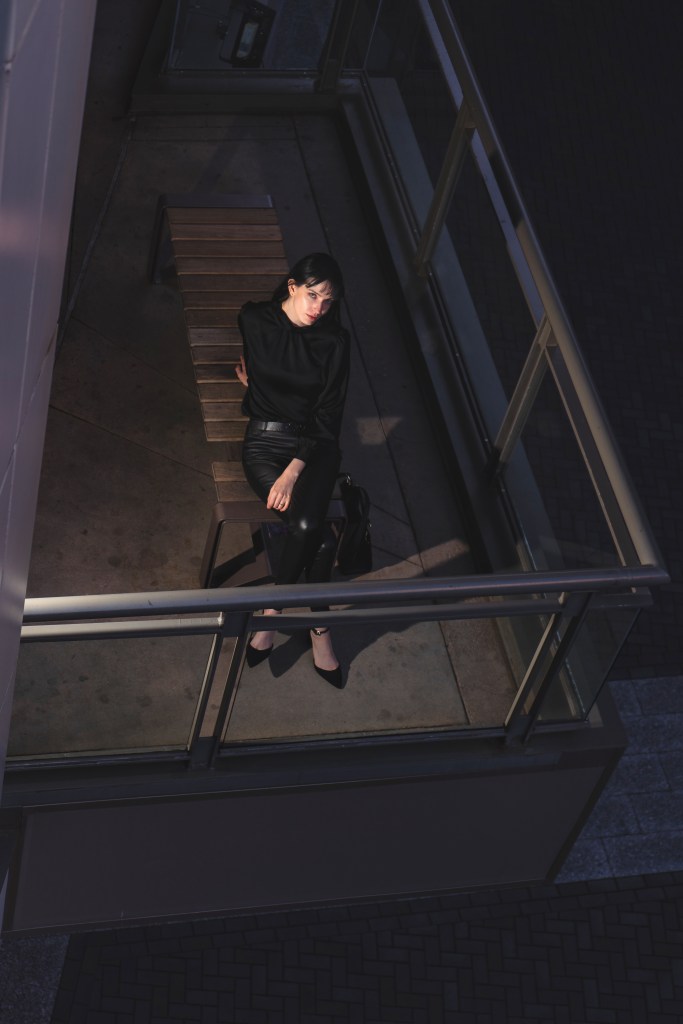
The photograph featuring model LilithW on Denver’s 16th Street Mall showcases an innovative blend of urban architecture and contemporary fashion. Through careful lighting, geometric framing, and thoughtful styling, the image transforms a functional stairwell into a dramatic portrait setting, emphasizing the photographer’s skill in capturing emotional depth within architectural spaces.

Woman dressed in black sits on a bench on an elevated walkway, viewed from above in an urban setting.
LilithW sits on a balcony along the 16th Street Mall in Denver, Colorado.

The photographer transforms an urban stairwell into a study of geometry, shadow, and contemporary fashion portraiture in this striking image from Denver’s 16th Street Mall. Shot with model LilithW, the photograph demonstrates a sophisticated understanding of architectural space as portraiture framework—a conceptual approach that positions this work as a significant entry within Chapter 4 of his Top 100 Journey project.

The compositional strategy reveals deliberate technical choices. Photographed from below, looking upward through the stairwell’s descending levels, the image creates a vertiginous sense of depth through repeating geometric forms. The metal railings create strong diagonal and horizontal lines that frame the subject, while the stairway’s perspective draws the eye upward toward LilithW’s figure. This bird’s-eye vantage point—or rather, its inverse—transforms a functional architectural space into a dramatic stage, demonstrating how environmental awareness can elevate location portraiture beyond mere documentation.

The lighting execution shows particular sophistication given the equipment employed. Using a single Godox AD100 flash without modifiers, the photographer has created directional illumination that separates the subject from the ambient darkness of the stairwell. The unmodified flash produces harder shadows and more dramatic contrast than diffused light would offer, a choice that complements the industrial setting’s angular architecture. This approach to lighting reveals growing confidence in working with minimal gear to maximum effect—a hallmark of photographers who understand that vision matters more than equipment inventory.

LilithW’s styling—black turtleneck, leather pants, and ankle boots—creates a monochromatic palette that harmonizes with the urban environment while maintaining visual distinction through texture and form. Her pose, caught mid-descent with hand resting on the railing, suggests movement arrested rather than static positioning. The downward gaze and slight forward lean create psychological engagement, as though the subject exists within her own narrative rather than performing for the camera.

Within the context of Chapter 4’s focus on studio, outdoor, and workshop portraiture, this image exemplifies the photographer’s ability to treat urban environments as found studios. The controlled lighting approach mirrors studio methodology, while the architectural setting provides the visual complexity and authentic texture that outdoor locations offer. The technical specifications—Sony A7II with the 28-70mm kit lens—underscore an important curatorial observation: this body of work privileges compositional intelligence and lighting understanding over equipment prestige.

The post-processing workflow, combining Adobe Photoshop Elements and Luminar AI, has enhanced the image’s moody atmosphere without sacrificing naturalism. The color grading emphasizes cool tones that reinforce the urban setting’s industrial character, while careful shadow detail preservation maintains dimensionality throughout the frame’s darker regions.

From a curatorial perspective, this photograph represents the photographer’s evolving facility with architectural portraiture—a subgenre that requires simultaneous attention to human subject, spatial geometry, and lighting choreography. The work’s inclusion in the Top 100 Journey project acknowledges its success in synthesizing these elements into a cohesive visual statement. The stairwell becomes more than backdrop; it functions as collaborator in creating psychological depth and visual drama. This image demonstrates how thoughtful photographers can transform everyday urban infrastructure into compelling portrait environments, finding beauty and narrative possibility in overlooked transitional spaces.

Portrait Slam 2024

Portrait Slam 2024 features Frank Graziano posed on a vintage railroad car, showcasing a blend of environmental portraiture and technical skill. The composition balances subject and setting, using light and shadow effectively. This portrait reflects the photographer’s evolution, integrating contemporary styling with Americana themes, and highlights a confident approach to on-location shooting.

Man wearing a hat stands on the side steps of a black railroad car, looking to the side.
Frank Graziano poses on a railroad car at the Colorado Railroad Museum in Golden, Colorado.

The photographer captures Frank Graziano in a moment of studied nonchalance, balanced on the step of a vintage railroad car against the industrial textures of riveted steel and weathered paint. This image, created during Portrait Slam 2024 at the Colorado Railroad Museum, exemplifies the photographer’s growing confidence in environmental portraiture—a technical and conceptual evolution clearly marked within Chapter 4 of his Top 100 Journey project.

What immediately distinguishes this portrait is its sophisticated balance between subject and setting. The railroad car’s dark, rivet-studded surface creates a powerful geometric frame, yet never overwhelms Graziano’s presence. The model’s positioning—one foot planted on the step, the other casually lifted, holding a vertical rail—demonstrates a dynamic use of diagonal lines that pulls the viewer’s eye through the composition. His cowboy hat and leather jacket evoke classic Americana, while the contemporary styling prevents the image from slipping into pastiche or nostalgia.

The photographer’s technical execution reveals careful consideration of light and shadow. The overcast sky provides even, diffused illumination that preserves detail across both the subject’s face and the textured metal surface behind him. This soft light wraps around Graziano’s features, creating subtle modeling without harsh shadows—a particularly important choice given the industrial setting’s potential to create competing visual elements. The muted color palette of charcoal grays, weathered browns, and faded blacks creates tonal harmony while allowing the warm leather tones of the hat to serve as a visual anchor.

Within the context of Chapter 4—Portraits Studio, Outdoor & Workshop Work—this image demonstrates the photographer’s ability to synthesize controlled studio techniques with the spontaneity of location work. Workshop environments often push photographers beyond their comfort zones, and this portrait suggests someone working confidently with both the challenges and opportunities of on-location shooting. The inclusion of the “KEEP OFF” text, partially visible in the frame, adds an element of subtle irony: the subject occupies precisely the forbidden space, transforming restriction into creative possibility.

The railroad setting serves as more than mere backdrop. It functions as visual metaphor—the convergence of journey, transit, and transitional spaces that resonates with the photographer’s larger Top 100 Journey project. The industrial heritage embedded in the railroad car’s weathered surface speaks to American mythology and masculine archetypes, themes Graziano’s styling deliberately engages while maintaining contemporary relevance.

From a curatorial perspective, this photograph marks a maturation in the photographer’s approach to environmental portraiture. Earlier works in his portfolio occasionally struggled with the balance between subject and location; here, both elements coexist in productive tension. The composition’s structured geometry—the vertical rails, horizontal platform, the rectangular frames within frames—creates order without rigidity, allowing Graziano’s natural pose to feel both choreographed and spontaneous.

The image’s inclusion in the Top 100 Journey project reflects its successful synthesis of technical skill, conceptual clarity, and visual impact. It demonstrates how workshop environments can push photographers toward their strongest work, combining the pressure of limited time with the inspiration of new locations and collaborative energy. The result is a portrait that honors both its subject and its setting, creating a narrative that extends beyond the single frozen moment into broader considerations of place, identity, and American visual mythology.

Mike Groth: Classical Studio Portraiture and the Language of Formality

Mike Groth’s studio portrait, featured in Chapter 4 of the Top 100 Journey, exemplifies traditional portraiture through controlled lighting and composition. Shot at Old Town Yoga Studio, the image focuses on character and presence, utilizing a classic backdrop and professional techniques. Its formal simplicity highlights the subject’s confidence, making it versatile across various contexts.

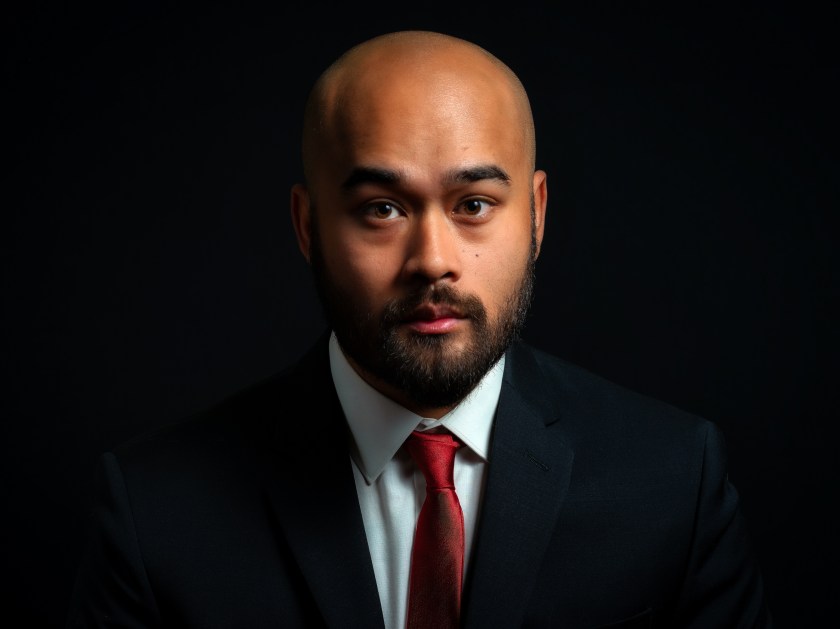
Bald man with a beard wearing a suit and red tie looks directly at the camera against a black background.
Mike Groth is photographed in a studio portrait at Old Town Yoga Studio in Fort Collins, Colorado.

Within Chapter 4 of the photographer’s Top 100 Journey, this portrait of Mike Groth represents a return to the foundational principles of studio portraiture—controlled lighting, deliberate composition, and the timeless formality of traditional headshot aesthetics. Shot at the Old Town Yoga Studio in Fort Collins, Colorado, the image demonstrates the photographer’s facility with classic studio techniques while exploring the psychological dimensions of formal masculine presentation.

The technical execution adheres to established conventions of corporate and editorial portraiture. Utilizing a Sony A7ii with an 85mm f/1.8 lens, the photographer has positioned his subject against a pure black backdrop, eliminating all environmental context to focus entirely on character and presence. A Godox V1s flash paired with a shoot-through umbrella provides the primary illumination—a traditional modifier choice that produces soft, diffused light with gentle shadow gradation across the subject’s features. This approach creates dimensional modeling without the harsh contrast of direct flash, revealing the contours of the face while maintaining a polished, professional quality.

The composition centers the subject in a classical three-quarter view, shoulders angled slightly to create visual interest while the face turns toward the camera. This positioning—neither fully frontal nor profile—has been a cornerstone of portraiture since the Renaissance, offering both dimensionality and direct engagement. The subject’s formal attire—dark suit, white shirt, burgundy tie—reinforces the traditional corporate aesthetic, while his neutral expression and direct gaze suggest confidence tempered with approachability.

What distinguishes this work within the photographer’s broader practice is its embrace of restraint. Where other images in Chapter 4 explore environmental integration and spontaneous moments, this portrait strips away context to examine how lighting, posture, and expression alone can convey character. The black void backdrop functions not merely as a neutral background but as an active element, creating psychological weight and directing all attention to the subtle details: the catch lights in the eyes, the texture of facial hair, the precise fall of shadow along the jawline.

The post-processing in Luminar 4 maintains the studio’s carefully controlled atmosphere. Skin tones are rendered with natural warmth while preserving texture and detail. The lighting reveals itself as directional yet forgiving, highlighting the subject’s facial structure without creating unflattering shadows. This balance between revelation and flattery characterizes effective professional portraiture—honest without being harsh, polished without appearing artificial.

Within the context of Chapter 4’s mission to document studio, outdoor, and workshop methodologies, this image anchors the studio component with particular authority. It demonstrates that contemporary portrait photography need not abandon classical techniques in pursuit of innovation. The photographer’s choice to work within established conventions reflects an understanding that certain approaches endure precisely because they succeed in their essential task: revealing the subject’s presence and character with clarity and dignity.

The formal simplicity of this portrait allows it to function across multiple contexts—editorial, corporate, archival. This versatility speaks to the photographer’s understanding of portraiture not merely as artistic expression but as functional communication. As part of the Top 100 Journey, the image represents a technical benchmark, showcasing the fundamental competencies upon which more experimental work can build. It is portraiture in its most distilled form: light, subject, and the photographer’s ability to orchestrate their interaction with precision and purpose.

Maia del Mazo Urban : A Study in Contemporary Youth Portraiture

Maia del Mazo’s portrait, captured in Old Town Fort Collins, exemplifies the intersection of contemporary youth culture and environmental portraiture. Utilizing natural light and artificial enhancement, the photographer balances technical precision with spontaneity. The subject’s confident pose and styling reflect a subcultural moment, fostering an authentic connection with the viewer.

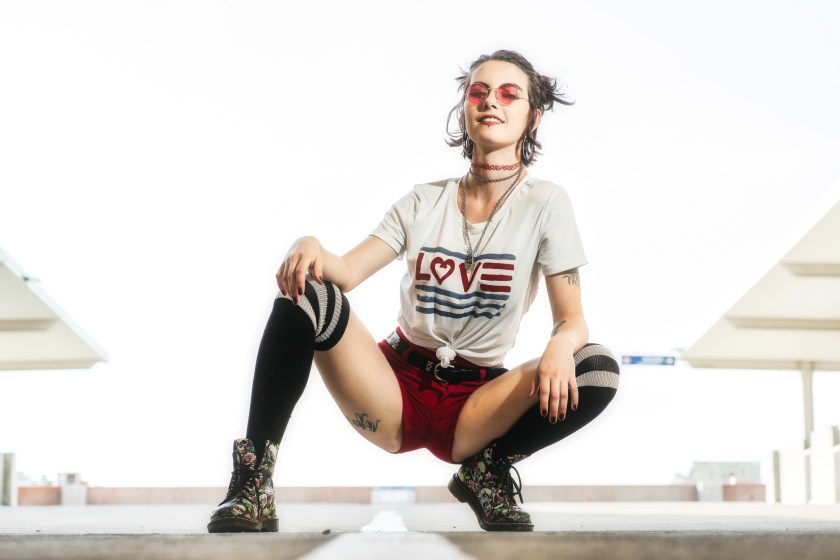
Woman wearing red shorts and knee-high socks crouches on a concrete surface in an urban setting with bright sky behind her.
Maia del Mazo poses in an urban location in Old Town Fort Collins, Colorado.

Within Chapter 4 of the photographer’s Top 100 Journey—dedicated to studio, outdoor, and workshop portraiture—this image of Maia del Mazo emerges as a compelling examination of contemporary youth culture and environmental portraiture. Shot in Old Town Fort Collins, Colorado, the photograph demonstrates the artist’s evolving command of natural light augmented by carefully controlled artificial illumination, a technical approach that has become increasingly refined throughout this chapter of his documentary project.

The composition presents the subject in a confident, grounded squat position against a minimalist architectural backdrop. Her styling—vintage band aesthetic meeting modern streetwear, complete with floral combat boots, striped knee socks, and layered chokers—speaks to a specific subcultural moment. The photographer has positioned her centrally within the frame, allowing the clean lines of the urban architecture to recede into soft focus, creating negative space that amplifies the subject’s presence rather than competing with it.

Technically, the image represents a sophisticated balance between available daylight and artificial enhancement. Shot with a Sony A7ii paired with an 85mm f/1.8 lens, the photographer employed a handheld Godox V1s flash without modification—a bold choice that suggests confidence in reading ambient conditions. The direct flash technique produces a subtle fill that lifts shadows without flattening the image’s dimensionality, while the 85mm focal length compresses the background just enough to isolate the figure without creating unnatural bokeh. The slight wind-swept quality of the subject’s hair adds dynamism to what might otherwise read as a static pose.

What distinguishes this work within the chapter’s broader context is its departure from traditional studio control. While maintaining the technical precision associated with formal portraiture, the photographer embraces environmental elements—concrete surfaces, architectural geometry, natural wind movement—that introduce spontaneity into the frame. This hybrid approach reflects an evolution in his practice, moving beyond purely controlled studio environments toward a more flexible methodology that captures authentic personality within structured compositions.

The post-processing in Luminar 4 demonstrates restraint appropriate to the subject matter. Color grading emphasizes warm tones in the subject’s skin and the amber cast of her sunglasses while maintaining the cooler neutrals of the concrete and sky. The processing enhances rather than transforms, supporting the documentary quality inherent in the photographer’s approach to his Top 100 Journey project.

The subject’s body language—relaxed yet assertive, casual yet deliberate—suggests a collaborative relationship between photographer and sitter. This comfort level allows for genuine expression rather than performative posing, a quality that distinguishes effective contemporary portraiture from mere documentation. The direct, knowing gaze above the rose-tinted frames establishes connection with the viewer while maintaining a degree of cool remove characteristic of youth subculture.

As part of the photographer’s long-term Top 100 Journey, this image contributes to an ongoing investigation into portraiture’s capacity to capture both individual personality and broader cultural moments. It represents the workshop and outdoor component of Chapter 4’s mission, demonstrating how environmental factors and technical adaptability can produce work that honors both formal photographic traditions and contemporary visual language. The result is a portrait that feels simultaneously timeless in its compositional confidence and distinctly anchored in its cultural moment.

Scale and Spectacle: Industrial Heritage as Portrait Stage

Savana Steinhoff’s portrait in front of the Rio Grande 5771 locomotive at the Colorado Railroad Museum showcases Greg Urbano’s artistic vision in environmental portraiture. The photo employs effective lighting, wardrobe choice, and spatial awareness to highlight both model and industrial backdrop, reflecting broader themes of coexistence and cultural significance in contemporary photography.

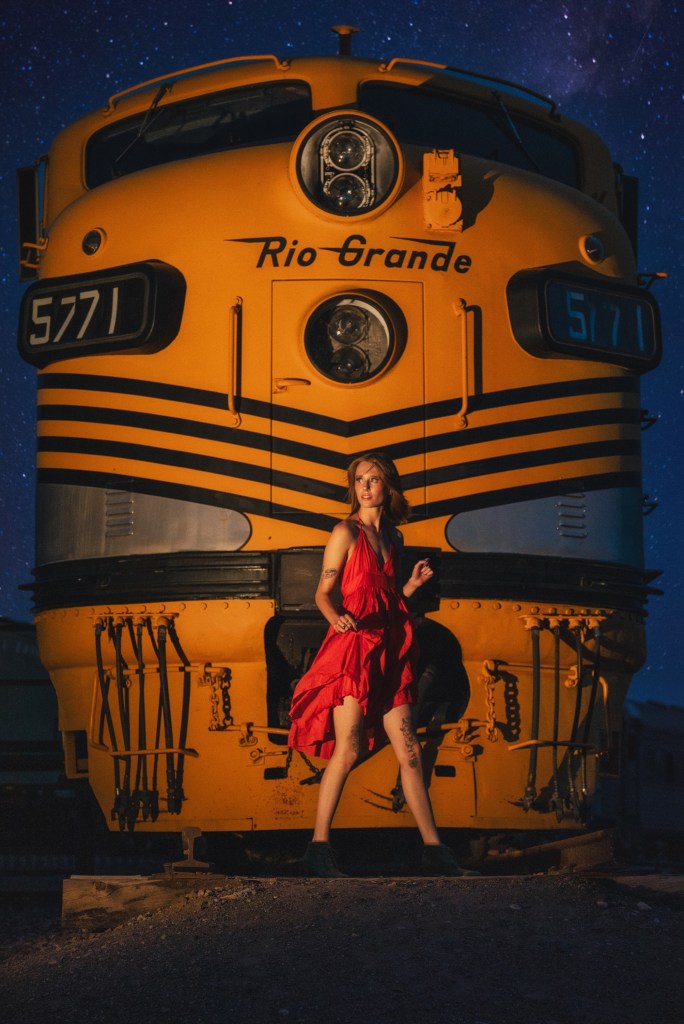
Woman in a red dress stands in front of a yellow Rio Grande locomotive at night, lit against a dark sky.
Savana Steinhoff poses in front of the Rio Grande 5771 locomotive at the Colorado Railroad Museum in Golden, Colorado.

Among the most ambitious entries in Chapter 4 of Greg Urbano’s Top 100 Journey, this photograph from Portrait Slam 2024 represents the photographer’s engagement with large-scale environmental portraiture under challenging technical conditions. Created at the Colorado Railroad Museum in Golden, the image positions model Savana Steinhoff against the imposing facade of Rio Grande locomotive 5771, transforming industrial artifact into dramatic backdrop and exploring the relationship between human scale and mechanical monumentality.

The composition immediately announces its ambitions. The locomotive dominates the frame, its iconic orange and black striping creating bold graphic elements that could easily overwhelm a human subject. Yet Urbano’s placement of the model—centered beneath the Rio Grande nameplate, her crimson dress echoing the warm tones of the engine—establishes a visual hierarchy that honors both subject and setting. The photographer has chosen a low angle that emphasizes the locomotive’s imposing height while maintaining the model’s presence as the compositional anchor. This decision reflects sophisticated spatial awareness, particularly valuable in workshop environments where multiple photographers compete for optimal vantage points.

The lighting strategy reveals careful planning and execution. Shot during the blue hour, the image captures that transitional moment when artificial illumination and residual daylight achieve balance. The locomotive’s exterior lighting creates warm pools of color against the deepening twilight sky, while additional lighting—likely strobes positioned to camera left—illuminates the model without destroying the ambient atmosphere. Stars visible in the darkening sky suggest either long exposure techniques or composite work in post-processing, adding a dreamlike quality to what might otherwise be straightforward location portraiture.

The choice of wardrobe proves integral to the photograph’s success. The flowing red dress provides both color contrast and movement, its flowing fabric creating visual interest against the rigid geometry of the industrial subject. The model’s pose—casual yet purposeful, one leg slightly forward—suggests confidence rather than confrontation with the massive machine behind her. This approach differs markedly from more aggressive “beauty and the beast” tropes often employed in automotive and industrial photography, opting instead for coexistence rather than contrast.

Within the context of Chapter 4’s documentation of workshop and collaborative shooting experiences, this photograph demonstrates the photographer’s ability to execute complex concepts under time constraints typical of group shooting events. Portrait Slam workshops challenge participants to work efficiently in unfamiliar locations with coordinated models and lighting setups, requiring both technical proficiency and decisive artistic vision. The inclusion of this image in the Top 100 Journey suggests Urbano views such collaborative environments not as limitations but as catalysts for ambitious work.

The photograph also reflects broader themes in contemporary portrait photography, where environmental context carries equal weight to subject representation. The locomotive serves as cultural artifact—a symbol of westward expansion, industrial heritage, and American rail history—while simultaneously functioning as pure visual element. This duality enriches the image beyond simple fashion or glamour photography, situating it within traditions of documentary-informed portraiture.

Ultimately, this work from Portrait Slam 2024 exemplifies the photographer’s mature approach to environmental portraiture: technically sophisticated, conceptually layered, and visually arresting without sacrificing authenticity or becoming mere spectacle.

Silhouette and Subversion: A Study in Controlled Drama

The portrait of Savage Van Sage by Greg Urbano in Chapter 4 of Top 100 Journey exemplifies refined environmental portraiture. It captures a blend of vulnerability and confidence through composition, lighting, and setting. The ivy backdrop, along with the model’s pose, invites viewers to engage with the complex narrative, reflecting Urbano’s artistic evolution and technical mastery.

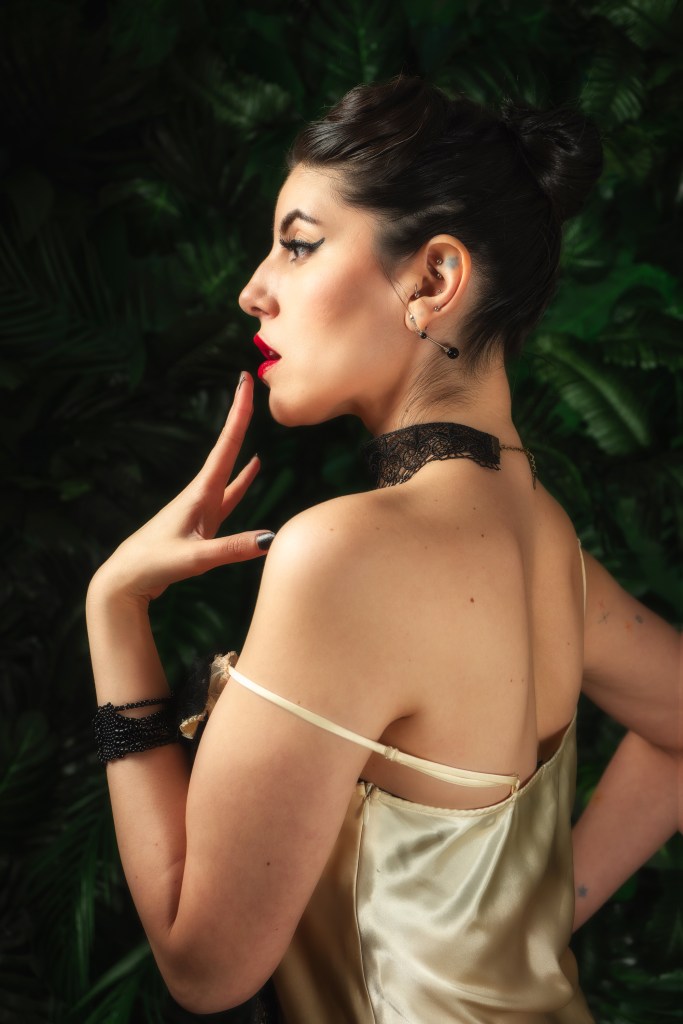
Woman in a satin dress shown in side profile against a dark leafy background, with hair in an updo and red lipstick.
Savage Van Sage poses in profile in a studio portrait with an ivy-covered wall near Denver, Colorado.

Within Chapter 4 of Greg Urbano’s Top 100 Journey—a section devoted to studio portraiture and collaborative workshop explorations—this photograph of model Savage Van Sage stands as a masterclass in theatrical restraint. Shot against an ivy-laden wall at the Headquarters studio near Denver, the image demonstrates the photographer’s evolving command of environmental portraiture, where setting and subject engage in a carefully choreographed dialogue.

The composition reveals sophisticated technical decision-making. Urbano positions his subject in profile, her face turned away from the camera yet fully engaged with the viewer through gesture and posture. The silhouette technique employed here—enhanced through post-processing in Adobe Camera Raw and Luminar 4—creates a striking interplay between illumination and shadow. Light sculpts the model’s features with precision, catching the curve of her jawline, the delicate architecture of her ear adorned with multiple piercings, and the bold contrast of crimson lips against porcelain skin.

What distinguishes this work within the chapter’s broader exploration of portrait photography is its willingness to embrace ambiguity. The model’s bare shoulder and the gossamer straps of her garment suggest vulnerability, yet her pose—hand raised to chin in a gesture of thoughtful poise—projects confidence and self-possession. The black lace choker and wrist accessory introduce elements of vintage glamour and contemporary subculture, positioning the subject at the intersection of multiple aesthetic traditions. This fusion of pin-up sensibility with darker, more enigmatic styling reflects Urbano’s interest in portraits that resist singular interpretation.

The natural ivy backdrop functions as more than mere decoration. Its organic chaos provides textural depth and creates a liminal space—neither entirely studio nor wholly natural environment. This choice aligns with the chapter’s documentation of the photographer’s studio and workshop methodologies, demonstrating how controlled environments can be manipulated to suggest narrative possibilities beyond their physical constraints. The deep greens recede into darkness, focusing attention on the figure while maintaining atmospheric richness.

Technically, the photograph showcases the photographer’s proficiency with studio lighting configurations. The illumination appears to originate from a single, directional source, creating the dramatic side-lighting characteristic of classic portraiture while maintaining sufficient fill to preserve detail in shadow areas. This approach—refined through workshop collaborations and repeated studio sessions—demonstrates a maturation from documentary impulses toward more deliberately constructed imagery.

The inclusion of this photograph in the Top 100 Journey marks a significant moment in Urbano’s artistic development. Where earlier chapters might emphasize spontaneity or environmental documentation, this studio work reveals an artist increasingly comfortable with artifice and construction. The model becomes collaborator rather than subject, her professional experience evident in the precision of her pose and the deliberate theatricality of her presentation.

Ultimately, this portrait succeeds because it understands the power of suggestion over declaration. The viewer receives fragments—a profile, a gesture, a carefully composed environment—and must construct meaning from these elements. It is portrait photography that honors both the technical traditions of studio work and the contemporary expectation that images should provoke rather than simply document. Within Urbano’s evolving practice, it represents a confident synthesis of technical skill and artistic vision.