Boulder Creek Long Exposure

The aerial photograph of Boulder Creek, captured with a DJI Mini 3 Pro drone, showcases a harmonious blend of long exposure techniques and modern technology. The composition balances flowing water and angular granite boulders, creating an abstract visual narrative that highlights the juxtaposition of motion and permanence in landscape photography.

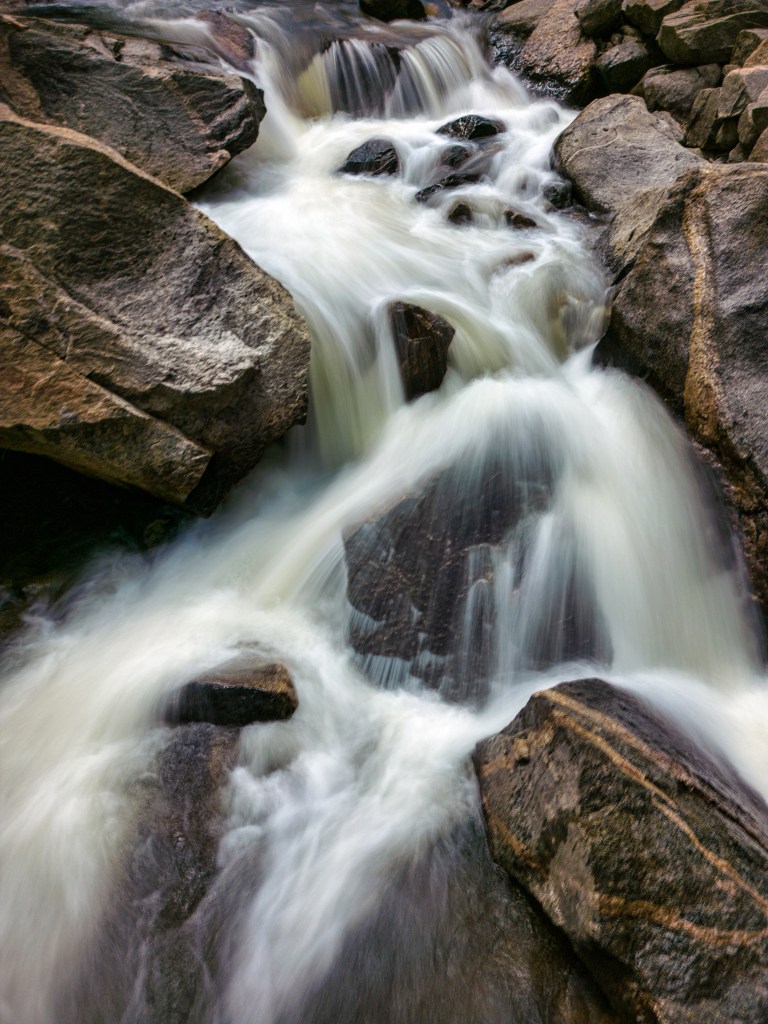
Long-exposure view of flowing creek water cascading over large rocks in a narrow channel.
Long-exposure water flows over boulders in Boulder Creek along Boulder Canyon Drive, Colorado.

This aerial perspective of Boulder Creek represents a striking departure in both technical approach and creative vision, captured not with traditional camera equipment but with a DJI Mini 3 Pro drone equipped with a Freewell ND2000 filter. The photographer’s willingness to embrace emerging technologies while maintaining classical long exposure techniques demonstrates an adaptive practice that refuses to be constrained by conventional methodologies. Shot at 6.7mm with ƒ/1.7 aperture, 1/2 second exposure, and ISO 100, the image transforms cascading water and weathered granite into an abstract study of motion and permanence.

The aerial vantage point offers what might be termed a “god’s eye” perspective—looking directly down upon the creek as it navigates through massive boulders along Boulder Canyon Drive. This top-down orientation fundamentally alters the traditional landscape viewing experience. Rather than observing the scene from a human standpoint at creek level, the viewer hovers above, granted access to compositional relationships and water patterns typically invisible from ground perspective. The half-second exposure blurs the rushing water into silken ribbons that weave between dark stones, creating organic shapes that appear almost calligraphic against the textured rock surfaces.

The geological elements provide crucial counterpoint to the flowing water. Angular granite boulders, their surfaces marked by striations and mineral deposits, display warm ochre and gray tones that anchor the composition’s cooler water tones. These stones reveal billions of years of geological history—compression, uplift, erosion—rendered in layers and fractures visible even from the drone’s elevation. The photographer frames the scene to balance solid mass with liquid movement, allowing neither element to dominate but instead creating a dynamic equilibrium between opposing forces.

The technical execution demonstrates sophisticated problem-solving. Achieving long exposure effects from an airborne platform presents unique challenges—the drone itself must remain perfectly stable while the camera shutter stays open. The ND2000 filter proves essential, reducing light transmission sufficiently to permit a half-second exposure in daylight conditions without overexposure. At ƒ/1.7, the lens operates wide open, yet the minimal depth of field concerns inherent in macro or portrait photography become irrelevant when shooting from such elevation; everything within the frame exists at roughly equivalent focus distance.

Within Chapter 2—Florida Landscapes & Cityscapes—this Colorado waterway continues the photographer’s geographic expansion evident throughout this section of the Top 100 Journey. The consistent choice to photograph Rocky Mountain landscapes suggests deliberate exploration of environments radically different from Florida’s flat, subtropical character. Perhaps this juxtaposition serves the project’s broader narrative: an artist defining his vision through contrast, discovering what landscape means by experiencing its various manifestations across diverse topographies.

“Boulder Creek Long Exposure ” ultimately represents the democratization of aerial perspective through consumer drone technology, married to time-honored long exposure aesthetics. The photographer recognizes that tools matter less than vision—that a small drone can produce work as artistically valid as traditional large-format equipment when wielded with intention and compositional awareness. The image stands as testament to adaptive practice in contemporary landscape photography, where technical innovation serves timeless artistic goals.

Black Forest

The photograph “Black Forest,” taken along Colorado Highway 14 in the Roosevelt National Forest, captures the aftermath of wildfire with striking clarity. The image, presented in monochrome, highlights resilience amidst destruction, showcasing charred pine trees against snow. Through meticulous technical execution, the artist transforms environmental tragedy into profound visual poetry.

all, fire-scarred pine trees rise from a snow-covered forest under an overcast winter sky.
Fire-scarred pine trees stand in deep snow along Colorado Highway 14 in the Roosevelt National Forest.

Stark verticality defines this haunting monochrome study captured along Colorado Highway 14 in the Roosevelt National Forest, where the photographer confronts the aftermath of wildfire with unflinching clarity. Titled “Black Forest,” the image transforms environmental tragedy into a meditation on resilience, absence, and the stark beauty found in landscapes marked by upheaval. Shot with a Sony Alpha a7 II equipped with a Samyang AF 18mm f/2.8 lens, the technical specifications—ƒ/11.0, 1/200s, ISO 100—reveal a photographer working with precision to render both foreground detail and atmospheric depth.

The composition presents a forest reduced to skeletal architecture. Charred pines, stripped of foliage by fire, rise as dark sentinels against pristine snow cover and a brooding sky. The wide-angle perspective at 18mm creates exaggerated depth, pulling the viewer into this expanse of vertical repetition. Trees march rhythmically across the frame, their bare trunks creating a natural grid that speaks simultaneously to destruction and order. The interplay between the blackened wood and white snow generates maximum tonal contrast—a decision reinforced by the photographer’s choice to render the scene in black and white during post-processing.

This monochromatic treatment proves essential to the image’s power. By eliminating color, the photographer strips away potential distraction, forcing attention to form, texture, and the dramatic chiaroscuro that defines the scene. The absence of color becomes metaphorically resonant, echoing the absence of living foliage. Shadows stretch across the snow-covered ground, cast by winter sun through the denuded canopy, creating secondary patterns that add visual complexity to the stark tableau.

The technical execution demonstrates sophisticated understanding of landscape photography fundamentals. The aperture choice of ƒ/11.0 provides substantial depth of field, ensuring sharpness from the foreground trees through to the distant background, while the relatively fast shutter speed of 1/200s freezes any potential wind movement in the upper branches. At ISO 100, the image maintains optimal clarity and tonal gradation—critical considerations when working in monochrome, where subtle gradations between black and white carry significant expressive weight.

The image’s inclusion within Chapter 2—Florida Landscapes & Cityscapes—continues the geographical expansion evident in this photographer’s evolving project. Again working far from Florida’s borders, he engages with Rocky Mountain topography and ecological narrative. This persistent geographic departure suggests an artist whose vision transcends regional documentation, seeking instead to explore universal themes of landscape transformation, human impact, and natural regeneration across diverse environments.

What distinguishes this work from mere documentation of fire damage is its formal rigor and unexpected aesthetic grace. The photographer finds pattern and rhythm in catastrophe, transforming a scarred forest into something approaching abstract composition. The trees function as both individual subjects and collective form—a forest that remains a forest even in its diminished state.

Within the broader context of the Top 100 Journey project, “Black Forest” represents an artist willing to engage with difficult environmental subjects while maintaining commitment to visual poetry. The photograph neither exploits tragedy nor sanitizes it, instead offering honest witness rendered through thoughtful craft—a balance that marks mature artistic vision.

Big Thompson Long Exposure

The photograph of the Big Thompson River showcases a masterful interplay of permanence and fluidity through long exposure techniques. Captured in Colorado, the image emphasizes detail in granite boulders alongside soft, flowing water. It reflects the photographer’s evolving artistic journey, expanding thematic boundaries while presenting a cohesive and naturalistic landscape composition.

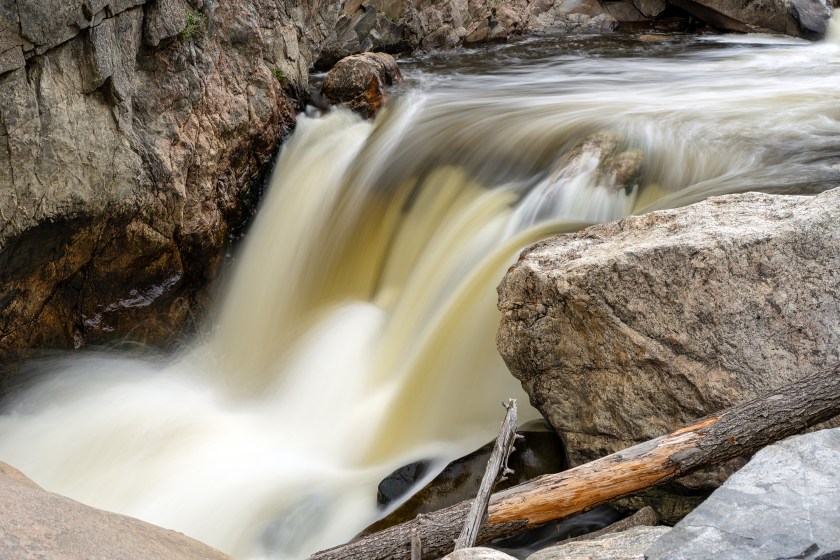
Long exposure view of fast-moving water flowing over a rocky drop on the Big Thompson River between granite boulders.
Water flows over a small rocky drop along the Big Thompson River, photographed with a long exposure.

The photographer’s technical mastery converges with natural drama in this commanding study of the Big Thompson River, captured in Colorado’s rugged high country. Shot with a Sony Alpha a7 II paired with the Sony FE 28-70mm f/3.5-5.6 OSS lens at 62mm, the image employs long exposure technique enhanced by neutral density filtration to transform rushing water into ethereal ribbons of motion. At ƒ/9.0 and ISO 50, the exposure settings reveal a deliberate approach to capturing both sharpness in the surrounding geology and the silken blur of flowing water.

What immediately arrests the viewer is the dramatic interplay between permanence and fluidity. Massive granite boulders—textured, ancient, immovable—frame a cascade that appears simultaneously powerful and gossamer-soft. The long exposure technique transforms the torrent into bands of cream and amber, creating visual movement that guides the eye through the composition in sweeping arcs. The golden tint in the water suggests the presence of sediment or tannins, lending warmth to what might otherwise read as a cool mountain scene.

The compositional architecture demonstrates sophisticated understanding of visual weight and balance. A substantial boulder occupies the right foreground, its weathered surface rendered in exquisite detail, while a piece of driftwood creates a diagonal element that adds depth and natural geometry. The left side reveals stratified rock walls, their vertical presence providing counterpoint to the horizontal flow. This triangulation of elements—stone, water, wood—creates a cohesive environmental portrait rather than merely documenting a waterfall.

The inclusion of this image within Chapter 2—Florida Landscapes & Cityscapes—presents an intriguing curatorial question. Clearly captured in Colorado’s Rocky Mountain ecosystem rather than Florida, the photograph signals an expansion in the photographer’s geographical scope and thematic boundaries. This apparent departure from the chapter’s titular focus suggests an evolving artistic journey, one where the photographer moves beyond regional constraints to explore universal themes of landscape and natural process. Perhaps the chapter title reflects the photographer’s home base or primary focus, while individual works demonstrate his widening field of exploration.

The technical execution reveals growing confidence with long exposure photography as a expressive tool. The neutral density filter allows for extended exposure times in daylight conditions, creating that characteristic motion blur while maintaining proper exposure across the frame’s dynamic range. The choice of ƒ/9.0 ensures adequate depth of field to keep both foreground rocks and background elements acceptably sharp, a critical consideration in landscape work where context matters as much as subject.

What elevates this beyond technical exercise is the photographer’s eye for natural composition. The cascade’s S-curve creates inherent grace, while the careful positioning relative to the boulder forms suggests patient observation and deliberate framing. The subdued color palette—grays, tans, muted greens—speaks to naturalistic rendering rather than heightened saturation, allowing texture and form to dominate over chromatic spectacle.

Within the broader trajectory of the Top 100 Journey project, this image represents an artist testing boundaries and methodologies. It demonstrates that landscape photography, when executed with technical precision and compositional awareness, can reveal the sublime within the observable—the eternal dance between stone and water, stillness and motion, captured in a single decisive exposure.

City Pier on Anna Maria Island: A Study in Patience and Atmospheric Drama

The long exposure photograph of the City Pier on Anna Maria Island captures the unique interplay of land, water, and sky under dramatic storm clouds. Through technical mastery, the image transforms fleeting moments into timelessness, blending sharp details of the pier with ethereal human figures and smooth water, reflecting deep engagement with Florida’s coastal landscapes.

Long exposure photograph of the City Pier on Anna Maria Island, showing a wooden pier leading to a waterfront building under dark storm clouds.
Long exposure view of the City Pier on Anna Maria Island beneath dramatic storm clouds.

Within the photographer’s carefully curated Top 100 Journey, this long exposure study of the City Pier on Anna Maria Island stands as a masterful example of how technical discipline can amplify emotional resonance. Positioned within Chapter 2—Florida Landscapes & Cityscapes—the image demonstrates a sophisticated understanding of the Gulf Coast’s unique visual character, where land, water, and sky exist in constant, subtle negotiation.

The composition reveals itself through classical simplicity: a weathered wooden pier extends from foreground to middle distance, leading the viewer’s eye toward a modest building crowned with an American flag. Yet what elevates this photograph beyond documentary record is the photographer’s deliberate manipulation of time itself. Shot with a fifteen-second exposure at f/18, the image transforms fleeting atmospheric conditions into something more permanent and contemplative. The threatening cloud formations above, rather than appearing frozen in mid-motion, achieve a painterly quality—their movement compressed and softened into bands of gray and white that suggest both weight and ethereality.

This temporal expansion creates a fascinating duality throughout the frame. While the pier’s wooden planks remain sharp and detailed, bearing the textural evidence of salt air and countless footfalls, the human figures near the building dissolve into ghostly presences, their individual identities surrendered to the longer rhythm of place. The water, too, undergoes transformation; what would typically appear as distinct waves and surface texture becomes a smooth, almost metallic gradient stretching from jade green to soft gray, merging seamlessly with the horizon.

The technical execution here deserves careful consideration. Working with a Nikon D610 and an 18-35mm lens set to 35mm, the photographer has achieved remarkable sharpness across the entire frame. The f/18 aperture ensures deep depth of field while the ISO 100 setting maintains clean tonal gradations essential for the image’s subtle atmospheric rendering. These choices reflect not mere technical competence but aesthetic intention—a desire to capture both concrete detail and ephemeral mood simultaneously.

Within the broader context of Chapter 2, this photograph exemplifies the photographer’s evolving relationship with Florida’s coastal environments. Where lesser practitioners might seek the obvious drama of golden hour or storm-tossed seas, he finds complexity in overcast conditions and the patient observation they demand. The image refuses easy categorization: it is neither purely documentary nor overtly romantic, but occupies a thoughtful middle ground where observation and interpretation merge.

The architectural elements—particularly the modest pier building with its peaked roof and practical design—anchor the composition in specificity while the long exposure technique universalizes the experience. This is simultaneously a portrait of a particular place and a meditation on impermanence, on how human structures persist while human presence itself becomes fluid and uncertain.

As part of a long-term project, this photograph suggests an artist committed to deep engagement rather than superficial tourism. The willingness to wait for proper atmospheric conditions, to set up the necessary equipment for extended exposures, and to see beyond the immediate toward something more contemplative marks this as serious photographic inquiry. Within his Top 100 Journey, it stands as evidence that Florida’s landscapes, often dismissed as visually unchallenging, reward patient observation with unexpected subtlety and depth.

Passage Through Green: Corkscrew Swamp Sanctuary

The photograph from the Corkscrew Swamp Sanctuary captures the harmonious relationship between human infrastructure and Florida’s natural environment. The cypress boardwalk invites viewers into an intricate ecosystem, showcasing careful light management and depth. By depicting the balance of accessibility and preservation, it highlights Florida’s ecological significance and the need for conservation.

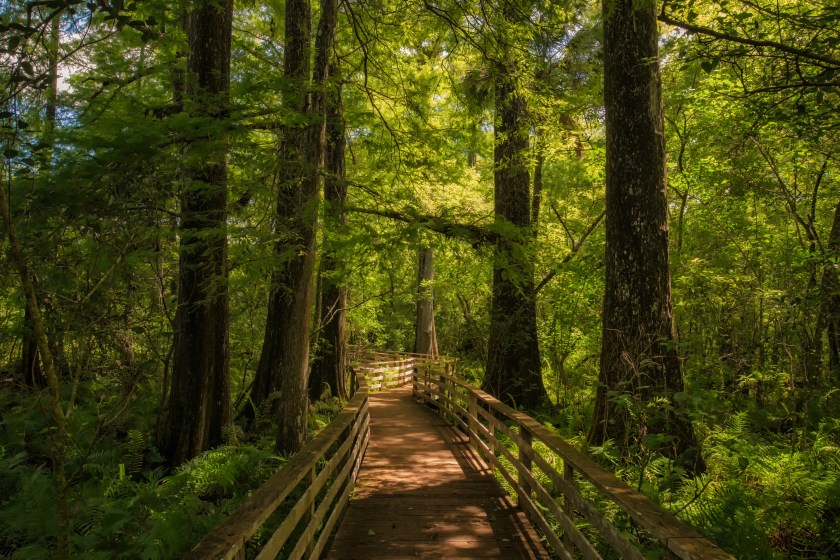
Wooden boardwalk winding through tall cypress trees and dense green foliage at Corkscrew Swamp Sanctuary, with dappled sunlight on the path.
Cypress Boardwalk at Corkscrew Swamp Sanctuary (2014)

In this luminous study from the Corkscrew Swamp Sanctuary, the photographer presents Florida’s natural landscape not as wilderness observed from a distance, but as an invitation to passage—a curated encounter between human infrastructure and primeval forest. The cypress boardwalk becomes both subject and compositional device, leading the viewer into a cathedral of green light that speaks to the delicate negotiation between preservation and access.

The technical approach reveals careful consideration of the swamp’s challenging photographic conditions. Working at ISO 100 with a half-second exposure at f/16, the photographer has maximized depth of field while maintaining exceptional image quality. This combination renders crisp detail from the weathered planks of the boardwalk through to the layered canopy above, where backlit foliage creates a luminous gradient from deep shadow to radiant yellow-green. The 24mm focal length—a moderate wide-angle perspective—provides visual breadth without the distortion that might compromise the scene’s natural proportions.

What distinguishes this image is its masterful handling of light. Shooting within the swamp’s dense canopy during what appears to be late morning or early afternoon, the photographer has captured the moment when sunlight penetrates the upper canopy, creating an almost ethereal glow. The graduated tonalities—from the shadowed foreground through the mid-tones of the boardwalk to the brilliant highlights beyond—establish a sense of progression and discovery. The exposure value suggests deliberate retention of highlight detail in what could easily have become overblown areas of white, instead preserving the textural complexity of individual leaves and branches.

The boardwalk itself serves multiple compositional functions. Its strong linear perspective creates depth and movement, drawing the eye inexorably toward the illuminated center. The railings function as framing elements, containing the viewer’s gaze while suggesting the carefully managed interaction between visitors and ecosystem. The warm tones of the aged wood provide chromatic relief from the overwhelming green, grounding the image in the tangible reality of human construction within natural space.

Within Chapter 2’s exploration of Florida landscapes, this photograph represents a significant counterpoint to the architectural documentation of the Dalí Museum. Where that image examined cultural infrastructure against an urban backdrop, this work investigates environmental infrastructure—the pathways that allow observation without destruction. The photographer recognizes that Florida’s identity is inextricably linked to its threatened ecosystems, and that contemporary experience of these spaces is mediated by such interventions.

The cypress trunks, standing as dark vertical elements throughout the frame, provide rhythmic structure while emphasizing scale. Their substantial girth and textured bark speak to age and resilience, while the dense understory of ferns visible in the lower portions of the frame suggests the biodiversity these swamp systems support. The photographer has captured not merely a scenic vista but a complex ecological narrative.

This image demonstrates the photographer’s evolving understanding of Florida’s duality—a place where nature and human presence exist in constant negotiation. The boardwalk, rather than intruding upon the swamp, becomes evidence of a conservation ethic, allowing passage while preserving the delicate substrate below. In documenting this careful balance, the photographer offers a vision of Florida that transcends tourism, revealing instead a landscape worthy of sustained attention and protection.

Nocturnal Geometry: The Dalí Museum, St. Petersburg

This photograph captures the illuminated Dalí Museum in St. Petersburg, Florida, showcasing the contrast between its geodesic structure and concrete form during twilight. The image highlights Florida’s cultural evolution through art, exemplifying a balanced compositional approach that emphasizes architectural integrity and the atmosphere, marking a sophisticated chapter in the photographer’s journey.

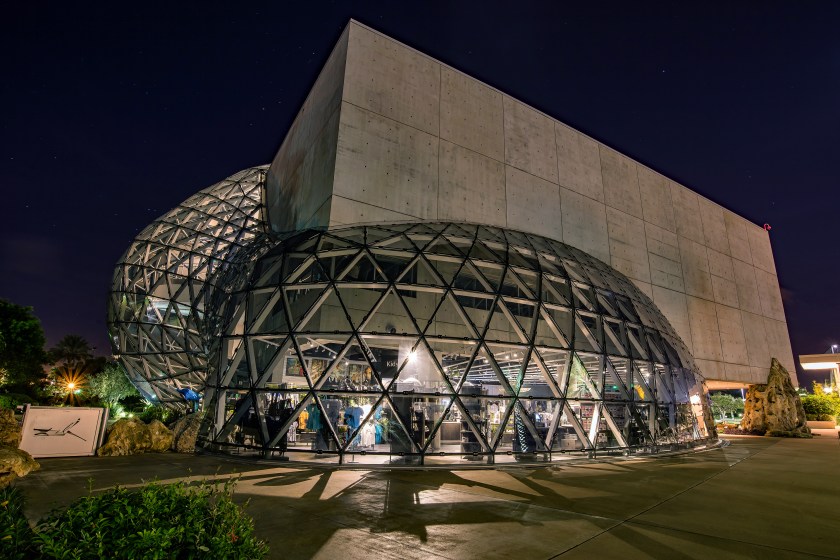
Nighttime long exposure photograph of the Dali Museum in St. Petersburg, Florida, showing its illuminated geodesic glass structure and concrete facade.
Nighttime long exposure view of the Dali Museum’s illuminated glass structure in St. Petersburg, Florida.

Within Chapter 2 of this photographic journey through Florida’s landscapes and cityscapes, this nighttime study of the Dalí Museum in St. Petersburg stands as a meditation on architectural dialogue—the convergence of structural rationality and organic form captured in the quietude of evening hours.

The photographer has positioned himself to emphasize the museum’s defining architectural gesture: the dramatic geodesic structure that emerges from the building’s otherwise austere concrete mass. Shot at 18mm, the wide-angle perspective accentuates the spherical dome’s imposing presence while maintaining the monumental quality of the adjoining concrete volume. This compositional choice creates a visual tension between geometric order and sculptural fluidity, perhaps an intentional echo of Dalí’s own artistic preoccupations with rigidity and metamorphosis.

Technical execution here demonstrates considerable deliberation. The 30-second exposure at f/11 has transformed the museum’s interior lighting into a warm, inviting glow that radiates through the triangulated framework, effectively rendering the geodesic dome as a luminous lantern against the deep blue-black sky. At ISO 250, the photographer has preserved tonal integrity in the shadows while avoiding the noise that might compromise the concrete’s textural detail—those subtle gradations and panel divisions that speak to the building’s material honesty.

The time of day proves critical to the image’s success. Shot during the transitional moment when civil twilight yields to night, enough ambient light remains in the sky to differentiate it from pure black, providing context and atmospheric depth. The surrounding landscaping, illuminated by strategic ground lighting, frames the architectural subject without competing for attention. The wet pavement in the foreground introduces specular highlights that guide the viewer’s eye toward the main structure while adding a layer of urban authenticity.

What distinguishes this photograph within the broader chapter is its representation of Florida’s cultural infrastructure rather than its natural or purely urban environment. While other images in this collection might emphasize the state’s coastal vistas or metropolitan skylines, this work acknowledges Florida’s role as a destination for arts and culture. The Dalí Museum, with its contemporary architectural interpretation housing works of surrealist mastery, becomes a symbol of Florida’s evolution beyond tourism clichés.

The photographer’s technical approach—the choice of a full-frame Nikon D610 paired with an 18-35mm lens—suggests a commitment to capturing architectural subjects with minimal distortion while maintaining portability for location work. The f/11 aperture provides sufficient depth of field to render sharp detail from the foreground plantings through to the building’s illuminated upper reaches, while the extended exposure time smooths any transient elements, creating a sense of permanence and contemplation.

In the context of the Top 100 Journey project, this image represents a maturation in the photographer’s documentation of Florida’s built environment. There is restraint here—a willingness to let the architecture speak through careful observation rather than dramatic intervention. The composition honors both the building’s geometry and its setting, creating a document that functions simultaneously as architectural photography and as a portrait of place, capturing a specific moment in Florida’s ongoing cultural narrative.

First Baptist Light Trails

The photographer captures long exposure light trails in front of Tampa’s First Baptist Church, merging urban movement with Neoclassical architecture. This duality creates an image of modernity and tradition, showcasing the church’s historical significance against dynamic traffic patterns. The piece illustrates Tampa’s evolving identity, emphasizing beauty in its urban landscapes through innovative techniques.

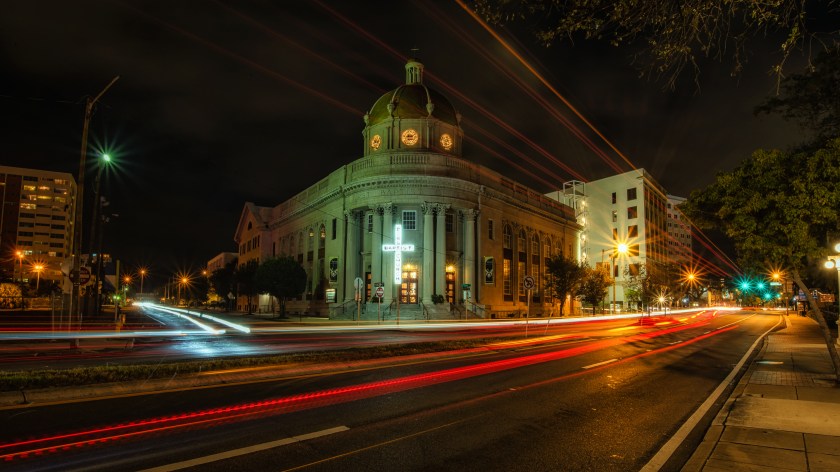
Long exposure nighttime photograph of the historic First Baptist Church in Tampa, Florida, with vehicle light trails in the foreground.
Long exposure light trails in front of the historic First Baptist Church in downtown Tampa.

In this nocturnal study of Tampa’s historic First Baptist Church, the photographer transforms urban infrastructure into kinetic painting, employing a twenty-second exposure to capture the ceaseless motion of vehicular traffic as ribbons of light that both frame and animate the Neoclassical architecture. The resulting image operates simultaneously as documentary record and abstract composition, a duality that characterizes his most successful explorations of Florida’s urban environments.

The church itself commands the frame with dignified authority. Its illuminated dome, rendered in theatrical green uplighting, draws the eye upward through classical columns toward the cupola’s glowing clock faces. This architectural landmark, likely dating to the early twentieth century, represents Tampa’s ambitions during its period of rapid growth—a permanence and civic gravitas that contrasts sharply with the ephemeral streaks of red and white light that sweep through the foreground. The photographer has chosen an exposure duration that allows traffic to complete its passage through the intersection, creating continuous trails rather than fragmented segments, a decision that required both technical precision and patience in timing.

The technical execution reveals careful calibration of competing priorities. The f/20 aperture serves multiple functions: it extends the exposure time necessary to capture substantial light trails while creating pronounced starbursts from the streetlamps and building lights that punctuate the scene. This diffraction effect, often considered a technical liability, becomes here an expressive tool that enhances the image’s sense of urban energy and nocturnal luminosity. The ISO 160 setting represents a pragmatic compromise, maintaining clean shadow detail without the noise that would emerge at higher sensitivities during a twenty-second exposure.

What distinguishes this work within the Florida Landscapes & Cityscapes chapter is its engagement with the state’s urban identity—a counterpoint to the natural environments that dominate popular conceptions of Florida photography. Tampa, often overshadowed by Miami’s architectural flash or Orlando’s manufactured spectacle, possesses a layered history visible in buildings like this repurposed church structure, now apparently serving commercial functions while retaining its ecclesiastical form. The photographer documents this transformation without nostalgia or critique, allowing the juxtaposition of classical architecture and contemporary traffic patterns to speak to ongoing urban evolution.

The composition demonstrates sophisticated spatial organization. The church occupies the middle ground with centered dignity, while the light trails sweep diagonally from lower right to left, creating dynamic movement that prevents the symmetrical architecture from becoming static. Flanking buildings and street trees provide contextual depth, establishing the church within its urban fabric rather than isolating it as a monument. The streetlamp at left edge, its starburst perfectly rendered, serves as a visual anchor that balances the compositional weight of the church’s mass.

Within his broader photographic journey, this image represents an expansion of the long-exposure vocabulary established in his Bay Pier work. Where that earlier piece explored natural elements transformed by time, here he applies similar temporal techniques to the urban realm, revealing how extended duration can render the chaos of city traffic as elegant abstraction. The photograph succeeds in making visible the patterns underlying apparent disorder, suggesting that beauty in Florida’s built environments requires not different locations but altered ways of seeing—a perspective shift measured in seconds rather than miles.