Briggsdale Scale and Silos: Monuments of Rural Persistence

The photograph of the Briggsdale Scale and Silos in eastern Colorado captures the beauty of agricultural remnants under a vast prairie sky. The artist portrays abandonment as transformation rather than decay, highlighting layered complexities and themes of economic change. This work reflects both personal exploration and broader cultural narratives in rural America.

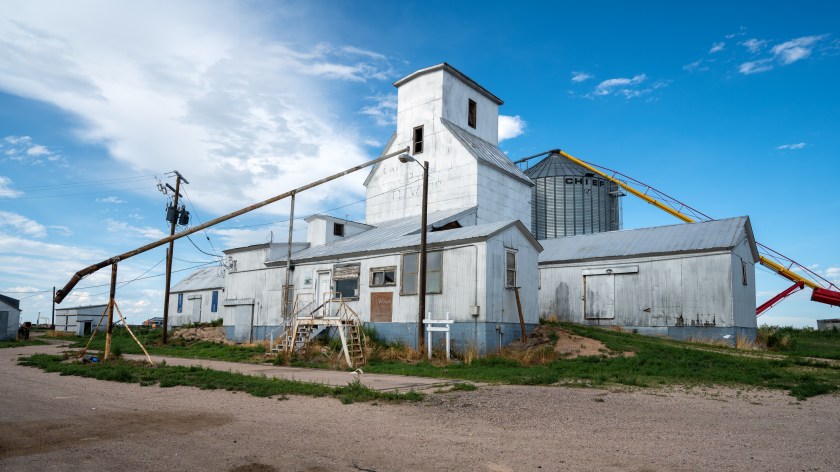
Rural grain elevator complex with white scale house buildings and metal silos under a blue sky in eastern Colorado.
The Briggsdale scale and silos stand along a roadside in rural eastern Colorado.

In this commanding photograph from Chapter 6 of Greg Urbano’s Top 100 Journey, the photographer turns his lens toward the structural remnants of agricultural infrastructure in eastern Colorado. The Briggsdale Scale and Silos stand as weathered sentinels against an expansive prairie sky, their utilitarian forms elevated to subjects of aesthetic contemplation through careful compositional framing and an acute sensitivity to light.

The image presents a study in contrasts—temporal, textural, and tonal. The white-painted grain elevator rises prominently in the frame’s left third, its verticality punctuated by narrow window openings that read as dark voids against the painted surface. Adjacent structures spread horizontally across the composition, their corrugated metal siding bearing the patina of decades exposed to the elements. A modern Chief grain bin introduces a cylindrical geometry, while the skeletal remains of what appears to be an auger system arc across the upper right quadrant, its yellow and red paint providing the only vivid chromatic notes in an otherwise muted palette.

What distinguishes this work within the photographer’s ongoing exploration is its treatment of abandonment not as decay but as transformation. The structures retain their monumental presence even as nature begins its slow reclamation—weeds push through concrete, grass encroaches on gravel pathways, and rust blooms across metal surfaces. The dramatic cloud formation sweeping across the cobalt sky suggests movement and change, while the buildings themselves remain rooted, immovable despite their gradual obsolescence.

The photographer’s technical execution reveals a sophisticated understanding of documentary traditions. Shot in brilliant midday light that might challenge less experienced practitioners, he harnesses the harsh illumination to articulate every surface detail—the vertical seams of the elevator, the weathering patterns on wood siding, the dimensional quality of the corrugated metal. The deep blue sky provides crucial tonal separation, preventing the white structures from dissolving into atmospheric haze while simultaneously emphasizing the vastness of the landscape context.

Within Chapter 6’s framework of “The Road Ahead,” this photograph functions as both retrospective and prospective statement. It acknowledges the photographer’s established interest in vernacular architecture and rural landscapes while suggesting new territories of investigation. The composition’s layered complexity—multiple structures occupying different spatial planes, the interplay of geometric forms, the dialogue between human-made and natural elements—indicates an artist pushing beyond straightforward documentation toward more nuanced visual poetry.

The work also engages broader themes of economic transition and cultural memory embedded in the American rural landscape. These agricultural structures, once vital nodes in the grain production and distribution network, now stand largely dormant, their continued presence a testament to both past prosperity and present uncertainty. The photographer neither romanticizes nor condemns this state of affairs; instead, he presents the scene with clear-eyed attention, allowing viewers to project their own narratives onto these architectural forms.

As part of his long-term Top 100 Journey project, this image demonstrates the photographer’s commitment to sustained engagement with place and subject matter. His repeated travels through eastern Colorado have yielded not mere repetition but deepening insight, as evidenced by this photograph’s confident handling of complex visual elements. It represents the work of an artist whose ongoing exploration continues to reveal new dimensions within familiar territory, finding monumentality in structures others might overlook and poetry in the persistent presence of the seemingly obsolete.
Venice Fishing Pier Sunset: Mastering the Fundamentals of Light

Greg Urbano’s sunset photograph of the Venice Fishing Pier exemplifies the intersection of technical skill and artistic sensibility in landscape photography. Through meticulous use of exposure and composition, Urbano captures a moment where structured permanence meets the fluidity of nature, showcasing balanced tones and dynamic movement in a serene coastal scene.

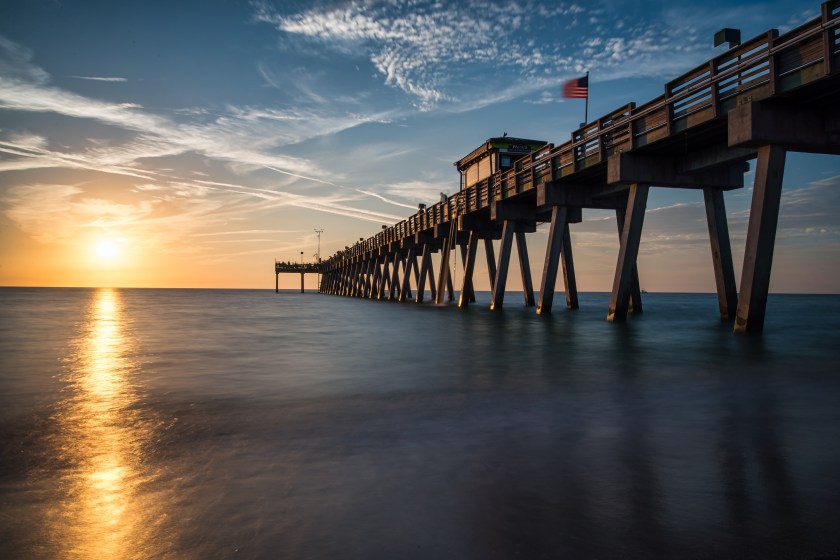
Sunset photograph of the Venice Fishing Pier in Florida, showing the pier extending into the Gulf of Mexico with golden reflections on calm water.
Sunset over the Gulf of Mexico with the Venice Fishing Pier in the background, captured in a long exposure.

Within Greg Urbano’s “Beginnings” chapter, this sunset photograph of the Venice Fishing Pier represents a photographer coming to terms with landscape photography’s essential discipline: the patient orchestration of light, water, and architecture. Shot along Florida’s Gulf Coast, the image demonstrates technical competence married to an emerging aesthetic sensibility—a combination that marks the transition from enthusiast to serious practitioner.

The technical execution reveals deliberate choices that elevate this beyond a simple sunset snapshot. Using a Nikon D610 with an 18-35mm lens set to 28mm, Urbano selected an aperture of f/18 to maximize depth of field, ensuring sharpness from the foreground water to the distant pier structure. The 13-second exposure at ISO 100 transforms the Gulf of Mexico into a silken plane, smoothing the texture of incoming waves into an ethereal blue gradient. This long exposure technique—fundamental to seascape photography—requires both technical knowledge and patience, waiting for the precise moment when light, tide, and atmospheric conditions align.

The composition demonstrates sophisticated spatial awareness. The pier’s diagonal thrust from lower right to upper left creates dynamic movement through the frame, leading the viewer’s eye from the silky foreground water toward the structure’s vanishing point. The rhythmic repetition of pier supports establishes a visual cadence, their angular geometry contrasting beautifully with the organic flow of water and clouds. An American flag atop the pier adds a vertical accent and a touch of patriotic iconography without overwhelming the scene’s natural beauty.

What distinguishes this photograph is Urbano’s treatment of light. The setting sun hovers just above the horizon line, its golden warmth reflected in a shimmering path across the water’s surface. The exposure balances multiple tonal zones expertly: the brilliant sun doesn’t blow out to featureless white, the shadowed pier structure retains detail, and the water holds both luminous highlights and cool, deep blues. This tonal control suggests a photographer who understands exposure compensation and potentially uses graduated neutral density filters or careful post-processing to manage the scene’s extreme dynamic range.

The sky deserves particular attention. Wispy cirrus clouds stretch across the frame in delicate streaks, their feathered patterns creating texture and visual interest in what might otherwise be empty blue space. The interplay between warm sunset tones near the horizon and cooler blues above establishes atmospheric depth, giving the image a sense of vast space and coastal openness.

As a “Beginnings” chapter work, this photograph represents mastery of landscape photography fundamentals. The long exposure technique, the careful attention to composition and leading lines, the patient waiting for optimal light—these are the building blocks upon which more experimental work can later be constructed. There’s confidence here, a photographer who has moved beyond technical uncertainty into intentional image-making.

The Venice Pier becomes more than a documentary subject; it transforms into a meditation on structure and impermanence. The solid, engineered permanence of the pier contrasts with the fluid, ever-changing water—a tension made visible through photographic technique. Urbano captures not just a place, but a moment of perfect equilibrium between human construction and natural forces, all bathed in the transient golden light that photographers chase endlessly along coastlines worldwide.