Light Paint Glass Vase: Minimalism and the Democratization of Photographic Practice

A minimalist black-and-white photograph of a glass vase showcases how simple materials can produce sophisticated visual art. Created for a structured challenge, the work emphasizes classical minimalist principles, focusing on light, form, and composition. It highlights the idea that accessible techniques can achieve impactful results through exploration and experimentation.

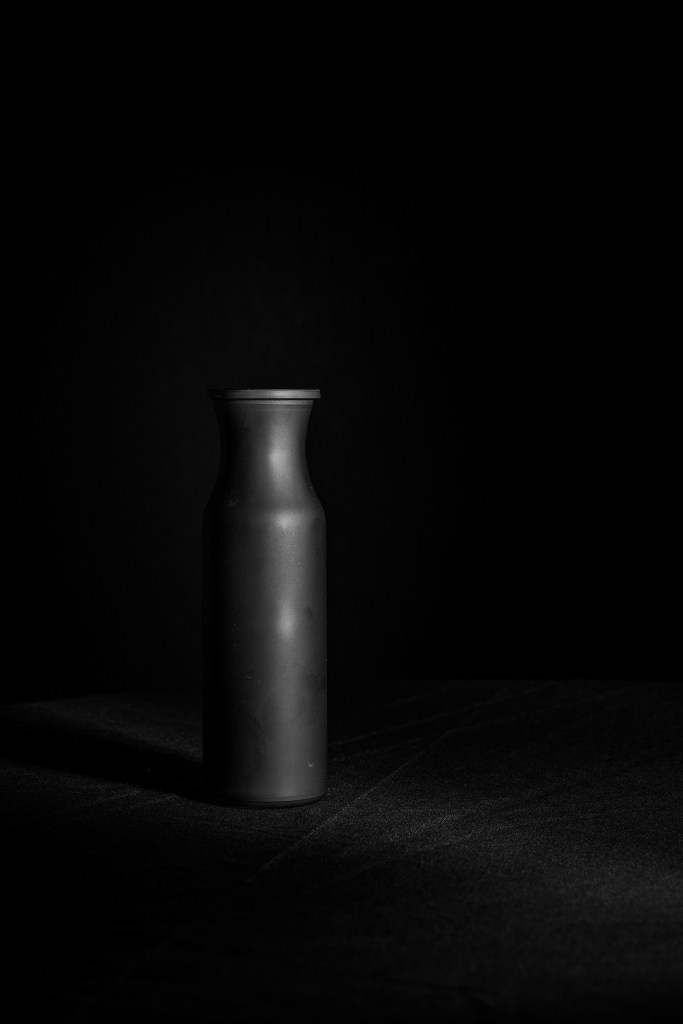
Black-and-white photograph of a single glass vase standing on a dark fabric surface, illuminated against a black background with subtle light-painted highlights.
A minimalist black-and-white study of a glass vase, photographed using light painting on a dark tabletop and background.

In this austere still life, the photographer demonstrates how constraint and accessibility can yield sophisticated visual results. Created for Week 46 of a structured challenge focused on black and white minimalism, the image features a green glass vase—rendered in monochrome—isolated against absolute darkness. The work’s genesis from dollar store materials and basic light painting techniques belies its formal accomplishment, positioning it as a compelling statement within Chapter 6’s exploration of ongoing practice and future directions.

The composition adheres to classical minimalist principles: a singular subject, centered and vertical, emerges from void. The vase’s elegant silhouette—narrow at neck and base, gently swelling through its body—receives careful illumination from a handheld flashlight, creating a gradient of tones that model the form with sculptural precision. The photographer’s light painting technique reveals selective control; highlights trace the vessel’s curve while allowing shadow to claim significant portions of the surface, suggesting volume through implication rather than complete revelation.

What distinguishes this work within the photographer’s broader trajectory is its embrace of democratic materials and process. By explicitly acknowledging the humble origins of both subject and lighting instrument, he advances a philosophy that technical sophistication need not depend on expensive equipment. This approach resonates with Chapter 6’s theme of exploration—suggesting that the road ahead involves continual experimentation with accessible means rather than escalating technical complexity.

The monochromatic treatment transforms what was originally a green glass vessel into a study of pure form and tonality. This chromatic reduction focuses attention on the interplay between light and surface, on the subtle texture variations across the vase’s body, and on the relationship between object and ground. The black tablecloth and background merge into a unified void, creating the impression that the vase floats in undefined space—a strategy borrowed from commercial and fine art photography traditions alike.

The image’s participation in a weekly challenge framework—Week 46 addressing black and white minimalism—situates the photographer’s practice within contemporary photography’s social and educational structures. Unlike the isolated studio practice of previous generations, his work emerges from dialogue with prompts, themes, and presumably a community of practitioners engaging similar constraints. This context enriches the reading of Chapter 6; the road ahead is both solitary and communal, shaped by individual vision and collective participation.

Post-processing in Adobe Camera Raw represents the final transformative stage, where the captured light painting receives refinement and intentional tonal mapping. The deep blacks exhibit rich density without blocking detail entirely, while the highlights maintain luminosity without burning out—evidence of considered digital darkroom practice.

Within the Top 100 Journey, this photograph stands as testament to fundamental photographic principles: light, form, composition, and tone. Its apparent simplicity masks deliberate choices regarding placement, illumination duration and direction, and subsequent processing decisions. The vase becomes more than household object; it transforms into a vehicle for exploring how light describes volume, how darkness defines presence, and how minimal means can generate maximal visual impact.

In embracing both constraint and accessibility, the photographer charts a sustainable path forward—one where ongoing exploration need not await perfect conditions or specialized equipment, but can unfold through disciplined attention to essential elements.
The Studio as Theater: Classical Portraiture in Contemporary Practice

Jessica Lynn’s studio portrait showcases a fusion of classical portraiture and contemporary technique, created during a workshop at Atelier Alchimia. The photograph illustrates the artist’s growth through collaboration, using refined lighting to enhance the subject’s regal appearance. This work embodies artistic evolution, blending tradition with innovation while emphasizing continuous learning.

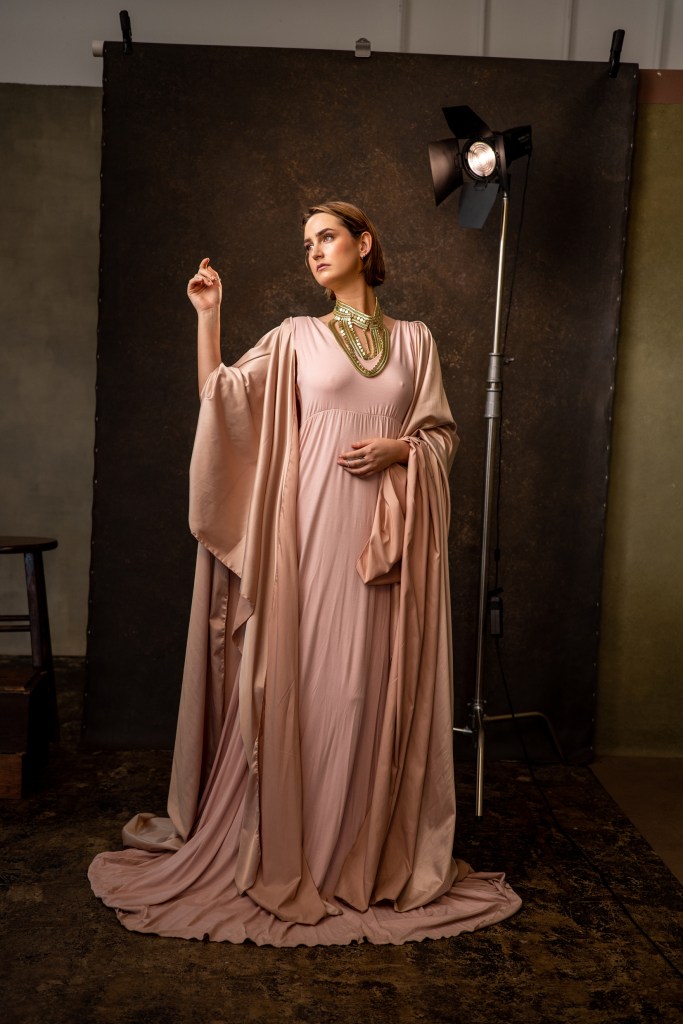
Studio portrait of Jessica Lynn standing in a flowing blush-colored gown, posed in front of a dark backdrop with a studio light visible behind her.
Jessica Lynn (QueenJess Rising) photographed in a studio setting during a workshop at Atelier Alchimia in Westminster, Colorado.

This studio portrait from Chapter 6 of the photographer’s Top 100 Journey represents a deliberate engagement with the formal traditions of classical portraiture, reimagined through contemporary technical means. Created during a workshop at Atelier Alchimia in Westminster, Colorado, the image demonstrates how collaborative learning environments can yield work of considerable aesthetic merit while advancing the artist’s technical vocabulary.

The subject, Jessica Lynn, is presented in a flowing blush-toned gown with dramatic bell sleeves that cascade to the floor, creating a silhouette reminiscent of Renaissance or Pre-Raphaelite painting. An ornate collar necklace in gold and green adds a regal quality that justifies the image’s title. The photographer has positioned her in a classical contrapposto-inspired stance—weight on one leg, torso gently twisted, one hand raised in a gesture of contemplation or perhaps benediction. This pose, combined with the upward gaze and theatrical lighting, evokes both historical portraiture and contemporary fashion photography’s ongoing dialogue with art history.

The technical execution reveals careful attention to studio craft. A single key light with barn doors, visible in the frame’s right edge, provides directional illumination that sculpts the subject’s features and creates tonal gradation across the fabric’s folds. The mottled canvas backdrop transitions from warm browns to darker tones, providing depth without competing for attention. The lighting setup, developed collaboratively with studio owner Jonny Edwards, demonstrates the photographer’s increasing comfort with controlled environments—a marked evolution from earlier work in the series that frequently engaged with natural light and outdoor settings.

What makes this image particularly relevant to “The Road Ahead: Recent Work & Ongoing Exploration” is its frank acknowledgment of artistic development through structured learning. Shot during a workshop led by Eric Brown, the photograph embodies a philosophy of continuous growth and technical refinement. Rather than presenting only work created in solitary practice, the photographer includes images born from educational contexts, recognizing that mastery often emerges through collaboration and mentorship.

The choice to work with studio lighting represents an expansion of technical range. The careful balance of exposure—maintaining detail in both the luminous fabric and the darker background—suggests growing confidence with artificial light sources. The warm color palette creates cohesion between subject, costume, and environment, while the visible studio elements (backdrop clamps, light stand) provide documentary transparency about the image’s construction.

Within the broader arc of the Top 100 Journey, this portrait signals a willingness to explore different photographic modes. Where earlier chapters emphasized environmental and location work, this studio piece demonstrates versatility and an interest in controlled aesthetic experiences. The theatrical quality—the visible apparatus of image-making—invites viewers into the creative process rather than presenting a seamless illusion.

The photograph succeeds both as a study in classical beauty and as evidence of artistic evolution. It captures a moment of learning translated into accomplished execution, showing that the road ahead need not abandon traditional craft in pursuit of innovation. Instead, it suggests that mastery comes through accumulation—building new skills atop established foundations, always remaining open to guidance, collaboration, and the timeless appeal of light falling gracefully upon fabric and form.

Suspension and Illusion: A Study in Controlled Ephemera

Model Everyn Darling is featured in a significant studio portrait taken during a photography workshop in Denver. This image, characterized by its minimalist setting and controlled lighting, explores themes of aspiration and vulnerability through the metaphor of a translucent balloon. The photographer’s evolving style emphasizes collaborative creativity and visual poetry over mere technical perfection.

Studio portrait of a woman in a black dress holding a translucent balloon against a plain backdrop.
Model Everyn Darling poses with a translucent balloon during a studio photography workshop in Denver, Colorado.

This studio portrait represents a significant departure within the photographer’s evolving practice, marking his exploration of collaborative, workshop-based creation and the controlled artifice of studio environments. Captured during a Creative Experimental Photography Meetup at RAW Studios in Denver, the image demonstrates how structured creative exercises can yield work of surprising conceptual depth when approached with technical precision and compositional awareness.

The photograph centers on model Everyn Darling, positioned within a minimalist studio setting characterized by graduated neutral tones that transition from cool blue-grey to warm cream. This chromatic subtlety provides visual breathing room while maintaining atmospheric presence—a backdrop that supports rather than competes. The subject, dressed in a simple black dress with white collar detail, appears barefoot in a pose of upward contemplation, one arm extended to hold a translucent balloon trailing delicate white ribbons or fabric.

What elevates this image beyond documentation of a workshop exercise is the photographer’s attention to the psychology of gesture and the poetry of the ostensibly simple prop. The balloon—that most ephemeral and-associated of objects—becomes a vehicle for exploring themes of lightness, release, and the tenuous connection between desire and drift. The model’s gaze follows the balloon upward, creating a diagonal compositional line that draws the eye through the frame while suggesting aspiration, longing, or perhaps the acceptance of letting go.

The technical execution reveals disciplined studio craft. Working with his Nikon Z5 and the versatile 24-120mm f/4 lens, the photographer has managed studio lighting with restraint, avoiding the harsh drama often favored in workshop settings. The illumination appears softly directional, modeling the subject’s features and dress while maintaining detail in the translucent balloon. Shadow work on the studio floor provides subtle grounding without becoming graphic or distracting. The slightly elevated perspective and negative space allocation give the subject room to breathe within the frame—a compositional generosity that reinforces the image’s contemplative mood.

Within the context of Chapter 6—”The Road Ahead: Recent Work & Ongoing Exploration”—this photograph signals important developments in his practice. The workshop origin indicates openness to collaborative creative structures and willingness to work within parameters set by others. Yet the result bears his aesthetic signature: careful attention to subtle tonal gradations, preference for psychological ambiguity over narrative certainty, and interest in objects as metaphorical carriers rather than mere props.

The image also represents exploration of human subjects with greater intimacy than much of his earlier landscape and architectural work. The model’s upturned face, though not confronting the camera directly, introduces vulnerability and interiority often absent from environmental documentation. This shift suggests expanding comfort with portraiture and the complex dynamics of photographer-subject collaboration.

The balloon’s deliberate artificiality—clearly held rather than actually floating—adds productive tension. The photograph acknowledges its own construction while inviting viewers to suspend disbelief, mirroring how all photography negotiates between document and fiction. In selecting this image as his best from the series, the photographer reveals evolving criteria for success: not technical perfection alone, but the achievement of visual poetry through careful orchestration of simple elements within controlled conditions.

Tomatos

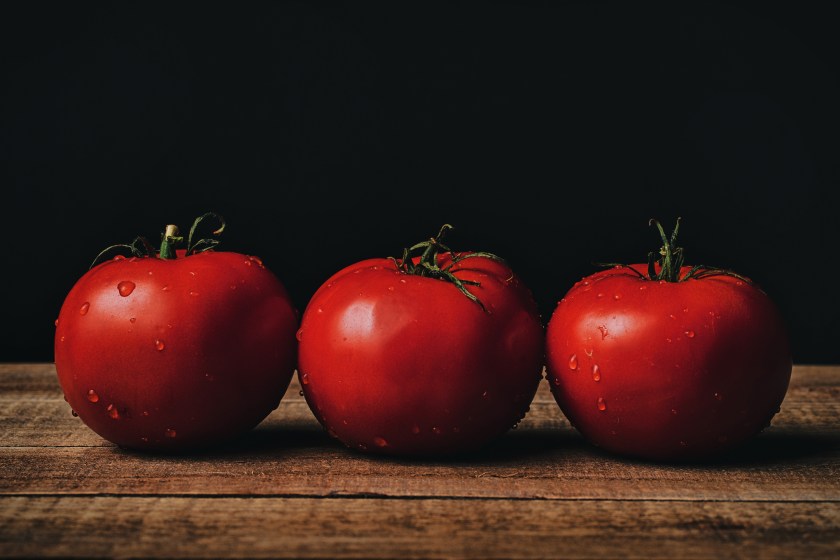
This photographic composition showcases three tomatoes on a textured wooden surface against a dark background, illustrating the themes of light and form in still life art. Using controlled lighting to create a dramatic chiaroscuro effect, the photographer emphasizes the tomatoes’ beauty, merging classical traditions with contemporary techniques.

Tabletop still life of three ripe tomatoes with water droplets on a wooden surface against a dark background.
A tabletop still life of three tomatoes arranged on a wooden surface and lit against a dark background.

In this deceptively simple composition, the photographer demonstrates how the most humble subjects—three tomatoes from a supermarket produce section—can become vehicles for exploring light, form, and the enduring traditions of still life photography. The work sits comfortably within the classical end of Chapter 5’s spectrum, channeling centuries of artistic precedent while employing decidedly contemporary tools and techniques.

The arrangement recalls Dutch Golden Age vanitas paintings, where ordinary kitchen staples were elevated to subjects of profound contemplation. Here, three ripe tomatoes rest upon a weathered wooden surface, their placement casual yet deliberate. The varying positions of their stems—pointing in different directions like botanical compasses—introduce subtle asymmetry that prevents the composition from becoming static. Water droplets cling to the glossy red skin, suggesting recent washing and adding points of light that animate the surface.

His lighting strategy proves crucial to the image’s success. Working with a single Godox V1s flash modified by a softbox and grid, he achieves remarkable control over illumination. The grid attachment narrows the light spread, creating focused illumination that emphasizes the tomatoes while allowing the background to fall into deep, theatrical darkness. This chiaroscuro effect—the dramatic interplay of light and shadow—lends gravitas to subjects that might otherwise seem merely documentary.

The wooden surface provides essential contextual grounding. Its rough texture and visible grain contrast beautifully with the smooth, taut skin of the tomatoes, creating a dialogue between refined organic form and rustic materiality. The warm tones of the aged wood complement the rich reds of the fruit, establishing a harmonious yet varied color palette that feels both earthy and sophisticated.

His post-processing approach through Skylum Luminar 4, utilizing a color LUT (Look-Up Table), demonstrates an efficient workflow that enhances rather than overwhelms the captured image. The color grading deepens the reds toward burgundy in the shadows while maintaining natural highlights, creating dimensionality that draws the eye around each form. This restrained digital intervention respects the photographic integrity of the scene while amplifying its visual impact.

Within the broader trajectory of his still life work, this image represents a return to fundamentals—a meditation on how controlled lighting and thoughtful composition can transform the everyday into the examined. Where other works in this chapter might push toward experimental territories, this photograph anchors itself in proven traditions, demonstrating that innovation need not always mean departure from established visual language.

The Sony A7ii captures these elements with clarity and subtle tonal gradation, rendering the tomatoes with sufficient detail to appreciate their imperfect spherical forms, the slight variations in color saturation, and the delicate green stems that signal recent harvest. These details matter; they prevent the image from becoming abstract or overly stylized, maintaining its connection to the tangible world.

Ultimately, this work succeeds through its quiet confidence. The photographer understands that compelling still life photography requires neither exotic subjects nor complex staging—only patient observation, technical competence, and an appreciation for how light reveals the inherent beauty in forms we too often overlook. These grocery store tomatoes, frozen in this particular moment of light and shadow, become worthy of sustained attention.

Pears: A Chromatic Triptych in Measured Light

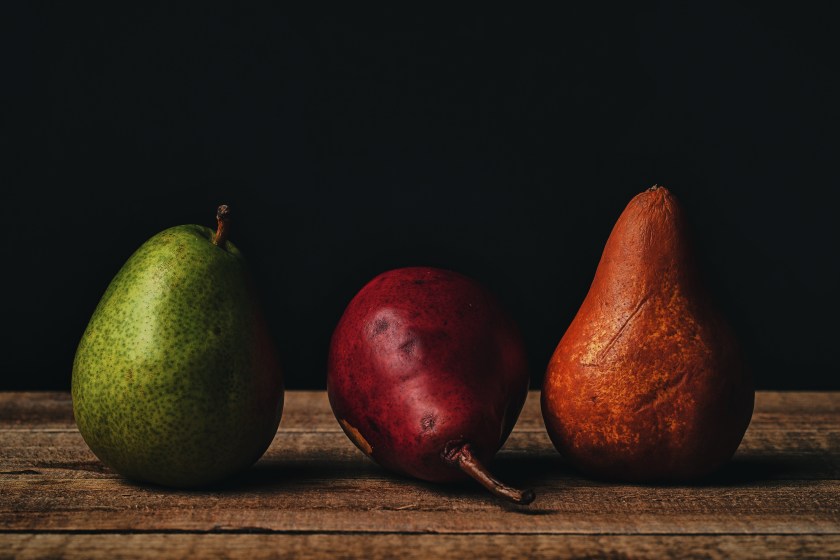
A still life photograph features three pears, highlighting the photographer’s evolving technique in transforming everyday produce into subjects for aesthetic contemplation. Using controlled lighting and a focused composition, the work emphasizes color variation and organic authenticity. This piece bridges classic and contemporary styles, encouraging viewers to appreciate the beauty in simplicity.

Tabletop still life of three pears arranged side by side on a wooden surface against a dark background.
A tabletop still life of three pears arranged on a wooden surface and lit against a dark background.

This composition of three pears exemplifies the photographer’s evolving approach to still life, transforming quotidian supermarket produce into subjects worthy of sustained aesthetic contemplation. Arranged in strict linear progression across weathered wood, the trio presents a study in chromatic variation and volumetric form that speaks to both classical still life traditions and contemporary minimalist sensibilities.

The technical framework mirrors the controlled approach evident throughout this body of work: a single Godox V1s strobe modified by softbox and grid, captured with a Sony A7ii paired with an 85mm f/1.8 lens. This choice of focal length proves particularly significant. Unlike the wider perspectives often employed in tabletop work, the 85mm compression subtly flattens spatial relationships while maintaining separation between subjects, creating a stage-like presentation where each pear occupies its designated position with theatrical clarity.

What distinguishes this image within the chapter’s trajectory is its bold embrace of color as primary subject matter. Where the earlier onion and garlic study operated within a narrow tonal range of earth and amber, here the photographer orchestrates a chromatic progression—verdant green, deep crimson, oxidized copper—that reads almost as a color theory exercise. Yet the natural imperfections of each fruit prevent the composition from becoming merely schematic. Surface blemishes, stem variations, and subtle textural differences assert the subjects’ organic authenticity.

The lighting strategy reveals sophisticated control over shadow placement and tonal gradation. The grid attachment concentrates illumination on the subjects while allowing the background to fall into near-absolute blackness, a technique borrowed from Old Master painting that isolates forms in dramatic relief. Light wraps around each pear’s curved surface with mathematical precision, creating highlight-to-shadow transitions that define volume without resorting to harsh contrast. The wooden platform receives just enough illumination to establish spatial grounding, its grain and weathering providing textural counterpoint to the fruits’ smooth skins.

Compositional decisions demonstrate a rigorous formal intelligence. The three pears, though similar in scale, exhibit distinct silhouettes—the green pear’s upright verticality, the red pear’s compressed roundness, the copper pear’s elongated diagonal lean. This variation within repetition creates visual rhythm while avoiding monotony. The spacing between subjects appears carefully calibrated, neither crowding nor isolating, allowing each fruit to maintain individual presence while contributing to the unified whole.

Post-processing through color grading has intensified chromatic saturation while preserving naturalistic tonality. The resulting palette suggests both heightened reality and painterly intention—colors feel amplified yet believable, enhanced rather than fabricated. This balance between documentation and interpretation positions the work at a productive intersection of photographic traditions.

Within the chapter’s arc from classic to experimental approaches, this image occupies transitional territory. Its formal rigor and single-light methodology align with classical practice, yet the chromatic boldness and almost Pop Art sensibility of three isolated, colored forms hint at more conceptual concerns. The photograph demonstrates that experimentation can emerge from treating simple subjects with exacting attention rather than through technical complexity alone.

The work ultimately asks viewers to reconsider the aesthetic potential residing in everyday objects, a question central to still life practice across centuries. By isolating these supermarket pears in dramatic light and formal precision, the photographer transforms the ordinary into an opportunity for visual meditation on color, form, and the enduring power of careful observation.

Vertical Ascension: Modernist Form in Downtown St. Petersburg

The black and white photograph of the Signature Place high-rise in St. Petersburg captures its architectural monumentality through a minimalist lens. Stripping color emphasizes form and texture, while a dynamic composition highlights urban development. The work reflects the photographer’s evolving vision, merging documentary and artistic interpretation within contemporary architectural photography.

Black and white low‑angle photograph of the Signature Place condominium tower in downtown St. Petersburg, Florida, showing strong geometric lines and modern architecture.
Black and white architectural study of the Signature Place high‑rise in downtown St. Petersburg.

In this striking image from Chapter 2 of the photographer’s Top 100 Journey, the Signature Place Condominium tower emerges as a study in architectural monumentality and photographic restraint. Shot in downtown St. Petersburg, Florida, the photograph transforms a contemporary residential structure into something both documentary and abstract—a meditation on verticality, light, and the geometric language of modern urban development.

The decision to render this scene in black and white proves essential to the image’s success. By stripping away color, the photographer directs attention to the fundamental elements of architectural photography: form, texture, and tonal gradation. The building’s repetitive window pattern creates a rhythmic grid that draws the eye upward, while the dramatic contrast between the illuminated facade and the darkening sky suggests a specific moment of transition—likely the golden hour, when natural light rakes across surfaces to reveal dimension and depth.

Technical execution demonstrates thoughtful consideration of both optics and exposure. Working at 35mm on an 18-35mm lens mounted to a full-frame Nikon D610, he selected a narrow aperture of f/18 to maximize depth of field and ensure crisp detail throughout the frame. The resulting sharpness allows the viewer to appreciate the building’s material qualities—the interplay of glass, concrete, and steel that defines contemporary high-rise construction. A shutter speed of 1/8 second at ISO 100 suggests the use of a tripod, essential for maintaining clarity at this exposure length while preserving clean shadow detail.

The composition employs a low vantage point that accentuates the tower’s dramatic thrust skyward. This perspective, common in architectural photography but executed here with particular effectiveness, creates a sense of imposing scale while maintaining architectural integrity. The building’s angular crown punctures the upper portion of the frame, while a lower podium structure grounds the composition and provides contextual anchoring in the urban landscape.

Within the broader framework of Chapter 2—Florida Landscapes & Cityscapes—this photograph represents an important counterpoint to the state’s more commonly photographed natural environments. Rather than beaches, wetlands, or subtropical flora, the photographer turns his lens toward Florida’s built environment, acknowledging the contemporary reality of rapid urban development along the Gulf Coast. St. Petersburg’s downtown skyline, transformed dramatically over recent decades, serves as a compelling subject for examining how modern architecture reshapes regional identity.

The image also speaks to the photographer’s evolving vision throughout the Top 100 Journey. Where other selections might emphasize natural wonder or environmental preservation, this work demonstrates equal comfort with urban subject matter. The modernist aesthetic—clean lines, geometric precision, monochromatic palette—suggests an appreciation for architectural form as a legitimate subject for serious photographic inquiry.

What elevates this photograph beyond mere documentation is its atmospheric quality. The graduated sky, rendered in smooth tones from deep black to luminous gray, provides a canvas against which the building performs. The partially visible vegetation at the frame’s base hints at the subtropical context without overwhelming the primary subject. This careful balance between architectural documentation and artistic interpretation positions the work within a tradition extending from early twentieth-century modernist photography through contemporary fine art practice—a lineage that recognizes buildings not merely as structures to be recorded, but as forms to be interpreted.