Light Paint Glass Vase: Minimalism and the Democratization of Photographic Practice

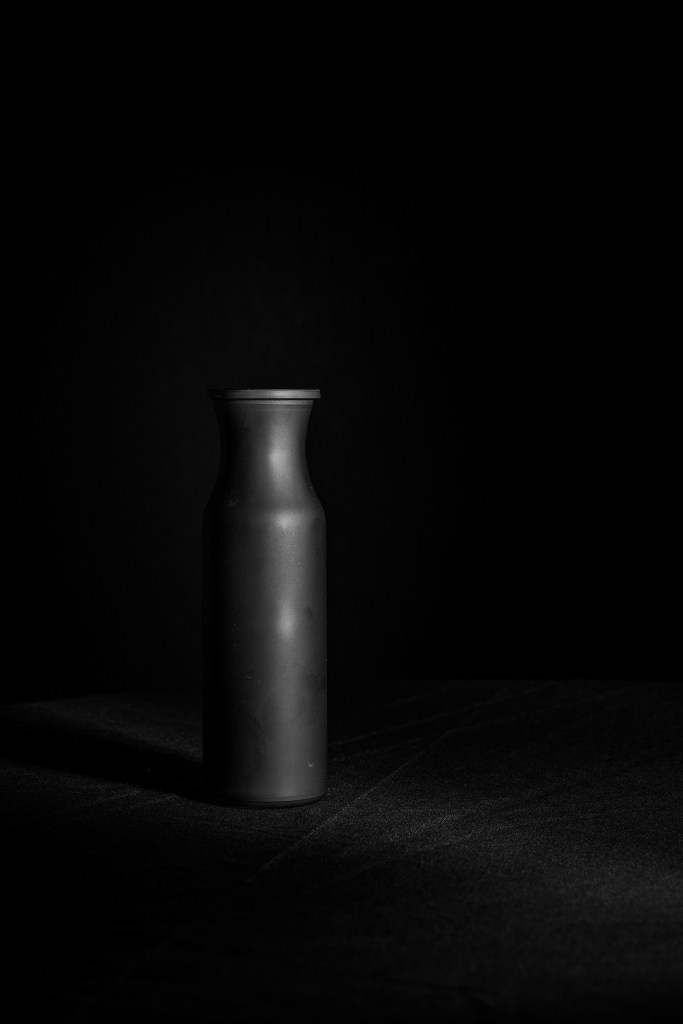
A minimalist black-and-white photograph of a glass vase showcases how simple materials can produce sophisticated visual art. Created for a structured challenge, the work emphasizes classical minimalist principles, focusing on light, form, and composition. It highlights the idea that accessible techniques can achieve impactful results through exploration and experimentation.

Black-and-white photograph of a single glass vase standing on a dark fabric surface, illuminated against a black background with subtle light-painted highlights.
A minimalist black-and-white study of a glass vase, photographed using light painting on a dark tabletop and background.

In this austere still life, the photographer demonstrates how constraint and accessibility can yield sophisticated visual results. Created for Week 46 of a structured challenge focused on black and white minimalism, the image features a green glass vase—rendered in monochrome—isolated against absolute darkness. The work’s genesis from dollar store materials and basic light painting techniques belies its formal accomplishment, positioning it as a compelling statement within Chapter 6’s exploration of ongoing practice and future directions.

The composition adheres to classical minimalist principles: a singular subject, centered and vertical, emerges from void. The vase’s elegant silhouette—narrow at neck and base, gently swelling through its body—receives careful illumination from a handheld flashlight, creating a gradient of tones that model the form with sculptural precision. The photographer’s light painting technique reveals selective control; highlights trace the vessel’s curve while allowing shadow to claim significant portions of the surface, suggesting volume through implication rather than complete revelation.

What distinguishes this work within the photographer’s broader trajectory is its embrace of democratic materials and process. By explicitly acknowledging the humble origins of both subject and lighting instrument, he advances a philosophy that technical sophistication need not depend on expensive equipment. This approach resonates with Chapter 6’s theme of exploration—suggesting that the road ahead involves continual experimentation with accessible means rather than escalating technical complexity.

The monochromatic treatment transforms what was originally a green glass vessel into a study of pure form and tonality. This chromatic reduction focuses attention on the interplay between light and surface, on the subtle texture variations across the vase’s body, and on the relationship between object and ground. The black tablecloth and background merge into a unified void, creating the impression that the vase floats in undefined space—a strategy borrowed from commercial and fine art photography traditions alike.

The image’s participation in a weekly challenge framework—Week 46 addressing black and white minimalism—situates the photographer’s practice within contemporary photography’s social and educational structures. Unlike the isolated studio practice of previous generations, his work emerges from dialogue with prompts, themes, and presumably a community of practitioners engaging similar constraints. This context enriches the reading of Chapter 6; the road ahead is both solitary and communal, shaped by individual vision and collective participation.

Post-processing in Adobe Camera Raw represents the final transformative stage, where the captured light painting receives refinement and intentional tonal mapping. The deep blacks exhibit rich density without blocking detail entirely, while the highlights maintain luminosity without burning out—evidence of considered digital darkroom practice.

Within the Top 100 Journey, this photograph stands as testament to fundamental photographic principles: light, form, composition, and tone. Its apparent simplicity masks deliberate choices regarding placement, illumination duration and direction, and subsequent processing decisions. The vase becomes more than household object; it transforms into a vehicle for exploring how light describes volume, how darkness defines presence, and how minimal means can generate maximal visual impact.

In embracing both constraint and accessibility, the photographer charts a sustainable path forward—one where ongoing exploration need not await perfect conditions or specialized equipment, but can unfold through disciplined attention to essential elements.
Light Paint Egg: Precision and Wonder in Contemporary Still Life

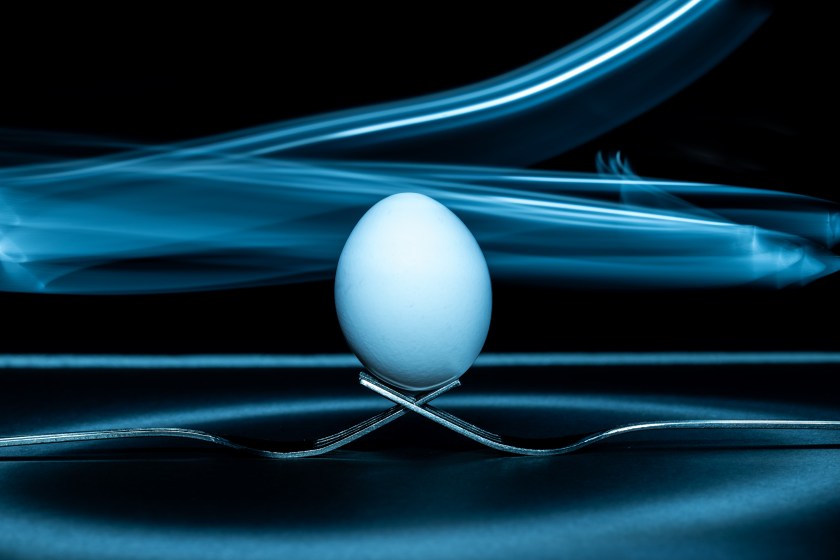
The photograph “Light Paint Egg” showcases a white egg balanced on crossed forks, illuminated through light painting techniques. This work exemplifies the artist’s blend of traditional and contemporary methods, capturing a balance between stasis and motion. It represents an innovative departure in still life, emphasizing creativity and technical mastery despite simple materials.

White egg balanced upright on crossed metal forks, photographed against a dark background with blue light trails created through light painting.
A white egg balanced on crossed forks, photographed using light painting techniques for the 52 Frames Week 11 “Egg” challenge.

In this meticulously crafted photograph, the artist demonstrates a masterful command of light painting technique, transforming an ordinary subject into an object of contemplation. The egg, positioned at the composition’s center, becomes a luminous focal point—its pale, almost ethereal surface contrasting dramatically against the deep black void that surrounds it. This is not merely documentation of an object, but rather an exploration of form, light, and the delicate balance between the tangible and the abstract.

The technical execution reveals a photographer working at the intersection of traditional still life aesthetics and contemporary experimental methods. Inspired by demonstrations from the lighting equipment company Adaptalux, he pursued this vision independently, relying on his own resourcefulness and understanding of photographic principles rather than specialized gear. This approach speaks to a fundamental confidence in craft—the knowledge that compelling imagery emerges not from equipment alone, but from vision and technical literacy working in concert.

The light trails that sweep through the frame possess an almost calligraphic quality, their cool blue tones suggesting both movement and stillness simultaneously. These luminous threads create a complex spatial environment, establishing depth and dimensionality around the egg while reinforcing its solidity and sculptural presence. The waves beneath appear to cradle the subject, while the diagonal streaks above suggest trajectory, momentum, perhaps even flight. There exists here a visual tension between stasis and motion, weight and weightlessness—themes that resonate throughout his broader body of work.

Positioned within Chapter 6 of his Top 100 Journey—”The Road Ahead: Recent Work & Ongoing Exploration”—this photograph exemplifies the artist’s willingness to embrace technical challenges and aesthetic risks. The chapter’s title suggests forward movement, continued evolution, and the photographer’s commitment to expanding his visual vocabulary. Indeed, this image represents a departure from more conventional approaches to still life, demonstrating how constraints—in this case, a weekly theme challenge—can catalyze creative innovation.

The composition adheres to classical principles while subverting expectations. The egg, that most ancient and universal of symbols, is elevated beyond its associations with fragility and potential. Here it becomes something simultaneously organic and otherworldly, as though suspended in a dimension where the laws of physics bend to artistic intention. The photographer’s choice to work with long exposure and moving light sources transforms the medium itself into a drawing tool, blurring the boundaries between photography, painting, and performance.

What distinguishes this work within his oeuvre is its synthesis of technical precision and poetic sensibility. The execution required careful planning—controlling exposure duration, choreographing light movement, managing ambient contamination—yet the final image transcends its methodology. It invites meditation on form, on the nature of photographic representation, and on how familiar objects can be estranged and renewed through careful observation and technical intervention.

As part of his ongoing exploration documented in the Top 100 Journey project, “Light Paint Egg” signals a photographer unafraid to experiment, to respond to creative prompts with rigor and imagination, and to push the boundaries of his practice. It stands as evidence that profound imagery can emerge from simple materials when vision, patience, and technical mastery converge.

Suspension and Illusion: A Study in Controlled Ephemera

Model Everyn Darling is featured in a significant studio portrait taken during a photography workshop in Denver. This image, characterized by its minimalist setting and controlled lighting, explores themes of aspiration and vulnerability through the metaphor of a translucent balloon. The photographer’s evolving style emphasizes collaborative creativity and visual poetry over mere technical perfection.

Studio portrait of a woman in a black dress holding a translucent balloon against a plain backdrop.
Model Everyn Darling poses with a translucent balloon during a studio photography workshop in Denver, Colorado.

This studio portrait represents a significant departure within the photographer’s evolving practice, marking his exploration of collaborative, workshop-based creation and the controlled artifice of studio environments. Captured during a Creative Experimental Photography Meetup at RAW Studios in Denver, the image demonstrates how structured creative exercises can yield work of surprising conceptual depth when approached with technical precision and compositional awareness.

The photograph centers on model Everyn Darling, positioned within a minimalist studio setting characterized by graduated neutral tones that transition from cool blue-grey to warm cream. This chromatic subtlety provides visual breathing room while maintaining atmospheric presence—a backdrop that supports rather than competes. The subject, dressed in a simple black dress with white collar detail, appears barefoot in a pose of upward contemplation, one arm extended to hold a translucent balloon trailing delicate white ribbons or fabric.

What elevates this image beyond documentation of a workshop exercise is the photographer’s attention to the psychology of gesture and the poetry of the ostensibly simple prop. The balloon—that most ephemeral and-associated of objects—becomes a vehicle for exploring themes of lightness, release, and the tenuous connection between desire and drift. The model’s gaze follows the balloon upward, creating a diagonal compositional line that draws the eye through the frame while suggesting aspiration, longing, or perhaps the acceptance of letting go.

The technical execution reveals disciplined studio craft. Working with his Nikon Z5 and the versatile 24-120mm f/4 lens, the photographer has managed studio lighting with restraint, avoiding the harsh drama often favored in workshop settings. The illumination appears softly directional, modeling the subject’s features and dress while maintaining detail in the translucent balloon. Shadow work on the studio floor provides subtle grounding without becoming graphic or distracting. The slightly elevated perspective and negative space allocation give the subject room to breathe within the frame—a compositional generosity that reinforces the image’s contemplative mood.

Within the context of Chapter 6—”The Road Ahead: Recent Work & Ongoing Exploration”—this photograph signals important developments in his practice. The workshop origin indicates openness to collaborative creative structures and willingness to work within parameters set by others. Yet the result bears his aesthetic signature: careful attention to subtle tonal gradations, preference for psychological ambiguity over narrative certainty, and interest in objects as metaphorical carriers rather than mere props.

The image also represents exploration of human subjects with greater intimacy than much of his earlier landscape and architectural work. The model’s upturned face, though not confronting the camera directly, introduces vulnerability and interiority often absent from environmental documentation. This shift suggests expanding comfort with portraiture and the complex dynamics of photographer-subject collaboration.

The balloon’s deliberate artificiality—clearly held rather than actually floating—adds productive tension. The photograph acknowledges its own construction while inviting viewers to suspend disbelief, mirroring how all photography negotiates between document and fiction. In selecting this image as his best from the series, the photographer reveals evolving criteria for success: not technical perfection alone, but the achievement of visual poetry through careful orchestration of simple elements within controlled conditions.

Color Drip: Materiality and Motion in Contemporary Still Life

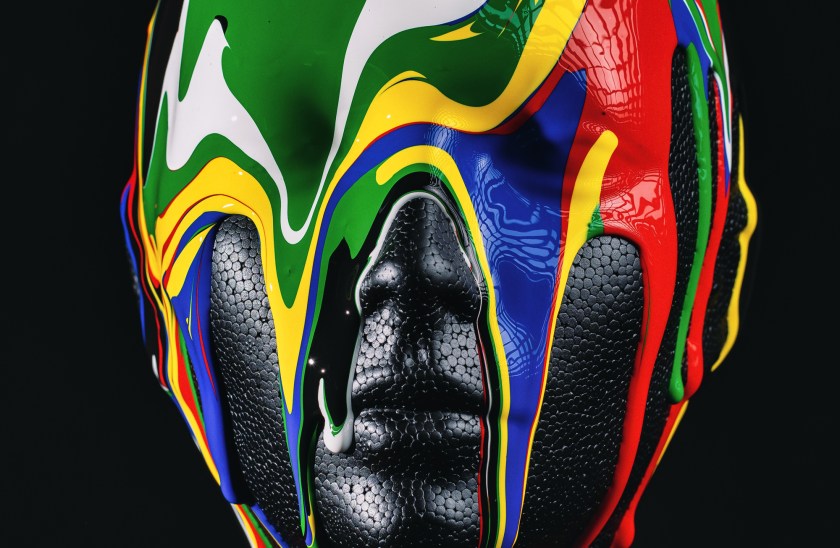
This photograph showcases multicolored paint dripping over a black mannequin head, representing the photographer’s exploration of paint as both subject and medium. By removing human elements, the focus shifts to paint’s properties and gestures, merging classic still life with contemporary material investigations. The composition embodies a dynamic interplay of control and chaos.

Close-up of a black mannequin head covered in glossy, multicolored paint dripping downward against a dark background.
Multicolored paint drips over a black mannequin head in a controlled studio setup.

Within the broader context of tabletop photography’s evolution from classical arrangement to experimental intervention, this photograph represents a decisive moment in the photographer’s exploration of paint as both subject and sculptural medium. The image captures viscous streams of color—green, yellow, red, and blue—descending across a black textured surface in fluid, organic patterns that suggest simultaneous control and surrender.

The composition reveals its conceptual origins while transcending them. Inspired by a live model photograph encountered on social media, the photographer sought to recreate similar effects using a styrofoam mannequin head painted black. This substitution proves significant: by removing the human element, the work shifts focus entirely to the material properties of paint itself—its weight, viscosity, and the temporal nature of its movement. The textured black surface, likely meant to simulate skin or hair, instead becomes an abstract topography across which color flows according to gravitational and physical laws.

Technically, the photograph demonstrates sophisticated handling of surface and light. The glossy quality of the wet paint creates highlights that map the three-dimensional contours beneath, while the matte black texture provides counterpoint and depth. The color palette—primary hues plus white—reads as deliberately elemental, avoiding the complexity of mixed tones in favor of pure chromatic statement. Each rivulet maintains its individual identity even as the colors converge and overlap, creating secondary interactions at their edges without complete integration.

The formal composition operates through diagonal movement and asymmetrical balance. The paint flows establish dynamic vectors across the frame, leading the eye downward and around the curved forms. The black areas function as negative space that gives structure to the chromatic chaos, while the textured surface adds a reptilian or industrial quality that complicates the otherwise organic flow patterns. This tension between the fluid and the fixed, the organic and the manufactured, activates the image beyond mere documentation of an experimental process.

As one of the first edits from this experimental series, the photograph captures the photographer working through ideas in real time. There exists a certain rawness here—an directness in the setup and execution that speaks to initial discovery rather than refined methodology. The black background isolates the subject completely, a studio technique that emphasizes formal relationships over contextual meaning. This approach aligns with classic tabletop photography’s concern with controlled environments, even as the unpredictable paint drips push toward the experimental end of the chapter’s spectrum.

Within Chapter 5’s framework, this piece marks a transition from static arrangement toward time-based phenomena. The dripping paint implies duration—the moment before and after this frozen instant. Unlike traditional still life’s carefully positioned objects, here the photographer choreographs a performance, then selects the decisive moment from its unfolding. The work thus bridges historical still life concerns with contemporary interests in process, materiality, and the indexical trace.

What emerges is less a portrait substitute than an investigation into how materials behave under specific conditions. The styrofoam head becomes armature, the paint becomes protagonist, and the photograph itself becomes evidence of an ephemeral sculptural event. It represents the photographer thinking through his medium, testing possibilities, and documenting the results with the clarity and precision his technical skill affords.