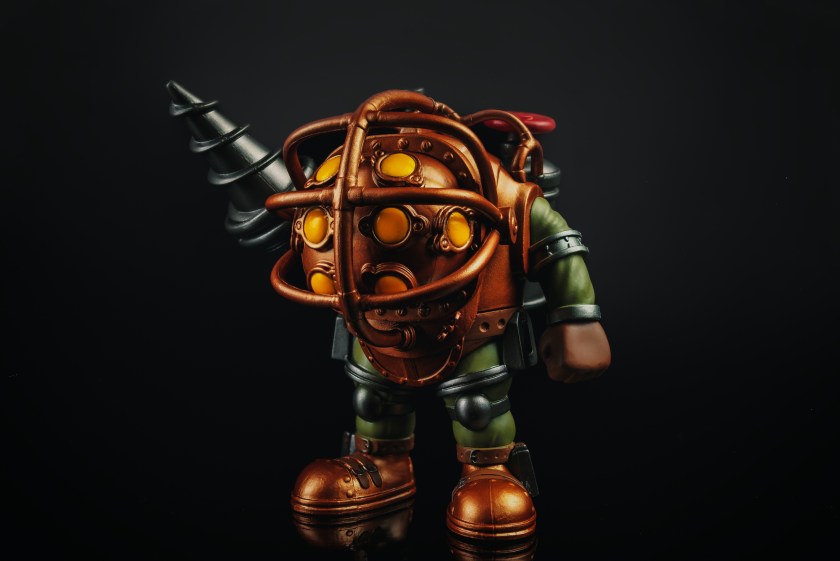
In this striking tabletop study, the photographer transforms a mass-market collectible into a subject worthy of contemplated observation. The Funko Pop! Games Bioshock 65 figure—depicting the iconic Big Daddy character—emerges from absolute darkness with a presence that transcends its commercial origins. This work exemplifies the photographer’s evolving command of still life technique, demonstrating how contemporary imaging technology can elevate genre photography into something more architecturally precise and visually arresting.
The technical execution reveals a sophisticated understanding of focus stacking methodology. By compositing multiple exposures captured at incrementally adjusted focal planes, he has achieved a depth of field impossible through traditional single-exposure photography. Every riveted seam of the copper-toned diving helmet, each glowing porthole window, and the textured surfaces of the green atmospheric diving suit maintain perfect clarity throughout the frame. This exhaustive sharpness creates an almost hyperreal quality, allowing viewers to examine the figure with a scrutiny typically reserved for museum artifacts rather than vinyl toys.
His lighting strategy demonstrates restraint and intentionality. The stripbox and softbox configuration creates dimensional modeling that accentuates the sculptural qualities of the form. The warm metallic tones of the helmet and boots catch highlights that suggest weight and substance, while the darker green suit recedes appropriately into shadow. The signature yellow portholes glow with an internal luminosity, creating focal points that guide the eye through the composition. Against the black acrylic surface and backdrop, the figure exists in a void that emphasizes form over context—a classic gallery presentation strategy that isolates the subject for pure visual analysis.
Within the framework of Chapter 5’s exploration of tabletop photography from classic to experimental, this image occupies an interesting transitional space. The setup itself—studio lighting, controlled environment, careful composition—adheres to traditional still life conventions established over centuries of studio practice. Yet the technical execution, particularly the focus stacking process completed in Affinity Photo, represents distinctly contemporary capabilities. The photographer bridges historical methodology with digital innovation, creating work that honors tradition while exploiting modern tools.
The choice of subject matter also merits consideration. By photographing a figure from video game culture with the same technical rigor one might apply to antique objects or fine art pieces, he democratizes the still life genre. This approach suggests that aesthetic value exists independent of an object’s pedigree or market position. The Big Daddy, rendered with such meticulous attention, becomes a study in form, light, and texture—qualities inherent to all successful still life work regardless of subject provenance.
The reflection visible on the glossy black surface beneath the figure adds a subtle but important element of depth. This mirroring effect grounds the subject in space while maintaining the minimalist aesthetic. The overall composition reads as both technically accomplished and conceptually considered—a balance not always achieved in enthusiast tabletop work.
As part of his Top 100 Journey, this photograph represents his technical proficiency in a controlled environment, showcasing abilities that extend beyond spontaneous capture into the realm of constructed, considered image-making where patience and precision yield images of remarkable clarity and presence.
Share this:


 Greg Urbano