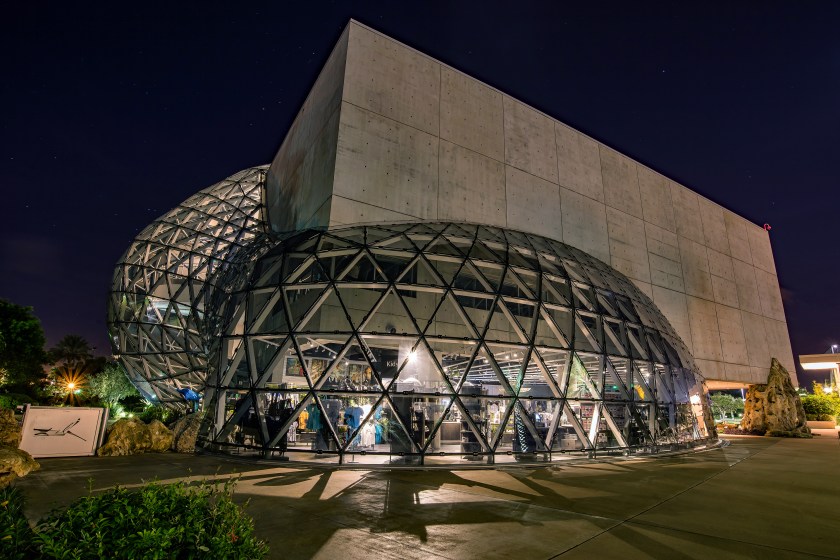
Within Chapter 2 of this photographic journey through Florida’s landscapes and cityscapes, this nighttime study of the Dalí Museum in St. Petersburg stands as a meditation on architectural dialogue—the convergence of structural rationality and organic form captured in the quietude of evening hours.
The photographer has positioned himself to emphasize the museum’s defining architectural gesture: the dramatic geodesic structure that emerges from the building’s otherwise austere concrete mass. Shot at 18mm, the wide-angle perspective accentuates the spherical dome’s imposing presence while maintaining the monumental quality of the adjoining concrete volume. This compositional choice creates a visual tension between geometric order and sculptural fluidity, perhaps an intentional echo of Dalí’s own artistic preoccupations with rigidity and metamorphosis.
Technical execution here demonstrates considerable deliberation. The 30-second exposure at f/11 has transformed the museum’s interior lighting into a warm, inviting glow that radiates through the triangulated framework, effectively rendering the geodesic dome as a luminous lantern against the deep blue-black sky. At ISO 250, the photographer has preserved tonal integrity in the shadows while avoiding the noise that might compromise the concrete’s textural detail—those subtle gradations and panel divisions that speak to the building’s material honesty.
The time of day proves critical to the image’s success. Shot during the transitional moment when civil twilight yields to night, enough ambient light remains in the sky to differentiate it from pure black, providing context and atmospheric depth. The surrounding landscaping, illuminated by strategic ground lighting, frames the architectural subject without competing for attention. The wet pavement in the foreground introduces specular highlights that guide the viewer’s eye toward the main structure while adding a layer of urban authenticity.
What distinguishes this photograph within the broader chapter is its representation of Florida’s cultural infrastructure rather than its natural or purely urban environment. While other images in this collection might emphasize the state’s coastal vistas or metropolitan skylines, this work acknowledges Florida’s role as a destination for arts and culture. The Dalí Museum, with its contemporary architectural interpretation housing works of surrealist mastery, becomes a symbol of Florida’s evolution beyond tourism clichés.
The photographer’s technical approach—the choice of a full-frame Nikon D610 paired with an 18-35mm lens—suggests a commitment to capturing architectural subjects with minimal distortion while maintaining portability for location work. The f/11 aperture provides sufficient depth of field to render sharp detail from the foreground plantings through to the building’s illuminated upper reaches, while the extended exposure time smooths any transient elements, creating a sense of permanence and contemplation.
In the context of the Top 100 Journey project, this image represents a maturation in the photographer’s documentation of Florida’s built environment. There is restraint here—a willingness to let the architecture speak through careful observation rather than dramatic intervention. The composition honors both the building’s geometry and its setting, creating a document that functions simultaneously as architectural photography and as a portrait of place, capturing a specific moment in Florida’s ongoing cultural narrative.
Share this:


 Greg Urbano