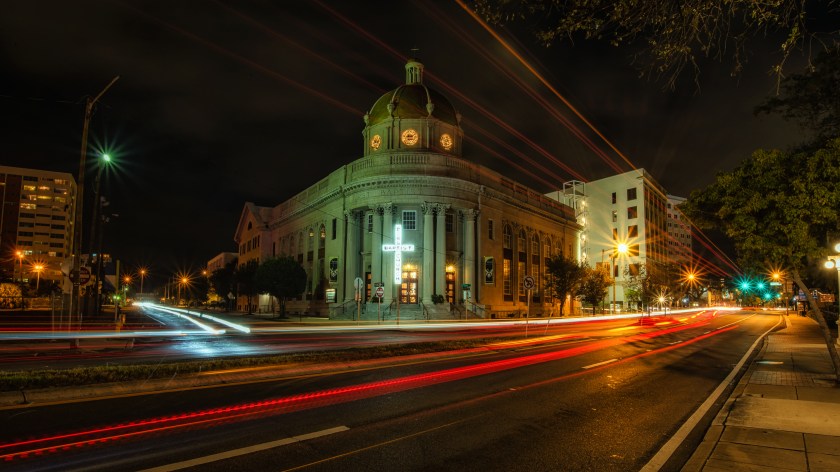
In this nocturnal study of Tampa’s historic First Baptist Church, the photographer transforms urban infrastructure into kinetic painting, employing a twenty-second exposure to capture the ceaseless motion of vehicular traffic as ribbons of light that both frame and animate the Neoclassical architecture. The resulting image operates simultaneously as documentary record and abstract composition, a duality that characterizes his most successful explorations of Florida’s urban environments.
The church itself commands the frame with dignified authority. Its illuminated dome, rendered in theatrical green uplighting, draws the eye upward through classical columns toward the cupola’s glowing clock faces. This architectural landmark, likely dating to the early twentieth century, represents Tampa’s ambitions during its period of rapid growth—a permanence and civic gravitas that contrasts sharply with the ephemeral streaks of red and white light that sweep through the foreground. The photographer has chosen an exposure duration that allows traffic to complete its passage through the intersection, creating continuous trails rather than fragmented segments, a decision that required both technical precision and patience in timing.
The technical execution reveals careful calibration of competing priorities. The f/20 aperture serves multiple functions: it extends the exposure time necessary to capture substantial light trails while creating pronounced starbursts from the streetlamps and building lights that punctuate the scene. This diffraction effect, often considered a technical liability, becomes here an expressive tool that enhances the image’s sense of urban energy and nocturnal luminosity. The ISO 160 setting represents a pragmatic compromise, maintaining clean shadow detail without the noise that would emerge at higher sensitivities during a twenty-second exposure.
What distinguishes this work within the Florida Landscapes & Cityscapes chapter is its engagement with the state’s urban identity—a counterpoint to the natural environments that dominate popular conceptions of Florida photography. Tampa, often overshadowed by Miami’s architectural flash or Orlando’s manufactured spectacle, possesses a layered history visible in buildings like this repurposed church structure, now apparently serving commercial functions while retaining its ecclesiastical form. The photographer documents this transformation without nostalgia or critique, allowing the juxtaposition of classical architecture and contemporary traffic patterns to speak to ongoing urban evolution.
The composition demonstrates sophisticated spatial organization. The church occupies the middle ground with centered dignity, while the light trails sweep diagonally from lower right to left, creating dynamic movement that prevents the symmetrical architecture from becoming static. Flanking buildings and street trees provide contextual depth, establishing the church within its urban fabric rather than isolating it as a monument. The streetlamp at left edge, its starburst perfectly rendered, serves as a visual anchor that balances the compositional weight of the church’s mass.
Within his broader photographic journey, this image represents an expansion of the long-exposure vocabulary established in his Bay Pier work. Where that earlier piece explored natural elements transformed by time, here he applies similar temporal techniques to the urban realm, revealing how extended duration can render the chaos of city traffic as elegant abstraction. The photograph succeeds in making visible the patterns underlying apparent disorder, suggesting that beauty in Florida’s built environments requires not different locations but altered ways of seeing—a perspective shift measured in seconds rather than miles.
Share this:


 Greg Urbano