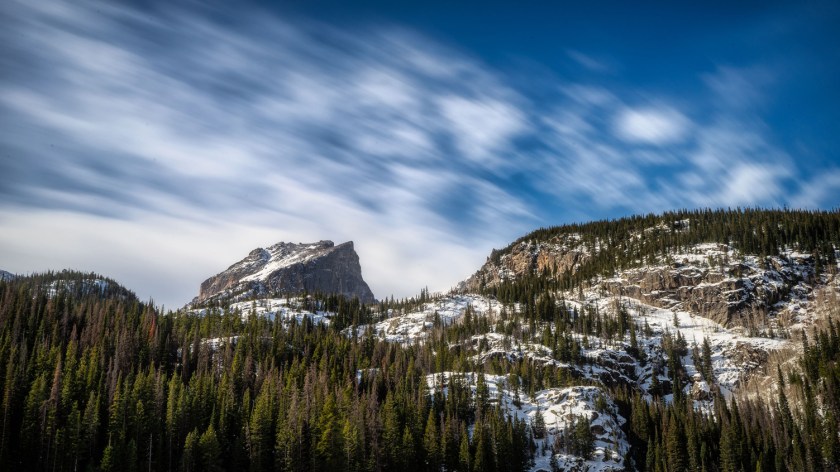
In this striking capture from Rocky Mountain National Park, the photographer demonstrates a sophisticated command of long-exposure technique to transform a familiar Colorado landscape into something both ethereal and architectural. The image of Hallett Peak, taken from the Bear Lake area, exemplifies the technical precision and artistic vision that defines Chapter 3 of his Top 100 Journey project.
The composition is anchored by the geological drama of Hallett Peak itself—that distinctive snow-dusted formation rising with muscular authority against the left portion of the frame. Yet it is the sky that commands immediate attention. Through extended exposure, the photographer has rendered clouds as diagonal streaks of motion, creating dynamic vectors that sweep across the upper two-thirds of the image. This technique transforms the sky from mere backdrop into active participant, suggesting the passage of time within a single frozen moment. The effect is cinematic, almost reminiscent of time-lapse sequences compressed into still photography.
The tonal range demonstrates careful exposure management in challenging high-altitude conditions. Deep blues saturate the upper atmosphere while softer, almost pearl-like whites and grays occupy the middle zones where cloud and sky intermingle. The snow-covered peaks and rock faces provide textural counterpoint—solid, immutable, sharply defined—against the fluid sky. This juxtaposition between the permanent and the transient becomes the photograph’s central artistic statement.
In the foreground, dense stands of evergreens establish both scale and context. The forest appears in rich greens and shadow-dark tones, creating a horizontal band that grounds the viewer’s eye before it ascends to the peaks and sky beyond. These trees serve multiple functions: they frame the composition, they provide Colorado’s signature ecological context, and they emphasize the vertical drama of the mountain forms rising behind them.
What distinguishes this work within the Colorado Landscapes & Cityscapes chapter is its sophisticated balance between documentary and interpretive approaches. While the location remains recognizable to anyone familiar with Rocky Mountain National Park, the artistic treatment elevates the image beyond straightforward landscape photography. The photographer has chosen to emphasize process—geological, meteorological, temporal—over simple representation.
The technical execution reveals careful planning. The long exposure required for cloud streaking demands stable tripod work, precise timing, and likely the use of neutral density filtration to manage the bright mountain light. The sharpness maintained throughout the frame, from foreground forest to distant peak, suggests a narrow aperture and careful focus technique. These are not accidental achievements but rather the results of deliberate craft.
Within the broader context of his Top 100 Journey, this photograph represents a mature artistic voice. It demonstrates that the photographer understands landscape work as more than capturing beautiful places—it involves interpreting those places through technical means that reveal aspects invisible to casual observation. The streaming clouds make visible the wind, the time, the atmospheric dynamics that define mountain environments but typically escape photographic capture.
This image invites extended viewing. Initially, one registers the dramatic sky; subsequently, the eye explores the geological complexity of the peaks, the play of snow and rock, the forest’s quiet density. It is work that rewards attention, revealing the photographer’s ability to transform a well-visited location into something that feels simultaneously familiar and newly seen—a hallmark of accomplished landscape photography.
Share this:


 Greg Urbano