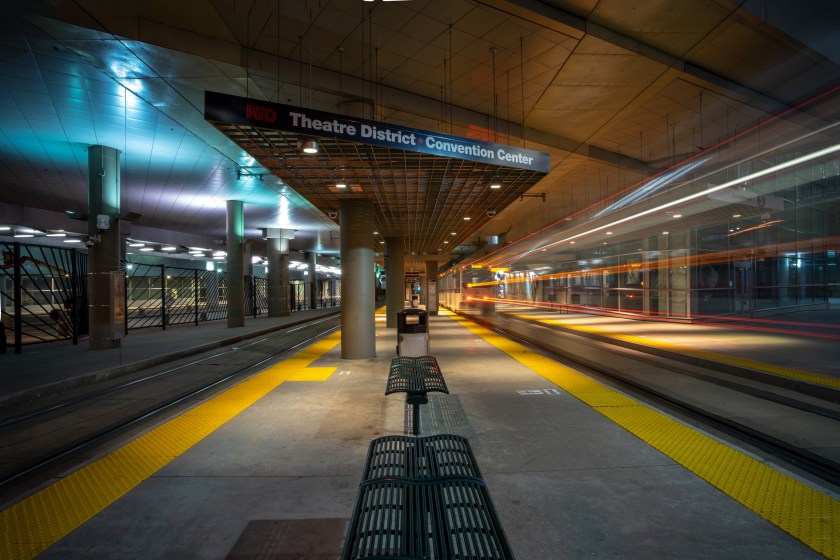
In the urban component of Chapter 3—Colorado Landscapes & Cityscapes—this long exposure photograph of Denver’s Convention Center RTD station marks a deliberate shift from natural subjects to the constructed environments that define contemporary Colorado life. The image captures a light rail train arriving at the platform, its motion rendered as luminous streaks of amber and red that cut through the architectural geometry of the underground station. This is urban photography that privileges process and temporal collapse over the decisive moment, transforming public transit infrastructure into an exercise in controlled abstraction.
The photographer’s technical approach is fundamental to the image’s success. Using a Sony A7ii paired with a Samyang 18mm wide-angle lens, he has embraced the distortions and expansiveness that such focal lengths provide. The wide angle compresses the station’s perspective while simultaneously stretching its architectural lines, creating a sense of depth that pulls the viewer’s eye from the central platform toward both vanishing points. The long exposure—likely several seconds given the degree of light trail elongation—allows the moving train to register as pure energy rather than solid form, a ghost of motion suspended within the static framework of concrete, steel, and tile.
Color plays a crucial structural role. The safety-yellow platform edges create strong horizontal bands that anchor the composition and provide visual weight at the bottom of the frame. These bright strips contrast sharply with the cooler tones dominating the upper portions—cyan-tinted fluorescent lighting that bathes the ceiling panels and creates atmospheric zones of cool illumination. The train’s light trails introduce warm amber tones that bridge these temperature extremes, serving as the compositional focal point despite their ethereal nature. The signage identifying the Theatre District/Convention Center stop glows in the upper third, grounding the image in specific geographic and civic context.
What distinguishes this work within the broader chapter is its commitment to representing Colorado’s urban character with the same attention previously devoted to its natural landscapes. Denver’s RTD system, as critical infrastructure connecting the metropolitan region, deserves documentation as much as any mountain vista or aspen grove. The photographer recognizes this and approaches the subject with seriousness of purpose. The empty platform—devoid of waiting passengers—allows the architecture and light to speak without human interruption, though the absence of people also raises questions about time of day, accessibility, and the photographer’s relationship to urban space during off-peak hours.
The symmetry is notable but not absolute. The central platform creates a strong vertical axis, reinforced by support columns and the overhead ceiling structure. Yet the composition retains enough asymmetry—particularly in the light trails and architectural details—to avoid static formalism. The textured platform surface, captured with clarity despite the low light conditions, provides tactile detail that prevents the image from becoming purely graphic.
Within a collection that spans Colorado’s diverse visual territories, this photograph asserts that the state’s identity includes its cities and their infrastructure. It is work that finds aesthetic potential in transit stations, that sees light trails as valid subjects alongside geological formations, and that expands the definition of landscape to include the spaces humans build for movement and connection.
Share this:


 Greg Urbano