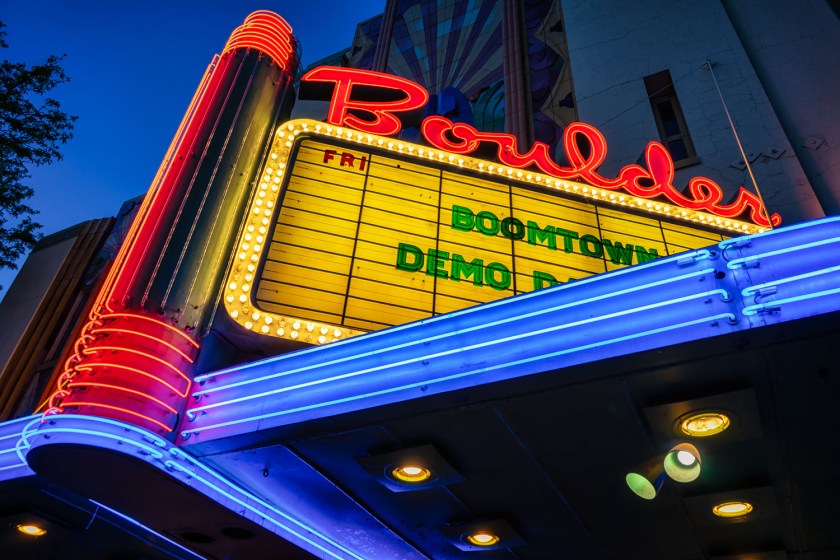
Within Chapter 3 of the Top 100 Journey—Colorado Landscapes & Cityscapes—this vibrant study of the Boulder Theater marquee represents a deliberate shift in the photographer’s engagement with place. Moving beyond natural terrain and monumental civic architecture, he turns his attention to vernacular structures that anchor community identity. The theater marquee, with its layered neon typography and saturated color palette, becomes a subject through which to examine cultural memory, commercial aesthetics, and the relationship between preservation and vitality in Colorado’s urban fabric.
The composition exploits the dramatic convergence of neon signage against the deepening blue hour sky. Shot at 28mm with the Sony FE 28-70mm f/3.5-5.6 OSS kit lens, the wide angle captures the marquee’s full architectural gesture—the sweeping curves of blue neon tubing that frame the illuminated message board, the iconic “Boulder” script rendered in brilliant red and orange, and the classic Art Deco detailing that situates this structure within a specific historical moment. The exposure settings—f/5.6 at 1/125s, ISO 400—balance ambient light with the intense luminosity of the neon, preventing blown highlights while maintaining detail in the surrounding architecture.
Color becomes the image’s primary narrative force. The red-to-orange gradient of the “Boulder” lettering contrasts sharply with the cool blue neon below, creating complementary tension that draws the eye across the frame. The yellow marquee board, studded with bulbs and announcing “BOOMTOWN DEMO D,” introduces a third chromatic element while grounding the image in specificity and time. This is not a sanitized historical recreation but a working theater captured mid-programming, its marquee functioning as intended—communication, invitation, spectacle.
The photographer’s decision to include surrounding context—the modern glass facade rising behind the vintage marquee, the darkening sky, the subtle presence of street elements—situates the theater within its contemporary environment rather than isolating it as nostalgic artifact. This approach speaks to his evolving methodology within the chapter, where place is understood not as static subject but as palimpsest, layered with temporal and cultural inscriptions. The Boulder Theater, a 1906 structure renovated and preserved, embodies this complexity: historic form activated by present-day use.
The low vantage point emphasizes the marquee’s projecting geometry, its thrust into public space. This compositional choice transforms signage into sculpture, highlighting the physicality of mid-century commercial architecture. The neon tubing, with its visible mounting hardware and electrical infrastructure, reveals construction and craft—elements often obscured in more polished architectural photography but celebrated here as integral to authenticity.
Within the broader trajectory of Chapter 3, the Boulder Theater image functions as cultural counterpoint to wilderness landscapes and governmental monuments. It represents Colorado’s smaller-scale urban centers, places where preservation efforts maintain continuity with architectural heritage while accommodating contemporary cultural production. The theater becomes microcosm—a site where community gathers, where entertainment and commerce intersect, where historical aesthetics remain relevant.
The photographer captures not merely a building but an experience of place, translating the visceral impact of neon light into two-dimensional form. In doing so, he documents Colorado’s layered identity: natural grandeur, civic aspiration, and the quieter vernacular spaces where daily life unfolds. The marquee, brilliant against evening sky, asserts that urban landscapes possess their own compelling beauty—electric, temporal, human-scaled, and essential to understanding the full spectrum of place.
Share this:


 Greg Urbano