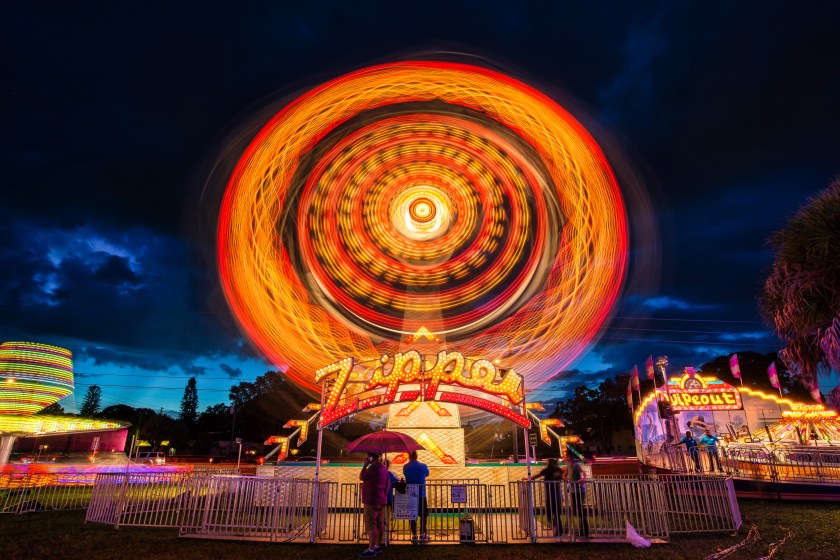
Within Chapter 2 of Greg Urbano’s Top 100 Journey, this carnival ride photograph stands as a compelling exploration of how Florida’s cultural landscape extends beyond its natural and architectural features into the realm of ephemeral entertainment. The image captures the Zipper in full rotation during twilight hours, transforming a traveling carnival attraction into a blazing mandala of light and motion that challenges traditional notions of what constitutes a “landscape.”
The photographer’s technical execution is precise and purposeful. Working with a Nikon D610 at 18mm, he has employed a six-second exposure at f/22 and ISO 100 to record not the ride itself, but rather the luminous trace of its movement through space. This approach fundamentally alters the subject’s visual character—what would typically appear as a stationary mechanical structure becomes instead a dynamic sculptural form composed entirely of light trails. The concentric circles of orange, red, and yellow fire outward from a brilliant white core, creating a hypnotic pattern that suggests both solar imagery and abstract expressionist painting.
The compositional framework demonstrates sophisticated spatial awareness. The ride occupies the central position, its circular motion perfectly framed against a deepening blue sky where storm clouds gather at the horizon. Silhouetted figures stand before the ticket booth in the immediate foreground, their stillness providing human scale and anchoring the viewer’s perspective. These stationary forms create a deliberate counterpoint to the violent spinning above them, emphasizing through contrast the temporal nature of the photographer’s chosen exposure duration.
Environmental context enriches the reading of this work. The characteristic Florida palm trees visible at right, the flat terrain, and the quality of the twilight atmosphere all ground the image firmly within the state’s visual vocabulary. Additional carnival rides glow at the periphery—including what appears to be a carousel and swing ride—establishing this as a comprehensive documentation of Florida’s traveling fair culture, a seasonal tradition that punctuates small-town life across the state.
What makes this photograph particularly significant within the Landscapes & Cityscapes chapter is its conceptual expansion of both terms. The photographer argues implicitly that Florida’s landscape includes not only its physical geography but also its temporal and cultural topography—the fairs, festivals, and itinerant amusements that transform ordinary municipal parks into spaces of collective experience. This is landscape photography that acknowledges human activity not as intrusion but as essential component.
The technical choices support this interpretation. The narrow aperture has rendered the background rides and architectural elements with acceptable sharpness while creating prominent starbursts on individual light points—a decorative effect that paradoxically enhances rather than diminishes the image’s documentary authenticity. The relatively brief six-second exposure has captured sufficient motion to abstract the Zipper into pure pattern while maintaining enough detail in the stationary elements to preserve spatial legibility.
In positioning this work alongside more conventional Florida landscapes within his broader project, the photographer demonstrates an inclusive vision of place-making. Here, the spectacular is found not in natural grandeur or architectural monumentality, but in the democratic pleasure of a county fair at dusk—a quintessentially American scene rendered with technical sophistication and genuine respect for its subject matter.
Share this:


 Greg Urbano