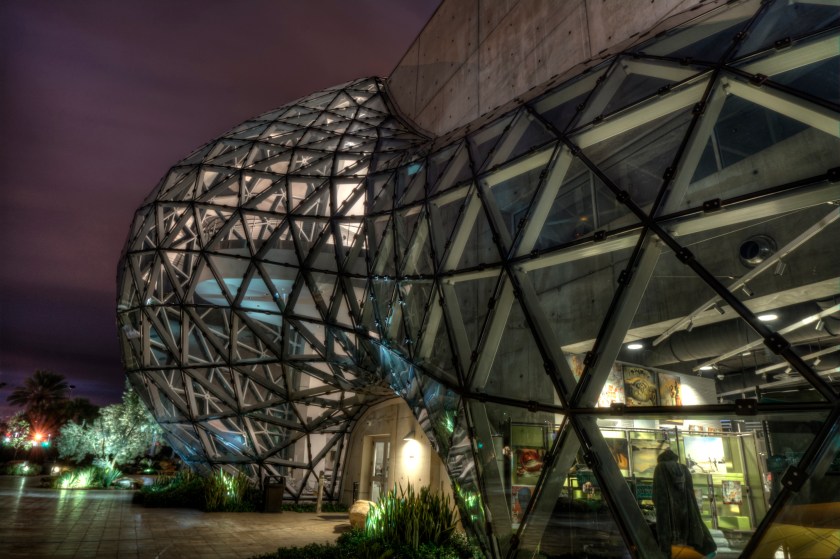
In this 2013 photograph of St. Petersburg’s Dalí Museum, Greg Urbano captures far more than an architectural landmark—he documents a photographer in the act of discovery, using his camera to decode the visual language of light, structure, and time. The image stands as a testament to what the Chapter 1 — Beginnings theme celebrates: the transformative power of experimentation and the artistic maturity that emerges from technical curiosity.
The composition immediately announces ambition. Shot with a 14mm ultra-wide lens, the perspective tilts upward to embrace the museum’s extraordinary geodesic glass bubble, that surrealist flourish erupting from an otherwise rectilinear concrete structure. The ultra-wide focal length creates dramatic spatial distortion—the glass sphere appears to swell toward the viewer while the building’s mass recedes at impossible angles. This is deliberate visual exaggeration, the photographer using optical characteristics as expressive tools rather than merely recording what stands before him.
Urbano’s fifteen-second exposure at ƒ/11 reveals careful consideration of night photography’s particular demands. The narrow aperture ensures front-to-back sharpness across the complex geometric planes, while the extended shutter speed gathers sufficient light to render both the illuminated interior spaces and the textured concrete exterior. At ISO 250, he maintained image quality while managing the sensor’s heat buildup during long exposures—a technical balancing act that night photography ruthlessly exposes when miscalculated.
The HDR processing, which Urbano identifies as a focus of his 2013 work, serves the subject’s inherent drama without overwhelming it. High Dynamic Range imaging compresses the vast tonal range between the glowing glass panels and the deep purple-gray twilight sky into a single viewable image. Here, the technique preserves detail in both the brightest interior lights and the shadowed architectural framework—the black steel triangles that form the geodesic pattern remain visible and textured rather than silhouetted into flat darkness.
What distinguishes this image within the Beginnings chapter is its transparency about process. The HDR treatment shows characteristic traces of learning—slight luminous halos around high-contrast edges, enhanced local contrast that gives surfaces an almost tactile presence, color saturation pushed just beyond naturalism. These are not flaws but evidence of active experimentation, a photographer testing the boundaries of technique to understand where effectiveness ends and excess begins.
The photograph’s context enriches its meaning considerably. This museum stood a brief walk from the photographer’s residence, close enough for repeated visits, for returning under different conditions, for the kind of sustained engagement that transforms casual documentation into genuine study. This proximity allowed Urbano to approach the subject with evolving sophistication, each attempt building on lessons from the previous one.
The wet pavement in the foreground adds an unexpected grace note—evidence of recent rain creating reflective surfaces that double the architectural lighting, adding visual complexity without cluttering the composition. Whether intentional or opportunistic, this detail demonstrates the photographer’s developing awareness of how environmental conditions can enhance rather than merely complicate a scene.
Viewed within the arc of artistic development, this photograph captures a crucial transition point: technical capability catching up with visual ambition, the gap between conception and execution narrowing with each frame. It is the work of a photographer actively becoming, embracing complexity as the necessary path toward mastery.