Alioto’s on Fisherman’s Wharf: A Study in Nocturnal Americana

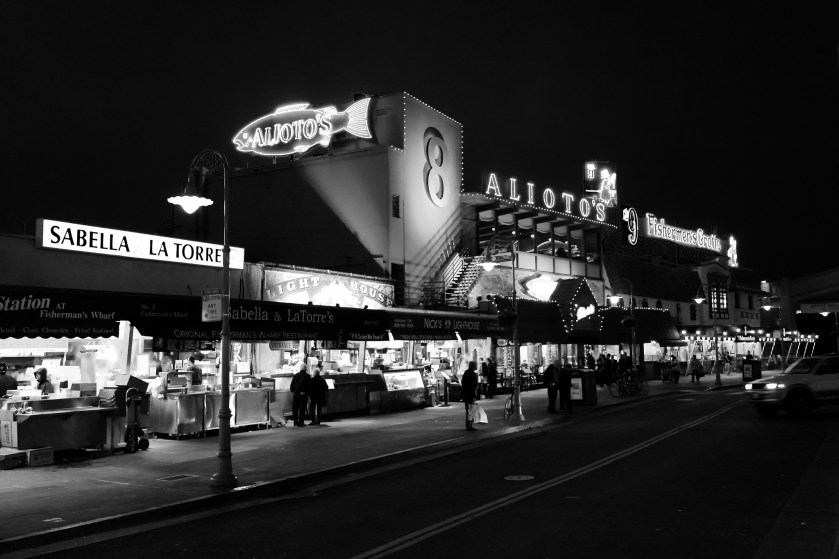
Greg Urbano’s 2010 black and white photograph of Alioto’s restaurant in San Francisco is a significant early work, capturing the intersection of technical skill and artistic vision. It explores familiar scenes through a developing photographic perspective, revealing how ordinary moments can become extraordinary. The image emphasizes light, structure, and context, marking a pivotal discovery in Urbano’s artistic journey.

Aliotos on Fishermans Wharf 2010
An early photograph from 2010. Taken on vacation in San Francisco a black and white image of the iconic Aliotos restaurant at night on Fishermans Wharf. Shot with my Samsung NX100.

Alioto’s on Fisherman’s Wharf: A Study in Nocturnal Americana

Greg Urbano’s 2010 photograph of Alioto’s restaurant on Fisherman’s Wharf stands as a pivotal work from Chapter One of his Top 100 Journey—a collection dedicated to early beginnings and the formative images that taught him how to see. This photograph represents more than just a vacation snapshot; it captures the moment when technical skill and artistic vision began to converge.

This image works on multiple levels simultaneously. On the surface, it presents a straightforward night photograph of a famous San Francisco landmark. But closer examination reveals a developing understanding of tonal relationships and compositional balance. The black and white treatment isn’t merely aesthetic—it’s revelatory. By stripping away color, the photographer forces viewers to see the architecture of light itself. The neon signs become sculptural elements, the illuminated storefronts transform into glowing boxes of human activity, and the darkness above presses down with an almost palpable weight.

What makes this photograph particularly significant as an early work is its democratic vision. He doesn’t attempt to elevate Alioto’s to fine art by isolating it or abstracting it beyond recognition. Instead, he presents the entire commercial ecosystem: the neighboring Sabella LaTorre sign, the smaller vendor stalls with their utilitarian lighting, the people moving through the frame as gentle blurs. This is tourism and commerce as theater, captured without cynicism or sentimentality—a mature perspective for someone still discovering their photographic voice.

The technical execution demonstrates the learning curve inherent in Chapter One. Shot with a Samsung NX100—not a professional camera by any measure—this image proves that vision was developing faster than equipment acquisition. The exposure is carefully controlled, holding detail in both the bright signage and the darker architectural elements. The vantage point shows deliberate thought: low enough to emphasize the vertical drama of the building, yet far enough back to include context. That giant illuminated fish and the number “8” become almost sculptural forms against the night sky.

As an early capture, this photograph reveals an artist already grasping something fundamental: great photographs often lie not in exotic locations but in how we see the familiar. Fisherman’s Wharf has been photographed millions of times, yet this image feels both specific and universal. It could only be this place, yet it speaks to every similar waterfront tourist district in America. This understanding—that the ordinary can become extraordinary through careful observation—marks a crucial lesson in any photographer’s development.

The inclusion of this work in the Top 100 Journey reflects its role as a foundational piece. It’s not about perfection; it’s about the spark of discovery. The photograph represents a moment when the camera revealed something the artist was only beginning to articulate—an ability to see light as structure, to recognize the poetry in commercial spaces, to trust in straightforward documentation over manipulation.

The photograph has aged beautifully, which speaks to the instincts already present in these early days. In an era of digital saturation and Instagram filters, there’s something refreshing about this honest image. It doesn’t try too hard. It simply observes, with emerging intelligence and care.

When displayed as part of Chapter One: Beginnings, this image invites viewers to consider the photographer’s journey. It rewards examination not just for its formal qualities—the geometry, the light, the tonal range—but for what it represents: a lesson learned, a moment of clarity, a step toward understanding how to translate vision into image. This is where the journey truly began.

Unknown's avatar

Author: greg_urbano

Photography is my way of slowing the world down—one frame at a time. From Florida’s coasts to Colorado’s peaks, I chase light, motion, and meaning through the lens.